Art History Survey Midterm
 Call Kai
 Learn
Learn Practice Test
 Spaced Repetition
 Match
Match Flashcards
 Knowt Play
1/64

There's no tags or description
Looks like no tags are added yet.
Name | Mastery | Learn | Test | Matching | Spaced | Call with Kai | Chat |
|---|
No analytics yet
Send a link to your students to track their progress
65 Terms
Prehistory
The period before written records.
Paleolithic
The Old Stone Age.
Mobiliary art
Portable art or sculpture.
Parietal art
Art made on walls, especially cave walls.
Naturalism
Representing forms in a realistic way.
Abstraction
Simplifying or altering natural forms.
Convention
A repeated cultural way of representing something.
Symbolic thinking
Representing ideas or things that do not physically exist.

Lion-Human
A c. 40,000 BCE hybrid lion-human sculpture; shows early

Woman from Willendorf
A c. 24,000 BCE sculpture with exaggerated breasts, belly, hips, buttocks, and thighs.

Chauvet Cave
C. 34,000 BCE cave art known for naturalism, perspective, modeling, and volume.

Lascaux Caves
C. 15,000 BCE cave paintings famous for large animals, especially bulls.
Twisted perspective
Showing different parts from different viewpoints to show the whole.
Conceptual representation
Showing what the artist knows about an object.
Perceptual representation
Showing what the eye sees from a viewpoint.
Modeling
Shading used to make a form appear three
Mesopotamia
Land between the Tigris and Euphrates Rivers.
Sumer
A civilization of early Mesopotamian city
Ziggurat
A stepped monumental religious structure.

White Temple at Uruk
A c. 3200–3000 BCE Mesopotamian temple built on a ziggurat.

Votive figures
Offerings to gods, often shown in perpetual worship.
Register
A horizontal band organizing a scene.
Hierarchical scale
More important figures are shown larger.

Standard of Ur
A c. 2600–2400 BCE work using registers and hierarchical scale.
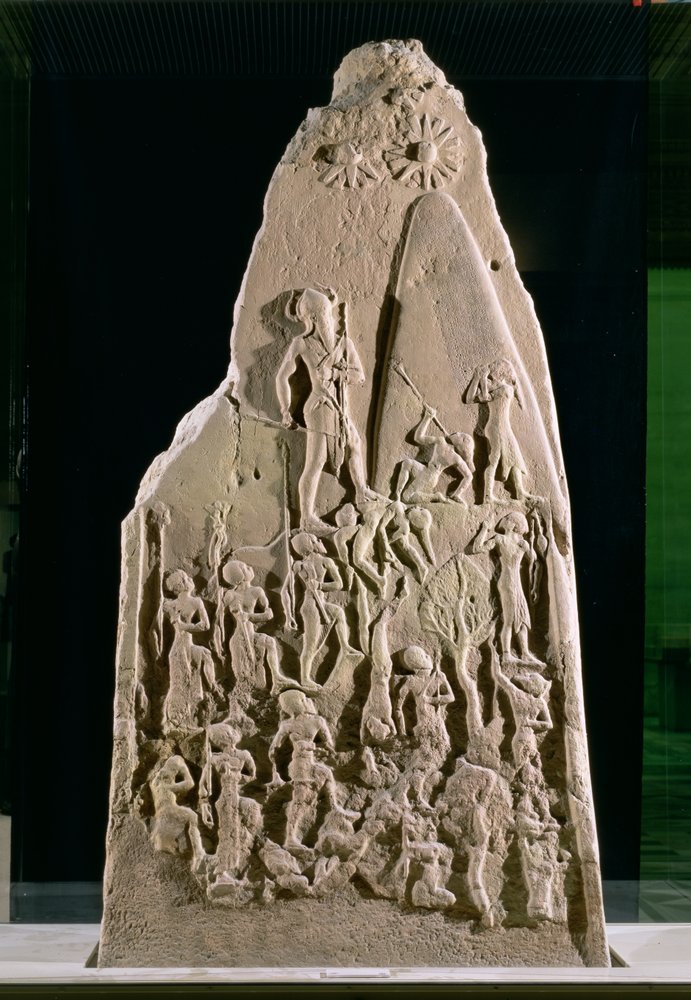
Stela of Naram-Sin
c. 2600–2400 BCE work using registers and hierarchical scale.
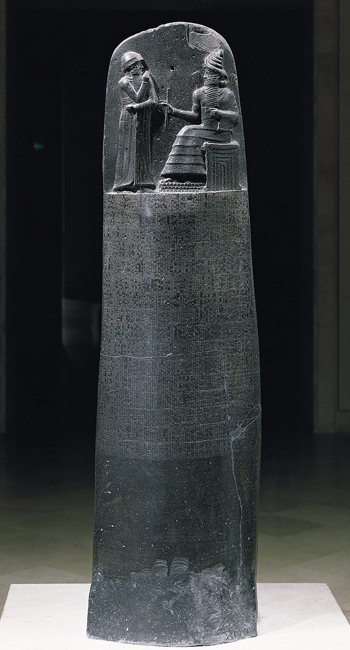
Stela of Hammurabi
Monument containing Hammurabi's laws and showing divine authority.

Lamassu
Assyrian protective human-animal hybrid with wings.
Apotropaic
Intended to ward off evil.
Kemet
The 'black' land associated with fertile Nile soil.
Djeseret
The 'red land' associated with the desert.
Composite pose
Different body parts shown from their most recognizable viewpoints.
Frontality
A figure facing directly forward.

Narmer Palette
A c. 2950 BCE Dynasty 1 object associated with Egyptian unification.
Mastaba
An early Egyptian tomb with a bench

Mastaba of Ti
A Saqqara tomb with scenes of everyday activities.

Djoser's Step Pyramid
A c. 2600 BCE monumental funerary complex at Saqqara.
Egyptian afterlife art
Art connected to religion, death, kingship, ritual, and continued existence after death.

Akhenaten
Pharaoh associated with Atenism, Amarna, and unusual elongated forms.
Amarna Period
Period associated with Akhenaten, Atenism, Amarna, and intimate royal family scenes.

Tutankhamun's funerary mask
A Dynasty 18 royal burial mask dating to about 1327 BCE.
Cycladic culture
Bronze Age Aegean culture known for simplified geometric marble figurines.
Minoan culture
Bronze Age Aegean culture centered on Crete.
Mycenaean culture
Bronze Age Aegean culture centered on mainland Greece.

Cycladic figurine
Simplified, geometric marble human figure from the Cyclades.

Palace of Minos at Knossos
Minoan palace complex centered on a large courtyard.
Fresco
Pigment applied to fresh plaster.

Bull-Leaping Fresco
C. 1550 BCE Minoan fresco emphasizing movement and the bull.

Lion Gate at Mycenae
Monumental Mycenaean entrance associated with Cyclopean walls.
Cyclopean walls
Massive Mycenaean walls built from huge stones.

Treasury of Atreus
Mycenaean tholos tomb with a long entrance and corbelled vault.
Dromos
The entry passage leading to a Mycenaean tomb.

Warrior Vase
C. 1200 BCE Mycenaean vase showing armed warriors.
Black-figure pottery
Black figures with details incised into the dark forms.
Red-figure pottery
Red/clay-colored figures with details painted on them.

Exekias's Achilles and Ajax Amphora
Black-figure amphora depicting Achilles and Ajax.

Death of Sarpedon
Red-figure krater by Euphronios.

Kroisos Kouros
Archaic Greek statue of a male youth with frontality and an idealized body. C. 530 BCE grave marker for Kroisos.

Peplos Kore
Archaic Greek statue of a female youth. C. 530 BCE female youth statue wearing a peplos.

Peplos Kore
C. 530 BCE female youth statue wearing a peplos.

Doryphoros
C. 450 BCE idealized male figure by Polykleitos.
Canon of Proportions
Polykleitos's system of ideal human proportions.

Temple of Aphaia
C. 500–480 BCE Greek temple using the Doric order.
Archaic Period
Greek art period approximately 800–500 BCE.
Classical Period
Greek art period approximately 500–323 BCE.
Monumentality
The use of impressive or large scale to convey importance.