Nerve impulses
 Studied by 0 people
 Call Kai
 Learn
Learn Practice Test
 Spaced Repetition
 Match
Match Flashcards
 Knowt Play
1/12

There's no tags or description
Looks like no tags are added yet.
Name | Mastery | Learn | Test | Matching | Spaced |
|---|
No study sessions yet.
13 Terms
Define a Nerve impulse:
a self-propagating wave of depolarisation that travels along the surface of the axon membrane
Explain maintenance of the Resting potential:
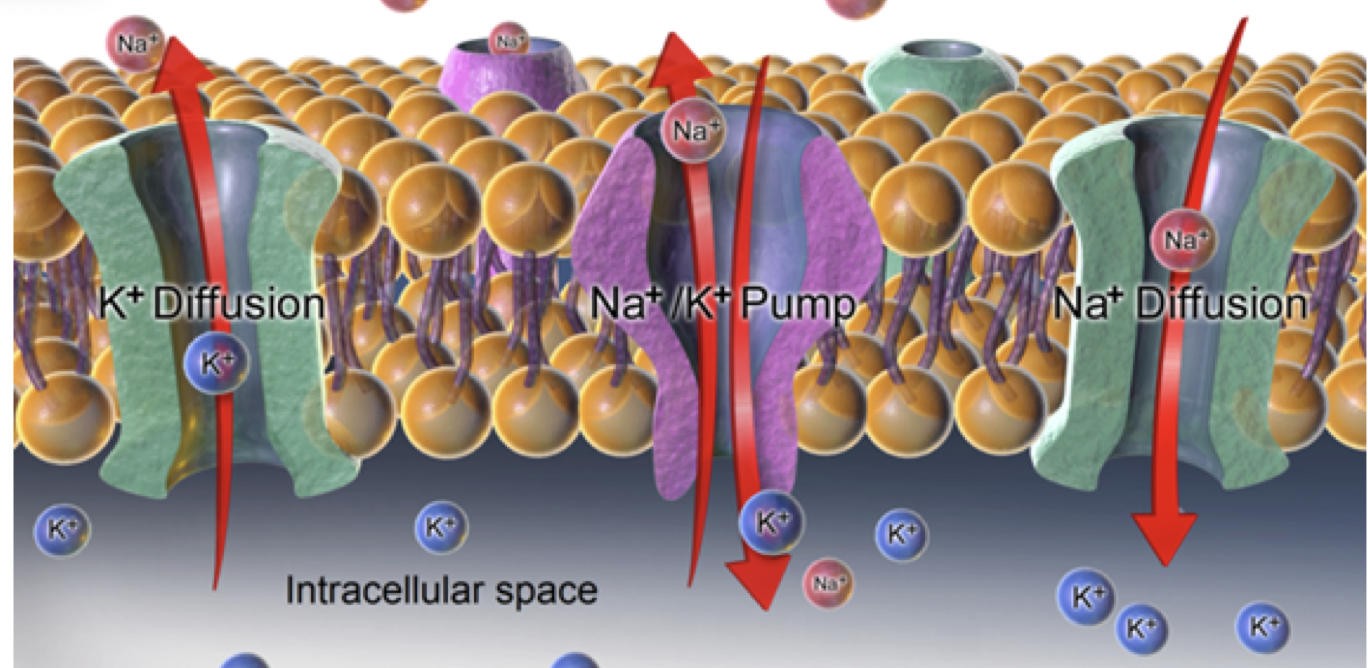
The resting potential is maintained through a balance between Na⁺ and K⁺ inside and outside the axon
Movement of these ions across the axon membrane is controlled by:
The phospholipid bilayer is impermeable to charged particles, so the sodum and potassium ions cannot diffuse across it
Specific, channel proteins embedded through the phospholipid bilayer can act as channels to allow these ions to pass into or out of the axon. Some are ‘gated’ channels, which open and close when needed. There are different gates for potassium and sodium ions. There are also some channels which remain open at all times - Leak channels
Ions move through the protein channels by facilitated diffusion
Some proteins actively transport potassium ions into the axon and sodium ion out of the axon - knwown as sodium-potassium pumps. Each pump double up as an ATP hyrolase enzyme, which hydrolyses ATP, providing the energy for active transport
How is a resting potential establish ?
When a neurone is not conducting an impulse, there is a difference between the electrical charge inside and outside the neurone - resting potential
There are more positive ions (Na⁺ and K⁺), outside compared to inside. Therefore, the inside of the neurone is comparatievly more negative at -70mV
The resting potential is maintained by a sodium potassium pump, involving active transport and therefore ATP.
The pump moves 2 K⁺ ions in and 3 Na⁺ ions out. This creates an electrochemical gradient and results in K⁺ diffusing out and Na diffusing in. - However, because the membrane is more permeable to K⁺, more K⁺ moved out by leak channels
results in -70mV
Are the gated channels open or closed during resting potential?
Closed
Draw a diagram for resting potential
Draw the graph between voltage and time
What is an action potential?
A atimulus is recienved by a receptor, its energy causes a temporary reversal of the charges across the axon membrane - the usual resting potential of -65mV inside the axon becomes more positive.
In this state the axon is known as being depolarised. If the axon is depolarised enough, it can result in the generation of an action potential
The stages which cause an action potential are:
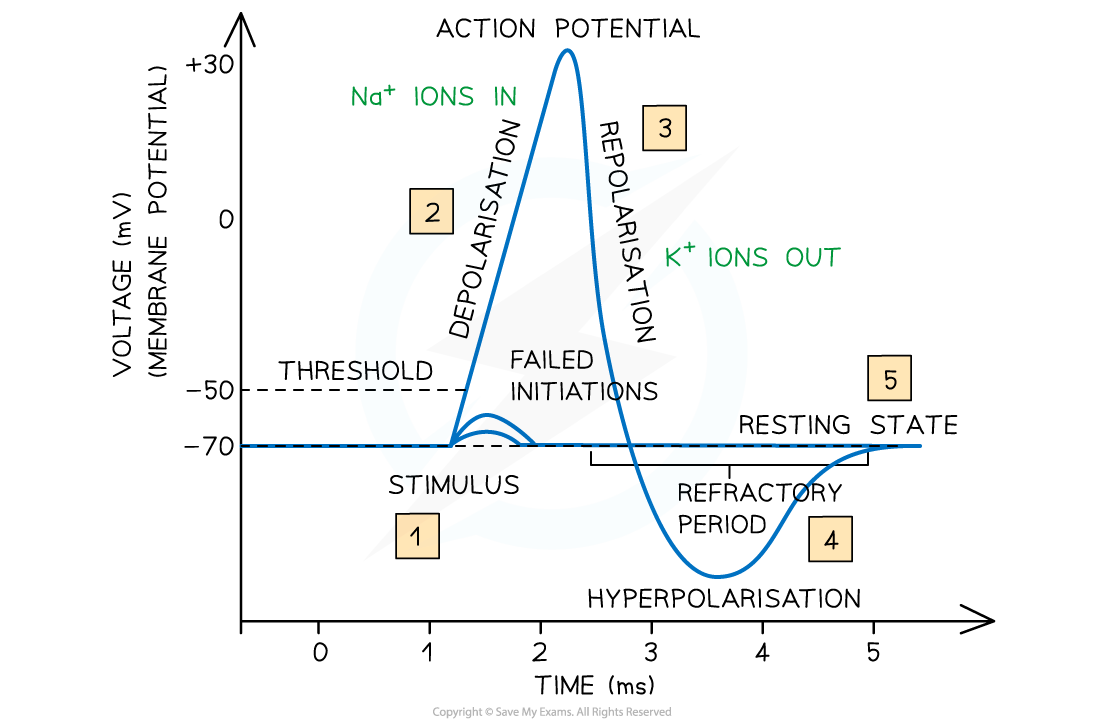
The axon is in its resting state, with a resting potential of approximately -70mV
When the axon is stimulated, some gated sodium ion channels in the membrane of the axon open, making the membrane more permeable to sodium ions. Na⁺ ions rapidly diffuse intothe axon - cuases depolarisation
if sufficiently large, this depolarisation causes voltage-gated Na⁺ channels to open, this causes even more Na⁺ ions to diffuse into the axon
This then activates and open even more voltage-gates Na⁺ channels, leading to even greater influx of sodium ions, until the inside of the membrane becomes charged to +40mV - this is known as action potential
Explain repolarisation
When the inside of the axon becomes charged to +40mV, all of the gated sodium ion channels close, meaning the axon is again almost impermeable to Na⁺ ions.
At +40mV, as the sodium ion channels close, voltage-gated potassium ion channels open and K+ ions diffuse rapidly out the axon - repolarisation
Explain hyperpolarisation and resting potential steps
So many potassium ions diffuse out of the axon that they cause a more negative potential difference than normal, dropping the axon interior down to about -90mV - known as hyperpolarisation and causes the relative refractory period
The voltage-gated potassium ion channels close and the sodium potassium pump restores the concentration gradients for Na⁺ and K⁺ - returns the resting potential of the axon to -70mV
How long does the whole process last
2-3 milliseconds
What is the all or nothign principle?
The events outlines above will only be set into motion if the initial stimulus is larger than a specific threshold value
If the initial stimulus is not large enough, then the voltage-gated sodium channels will not open and the axon membrane will not become fully depolarised - no action potential will be generated
If the stimulus is large enough (above the threshold), then an action potential will be generated at a constant size and speed - all or nothing principle
increasing the initial stimulus will not produce a larger or faster action potential - however increase the frequency of action potential
What id the Refractory period ?
After an action potential has been generated, the membrane enters a refractory period when it can’t be stimulated, becuase sodium channels are recovering and can’t be open
This is important for 3 reasons
it ensures that discrete impulses are produced, meaning that an action potential cannot be generated immediately after another one - makes sure that each is seperate
It ensures that action potential travels in one direction . This stops the action potential from spreading out in two directions which would prevent a response
It limits the number of impulse transmissions. This is important to prevent overrection to a stmulus and therefore overwhelming the senses