Action potentials
 Studied by 0 people
 Call Kai
 Learn
Learn Practice Test
 Spaced Repetition
 Match
Match Flashcards
 Knowt Play
1/17

There's no tags or description
Looks like no tags are added yet.
Name | Mastery | Learn | Test | Matching | Spaced |
|---|
No study sessions yet.
18 Terms
What is an AP?
→ fundamental unit of info in the NS
‘A short lasting event in which the electrical membrane potential of a cell rapidly rises and falls’
lasts 1-2ms
Cells have negative membrane potential compared to extracellular space
Where do action potentials occur
Excitable cells:
neurons
Muscle cells
Cardiac cells
Endocrine cells
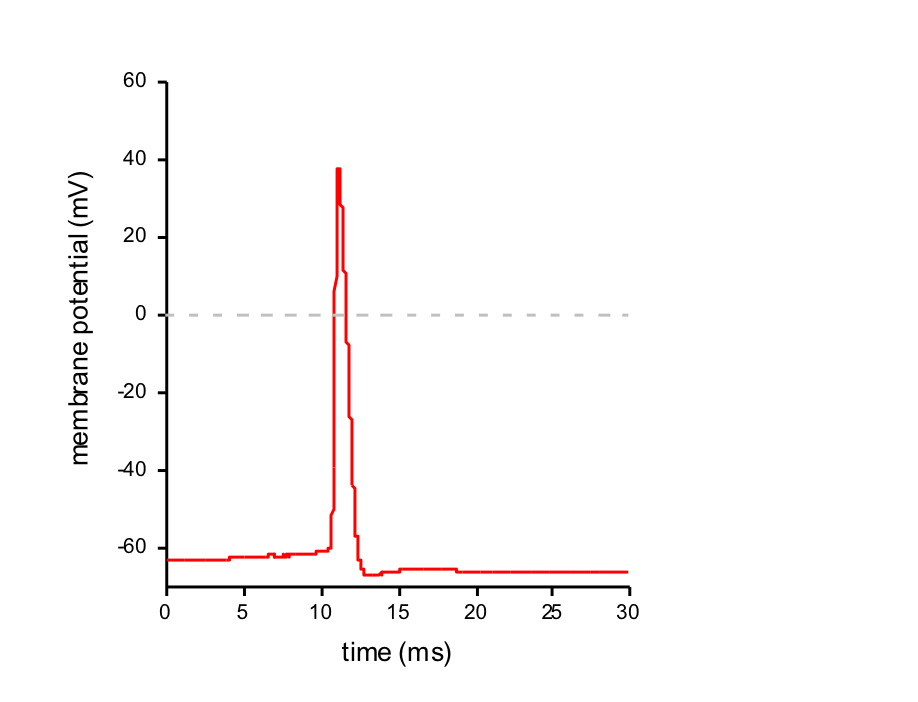
Phases of an action potential simple
Action potential threshold is reached, membrane potential depolarised
Depolarisation causes an upwards (+ve) spike
Membrane rapidly repolarises during the downwards spike
Often followed by a temporary additional after hyperpolarisation
Voltage gated Na+ channel
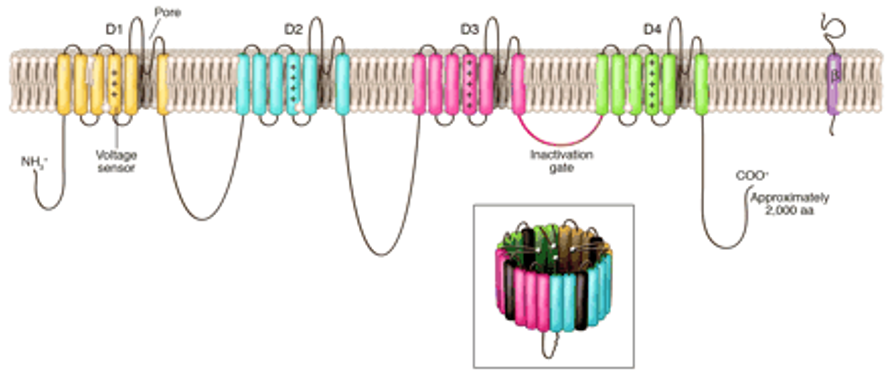
large alpha subunit→ ion conducting pore
4 domains, each with 6 transmembrane proteins
Voltage sensors on the 4th
1+ beta subunits = regulation of gating, kinetics and expression
How do Na+ and K+ channels work?
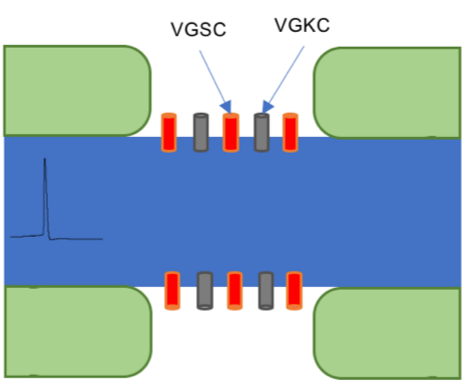
Activation gate opens in response to a depolarisation, AP threshold = -55/60mV
Na+ flows into the cell, activates more channels, more flows in = depolarisation
Na+ channels rapidly inactivate
K+ channels also activated by depolarisation, but much slower
K+ ions leaving the cell repolarises the cell, but causes and overshoot = after-hyperpolarisation
NaK+ pump resets
How is the resting membrane potential maintained
leak K+ channels (facilitated diffusion)
NaK pump (active transport)
Saltatory conduction
→ rapid ‘leaping’ of nerve impulses between gaps in myelin sheath
electrical resistance in the axon is higher in thinner axons = slower conduction
How does myelination cause saltatory conduction?
Myelin sheath insulates axon from external -ve charge
higher resistance across membrane
Lower ability to store charge
Still has some capacity to store charge→ signal degrades
Nodes of Ranvier = gaps that act as signal boosters
Lots of Na and K channels in nodes
When AP reaches node, a new one is initiated
Two examples of action potential diversity
Purkinje neuron→ in the cerebellum
equilibrium and fine movement
AP are very brief - 180us
CA1 neurons → hippocampus
tense to last longer- 800us
Slow decay after depolarisation
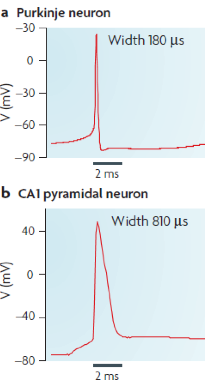
Two examples from hippocampus
CA1 pyramidal neuron→ Glutamatergic
afferents (towards CNS) = CA3 cells, Entorhinal cortex
Efferent (away from CNS) = prefrontal cortex, subiculum
OLM → GABAergic interneuron
afferents = hippocampal pyramidal cells, medical septum
Efferents = distal CA1 dendrites, other interneurons
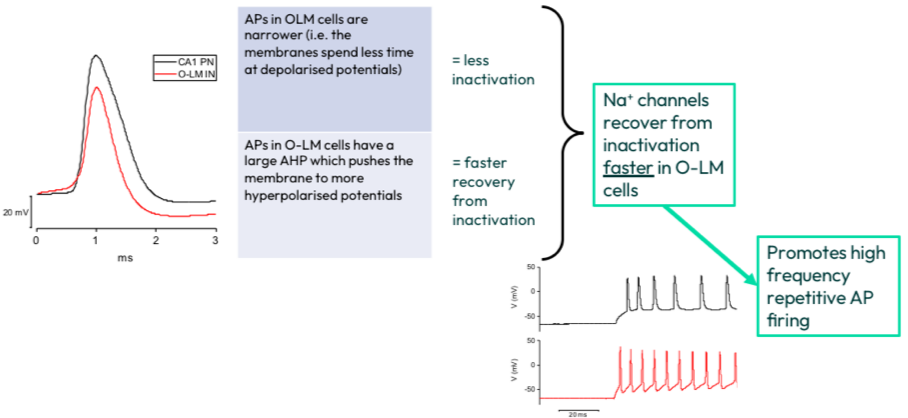
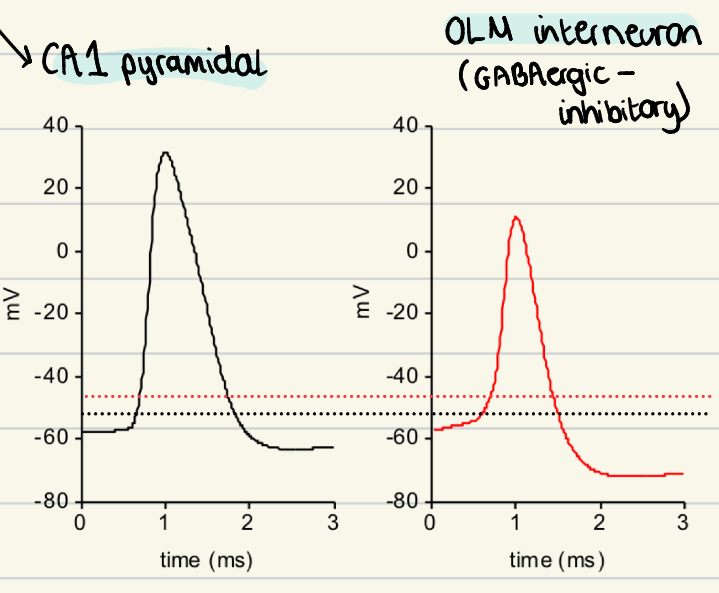
AP waveforms of hippocampal examples
CA1 threshold is more hyperpolarisation (lower) than OLM
Properties of the ion channels influence different threshold
Peak of depolarisation is higher in CA1
Larger AHP in OLM neurons
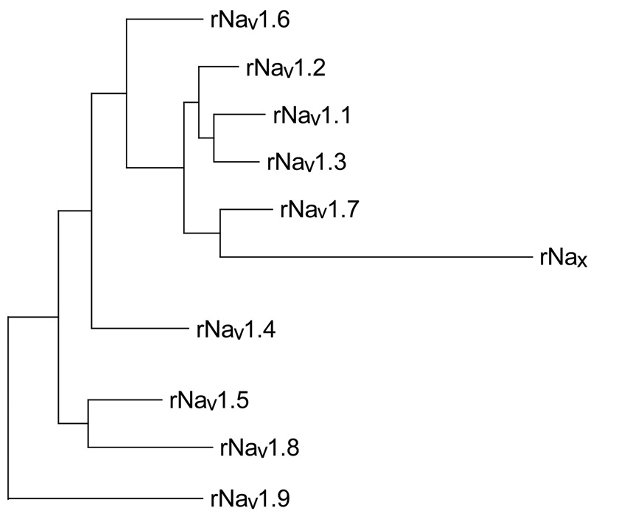
Na+ channel subtypes
9 different subtypes
Properties of each influence thresholds
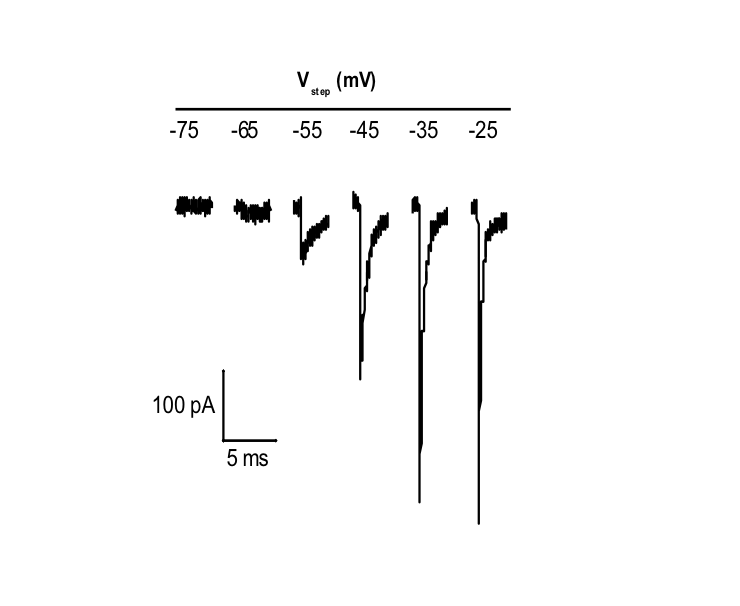
Measuring activation properties of Na+ current
the activation of the whole cell is reflected by the no. Of channels open at a certain voltage
The graph = electrical activity against size of voltage step
V½ = when half of channels are activated
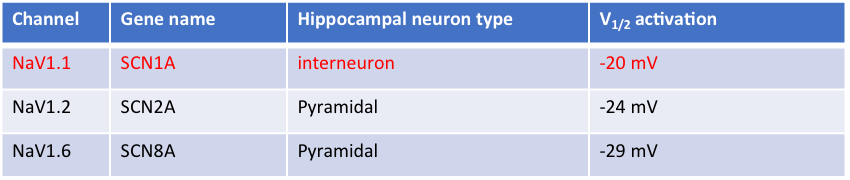
Different activation properties of CA1/OLM
NaV1.1 channels in OLM interneurons have a more depolarised V½ (higher) compared to CA1
Caused by differences in activation properties of Na+ channel isoforms
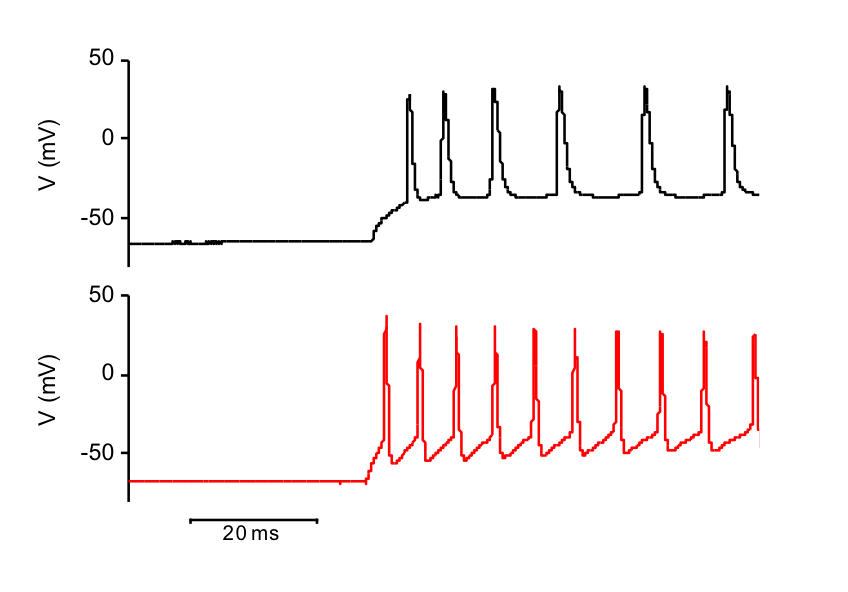
Firing patterns in the two neurons
OLM cells have larger AHPs and fire faster than pyramidal cells
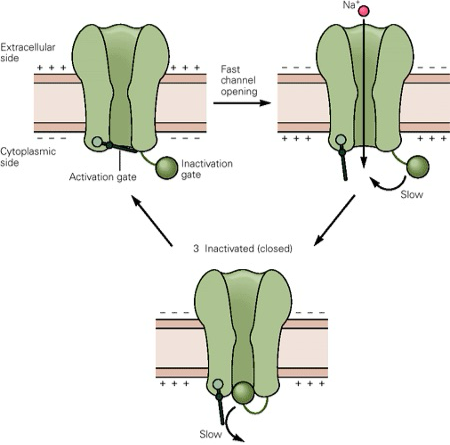
3 states of Na+ channels
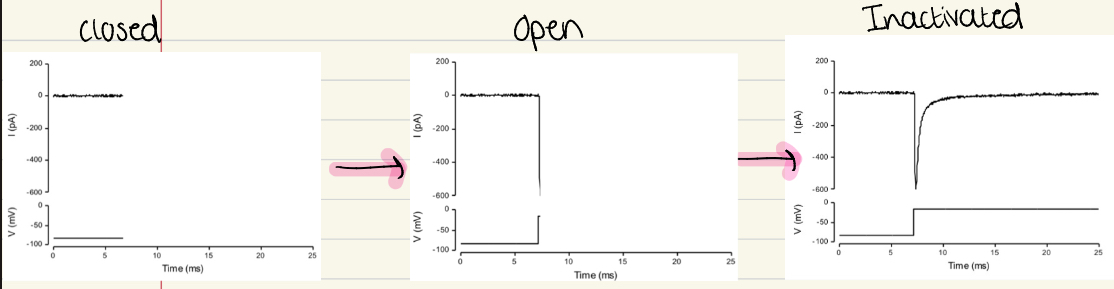
Resting state = gate is closed at -ve membrane potentials similar to resting, but available
Depolarising stimulus = polarity of the membrane changes mean the gates open, create in inward current
Inactivation gate = closes the pore from the inside = inactivated channel by inactivation gate and are unavailable
Voltage and current graphs between channel phases
What does recovery from initiation depend on?
Time→ it takes time for channels to go from inactivated to closed, channels will open proportionally to time since the first stimulus
Voltage→ depends on voltage steps , the more hyper-polarised the membrane between pulses, the larger the second pulse