Growth of the Nazi Party Flashcards
 Call Kai
 Learn
Learn Practice Test
 Spaced Repetition
 Match
Match Flashcards
 Knowt Play
1/37

There's no tags or description
Looks like no tags are added yet.
Name | Mastery | Learn | Test | Matching | Spaced | Call with Kai | Chat |
|---|
No analytics yet
Send a link to your students to track their progress
38 Terms
Manifesto meaning
Declaration of policies and aims.
Ideology
Beliefs and attitudes.
DAP
German Workers’ Party.
SA
‘Brownshirts’ – Nazi Party’s private army.
Hitler hired the unemployed, students and ex-soldiers into the SA. These groups were very angry with the Weimar government.
Hitler used the SA to: Control crowds at meetings, Start fights on the streets, Disrupt the meetings of opposition groups like the KPD, Strengthen the image of the NSDAP
the SA gave them food, uniforms, and purpose
they were attracted to its violence and radicalism
they felt betrayed by the Weimar Republic
NSDAP
National Socialist German Workers’ Party (Nazi Party).
Hitler before Nazi Party
served in WWI & was injured
applied for art school in Vienne but was rejected.
Nazi Party timeline
Beginning of 1919: Anton Drexler creates the German Worker’s Party (the DAP)
January 1920: Hitler becomes head of propaganda for the DAP.
February 1920: Hitler & Drexler wrote the Twenty-Five Point programme (a manifesto).
Hitler added ‘National Socialist’ to the DAP’s name – the party now became the NSDAP (National Socialist German Workers’ Party aka the Nazi Party).
Hitler became leader of the NSDAP.
SA was set up to protect the Nazi Party. They were also known as the Brownshirts.
Hitler’s publicity of the Nazi Party meant that membership grew from about 1,100 in June 1920 to about 55,000 in November 1923.
25 Point Programme (themes)
Treaty of Versailles: should be scrapped
Race: citizenship of the state only granted to people of German blood (therefore, no Jew was to be a citizen of the nation), foreign nationals to be deported if it became impossible to feed the entire population, all newspaper editors and contributors to be German.
Religion: religious freedom for all, providing the views expressed did not threaten or offend the German people
People’s rights: right to vote in election only allowed to German citizens
Industry/economy: the government to nationalise all businesses that had been formed into corporations, the government to profit-share in major industries
What was the Munich Putsch?
In November 1923, Hitler and the Nazi Party tried to take over the government in Munich. At the time, Germany was struggling with big problems like high prices, poverty, and anger at the government. Hitler thought this was the right time to act.
On 8th November, Hitler and some armed Nazis stormed into a beer hall where important politicians were meeting. He held them at gunpoint and said he was taking control. At first, it looked like the plan might work.
Hitler left the beer hall placing Ludendorff in charge of watching the Bavarian officials. Ludendorff failed in this role by being persuaded to let Kahr, Seisser and Lossow go. Without their support, the putsch had no official backing and the army suppressed the SA with ease.
Hitler continued with the putsch after learning he had lost the support of the Bavarian officials.
But the next day, when Hitler and about 2,000 Nazis marched through Munich, the police stopped them. Shots were fired, 16 Nazis were killed, and Hitler was arrested.
The Putsch failed, but it gave Hitler national attention. While in prison, he wrote Mein Kampf and decided to try to win power by legal means instead of using violence.
General Ludendorff - conspirator of the putsch
What caused the Munich Putsch?
Short-term:
The French invasion of the Ruhr caused many shortages of goods in Germany. When German workers resisted, they were arrested, imprisoned and even deported.
The hyperinflation crisis reached its worst state towards the end of 1923. People couldn’t buy everyday goods, and their savings became useless. People resented the Weimar government for how they handled the crisis.
Medium-term:
Mussolini, the fascist leader of Italy, inspired Hitler. Mussolini led his successful ‘March on Rome’ in 1922.
Long-term:
The people were angry with the Weimar government from its beginnings, due to reparations and the loss of Germany’s colonies. The Treaty of Versailles in 1919 was a ‘dolchstoss’ for many Germans.
from 1920, the NSDAP was growing in support and popularity in Munich and Bavaria
Why did Hitler try to seize control in 1923?
Hitler aimed to get the support of Kahr, Seisser and Lossow for the NSDAP’s putsch
Hitler knew that, if he established control of Bavaria, it would be easier for him to take over Berlin.
hated Weimar Republic & ToV
he had won the support of General Ludendorff, an extremely popular figure
The consequences of the Munich Putsch
Positive:
Hitler avoided deportation back to Austria by impressing the right-wing judges
Multiple newspapers across Germany reported on Hitler’s trial. Hitler became a national celebrity.
In prison, Hitler wrote a book called Mein Kampf (‘My Struggle’), which formalises his ideas and a new approach to how to govern Germany
Hitler had learnt that violent putsches did not work. After being released from prison, he considered how to use the Weimar legal system to gain ultimate power in Germany
Negative:
Hitler was convicted of high treason. His putsch was unsuccessful in achieving its aims
The Munich authorities decided to ban the NSDAP. Support for the party dropped.
Many Germans believed Hitler had missed his opportunity to govern Germany. The appointment of Gustav Stresemann marked the improvement of Germany’s economy and government
The Lean Years
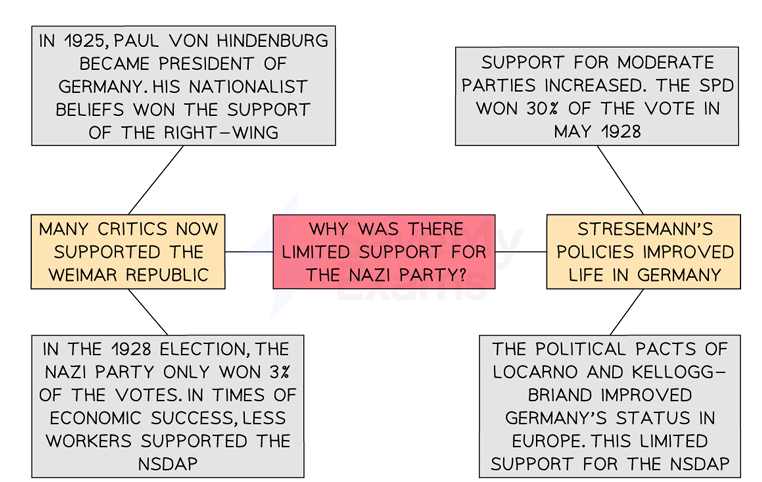
Historians call the support for the Nazi Party in 1924−28 ‘The Lean Years’. This means that the German people considered the NSDAP a small, extremist group after the Munich Putsch.
There is a clear link between the ‘Golden Years’ of the Weimar Republic and ‘The Lean Years’ of the Nazi Party. For extremist parties to succeed, the country’s economy or political leadership needs to be failing. The public is more likely to look for alternative solutions offered by extremism if moderate government is ineffective. The recovery of the Weimar Republic through Stresemann’s policies limited the need for the NSDAP’s policies. This resulted in a decline in support for Hitler’s party.
Although the Nazi Party lost support, Hitler used 1924−28 as a period to restructure the party. Hitler had learnt much from the Munich Putsch. He wanted to ensure the NSDAP was ready to benefit if Germany experienced political or economic turmoil again. Without ‘The Lean Years’, the Nazi Party would not have been able to benefit from the subsequent impacts of the Wall Street Crash on Germany from 1930.
The Nazis only won 12 seats in the Reichstag in 1928. This was down from 1924 when they had 34.
It was growing in size – its membership increased from 27,000 in 1925 to 100,000 in 1928
But it struggled to win seats in the Reichstag
Ways that 1924-1928 was a disaster for the Nazi Party
Hitler started the period in prison – there was no leadership.
The party itself was banned and Hitler was banned from speaking in public.
The Nazis had lost a lot of support and respect from the public for attempting to seize control by force.
As the economic situation in Germany improved, people became less willing to vote for more radical parties.
The Nazis only won 12 seats in the Reichstag in 1928. This was down from 1924 when they had 34.
Ways that 1924-1928 was not a disaster for the Nazi Party
1925 – Nazi membership was 27,000. 1928, this rose to 100,000.
Hitler wrote Mein Kampf while in prison which outlined Hitler’s ideology. It soon became a bestseller, because of the publicity from Hitler’s trial.
Party propaganda was organised well under Goebbels.
Nazi Party was only banned temporarily. The ban was lifted in 1925.
The SA was strengthened with more young men encouraged to join. The image of the organisation was changed, placing the emphasis on discipline and order rather than violence and intimidation.
1926 – Hitler removed opposition to his leadership at the Bamberg Party Conference. He also won over potential rivals like Goebbels by giving them senior positions in the party.
The Wall Street Crash
The Wall Street Crash happened in the New York Stock Exchange on October 29, 1929. Bank failures followed, resulting in businesses closing. This caused worldwide panic, which started the Great Depression.
How did the Wall Street Crash impact Germany?
Germany was dependent on American loans under the Dawes Plan. When the Wall Street Crash occurred in October 1929, the USA recalled these loans immediately.
Wall Street Crash: US banks collapse.
Loan Recall: US demands immediate repayment of German loans.
Industrial Collapse: German factories close; they can't pay debts or wages.
Mass Unemployment: Figures skyrocket from 1.3 million (1929) to 6 million (1932).
Political Instability: People lose faith in democracy and the Weimar Republic.
The impact of unemployment in Weimar Germany
When share prices fell, the value of savings dropped. If people became unemployed, they would not have any savings to survive on
The workers had to pay increased taxes to support the unemployed. Businesses were forced to cut the real income of workers. Even after raising taxes, the government had to cut unemployment benefits. This increased the hardship of the unemployed.
The support for the KPD grew after the Wall Street Crash. The KPD benefited from Germany’s economic crisis. The levels of unemployment increased. Workers felt frightened that they were going to lose their jobs. The value of wages fell. Workers’ living standards dropped significantly. The working classes believed that the KPD would improve their living conditions if they came to power.
A communist government scared the middle and upper classes
Communism was against the private ownership of land and property, which was the source of wealth for the middle and upper classes
The USSR symbolised a real revolutionary threat. The KPD was the largest communism movement outside the Soviet Union, and people lacked freedom in the Soviet Union, so German people believed that a communist government would revoke their rights
This fear forced the middle and upper classes to look for alternative solutions. Their conservative values aligned with the NSDAP’s policies.
Whilst politicians like Hindenburg felt Hitler and the NSDAP were extremists, they disliked the KPD even more. Given the choice between communism and fascism, the upper classes of Germany chose fascism. Fascism did not threaten their wealth or position in society.
Negative cohesion meaning
Supporting someone because you have similar dislikes, rather than because you have Nazi ideas
Propaganda meaning
Information, often exaggerated, used to influence opinions (Posters, speeches, films)
Nazi Propaganda Themes
Goebbels used the financial support from big businesses to produce posters, radio broadcasts and pamphlets to spread Nazi propaganda
Theme 1: The Führer cult. Hitler was always portrayed as Germany’s saviour – the man who would rescue the country from the grip of depression.
Theme 2: Volksgemeinschaft (people’s community). This was the idea that the Nazis would create one German community that would make religion or social class less relevant to people.
Theme 3: Scapegoating the Jews (and others) for Germany’s ills. Jews were often portrayed in Nazi propaganda as sub-human, or as a threat to both the racial purity and economic future of the country.
How else did the Nazis increase their base of support?
The SA and the Communists
Hitler used the SA to fight against the Communists and show he could bring order to Germany. The SA protected Nazi meetings and disrupted Communist ones. There were many violent clashes between the SA and the Communists’ private army, the RFB. Hitler used these fights as propaganda to show he could stop the threat of a Communist revolution. The SA also helped scare and intimidate other political opponents.
The SA also appealed to Germans.
Having a uniformed army made the NSDAP look disciplined.
In an economic crisis, the Nazi Party had the manpower to keep law and order
The role of Hitler & his charisma
Hitler also gained support through powerful speeches. He gave people hope by promising to end unemployment, stop the threat of Communism, and make Germany strong again. His speeches made many feel excited and inspired, especially during a time when democracy seemed to be failing. Even those who were unsure at first, like Albert Speer, were won over by Hitler’s confidence and promises.
Financial support from big businesses funded Hitler’s tour around Germany. During the tour, Hitler: Used his oration talents to make numerous speeches to the people, Hired aeroplanes for travel across the country, Organised impressive marches and rallies
Hitler’s ideas began to appeal to a broader audience. Hitler promised to restore law and order. Homelessness increased violence on the streets, particularly among unemployed young men. The NSDAP promised that, if elected, they would provide “Bread and Work” to the unemployed.
Hitler rallied the people around the issue of the Treaty of Versailles. It was a popular belief in Germany that the government should ignore the Treaty because its terms were so unfair
What Groups of People Supported Hitler?
Hitler persuaded big businessmen like Krupps to fund the NSDAP
Working-class support The NSDAP tried to become the party of the workers. They were named the National Socialist German Workers’ Party. The NSDAP targeted many of their policies towards the working classes. These include the redistribution of land and improved working conditions. The NSDAP had some election success with the workers but never gained the majority of the working-class vote
Middle-class support. The middle classes contained teachers, lawyers and smaller business owners. They often owned property and had savings. From 1929 to 1933, the middle classes no longer supported moderate parties.
Farmers were poorly treated under the Weimar Republic. High debt, low prices and increasing taxes damaged the standard of living in farming communities.
young people: suffered greatly from the economic crisis in the 1930s. by January 1933, unemployment hit 6.1 million people.
While the Nazi Party appealed to separate groups, Hitler also aimed to target the nation as a whole. Campaigning for national unity was a new concept in German politics. Bringing the whole nation together increased support for the NSDAP. The Nazi Party chose matters that unified the majority of the nation. He reminded Germans of the dolchstoss committed by the Weimar government in 1919. He campaigned for revenge on the ‘November Criminals’ for ending the First World War and signing the Treaty of Versailles. He accused the Jewish people of being ‘enemies of Germany’. He argued that the Jewish people were responsible for all of Germany’s issues. He promoted the return to traditional values
Bruning
Chancellor of Germany 1930-32
Von Papen
Chancellor of Germany 1932, Vice Chancellor to Hitler in 1933
Von Schleicher
The last Chancellor of Germany before Hitler in 1932
Hindenburg
President of Germany up until 1934, when he died
How did the Weimar constitution work?
In the Weimar Constitution, the President was elected by the people every seven years. The President had important powers, such as appointing the Chancellor and using emergency powers to rule without the Reichstag in a crisis.
The Reichstag was the main parliament. It was elected by the voters, who voted for parties using proportional representation. The Reichstag's job was to pass new laws and control the government’s budget.
The Chancellor and their ministers ran the day-to-day government and proposed new laws.
Sometimes, the public could vote directly on an issue in a plebiscite, which is a direct vote by the people on a specific issue, rather than through elected representatives.
After the failed Munich Putsch, Hitler learnt that…
achieving power was not possible through violent putsches. He understood that, to take control of Germany, the people must vote for the NSDAP.
events leading to Hitler becoming Chancellor.
March 1932: Hindenburg stands for re-election as President. He failed to win over 50% of the votes (a majority).
April 1932: Presidential election was held for a second time. This time Hindenburg won, gaining 53% of the vote. Hitler still achieved 36%, however. This scared many moderate parties in the Reichstag.
Papen replaces Bruning after he lost support in the Reichstag
July 1932: Elections to the Reichstag – the Nazis won 230 seats (38% of the vote) making them the largest party in the Reichstag. Hitler demanded to be made chancellor but Hindenburg refused.
Papen sacked, Hitler demands to be made chancellor, Hindenburg refuses
Von Schleicher becomes chancellors but has no support in the Reichstag or amongst the public.
Jan 1933: Papen convinced Hindenburg to make Hitler chancellor promising that he could be controlled (in return he would become vice chancellor).
30th Jan 1933: Hitler became chancellor of the Weimar Republic.
What caused Hitler to become chancellor?
Hitler’s personal appeal: Hitler’s oration skills persuaded more and more of the German public to vote for the NSDAP
policies of the NSDAP: Hitler’s policies created national unity and common enemies of the German state
The weakness of the Weimar Constitution: Proportional representation made it nearly impossible for political parties to gain a majority in the Reichstag. The chancellors continually abused Article 48. This turned the public away from democracy. It also made Hitler's actions look appropriate.
The economic collapse of 1929−33: Germany had suffered two depressions in adecade. The people did not trust moderate parties in times of crisis. They looked to Hitler for an alternative solution.
Hindenburg: Hindenburg allowed and condoned the abuse of Article 48. (bypassing parliament, used by Hindenburg to suspend democratic processes during economic crises) He never fully supported the Weimar Republic. His actions weakened the power of the Reichstag and people’s belief in democracy. The public looked to Hitler for a strong ruler.
Von Papen: Von Papen ignored election results to favour a government controlled by the wealthy. This weakened the people’s trust in the Weimar Republic.
Underestimating Hitler’s power: Von Papen and Hindenburg believed they could control Hitler and the NSDAP. Hitler used their naivety to his advantage. He used Weimar’s legal system to manoeuvre himself to the position of Führer of Germany by 1934
Reichstag fire
A fire destroyed the Reichstag building on 27th February 1933: A Dutch communist named Marinus van der Lubbe was arrested at the scene and later executed. The fire resulted in the arrests of around 4,000 communists.
Reichstag Fire Decree
Hitler persuaded Hindenburg to pass the Reichstag Fire Decree: The Reichstag Fire gave Hitler the opportunity to scapegoat the Communist Party (KPD). Political opponents were imprisoned legally and communist newspapers were shut down. The SA was able to justify using violence and intimidation towards political opponents.
The Enabling Act
March 1933
The Act gave the Nazi Party a number of powers: As chancellor, Hitler could propose new laws Hitler’s cabinet could pass these laws. These laws could overrule the Weimar Constitution. Parties in the Reichstag could no longer oppose new laws, marking an end to democratic rule in Germany.
getting rid of Other Political Parties
In another step in the transformation of German society from a democracy to a dictatorship, the Nazi leadership passed the Law against the Founding of New Parties.
With this law, passed on July 14, 1933, all other political parties were disbanded or dissolved. As a consequence, some activists fled abroad. Others tried to continue with their political party illegally. Some parties simply dissolved from intimidation and pressure.
Germany became a one-party dictatorship led by the Nazis, whom the law made the only legitimate political party in the country.
The Night of the Long Knives
Hitler was concerned about internal opposition, particularly from the head of the SA Ernst Röhm:
Röhm was a suspected homosexual, which did not align with Nazi Party values
Röhm led around three million SA members, around 60% of which were unemployed by 1933
Röhm wanted a greater focus on supporting the working class, which contrasted with Hitler’s desire to help the rich
Hitler arranged a meeting with Röhm and other SA leaders on 30th June 1934: Röhm and around 400 SA members were arrested and later shot. Other opponents such as von Schleicher were also arrested and killed. The public was informed that Röhm had been planning to replace Hitler, and therefore his death served the interests of the country.
The Death of Hindenburg
Paul von Hindenburg had been President of Germany since 1925.
He died in August 1934.
On the 19th August 1934, Hitler held a referendum in which 90% of the German public voted in favour of Adolf Hitler becoming Führer (Leader) of Germany, combining the powers of Chancellor and President.
He also took over as head of the army, with members of the armed forces having to swear a personal oath of allegiance not to Germany, but to Hitler.
This marked the end of the Weimar Republic and the beginning of Hitler’s Nazi Germany.