containment (4/6/10)
 Studied by 0 people
 Call Kai
 Learn
Learn Practice Test
 Spaced Repetition
 Match
Match Flashcards
 Knowt Play
1/50

There's no tags or description
Looks like no tags are added yet.
Name | Mastery | Learn | Test | Matching | Spaced | Call with Kai |
|---|
No study sessions yet.
51 Terms
Who was Fidel Castro? [4]
Fidel Castro led the
Cuban Revolution from 1953 to 1959.
He was a lawyer/had studied law.
In 1959, he overthrew the Batista regime.
he won, first communist state in the Western Hemisphere.
claimed he wanted to merely run Cuba without American interference.
However, by summer 1960 he was receiving arms from USSR
He gained popular support by promising to give the Cuban people their land. • He made changes to Cuba, such as reorganising healthcare and offering free education, and exile political opponents
[US banned the buying of sugar July 1960 and US ended all trade relations by Oct 1960]
Describe events in Korea between June and September 1950. [4]
June 25, 1950, in a surprise attack, North Korean soldiers, who were directed by Soviet advisors and equipped with Russian tanks and artillery, flooded into the South.
North Koreans captured Seoul within 3 days
Ten days later (July), the first U.S. soldiers arrived on the peninsula.
At one point North Koreans had conquered all but Pusan.
In September US forces pushed back North Koreans
What was the ‘draft’? [4] (Vietnam)
compulsory military service
many felt was unfair.
Men were drafted from the age of 18 and given basic training before going to fight.
People who were the only sons or wage earner of a family were exempt
Physically or mentally unfit people were exempt
Some people left the country illegally or went into hiding
About 650,000 of the 2.6m soldiers in Vietnam were drafted.
About 15m eligible men avoided the draft.
What was the policy of ‘containment’? [4]
prevent the spread of communism by offering economic and military aid to countries threatened by Soviet influence, rather than directly attacking existing communist nations.
It was a policy of President Truman. To stop the spread of communism. It meant the USA became involved in the Greek Civil War. It meant the USA gave military aid to Turkey. It started in the late 1940s. It was part of the Truman Doctrine
What was Truman’s attitude to the North’s invasion of South Korea? [4]
Truman acted quickly, following his policy of Containment, to prevent further expansion of communism
Worried about the domino effect - if South Korea fell, other surrounding countries like Japan could be next.
Blamed Soviet Union
The US put into the Security Council a resolution for the cessation of hostilities and the withdrawal of North Korean forces to the 38th parallel. (asked UN for help/to legitimise sending troops)
What were the Paris Peace Accords of 1973? [4]
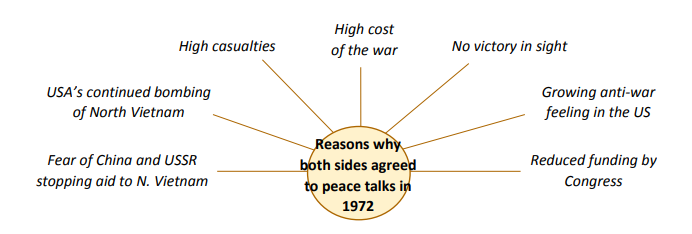
Official peace talks began in Paris in 1968 but got nowhere - America wanted South Vietnam to be independent, but North Vietnam wanted Vietnam reunified as one country.
As a result, Nixon also held secret talks with North Vietnam and its allies China and the USSR, pressuring them to reach an agreement
Vietnam was to be a single country.
A new government would be elected without interference from other countries.
A ceasefire would begin, and all US military would be withdrawn.
America would not interfere in Vietnam anymore, and US aid to the ARVN would stop.
The USA would give aid for reconstruction
when did the Vietnamese beat the French?
what happened at the Geneva Accords
_____ (name of resistance) from _____(date) sent troops and weapons into the South via the Ho Chi Minh Trail
In 1954, the Vietminh defeated the French in a battle at Dien Bien Phu. Because they had support of local people, knew the territory, more troops.
After the French defeat, nine countries met and came up with the Geneva Accords. They agreed that Vietnam would be temporarily divided into North and South along the 17th parallel. Elections would then be held in 1956 to create a united Vietnam.
However, South Vietnam’s prime minister Diem refused to hold elections in 1956, because he feared Ho Chi Minh (North Vietnam) would win. As a result, Vietnam stayed divided.
The Vietcong from 1959 sent troops and weapons into the South via the Ho Chi Minh trail
limited war – sending advisers to train the South Vietnamese Army (ARVN), but not fighting with them.
Two reasons Eisenhower got more involved in the Vietnam war
(what treaty was set up when)
Eisenhower - 1953 - 1961
anti-communism/Containment/Domino theory
In 1954 Eisenhower set up the South East Asia Treaty Organisation (SEATO): a group of countries who would work together to stop communism spreading in the region
South government was very weak - without US help, would collapse
Diem was cruel and unpopular, seen as US puppet not for the people
He hunted and killed suspected communists in South Vietnam.
He was a Catholic and he treated Vietnam’s Buddhists harshly.
He gave most government jobs to family members and Catholics.
He didn’t introduce reforms to help ordinary village peasant
how did US involvement change under Kennedy 1961-1963
Kennedy continued Eisenhower’s ‘limited war’ approach:
He sent 16,000 US military advisers to train the ARVN (Army of the Republic of Vietnam)
pacification – winning over local people so that they wouldn’t support communism
He sent in US Special Forces (‘Green Berets’), who trained villagers to protect themselves from the VC.
He agreed the use of chemical spraying to kill crops and jungle areas where the VC could be hiding.
what was the The Strategic Hamlet Program (1962)
The US helped Diem set up strategic hamlets: large villages guarded by the ARVN, where people could feel safe and protected by the government.
hoped this would stop peasants being recruited by the Vietcong. About 5,000 had been built by September 1962.
However, the program actually turned more people against Diem’s government:
Villagers did not want to leave their old homes
Diem’s government didn’t provide enough food, so people went hungry.
how did US involvement change under Johnson
what were (still) his goals, and what had made the VC a greater threat
goals:
set up a stable government in South Vientam
win the war quickly/prevent further fighting or spreading of war
South Vietnam weakness/North strength
South Vietnam government was weak after Diem’s death and unpopular because of strategic hamlets/Buddhist harshness
North received foreign aid from USSR and China
Soviets sent huge numbers of military aid - 2,000 tanks.
10,000 Soviet military specialists went on assignments to Vietnam
Americans knew about USSR involvement despite them trying to be secret, because they didn’t want to risk further war, especially with failures of Vietnam currently
local support
Respected villagers and made local reforms. Won people round with propaganda
VC was organised, acted quickly, knew the terrain and were fighting for their country
The war escalated following the ____________________________ incident in August ______. Two US ships claimed to have been attacked by ____________ boats, although there was some confusion about what actually happened. Shortly after, _________________ passed the Gulf of Tonkin ____________________, which allowed Johnson to use troops in Vietnam if necessary. North Vietnam saw this as a _____________________ of war.
escalated following Gulf of Tonkin incidence
two US Navy ships claimed they had been torpedoed by North Vietnamese boats in the Gulf of Tonkin.
but some confusion - Conditions were stormy and some believed there had been no attack at all
Congress passed the Gulf of Tonkin Resolution. This allowed Johnson to send in US troops if necessary.
The Resolution was not a declaration of war – although North Vietnam saw it that way
when was Diem assassinated - did the US know?
how long after Diem’s death was Kennedy assassinated
In November 1963 Diem was assassinated in a coup by ARVN generals - the USA knew it was coming but deliberately didn’t warn him.
November 22, 1963.
Just 3 weeks after Diem’s death, Kennedy was also assassinated. Lyndon B. Johnson took over as US President.
when did US involvement in Vietnam start
US involvement in Vietnam began in 1950, when President Truman sent $10 million in military aid to the French
First combat troops in Vietnam - ___/_____, when ______ US marines arrive at Da Nang
by the end of 1965, US had more than______ military personnel in Vietnam
at the height of America involvement - 1968, the number rose to more than ______
March 1965 - 3,500 US marines arrive at Da Nang (under Johnson)
end of 1965 - US had more than 180,000 military personnel in Vietnam
1968 - more than 500,000
what were America’s war tactics (3) brief
Operation Rolling Thunder (1965-68)
Search and destroy
chemical warfare
what was operation rolling thunder
why not successful
bombing campaign -
targeted the Ho Chi Minh Trail and industrial areas in North Vietnam. As well as bombs the US also dropped napalm (a burning chemical) and pineapple bombs
The Ho Chi Minh Trail was constantly repaired, so supplies still got through to the South.
Aid from China and the USSR was not targeted.
The destruction it caused turned the Vietnamese people against the USA.
It killed thousands of civilians, which was bad for the USA’s image.
what was search and destroy
why not successful
small units of US soldiers searching the jungle for VC camps, then ordering helicopters to bomb or spray them.
The USA thought these missions were successful because they destroyed VC supplies and tunnels.
BUT the US troops usually left the area once it had been ‘destroyed’.
allowed the VC to move straight back in.
The bombing and chemical spraying harmed villagers and turned them against the US.
how did the US use chemical weapons
when first, why
home reaction
first in 1961.
sprayed crops and jungle with herbicides to make the VC easier to find, and to cut off their food supply.
Agent Blue was used to kill crops.
Agent Orange was used to kill jungle forests.
One plane could spray 300 acres in 4 minutes
poisoned the soil and rivers, causing health issues and birth defects. + Killing crops led to starvation.
People back home were outraged by the dangerous effects of spraying chemicals. The government stopped using them in 1971, but by then lots of damage had already been done.
what were VC tactics
guerrilla war:
attacked with simple traps and sabotage (e.g. blowing up roads and bridges)
‘hit and run’ tactics, attacking then disappearing back into the jungle
only fought big battles occasionally, so that when they did it was a surprise tactic
dressed like normal people – they were a ‘shadowy enemy’
complex system of tunnels to move around and surprise US troops
What was the Vietcong? [4]
communist-led South Vietnamese guerrilla army that fought against the South Vietnamese government and its allies, including the United States, during the Vietnam War
what was the Tet Offensive
tactical win for US
political win for VC
In January 1968, the North Vietnamese Army (NVA) and the Viet Cong planned an attack on towns and cities in South Vietnam during the Tet holiday - an important celebration in Vietnamese culture. Before the Tet Offensive, they launched a series of distraction attacks in the countryside from October 1967 onwards, to tempt the US and Army of the Republic of Vietnam (ARVN) troops out of the cities. In the meantime, the Viet Cong placed more of their troops in the cities, disguised as ordinary civilians.
Then, on 30 January 1968, the Viet Cong and the NVA launched their attack against a large number of urban targets. They had considerable short-term success and even broke into the US embassy in Saigon, occupying it for a short time. Some cities, such as Hue, were taken for almost a month. However, the US and ARVN troops launched a counter-attack and took back control of the urban areas from the communists.
The offensive was a tactical win for the US…
The US and ARVN recaptured most cities and bases quickly.
The VC suffered so many losses that they were almost wiped out.
The offensive did not lead to a revolution in South Vietnam, as the VC had hoped.
political win for North Vietnam and the VC:
It was a huge propaganda victory for the VC – they had successfully caught the US off guard.
People in America were shocked by the fighting, and lost faith in the government who said that the war would be won soon. Anti-war feeling increased
undermined confidence in the US government's handling of the war, and led to a reassessment of US strategy in Vietnam.
what was Vietnamisation (under what president)
newly elected Nixon (after Johnson didn’t stand again because of how unpopular the war was)
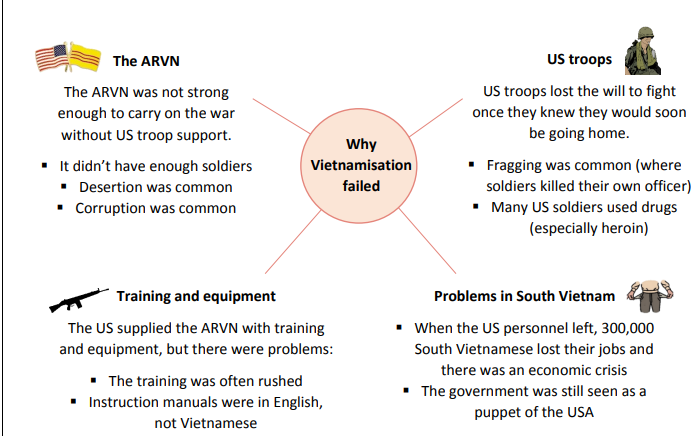
Vietnamisation - shifting responsibility for fighting to the South Vietnamese Army (ARVN). Withdraw ground troops, keep supplying aid and advisors
failures of Vietnamisation
how did the war expand under Nixon (3)
Secret Bombing of Cambodia:
In late 1969, Nixon approved a covert air campaign (Operation Menu) targeting Viet Cong
Laos (1971) In 1971 the US agreed to provide air support for an ARVN invasion of Laos, where communists were still using the Ho Chi Minh Trail. The ARVN attacked the city of Tchepone but were driven out by the communists – an embarrassment for the USA.
Bombing of North Vietnam (1972)
heavy bombing of North Vietnam.
Major cities including Hanoi were targeted
North Vietnamese industry and communication was destroyed
Supplies from China and the USSR were disrupted
what was the My Lai massacre
My Lai 1968 ( event was only uncovered in 1969. )
massacred a hamlet at Mai Lai, including women and children.
After Tet Offensive, Barker ordered Calley to eradicate all Vietcong—they went into Mai Lai, found only villagers but rounded them up, abused, raped and killed them, before mass burying them. Even animals were slaughtered.
Between 300-500 civilians were murdered. The USA was horrified and the press began to step-up anti-Vietnam sentiments.
Only Calley was charged, and even he was let off after 3 years.
The ___________, a classified study of US involvement in Vietnam, were leaked in 1971 and revealed decades of government deceit, which fueled public distrust of the war effort.
The Pentagon Papers
reasons for growing public opposition to the war
escalation of war:
People worried about the rising death toll and loss/injury of loved ones (total 60,000 US and millions of Vietnamese, over 150,000 injured)
Politicians opposed the high cost of the war, and its bad impact on America’s image abroad.
From 1965, it was spending more than $50 billion per year. (total = hundreds of billions - $828 billion on its military). Johnson had to cancel ‘The Great Society’ reform plan due to the cost.
in Vietnam Agent Orange caused birth defects in children and this chemical continues to have a negative effect on Vietnam.
Vietnam was the first war that was widely watched on TV. Ordinary people saw uncomfortable footage of the war (and anti-war protests) which made them think about it. People lost faith in the government, because news reporters in Vietnam showed that the war was not being won like the government claimed. My Lai massacre, etc.
Why did the United States object to the Soviet Union placing nuclear missiles on Cuba? [6]
threat of nuclear war
90 miles off coast of Florida
ICBMs? - check this
could reach almost in USA and have devastating consequences
being in their ‘own backyard’ or sphere of influence
US looked weak internationally
after Bay of Pigs failure Kennedy has to prove themselves strong
difficult as inexperienced president
looked as though Khrushchev was gaining the upper hand in the Cold War.
Why was General MacArthur dismissed from command of the UN forces in Korea? [6]
got China involved in the Korean war
Initially US forces were very successful
But then they got too close to the Chinese border, despite warnings from China, that if they went too close China would enter the war (McArthur didn’t believe they would )
Chinese sent large numbers of troops across the Yalu river and pushed back the Americans
China now as new threat and major player in cold war
especially since new Communist 1949 Chinese un-recognised by US government
directly disobeyed Truman’s orders
MacArthur was dismissed because he disagreed with President Truman over what to do in Korea when the fighting reached stalemate around the 38th parallel. Truman was content to save South Korea but MacArthur wanted to continue the war and invade China. He even threatened to use nuclear weapons.
MacArthur was ordered by Truman not to go back into North Korea. He ignored the command, saying he wanted to unite Korea and the USA should be prepared to engage in nuclear warfare if that was what it took.
not the first time he had directly disobeyed orders - insubordination dealt with harshly
Why was the impact of the Tet Offensive disastrous for the United States? [6]
initial military failure
were taken by surprise
US embassy in Saigon was occupied by VC
public began to think that the government’s version of events so far, claiming that the USA was winning the war, was not true. They were shocked that the US army had been forced to retreat in the Tet Offensive.
Vietnamese losses
USA suffered just over 1,000 deaths, estimates of the numbers of Vietnamese deaths vary between 30,000 and 50,000 communist soldiers, and it is thought that around 12,500 civilians died.
Was the UN just a puppet for the US in the Korean war? [6]
Yes: · 90% of all army personnel, 93% of all air power and 86% of all naval power was from the USA · $12bn from USA alone · It was Truman who fired MacArthur, not Trygve Lie · There was no reason for the UNO to get involved in N.Korea – the USSR argued it was a civil war and, as N.Korea were not even permitted a seat in the UN General Assembly, they were not within the UN’s remit. · Acted incredibly fast – within a month – this seemed an indication of US urgency. · Failed to hold elections immediately after WW2
No: · Trygve-Lie had to act quickly in order to show the UN was not the LON · The North Koreans had attacked the S.Koreans—this was a breach of peace
Why did North Korea invade South Korea in 1950? [6]
to reunify and make Korea communist
had the means/support
Why was President Kennedy humiliated by the failure of the Bay of Pigs invasion? [6]
Reason 1: The invasion was a complete military failure
The CIA-backed Cuban exiles were defeated within 3 days by Castro’s forces.
1,400 exiles landed at the Bay of Pigs, but they were outnumbered and lacked air support.
Over 1,100 were captured and around 100 were killed.
Reason 2: It damaged Kennedy’s international reputation
It made the USA look weak and incompetent in front of the world, especially during the Cold War.
The failed invasion pushed Cuba closer to the Soviet Union, increasing Cold War tensions.
Kennedy was seen as inexperienced and naïve just months into his presidency.
Why did President Johnson (1963—1969) increase American involvement in Vietnam? [6]
short term reasons that allowed him to:
The Gulf of Tonkin Incident - 2nd August, 1964.
The Gulf of Tonkin incident occurred when North Vietnamese boats allegedly attacked American naval vessels in the Gulf of Tonkin.
During the incident, North Vietnamese torpedo boats were seen approaching a US ship. As a result, the US fired three warning shots. Allegedly, the boats attacked and fired torpedo shots which Maddox evaded. When they continued to approach, Maddox, the US ship, fired on them. It resulted in major damage to the North Vietnam torpedo boats and the deaths of some on board while the US ship Maddox received minor damage and zero casualties or injuries.
In reaction to the Gulf of Tonkin Incident, the Gulf of Tonkin Resolution was passed by congress, allowing the President to do anything to assist "any member or protocol state of the Southeast Asia Collective Defense Treaty", including the use of armed forces.
Congress passed the Gulf of Tonkin Resolution, giving Johnson the power to pursue military action in Vietnam in August 1964.
two assassinations
JFK and Ngo Dinh Diem (both Nov 1963)
radicalised government and people
long term: domino theory and containment
cold war convictions of containment, truman doctrine, etc.
but Laos and Cambodia fell to communism in 1947 despite/caused by US bombings
already spent so much money may as well try end it
first troops: March 8, 1965, 3,500 United States Marines
Why did Khrushchev place nuclear missiles in Cuba? [6]
Kennedy’s huge military build up
Kennedy carried out the largest peacetime increase in military spending is US history up to that point
Kennedy (whilst studying in Harvard) learnt about British appeasement of Nazi Germany, and thought that the mistake that the British made in dealing with Hitler was was that they did not prepare militarily to confront him. Influenced Kennedy’s foreign policy
Long-term growth of US power: 1945 - first A bomb, 1952 - first H bomb, 1958 - US places ICBMs in NATO countries pointed at USSR
many failed assassination attempts on Castro, including hiring American mobsters/the mafia
To support Fidel Castro (communist ally)
late 1961, Fidel Castro asked for more SA-2 anti-aircraft missiles from the Soviet Union. The request was not acted upon by the Soviet leadership. In the interval, Castro began criticizing the Soviets for lack of "revolutionary boldness", and began talking to China about agreements for economic assistance. Castro outed Russians from his communist government. Then USSR sent missiles
Soviet foreign policy planners were concerned that Castro's break with Escalante foreshadowed a Cuban drift toward China, and they sought to solidify the Soviet-Cuban relationship through the missile basing program.
In the spring of 1962 Nikita Krushchev would respond to those two things
Who gained more from the Cuban Missile Crisis: Kennedy or Khrushchev? Explain your answer. [10]
JUDGEMENT: Kennedy, despite it being embarrassing as the results of his failure of Bay of Pigs, ended up with best
The Cuban Missile Crisis (October 1962) was the peak of Cold War tension and brought the world to the brink of nuclear war. It revolved around the secret deployment of Soviet nuclear missiles in Cuba and the U.S. response under Kennedy’s leadership.
KENNEDY - public support at home
Kennedy appeared strong and resolute on the world stage.
Delivered a calm but firm televised address on October 22, announcing the naval blockade ("quarantine") of Cuba
Internationally, the U.S. was seen as containing Soviet aggression, while Khrushchev was perceived as backing down.
Result: Kennedy’s popularity surged domestically and globally; he appeared to have stood up to the Soviets and forced their retreat.
KENNEDY - beating communism and international clout
makes USSR look weak to the world
Key moment: Adlai Stevenson at the UN (October 25) publicly confronted the Soviet ambassador with photographic evidence of missiles—hugely boosted U.S. credibility.
Gained overwhelming support from Western allies: Charles de Gaulle (France), UK, US
prevents USSR from taking more risks
got so close to war that they:
Direct communication line: In the crisis’s aftermath, Kennedy and Khrushchev agreed to establish the Moscow–Washington hotline to prevent future miscalculations
In August 1963, the USA and the USSR agreed a Nuclear Test Ban Treaty.
Both sides had had a fright. They were more careful in future.
In a turnabout of attitude in June 1963, Kennedy gave a speech acknowledging Soviet suffering in the Second World War, praising their advancements in science and industry
prevents USSR from advancing technologically
KRUSCHEV - secret gains
Khrushchev did achieve key goals:
Secured a guarantee that the U.S. would not invade Cuba, protecting Castro and preserving the socialist regime close to U.S. shores.
kept Cuba safe from American action and this was a major achievement. Cuba was a valuable ally and proved a useful base to support communists in South America
Got a secret U.S. agreement to remove Jupiter missiles from Turkey—a real strategic gain, though kept hidden from the public.
However, the public perception was one-sided:
Only the Soviet concessions were public (removal of missiles from Cuba).
The U.S. concession in Turkey was never acknowledged, per the secret deal mediated via Bobby Kennedy and Soviet ambassador Dobrynin.
Thus, Khrushchev made gains, but Kennedy gained more in visible terms—especially important during the Cold War, where optics and public strength mattered immensely.
but was deposed in 1964
Which was more successful in the Korean War: North Korea or the USA? Explain your answer. [10]
YES
Contained communism (didn’t spread to South Korea)
firmly established US as willing and able to use military force for containment
lead to the creation of SEATO (South East Asian equivalent of NATO)- an anti-communist military alliance
acted quickly - UN drawn up fast and outcome reached quickly - better than inefficient League of Nations
NO
costly (life + money) - more Americans died per year than in the Vietnam War
North Korea not liberated
tension between American leaders - to contain or win over countries
new threat of China emerged
The USSR had realised that it should never boycott the UN Security Council again as it was clear that the power of veto was important in blocking US attempts to stop the spread of communism.
overall USA did better
By _____, both Laos and Cambodia were communist
by 1975
How far was Vietnamisation responsible for the ending of the Vietnam War? Explain your answer. [10]
Vietnamisation =
gradual withdrawal of US troops from Vietnam while simultaneously strengthening the South Vietnamese army
began in April 1969 and ended in 1971.
By 1972, over 400,000 US personnel, including combat troops, had been withdrawn
YES - removed US who had huge part in the continuing of the war
As the ARVN became more self-sufficient, US troops would be withdrawn from Vietnam.
estimated $176 billion on the Vietnam War between 1961 and 1973
massive amounts of money, 58,000 men killed, hundreds of thousands sent there
NO - US continued to bomb/send other forms of support
Nixon increased bombing campaigns against North Vietnam to show he was not weak. He also invaded Vietcong bases in Cambodia causing outrage across the world even in the USA
escalated the bombing campaign in North Vietnam, for two reasons:
to disrupt the Ho Chi Minh trail and hit Vietcong bases in the neighbouring countries of Laos and Cambodia
to force the North Vietnamese to negotiate after initial peace talks (from early 1969 on) broke down
More bombs were dropped on N.Vietnam than on Germany and Japan in the entire Second World War
NO - war continued after US left
war only officially ended in April 1975
The 1973 Paris Peace Accords led to the US withdrawal, but they failed to establish a lasting peace and North Vietnam continued to escalate the conflict.
Nixon’s plan to secure ‘peace with honour’
but not about peace, about removing US because of loss of public support, economic/political reasons
JUDGEMENT: no, war continued after
‘The Korean War was a victory for the United Nations.’ How far do you agree with this statement? Explain your answer. [10]
The UN forces, drawn from 16 countries, had helped to prevent one country from overrunning another.’
UN was dominated by the US and this made the UN look weak. The Korean War was a victory for the USA as it provided 90% of UN forces.
YES
Contained communism (didn’t spread to South Korea)
firmly established US as willing and able to use military force for containment
lead to the creation of SEATO (South East Asian equivalent of NATO)- an anti-communist military alliance
acted quickly - UN drawn up fast and outcome reached quickly - better than inefficient League of Nations
NO
costly (life + money) - more Americans died per year than in the Vietnam War
North Korea not liberated
tension between American leaders - to contain or win over countries
new threat of China emerged
The USSR had realised that it should never boycott the UN Security Council again as it was clear that the power of veto was important in blocking US attempts to stop the spread of communism.
agree - a win for the united nations, yes - but since the united nations was basically a puppet for the US, it really was a win for the US, as well as UN
‘Placing missiles in Cuba achieved Khrushchev’s aims.’ How far do you agree with this statement? Explain your answer. [10]
Khrushchev’s aims
To defend Cuba o To rest American strength – whether they would back off or face up o To trap the USA into nuclear war – he did not even try to hide them o To get upper hand in arms race due to concern over missile gap would prevent US ever launching 1st strike o To bargain with USA for concessions: remove military bases in Turkey & Italy (events of pg. 350 = important!)
YES: Defensive Motivation and Deterrence (initially)
protect Cuba (who had asked for USSR support as early as late 1960 and early 1961, following the failed Bay of Pigs invasion in April 1961.)
as only communist state in Western hemisphere, and having just survived Bay of Pigs
kept communist state going 90 miles off Florida
Defending Cuba from U.S. aggression: Khrushchev’s primary goal in placing missiles in Cuba was to protect the island from a potential U.S. invasion. The Bay of Pigs invasion (April 1961) had proven the U.S.'s determination to overthrow Fidel Castro's communist regime
Just as the U.S. placed missiles in Europe to deter Soviet expansion, Khrushchev placed missiles in Cuba to prevent U.S. actions against a Soviet satellite near U.S. shores. This step made sense as a defensive manueuver in the context of the Cold War, seeking to level the playing field after U.S. nuclear superiority.
restore missile balance and close missile gap
YES: result
Secured a guarantee that the U.S. would not invade Cuba, protecting Castro and preserving the socialist regime close to U.S. shores.
kept Cuba safe from American action and this was a major achievement. Cuba was a valuable ally and proved a useful base to support communists in South America
Got a secret U.S. agreement to remove Jupiter missiles from Turkey—a real strategic gain, though kept hidden from the public.
NO:
To achieve arms race superiority – Khrushchev was running out of money and grew concerned about the missile gap between the USSR and the USA. Having arms on Cuba would allow him the first strike and breathing space. did not
missiles were removed after naval blockade by US
made Khrushchev look weak and he was later removed from power in 1964
One of Khrushchev’s aims had been to strengthen his own position in the USSR. He had been under criticism for not standing up to the USA strongly enough and for letting the USA become much stronger in terms of nuclear weapons. However, Khrushchev ended up being humiliated. Under pressure he gave way and removed the missiles from Cuba. This was seen as a defeat in the USSR and soon after, in 1964, Khrushchev was forced from power
‘American public opinion was more important than the tactics of the North Vietnamese forces in causing the United States to withdraw.’ How far do you agree with this statement? Explain your answer. [10]
How surprising is it that the United States did not win the Vietnam War? Explain your answer. [10]
JUDGEMENT: no
YES - US traditionally military beast
wealthiest power in the world and deployed hundreds of thousands of troops in the second half of the 1960s. These troops were heavily armed and well equipped
over 2 million troops were deployed, at peak 500,000 in Vietnam at once
By the late 1960s, the war was costing the US $30 million a year
USA has never officially lost a war in its, albeit short history
BUT:
North Vietnamese were supplied and supported by China and the Soviet Union. A total of $2 billion was given in aid to the fight against America between 1965-1968. This included 8,000 anti-aircraft guns and 200 anti-aircraft missile sites.
NO - demoralising military failures
brute-force American tactics didn’t work on guerilla warfare
still had to face up to international judgement so couldn’t bomb everything
tunnel systems, booby-traps and jungle cover meant Viet Cong were difficult to find
total 58,000 American troops were killed
61% of whom were younger than 21 years old
incredibly low morale, especially in latter parts of war when clear no progress being made
soldiers deserted, took drugs, shot officers
contrast fanatically determined Viet Cong defending land
and who have been at war for consecutive decades, contrasts short American One-Year tour of service (US troops much more inexperienced)
significant military failures
Failure of Operation Rolling Thunder: The bombing campaign failed because the bombs often fell into empty jungle, missing their Vietcong targets.
Tet Offensive - Viet Cong briefly occupied U.S. Embassy in Saigon
compared to:
all the Vietcong needed to do to win was not be eliminated. As long as they had enough membership and could engage on occasion, they were winning. The US needed a total and decisive defeat of the North Vietnamese. The North Vietnamese just had to wait until the US went home.
North Vietnamese soldiers were dedicated to fighting for independence and for communism. They were fiercely loyal to their leadership, which had already provided land reform in the north.
These soldiers were conscripted and served long tours of duty.(vs. US short one year) As a result, the Vietcong became highly experienced and knowledgeable about American tactics.
NO - public opinion/US horrors
Media coverage meant public witnessed atrocities
My Lai massacre - where US killed up to 500 of unarmed citizens (mainly women, children, elderly)
effects of napalm and Agent Orange
May 1970 - 4 students shot in Ohio Kent State University for protesting Viet war
influential figures opposed - e.g. Muhammed Ali who risked prison for avoiding the draft
Nixon’s upcoming election campaign
The Pentagon Papers, a classified study of US involvement in Vietnam, were leaked in 1971 and revealed decades of government deceit, which fueled public distrust of the war effort.
The US withdrew from Vietnam because of public opinion in America. How far do you agree? [10]
NO - impact on the US economically
By the late 1960s, the war was costing the US $30 million a year
to the detriment of President Johnson’s ‘Great Society‘ domestic programme - promised to ‘end poverty‘ and improve healthcare and education
Johnson was unwilling to raise taxes to fund the war so he created a surge in inflation - considered the start of the ‘Great Inflation‘ which lasted until 1981.
New President Nixon abandoned the gold standard in 1971 to try curb the inflation
to prevent inflation and halt the massive increase of state debt → withdraw from war
NO - demoralising military failures/unwinnable
total 58,000 American troops were killed
61% of whom were younger than 21 years old
incredibly low morale, especially in latter parts of war when clear no progress being made
soldiers deserted, took drugs, shot officers
contrast fanatically determined Viet Cong defending land
and who have been at war for consecutive decades, contrasts short American One-Year tour of service (US troops much more inexperienced)
significant military failures
Failure of Operation Rolling Thunder: The bombing campaign failed because the bombs often fell into empty jungle, missing their Vietcong targets.
Tet Offensive - Viet Cong briefly occupied U.S. Embassy in Saigon
YES - public opinion
Media coverage meant public witnessed atrocities
My Lai massacre - where US killed up to 500 of unarmed citizens (mainly women, children, elderly)
effects of napalm and Agent Orange
May 1970 - 4 students shot in Ohio Kent State University for protesting Viet war
influential figures opposed - e.g. Muhammed Ali who risked prison for avoiding the draft
Nixon’s upcoming election campaign
The Pentagon Papers, a classified study of US involvement in Vietnam, were leaked in 1971 and revealed decades of government deceit, which fueled public distrust of the war effort.
JUDGEMENT: main reason was public support
timeline of viet war

Why did the Vietnam War become increasingly unpopular with the people in America? [6]
My Lai Massacre
public spending affecting US home economy
Why was the Ho Chi Minh Trail important? [6]
trail for troops and equipment to pass from NV to VC (including supplies from USSR/China)
U.S. Navy's blockade of the South Vietnamese coast forced North Vietnam to rely on the overland Ho Chi Minh Trail for supplies
it kept being rebuilt and was almost always active - check
Why was the policy of Vietnamisation introduced? [6]
US to save face/not be embarrassed by loss
US public support too low to continue + economic + demoralised
How successful was the USA in Vietnam in the period 1963-1975? [10]
YES -
kept south vietnam going for some time
NO - military tactics didn’t work on guerrilla fighting
inexperienced tours
woods
underground
dress as civilians
NO - difference in morale
shooting officers, drugs, no real aim
fanatics, just have to not be eliminated
destabilised government
failures of vietnamisation as above - 30,000 become unemployed
‘ The USA’s policy of containment was a complete failure in Vietnam’. How far do you agree with this statement? Explain your answer. [10]
Paragraph 1 – Agree: Containment failed (North Vietnamese victory)
Fall of Saigon (April 1975): Despite years of U.S. involvement, communist North Vietnam captured Saigon and unified the country under communism.
Billions spent & 58,000 U.S. deaths: Massive investment (over $100 billion) and loss of life failed to stop the spread of communism in Vietnam.
Domino theory disproved: U.S. feared communism would spread across Asia, but Vietnam’s fall didn’t trigger a widespread domino effect—highlighting flawed logic behind containment.
Paragraph 2 – Agree: Guerrilla warfare and lack of public support undermined policy
Viet Cong tactics: U.S. forces struggled against guerrilla warfare—Ho Chi Minh Trail, booby traps, and local support for the Viet Cong made containment difficult.
U.S. tactics alienated population: Use of napalm, Agent Orange, and strategic hamlets pushed civilians towards the communists.
Anti-war movement: Media coverage (e.g. My Lai Massacre, Tet Offensive in 1968) triggered mass protests and eroded U.S. public support, forcing withdrawal (Paris Peace Accords, 1973).
Paragraph 3 – Counterpoint: Delayed spread of communism temporarily
South Vietnam survived from 1954 to 1975: Containment held for two decades, showing it wasn’t an immediate failure.
U.S. supported allies in the region: Countries like Thailand, Malaysia, and Indonesia did not fall to communism, partly due to U.S. presence in Vietnam.
Military dominance: U.S. won most major battles (e.g. Operation Rolling Thunder showed military superiority), but political will failed.