9 Oral Pathology II
 Call Kai
 Learn
Learn Practice Test
 Spaced Repetition
 Match
Match Flashcards
 Knowt Play
1/55

There's no tags or description
Looks like no tags are added yet.
Name | Mastery | Learn | Test | Matching | Spaced | Call with Kai | Chat |
|---|
No analytics yet
Send a link to your students to track their progress
56 Terms
Carcinoma
This is a tumor that arises from the epithelium
Sarcoma
This is a tumor that arises from non epithelial tissue
Odontogenic
This is the term to describe developing or forming from tissue that allows the formation of teeth
Benign odontogenic tumors (see all the "omas")
Peripheral odontogenic fibroma, canine acanthomatous ameloblastoma, odontoma, amyloid producing odontogenic tumor, feline inductive odontogenic tumor, and feline epulides are all examples of what types of tumors?
Benign non-odontogenic tumors
Papilloma, osteoma, plasma cell tumors, and giant cell tumors are all examples of what types of tumors?
Malignant non-ondotogenic tumors
Squamous cell carcinoma (like papillary SCC), oral malignant melanoma, fibrosarcoma, and osteosarcoma are all examples of what types of tumors?
RADIOGRAPHS
What is the standard of care for a COHAT?
Peripheral odontogenic fibroma (oma=benign) affecting labial gingiva of left mandibular canine tooth (304) = fibromatous
What is this?
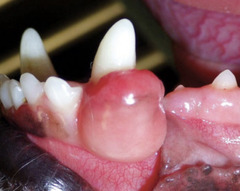
1. fibromatous (only soft tissue)
2. ossifying (bone involvement)
What are the two variants of peripheral odontongenic fibroma?
1. canine acanthomatous ameloblastoma (this one is NOT seen in cats)
2. peripheral odontogenic fibroma
What are the top two most common odontogenic tumors in dogs?
Peripheral Odontogenic Fibroma of rostral mandible and then rads = mineralization within soft tissue
TREATMENT: en bloc resection of tumor and teeth involved
What is this? How do you treat?
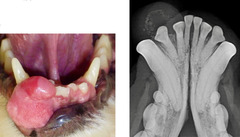
Canine acanthomatous ameloblastoma = teeth pushed out from space occupying mass and there is pitting
What is this?
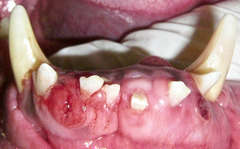
Canine acanthomatous ameloblastoma
This benign odontogenic tumor in dogs appears as an extraosseous swelling with or without tooth displacement and bone invasion. Commonly appears in *ROSTRAL MANDIBLE* in golden retrievers, akitas, cockers, and shelties
Canine acanthomatous ameloblastoma = confined to a region. loss of alveolar bone, canine involved with tumor.
TREATMENT: wide excision within 1 cm margins
What is this? How do you treat it?
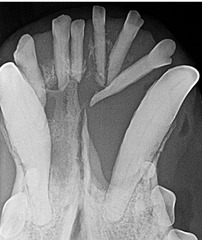
canine acanthomatous ameloblastoma
Which odontogenic tumor shows sheets of mature cells that are clearly squamous epithelium bonded by palisading cells on histology?
Odontoma "denticle" = compound odontoma
TREATMENT: marginal excision or intracapsular excision
What is this? How do you treat?
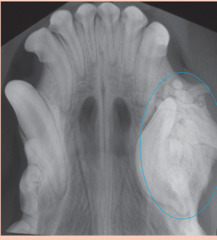
Odontoma
Which benign odontogenic tumor is seen in young animals, and is often non painful, expansile.
Has TWO TYPES: complex (disorderly dental tissue) and compound (contains tooth like structures and denticles)
Amyloid producing odontogenic tumor
TREATMENT: surgical resection within 1 cm (basically are going to amputate just behind 305 and remove everything rostrally)
An older animal comes in presenting with gingival enlargement and a slow growing expansive mass. What is this? How do you treat?
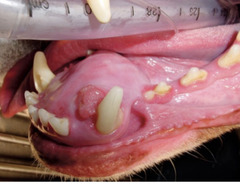
Feline inductive odontogenic tumor
TREATMENT: wide excision is curative
Note: aggressive mandibulectomy often required to treat something like this doesn't work well on cats and they often don't return to eating normally
What is this? How do you treat it?
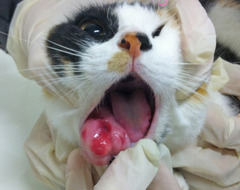
Feline inductive odondogenic tumor
Which odontogenic tumor appears in cats 8-18 months old, appearing raised, submucosal and rapidly expansive, locally destructive, appearing unilaterally on rostral mandible?
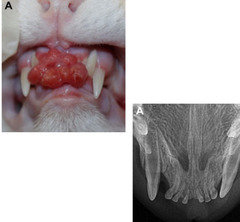
Feline Epulides = combo of fibromatous, ossifying, and acanthomatous features in the same lesion
TREATMENT: surgical management (just difficult with multifocal lesions), some may need multiple extractions
What is this? How do you treat?
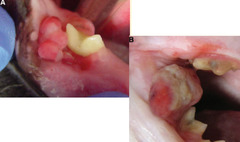
Pyogenic granuloma = comes from contact with maxillary 4th premolar to tissue (mandibular first molar in dogs)
What is this? What causes it?
MAL 2 (mandibular distoclusion aka overbite)
What type of malocclusion is this?
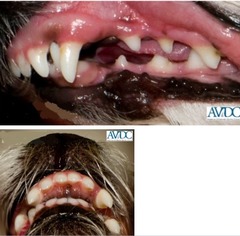
MAL 3 (mandibular mesioclusion aka underbite) = misaligned 1st molar and 4th premolar
What type of malocclusion is this?
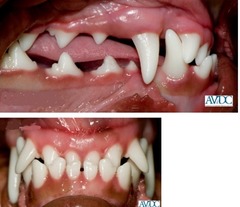
Neutroclusion (nonskeletal, normal relationship between maxilla and mandible) = Class 1 (MAL 1)
Skeletal malocclusion (abnormal relationship between maxilla and mandible) = Class 2 (MAL 2), Class 3 (MAL 3), Class 4 (MAL 4)
Name the two BROAD categories of malocclusion and the classes they encompass
Class 1 (MAL 1) nonskeletal = neutroclusion
Distroversion, Mesioversion, linguoversion, palatoversion, labioversion, buccoversion, and crossbite are all examples of which type of malocclusion?
Distroversion, Mesioversion, linguoversion, palatoversion, labioversion, buccoversion, and crossbite
Name some examples of Class 1 malocclusions
MAL 1: distroversion
*DISTAL VERSION*
Which class of malocclusion describes a tooth in its anatomically correct position in the dental arch BUT abnormally angled in a distal direction?
MAL 1: Mesioversion
*MESIAL (interproximal facing forward) VERSION*
Which class of malocclusion describes a tooth in its anatomically correct position in the dental arch BUT abnormally angled in a mesial direction?
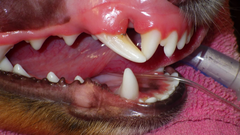
MAL 1: linguoversion
*LINGUAL (surface facing tongue) VERSION*
Which class of malocclusion describes a tooth in its anatomically correct position in the dental arch BUT abnormally angled in a lingual direction?
MAL 1: palatoversion
Which class of malocclusion describes a tooth in its anatomically correct position in the dental arch BUT abnormally angled in a palatal direction?
MAL 1: labioversion
*LABIAL (surface facing lip) VERSION*
Which class of malocclusion describes a tooth in its anatomically correct position in the dental arch BUT abnormally angled in a labial direction?
MAL 1: buccoversion
*BUCCAL (cheek facing surface) VERSION*
Which class of malocclusion describes a tooth in its anatomically correct position in the dental arch BUT abnormally angled in a buccal direction?
MAL 1: Crossbite
Which class of malocclusion describes a mandibular tooth has a more buccal(cheek) or labial(lip) position than the antagonist maxillary tooth?
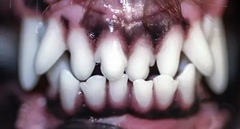
MAL 2: OVERBITE = Mandibular distoclusion
Which class of malocclusion is an abnormal rostral caudal relationship where the lower dental arch occludes CAUDAL to its normal position relative to the upper dental arch?
MAL 3: UNDERBITE = mandibular mesioclusion
Which class of malocclusion is an abnormal rostral caudal relationship where the lower dental arch occludes ROSTRAL to its normal position relative to the upper dental arch?
MAL 4: maxillomandibular asymmetry aka wry bite
Which class of malocclusion is a skeletal malocclusion with asymmetry in a rostrocaudal, side to side, or dorsoventral direction?
MAL 4 = wry bite, maxillomandibular asymmetry (side to side direction aka MAL 4 STS)
Which malocclusion?
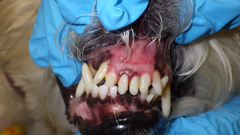
Calcinosis circumscripta
This is a circumscribed area of mineralization characterized by deposition of calcium salts
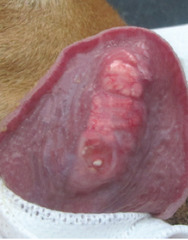
stage for metastasis
What should you consider doing if you suspect malignant non-odontogenic tumors?
Squamous cell carcinoma
What is the *second* most common *oral tumor in dogs* AND the *first* most common *tumor in cats*?
Squamous cell carcinoma
This aggressive locally infiltrative tumor is typically caused by chronic exposure to toxins like pollution, tobacco smoke, and radiation exposure. Masses are typically red, friable, and vascular OR may simply present as ulceration. Rads = destructive, osteolysis of underlying bones with moth eaten lucency
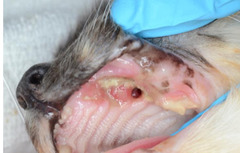
DOGS: surgery = aggressive resection
CATS: surgery often not possible due to tumor size
Can do radiation but NOT chemo. NSAIDs
How can you treat squamous cell carcinoma?
Papillary squamous cell carcinoma
This malignant tumor is associated with papillomavirus, affecting younger dogs (2-5 mo.) most commonly. Locally aggressive with bone lysis. No metastasis reported. Do surgical excision
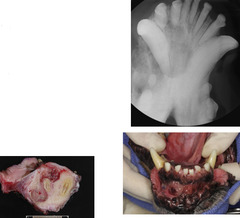
Oral Malignant Melanoma (OMM)
What is the most common oral malignancy of dogs?
Oral malignant melanoma
This malignant tumor typically occurs in the gingiva, buccal/labial mucosa, and tongue, appearing as a gray/brown/black mass which is ulcerated, friable, and easily bleeds. Gast growing and commonly causes necrosis
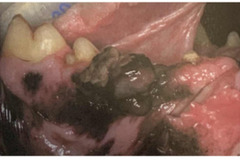
Want to catch tumor at less than 2 cm and excise 1 cm margins. If you catch it over 2 cm, it is often deadly no matter if you get the margins.
What is important to keep in mind about the margins of surgical excision for oral malignant melanoma?
Regional lymph nodes and lungs
Where does oral malignant melanoma often metastasize to?
Fibrosarcoma
What is the 3rd most common malignant tumor in dogs and 2nd most common malignant tumor in cats?
Fibrosarcoma
This tumor is most common in 8 year old large breed dogs. Tends to present as broad-based, firm swelling which is difficult to discern the full extent of on radiographs. Aggressive surgery is best chance for curing but local recurrence rate is HIGH.
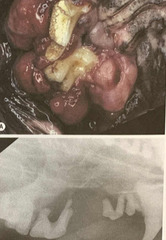
High low fibrosarcoma
This tumor appears benign histologically but behaves like an aggressive malignant neoplasm clinically. GOLDEN RETRIEVERS ARE PREDISPOSED. May be misdiagnosed as fibroma. Most dogs have underlying bone lysis
Osteosarcoma
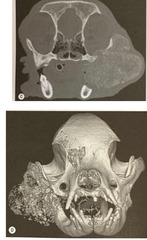
This malignant tumor often presents as a soft tissue mass surrounding bony lysis rather than hard tissue proliferation. More common in appendicular skeleton. If it occurs on axial = mandibular and maxilla (mandible preferrable). Cats have poor prognosis. Median survival rate after surgery is 9 months.
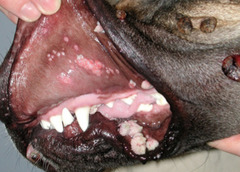
Papilloma
This benign non-odnotogenic tumor appears in young dogs as a "sea anemone". Most lesions tend to regress on their own, cleared by the immune system
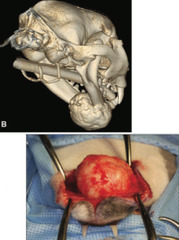
Osteoma (*MUST* be differentiated from osteosarcoma)
This benign non-odontogenic tumor occurs in cats or dogs as a well circumscribed, firm raised bone lesion. Shows normal woven bone on histopath. Common on hard palate, zygomatic arch, caudal mandible.
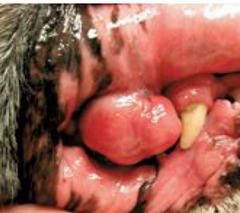
Plasmacytoma
This benign non-odontogenic tumor is RARE and is biologically more aggressive. May undergo local invasion. Often less than 1 cm, this well circumscribed red mass can be located on dorsal tongue. Surgical margins of 1 cm have been curative
ODONTOGENIC IN DOGS: 1. canine acanthomatous ameloblastoma (this one is NOT seen in cats)
2. peripheral odontogenic fibroma
DOG TUMOR: 1. oral malignant melanoma (oral tumor)
2. squamous cell carcinoma (oral tumor)
3. fibrosarcoma
CAT TUMOR: 1. squamous cell carcinoma
2. fibrosarcoma
Name the most common tumors of dogs and cats?