Trigonometry - Bearing

0.0(0)
studied byStudied by 0 people
0.0(0)
full-widthCall Kai
learnLearn
examPractice Test
spaced repetitionSpaced Repetition
heart puzzleMatch
flashcardsFlashcards
GameKnowt Play
Card Sorting

1/3

flashcard set

Earn XP

Description and Tags

Math

Study Analytics
Name
Mastery
Learn
Test
Matching
Spaced

No study sessions yet.

4 Terms

1
New cards

Bearings

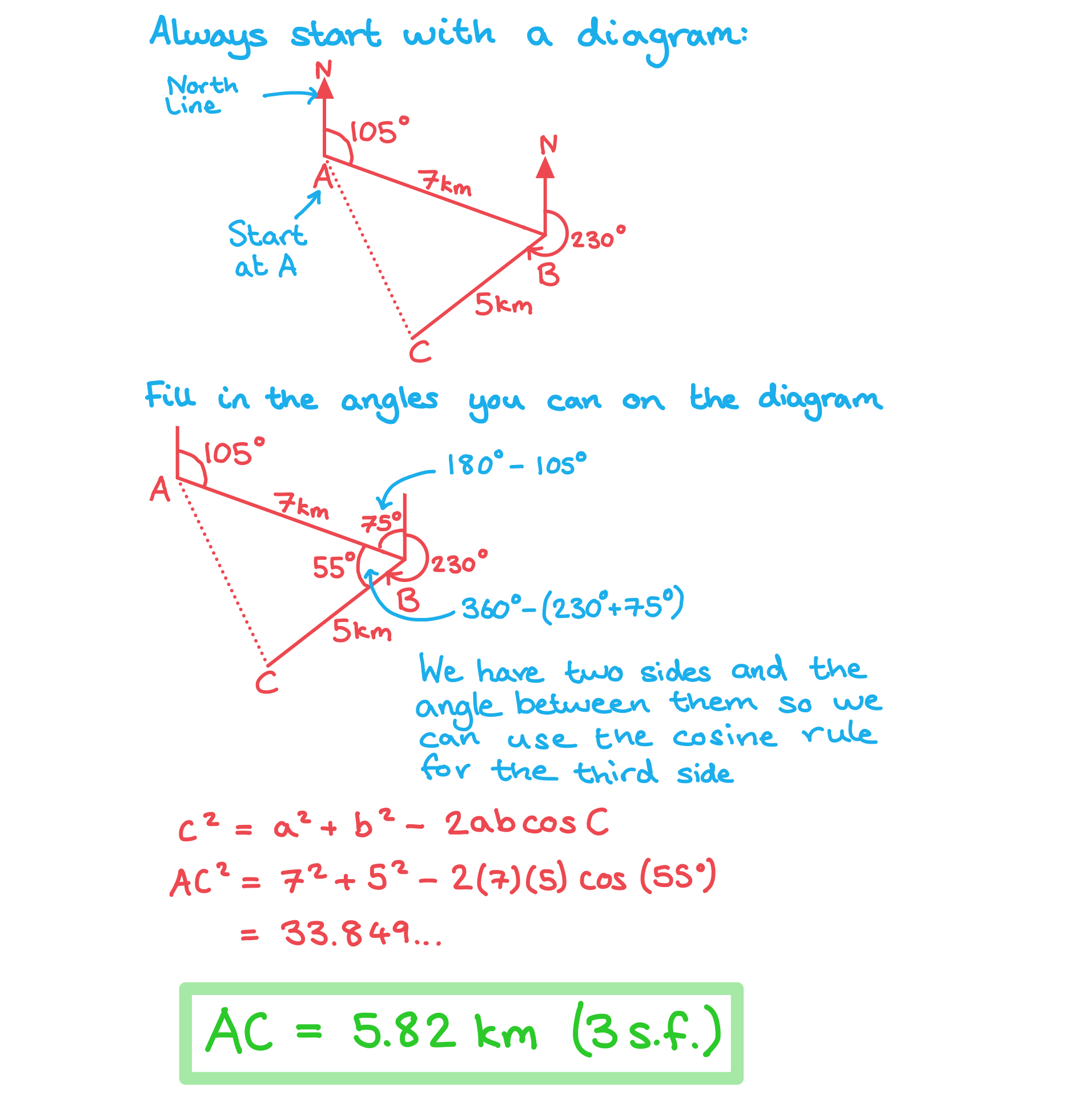
  • Bearings are a way of describing and using directions as angles

  • To answer a question involving drawing bearings the following steps may help:

    • STEP 1: Draw a diagram adding in any points and distances you have been given

    • STEP 2: Draw a North line (arrow pointing vertically up) at the point you wish to measure the bearing from

      • If you are given the bearing from A to B draw the North line at A

    • STEP 3: Measure the angle of the bearing given from the North line in the clockwise direction

    • STEP 4: Draw a line and add the point B at the given distance
<ul><li><p><span><strong><span>Bearings </span></strong><span>are a way of describing and using </span><strong><span>directions </span></strong><span>as</span><strong><span> angles</span></strong></span></p></li></ul><ul><li><p><span><span>To answer a question involving </span><strong><span>drawing bearings</span></strong><span> the following steps may help:</span></span></p><ul><li><p><span><span>STEP 1: Draw a diagram adding in any points and distances you have been given</span></span></p></li><li><p><span><span>STEP 2: Draw a North line (arrow pointing vertically up) at the point you wish to measure the bearing </span><strong><span>from</span></strong></span></p><ul><li><p><span><span>If you are given the bearing </span><strong><span>from A to B </span></strong><span>draw the North line at </span><strong><span>A</span></strong></span></p></li></ul></li><li><p><span><span>STEP 3: Measure the angle of the bearing given </span><strong><span>from the North line</span></strong><span> in the </span><strong><span>clockwise direction</span></strong></span></p></li><li><p>STEP 4:<strong> </strong><span><span>Draw a line and add the point B at the given distance</span></span></p></li></ul></li></ul><p></p>
2
New cards
<p>Elevation &amp; Depression</p>

Elevation & Depression

If a person looks at an object that is not on the same horizontal line as their eye-level they will be looking at either an angle of elevation or depression

<p><span><span>If a person looks at an </span></span><strong>object</strong><span><span> that is not on the same horizontal line as their eye-level they will be looking at either an angle of </span></span><strong>elevation </strong><span><span>or </span></span><strong>depression </strong></p>
3
New cards

Diagram Drawing Techniques

  • Make sure you know your compass directions

    • Due east means on a bearing of 090°

      • Draw the line directly to the right

    • Due south means on a bearing of 180°

      • Draw the line vertically downwards

    • Due west means on a bearing of 270°

      • Draw the line directly to the left

    • Due north means on a bearing of 360° (or 000°)

      • Draw the line vertically upwards

4
New cards

Example for Diagram

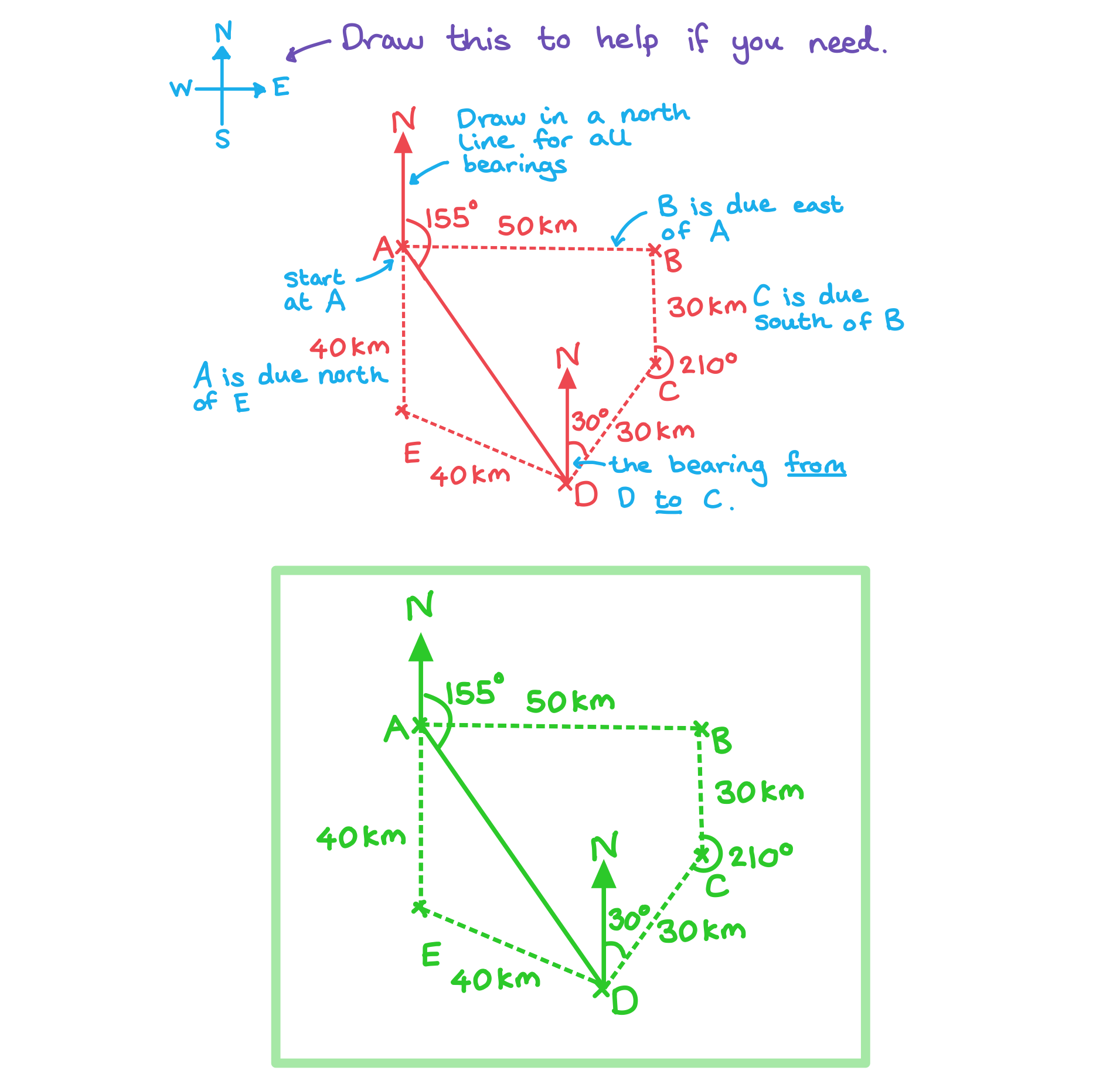
A city at B is due east of a city at A and A is due north of a city at E. A city at C is due south of B.

The bearing from A to D is 155° and the bearing from D to C is 30°.

The distance AB = 50 km, the distances BC = CD = 30 km and the distances DE = AE = 40 km.

Draw and label a diagram to show the cities A, B, C, D and E and clearly mark the bearings and distances given.
<p>A city at B is due east of a city at A and A is due north of a city at E. A city at C is due south of B.</p><p>The bearing from A to D is 155° and the bearing from D to C is 30°.</p><p>The distance AB = 50 km, the distances BC = CD = 30 km and the distances DE = AE = 40 km.</p><p>Draw and label a diagram to show the cities A, B, C, D and E and clearly mark the bearings and distances given.</p>