Week 2: Globular Proteins and Enzymes
 Call Kai
 Learn
Learn Practice Test
 Spaced Repetition
 Match
Match Flashcards
 Knowt Play
1/67

There's no tags or description
Looks like no tags are added yet.
Name | Mastery | Learn | Test | Matching | Spaced | Call with Kai | Chat |
|---|
No analytics yet
Send a link to your students to track their progress
68 Terms
List 5 functions of globular proteins
-Storage of ions and molecules
-Transport of ions and molecules
-Defense against pathogens
-Muscle contractions
-Biological catalysis
What’s a ligand?
any molecule or ion that binds to the binding site of a protein, usually through non-covalent interactions
What does “transient” mean in ligand binding?
temporary and reversible; the ligand binds then dissociates
Why do non-covalent interactions make ligand binding transient?
They are weak individually, allowing the ligand to bind long enough to function but dissociate easily when conditions change
What is the association rate constant (ka)?
Describes how quickly a ligand and protein associate to form a complex[PL]/([P][L]). It tells you how strongly a ligand binds to a protein.
What does a high association rate constant (ka) represent?
fast protein-ligand binding
What does a low association rate constant (ka) represent?
slow protein-ligand binding
When would the association rate constant (ka) be large?
when most protein is in the protein-ligand complex, so binding is fast
When would the association rate constant (ka) be small?
When most of the protein is free, so binding is slow
What is the dissociation rate constant (kd)?
the rate constant for how quickly a protein–ligand complex falls apart
What does a high dissociation rate constant (kd) represent?
-the ligand falls off quickly, so the binding is weak
What does a low dissociation rate constant (kd) represent?
-the ligand stays bound, so the binding is tight
What does affinity mean in protein–ligand binding?
the strength of the interaction between a protein and its ligand.
High affinity → they bind tightly
Low affinity → they bind weakly
Why does a protein–ligand binding curve plateau instead of staying linear?
Because as binding proceeds, free protein and ligand decrease, association slows, and eventually the association and dissociation rates become equal, producing an equilibrium plateau.
What does the equilibrium constant (Keq) represent?
describes the ratio of products to reactants at equilibrium for a reversible reaction. It tells you where the equilibrium lies — toward products or toward reactants
What does a large Keq (>1) mean?
-products are favored
-ΔG° is negative (exergonic)
-Reaction “lies to the right”
What does a small Keq (<1) mean?
-reactants are favored
-ΔG° is positive (endergonic)
-reaction “lies to the left”
If the dissociation constant (Kd) value is small, is the protein-ligand complex favored?
Yes. A small Kd means slow dissociation, tight binding, and a low KD
If the dissociation constant (Kd) is large, what is favored?
The individual components (free protein and free ligand). A large Kd means weak binding and little PL complex.
What does the dissociation constant (Kd) represent?
how much of the protein–ligand complex exists at equilibrium
Are Kd and kd the same?
No. Kd is an equilibrium constant describing how much complex exists at equilibrium. kd is a kinetic constant describing how fast the complex dissociates.
If [P]T≪[L]T, is free ligand basically equal to total ligand?
Yes. Protein binding barely reduces ligand concentration, so free ligand concentration is essentially the same as the total ligand concentration
[L]free ≈ [L]T.
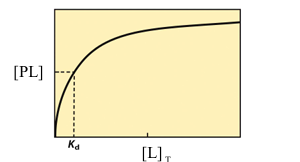
Is Kd the ligand concentration at half‑max binding?
Yes — if ligand is in excess. Under that condition, Kd equals the free ligand concentration at which half of the protein is bound.
Is Kd< 10 nM weak or strong binding?
strong
Is Kd > 10 microMolers weak or strong binding?
weak
What is needed to have a more negative delta G and what does it lead to?
-a small Kd value is needed
-Leads to a more negative delta G which means the interaction is energetically favorable
What does a negative delta G represent when it comes to protein-ligand binding?
-the protein and ligand “want” to bind
-binding releases energy
-the bound state is more stable than the unbound state
-the interaction is thermodynamically favorable
What is the induced fit model?
A model where the ligand’s initial binding causes the protein to change shape, creating a more complementary and tighter binding interaction.
Define apoprotein
It’s the protein alone, without its required non‑protein component. Cannot perform its biological function until it obtains its required partner (cofactor, prosthetic group, metal ion, coenzyme)
Define holoprotein
It’s the complete, functional protein, with its required non‑protein component bound. Ready to function.
What is the function of myoglobin?
Myoglobin is an oxygen-binding protein in muscle that serves as intracellular oxygen reservoir
What does myoglobin have high affinity for?
Very high affinity for oxygen
Myoglobin has very high affinity for oxygen, what does that mean?
-myoglobin binds tightly to oxygen
-Kd is extremely low
Why aren’t transition metals used to bind oxygen to myoglobin?
Transition metals would:
-generate free radicals if free in solution
-create irreversible oxidation
-damage the cell/protein
How many binding sites does myoglobin have?
One
Why is myoglobin’s oxygen-binding curve hyperbolic?
-Since myglobin binds one oxygen molecule, with one binding site, there is no cooperativity, binding is simple and independent, 1:1 ligand binding?
How many binding sites does hemoglobin have?
Four
A sigmoidal (S‑shaped) curve for hemoglobin means cooperative binding, what does this mean?
It means the protein’s affinity for oxygen changes depending on how many O₂ molecules are already bound.
Explain what it means for hemoglobin to bind oxygen cooperatively
Each O2 molecule increases the affinity for the next
Hemoglobin is perfect for?
oxygen transport
Describe hemoglobin at low O2 (beginning of the S-shaped curve)
-hemoglobin is in the T state (tense, low affinity)
-it does not want to bind to oxygen yet —> curve rises slow
Describe hemoglobin in the S-shaped curve once the first O2 binds
-Hemoglobin shifts toward the R state (relaxed, high affinity)
-affinity increases —> curve becomes steep
-this is the cooperative part
Why does hemoglobin unload O2 in tissues?
-Because low oxygen pushes it into the T-state (low affinity)
Why does hemoglobin load O2 in lungs?
-Because high oxygen pushes it into the R-state (high affinity)
Why does hemoglobin have low affinity in tissues?
In the tissues:
-oxygen concentration is low
-hemoglobin tend to be in the T-state
-T-state has low affinity
-At low affinity, hemoglobin releases oxygen
Why does hemoglobin have high affinity in the lungs?
In the lungs:
-oxygen concentration is very high
-hemoglobin shifts into the R-state
-R-state has high affinity
-At high affinity, hemoglobin loads oxygen rapidly
What is the role of heme in myoglobin?
A prosthetic group containing Fe²⁺ that allows reversible oxygen binding, prevents iron oxidation, stabilizes O₂, and enables myoglobin to store oxygen in muscle
Where does heme allow myoglobin to store oxygen?
in muscle tissue
Does heme give myoglobin high or low affinity?
very high affinity
What does the porphyrin ring of heme do?
-stabilizes Fe2+ (ferrous)
-prevents harmful oxidation
-allows reversible O2 binding
-holds Fe2+ in a precise orientation
What is the role of proximal histidine in heme?
-It binds directly to the iron in heme, it is part of the iron’s coordination sphere
What role does the proximal histidine have in heme when oxygen binds to the iron?
-the iron moves slighting into the porphyrin plane, which tugs on the proximal histidine and that leads to movement in the protein backbone
Why allows heme to be a chromophore?
Heme is a chromophore because its conjugated porphyrin ring absorbs visible light and gives myoglobin and hemoglobin its red color.
What does oxygenated myoglobin look like?
bright red
What does deoxygenated myoglobin look like?
dark/purplish color
How many heme’s does hemoglobin have?
4
What makes hemoglobin a heterotetramer?
hemoglobin has two alpha and two beta subunits
What is the Bohr effect?
The pH differences between lungs and metabolic tissues increase the O2 transfer efficiency
What effect does a higher pH (7.4-7.6) have on oxygen binding to hemoglobin in the lungs?
-hemoglobin binds oxygen more tightly in the lungs where there is a high pH
-Low CO2 + low H+ concentration pushes hemoglobin to the R-state
What effect does a lower pH (7.2) have on oxygen binding to hemoglobin in the tissues?
-hemoglobin releases oxygen in tissues where there is a low pH
-High CO2 + lactic acid + high H+ pushes hemoglobin toward the T-state
When histidine is protonated, does it favor the R-state or the t-state and why?
Favors the T-state because:
-histidne gains a positive charge
-allows it to form strong salt bridges
-These salt bridges lock hemoglobin in the T‑state
-T‑state = low affinity → O₂ released
When histidine is deprotonated, does it favor the R-state or the t-state and why?
Favors the R-state because:
-Histidine loses the positive charge
-Salt bridges cannot form
-T‑state becomes unstable
-Hemoglobin shifts to the R‑state
-R‑state = high affinity → O₂ bound
How can hemoglobin export CO2 in the form of a carbamate?
Hemoglobin exports CO₂ by forming carbamates when CO₂ binds to the amino‑terminal amino groups on each globin chain
the formation of a carbamate yields a proton which can bind to hemoglobin, what does this promote?
oxygen dissociation
When the hemoglobin reaches the lungs, the blank pH and blank concentration of oxygen promotes blank and blank
-higher
-high
-O2 binding
-release of CO2
What is the role of BPG in hemoglobin?
it’s the molecule that makes hemoglobin let go of oxygen in the tissues.
How does BPG help hemoglobin release oxygen in the tissues?
BPG binds to deoxygenated hemoglobin in the central cavity, stabilizing the T‑state and lowering O₂ affinity. This promotes oxygen release in tissues
Where does BPG bind in hemoglobin?
binds in a cavity that is lined with positively charged amino acids located between the beta subunits.