Unit 6 - Industrialization and Its Effects
 AP Practice
 Call Kai
1/110

Earn XP
Name | Mastery | Learn | Test | Matching | Spaced | Call with Kai |
|---|
No analytics yet
Send a link to your students to track their progress
111 Terms
Commercial Revolution
Roots of the Industrial Revolution - With a change in commerce, there was an economic growth of Europe that brought about the age of exploration.
The bourgeoisie (meaning well to do without noble titles) acquired much of this wealth, through trading and manufacturing.
With the rise of capitalism, and the transitioning away from mercantilism, the increased use of surplus money for investment in ventures to make a profit grew significantly.
The Scientific Revolution produced the first wave of mechanical inventions and technological advances.
The increase in Europe’s population provided larger markets.
Proto-Industrialization: The Cottage Industry
Roots of the Industrial Revolution - Rural industry was fundamental to Europe’s growing economy in the 18th century.
The rural population was eager to supplement income.
Merchants in cities sought cheap labor rather than paying guild members in towns higher fees.
The early industrial production was “put out” into countryside, aka “putting-out system”
Essentially a family enterprise.
Problems with the industry:
Rural labor was unorganized and difficult to manage
Merchant-capitalists searching for more efficient methods of production will result in the growth of factories in the Industrial Revolution
Putting-Out System
Early industrial production was being brought into the countryside -- this formed the Cottage Industry.
A method of production in which merchants would distribute raw materials to rural families who would then produce finished goods at home, significantly impacting early industrialization.
Proto-Industrialization: The Cottage Industry
Roots of the Industrial Revolution -
Results:
Thousands of poor rural families were able to supplement their incomes
Unregulated production resulted in experimentation and diversification of goods
Goods included; textiles, knives, forks, housewares, buttons, gloves, clocks and musical instruments
Where: Flourished first in England, but it would later spread to Continental countries like France and Germany
Technology (prior to the steam engine):
Flying shuttle and the spinning jenny allowed for more efficient production
Water frame required large specialized factories with nearly 1,000 workers to operate
Eventually these new inventions resulted in all cotton spinning gradually being done in factories
Urbanization
Agricultural Revolution → Not as many farmers needed → More Food → Population Increase → Need Jobs → People move away from farms
England
The first country to industrialize -- beginning mid 1700s, complete by the 1830s.
Industrialization
Had no impact on continental Europe until 1815 (post- Napoleon).
Second Industrial Revolution
Begins 1870s (mass production, increase technology).
Land and Geography
Why England?
Location offered protection (example: Napoleonic wars)
Waterways (canal systems) offered alternative source of travel (cheaper) for trade/commerce
Excellent supply of coal and iron (Wales and N. England)
Wealth
Why England?
Large supplies of capital were available (over two centuries of commercial activity)
Avoided many costly wars
Atlantic trade/commerce
Establishment of the Bank of England in 1694
Insurance companies -- provided from degree of protection
Entrepreneurs -- a class of inventive and highly motivated inventors, engineers and capitalists willing to take economic risks
Colonial Empire
Why England?
Access to additional raw materials (outside of the UK). By 1922, the British Empire will account for 24% of total land area on Earth.
Government
Why England?
England was different -- got out of the mercantilism mindset early on.
Adam Smith pointed this out.
Constitutional monarchy -- no control over the economy and no impediment on the middle class.
Parliament promoted commercial and industrial interests.
The rise of the House of Commons became an instrument of the middle class to gain government control.
Legislation is favorable towards the growth of industry.
England had a stable government.
Not at civil war. Not in the middle of a revolution. Not devastated from the Napoleonic wars.
Inventions
Why England?
Late 1700s -- James Watt: Steam engine
Application to textile production was perhaps the key event of the industrial revolution
Quickly turns into a steam tractor, steam ship and eventually the locomotive Radical transformations occurred in manufacturing and transportation b/c of the steam engine
Factories can be anywhere now, not just by a water source = creation of cities
James Watt
The inventor of the Steam Engine.
Steam Engines and Coal
Why England?
The use of coal to power steam engines was one of the hallmarks of the industrial revolution
Transition from wood-burning to coal burning
Much of Europe was suffering from deforestation
By 1850, England produced ⅔ of the world’s coal
Transportation Revolution
Made possible by steam power
Became necessary to distribute finished goods as well as raw materials to factories
Construction of hard-surfaced roads significantly improved land travel
Steamboats
Early 1800s - Robert Fulton
1807, first steamboat traveled up the Hudson River from New York City to Albany using the Watt steam engine.
This made two-way river travel possible and travel on the high seas faster
1838, first steamship crossed the Atlantic
Robert Fulton
The inventor of the Steam Boat.
The Railroad
1825, George Stephenson made the railway locomotive commercially successful
By 1829, it was widely used on England
In 1830, his locomotive called The Rocket, traveled the Liverpool-Manchester railway at 16mph… it was the world’s first and was located in the heart of industrial England.
Impacts of the railroad:
It greatly reduced the cost of shipping freight on land
It resulted in the growing regional and national market
It facilitated the growth of the urban working class who came from the countryside
Many former cottage workers, farmers and peasants worked building railroads
After the rail lines were built, many traveled on them looking for work
George Stephenson
Made the railway locomotive commercially successful
House of Hanover
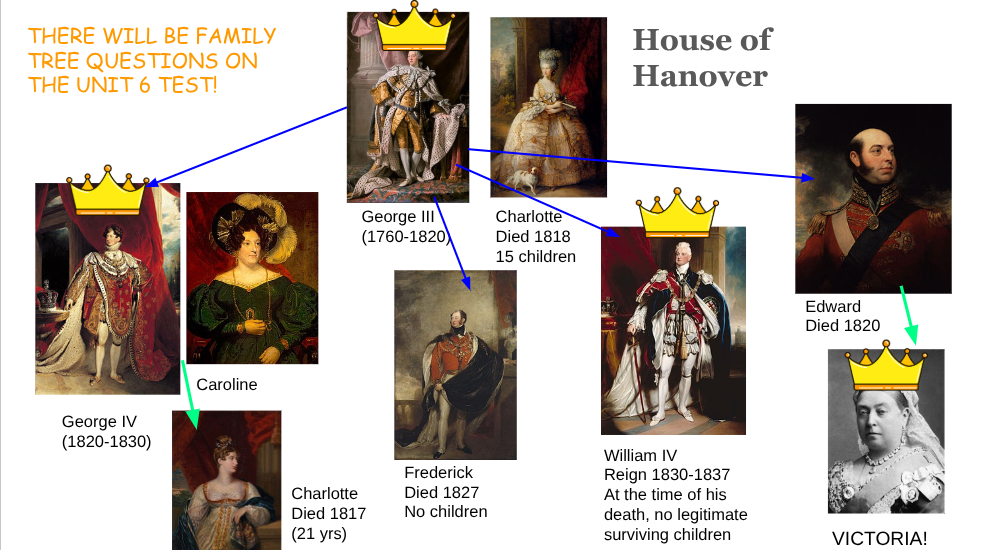
Saxe-Coburg and Gotha
A new house enters the throne as Queen Victoria marries Prince Albert
Lord Melbourne, Prime Minister (William Lamb)
A mentor to Queen Victoria and played a crucial role in guiding the young Queen Victoria when she ascended to the throne in 1837.
As her first prime minister, acted as:
A political advisor
Personal friend
AND significantly influenced her early reign… which wasn’t always popular
Leopold I of Belgium
From House; Saxe-Coburg and Gotha
Became influential through strategic marriages!!!
England, Portugal, Bulgaria
The brother of Victoria’s mom and Albert’s dad
Prince Albert
President of the Society for the Extinction of Slavery
Supported movements to help eliminate child labor
Elected Chancellor of Cambridge and worked to expand the curriculum beyond tradition
Mind behind the Great Exhibition of 1851 -- the Crystal Palace
The Crystal Palace
Early incarnation of the World’s Fair. Massive exhibit of British engineering and ingenuity. England wants to sell its products and show them off. Intended to signify Britain’s industrial and economic might, but was it really reflective of England’s society as a whole? No.
The Crystal Palace
Some 14,000 exhibitors participated, half of which weren’t British. The US sends 560 people. Attracts more than 6 million visitors between May - October. Burnt down in 1936
Symbol of progress, capability, wealth, possibility… but does this really represent England? No.
Kensington Palace
Built in 1605, William and Mary were the first royals to live here. Queen Victoria was born here, but later moved to Buckingham Palace.
Industrialization and Technological Advancement
Defining Characteristics of the Victorian Age - The Industrial Revolution reached its peak leading to rapid urbanization, the growth of factories, and advancements in transportation
Example: railways, steamships and communication (such as the telegraph).
Social Stratification and Class Consciousness
Defining Characteristics of the Victorian Age - Victorian society was highly structured, with rigid class divisions. The upper classes enjoyed immense wealth, while the working classes often faced harsh living and working conditions. This disparity fueled social reforms and debates on poverty and labor rights.
Strict Social Etiquette
Defining Characteristics of the Victorian Age - emphasis on morality, propriety, and decorum. Values such as chastity, modesty, and a strong work ethic were idealized, influencing literature, art, and everyday behavior.
Imperial Expansion and Colonialism
Defining Characteristics of the Victorian Age - The British Empire reached its zenith during this period.
Flourishing of Arts and Literature
Defining Characteristics of the Victorian Age - The Victorian era produced some of the most renowned literary figures; Charles Dickens, the Brontë sisters, Thomas Hardy, and Alfred Tennyson.
Literature often explored themes of social injustice, industrialization’s effects, and complex human emotions.
British Supremacy by 1850
Produced ⅔ of world’s coal
Produced more than ½ world’s iron
Produced more than ½ of world’s cotton clothes
GNP* rose 350% between 1801 and 1850
Population increased from 9 million in 1780 to 21 million in 1851
Per capita income (income earned per person) increased almost 100% between 1800 and 1850
Gross National Product (GNP)
The market value of goods and services produced by labor and property supplied by GB residents, regardless of where they are located.
Changes to Class Divisions
No longer see a major distinction between the lifestyles of the nobility and upper class industrialists (wealthy factory or bank owners)
Middle class is growing, slowly
The term peasant is being used less and less in the 19th century
Changes to Class Divisions
Upper class industrialists are a new social class
Gaining wealth and status from the profits of industry
Setting a new standing of respectability and hard work, the ideal of social mobility through self-help (Marx: the bourgeoisie)
Changes to Class Divisions
Working class -- made up of factory and (still) farm workers
The growth of unskilled workers (Marx: the proletariat) owned no capital or personal property, forced to sell their labor at a disadvantage
Servants are an emerging class/group
Changes to Class Divisions
Each class is still very distinct
Mannerisms, culture, dress, lifestyle -- class consciousness (awareness of your social class)
Privacy is a privilege
The Growing Middle Class - “Polite Society”
More leisure time
Emergence of parks, theaters, opera houses, more coffee houses and sporting clubs
The bicycle, 1817
Incredibly literate -- purchasing newspapers and magazines, with advertisements
Shoppers mentality
Use of catalogs
Production in factories made items more available and cheaper
The Working Class
How the masses lived
Only around 10% of the population were upper, upper-middle class
A lot of people are in poverty
Rise in crime rates and alcoholism
Can’t pay child care? Take your kid to work!
Child labor
Challenging work in the factories
Dangerous, polluted, tedious
Insanely low wages… capitalism! (maximize profits)
Make sure the costs are as low as possible… one of the most expensive costs of running a business is the cost of labor
Working Class Women & Children
Women are paid far less than men but make up 50% of the textile factory workforce before 1870
Women and children were easier to control/manipulate
Women were paid intentionally less to encourage bringing kids to work, to supplement income.
Women were often paid based on their age, and often paid the least between the ages of 20-30.
Pregnancy years, incentive to go have more kids, to then bring to work with you
Children not growing up strong/healthy
Literacy rates for working class decline, while literacy is increased for middle class
Desperation at an all time high for women -- what was one willing to do for money?
Rise in prostitution, “fallen women”
Factory worker, servant - most likely to engage in prostitution
The Contagious Diseases Acts of 1864: the right to stop and detain any woman identified as a prostitute and examine for disease, repealed in 1886
The Contagious Diseases Acts of 1864
The right to stop and detain any woman identified as a prostitute and examine for disease, repealed in 1886
Diseases and Lifespan
When are you most likely to get sick? Small, confined places.
Diseases of overcrowding
Dysentery, cholera, typhoid, tuberculosis, smallpox, chicken pox
Most common = tuberculosis (also called consumption or scrofula)
Diseases and Lifespan
Most factories/places of employment packed as many people in as possible, conditions at home are much the same
Capacity limits non existent
Tenement housing -- small one room apartments
Cheap housing, as close together as possible, as many shared walls as possible
Diseases and Lifespan
Life expectancy in Manchester and London average between 30-33 years, Manchester dipping as low as 25… Liverpool was an average age of 15 for factory workers!!!
End of 18th century, 25% of people died before the age of 5 -- if you can survive childhood the likelihood of 50+ is realistic
Why so low in cities? Dangerous working conditions, sanitation (lack of)
People in the countryside living on average 10 years longer
How to solve this problem? → Sanitation, Infrastructure Development (sewage system)... this takes a long time to develop.
Living Conditions
Clean water?!
Collect rainwater but quickly dirtied by the polluted air
River Thames reported as the color of “strong green tea” and “black marble”
Often contaminated with lethal bacteria or industrial waste
Access to bathrooms (the “privy”)
Most streets had one bathroom per 300 people
Related to outbreaks of cholera
Due to the lack of sewage systems, human waste literally piled up on the street (referred to as dunghills)
People made a business out of it, selling it farmers
Registration Act
In 1837, Parliament passed an act ordering the registration of all births, marriages and deaths that took place in Britain.
The goal was to provide evidence that unhealthy living conditions were killing thousands of people every year.
Registration Act
In 1837, Parliament passed an act ordering the registration of all births, marriages and deaths that took place in Britain.
The goal was to provide evidence that unhealthy living conditions were killing thousands of people every year.
Reaction Movements during the Industrial Revolution
Luddites
A violent group of irate workers that blamed industrialism for threatening their jobs
Around 1812, begin attacking factories in northern England, destroying new machines that they believed were putting them out of work
Union Movement
Some began organizing groups of workers to resist exploitation of the working class (proletariat)
Combination Acts 1799
Parliament prohibited labor unions
Repealed in 1824, and unions were “tolerated” by 1825
Robert Owen -- in 1834 organized the Grand National Consolidated Trades Union
Welsh industrialist with a concern for health, safety and limited work hour
Chartists (1838-1848)
Goal = gain political influence for the working class
Demanded; universal male suffrage, elimination of property requirements for Parliament
Women joined the movement → to fight for their husbands, not themselves
Despite thousands of signatures on petitions, the movement largely faded overtime
Combination Acts 1799
Parliament prohibited labor unions
Repealed in 1824, and unions were “tolerated” by 1825
Luddites
A violent group of irate workers that blamed industrialism for threatening their jobs
Around 1812, begin attacking factories in northern England, destroying new machines that they believed were putting them out of work
Union Movement
Some began organizing groups of workers to resist exploitation of the working class (proletariat)
Combination Acts 1799
Parliament prohibited labor unions
Repealed in 1824, and unions were “tolerated” by 1825
Robert Owen -- in 1834 organized the Grand National Consolidated Trades Union
Welsh industrialist with a concern for health, safety and limited work hour
Chartists
Goal = gain political influence for the working class
Demanded; universal male suffrage, elimination of property requirements for Parliament
Women joined the movement → to fight for their husbands, not themselves
Despite thousands of signatures on petitions, the movement largely faded overtime
The Saddler Commission
Created by Parliament as a way to investigate working conditions in factories and then improve those conditions
Factory Act of 1833
Limited workday for children ages 9-13 to 8 hours per day
Limited workday for 14-18 to 12 hours
Probitied hiring children under age 9: children were to go to elementary schools factory owners were required to established
Employment of children declined rapidly
Poor Law Act of 1834
(Controversial reform of welfare system) -- Lord Melbourne was responsible for this!
For the paupers (really poor ppl), the gov’t created poorhouses or workhouses, where conditions are deliberately harsh…
Why? The idea is to make “relief” much less attractive than work in factories or other places
Mines Act of 1842
Prohibited all boys and girls under age 10 from working underground
1842 Game Laws
Harsher Punishments for Poaching – Increased fines and imprisonment for illegal hunting
Stricter Licensing and Sale Rules – Required game licenses for hunting and restricted the sale of game
Enhanced Landowner Protections – Strengthened legal rights for landowners and gamekeepers to prevent trespassing and illegal hunting.
It continued the trend of restricting access to hunting primarily to landowners and those with financial means to obtain licenses.
1842 Game Laws
It contributed to social tensions, as poorer rural populations, who relied on hunting for subsistence, were increasingly criminalized.
Great Britain
Scotland, England, and Wales
United Kingdom
Scotland, England, Wales, and Northern Ireland
British Isles
Scotland, England, Wales, Northern Ireland, and the Republic of Ireland
Ireland
Northern Ireland and Republic of Ireland
The Hungry 40s
Northern Europe suffered from a potato failure in the 1840s
Other crops/resources impacted as well, not just potato
But felt the most in Ireland because of single crop dependence
Other areas are impacted -- Revolutions of 1848 are related to this famine
The Irish Potato Famine (The Great Hunger)
Catholic nation, impoverished, renting land from Protestant Absentee Lords
Desperation, poverty + overpopulation
The potato gave the Irish a dependable food
Between 1781 - 1845… the Irish population double from 4 million to 8 million
Summer 1845, potato crop struck with “blight” -- fungus that turns the potato black
Nearly 1 million deaths, 2 millions refugees and century long population decline
1911, population was 4 million
British response was inadequate
Increases the strain between England and Ireland
Corn Laws
Tariffs and other trade restrictions on imported food and grain were enforced in the United Kingdom between 1815 and 1846. Blocked the import of cheap grain by forbidding importation below a set price.
People had to purchase grain from wealthy land owners.
Repeal = Liberal Legislation
Corn Laws
The work of manufacturers Richard Cobden (english manufacturer radical liberal) and John Bright, who formed the Anti-Corn League in 1838 to help workers lower bread prices.
A factor that accelerated the repeal was the Irish potato Famine due to URGENT need for supplies
Germany
The next area to embrace the Industrial Revolution on the same level as England.
Has many advantages:
A lot of iron ore = ability to make steel
A lot of coal = power steam engines, and make steel
Bank of Berlin established in the 18th century = embracing modern banking
Problem????
Country is not unified
Solution?
German economist Friedrich List
Friedrich List
Proponent of German nationalism. If Germany is going to be strong and competitive, Germany must be economically strong. The way to achieve this? The (30ish) states have to work together.
The Zollverein
An agreement to work together to develop the economy, infrastructure, tariffs on imported goods and free trade amongst the German states.
THIS IS A HUGE STEP TOWARDS UNIFICATION!
Encouraged Germans support other Germans. Don’t let the English dominate -- invest in the German people
Helps with the creation of a Railway system
Eastern Europe
SLOW to industrialize, if at all.
Why?
Refusal from the nobility to change
Will not eliminate serfdom
If people can’t be released from the land, they can’t move to form “cities” and therefore the process of industrialization cannot begin.
This will have a drastic impact in WWI.
Russia
In the 19th century, still overwhelmingly rural, agricultural, and still autocratic.
Alexander I
Initially favored enlightened despotism, a glimmer of hope.
Relaxed censorship
Freed political prisoners
Reformed educational system
He did REFUSE to free the serfs
After the defeat of Napoleon, becomes much more conservative.
Opposition to his rule forms, and causes the formation of secret societies.
The Northern Union
Secret society forms:
Young aristocrats
Served in the Napoleonic Wars
Became very aware of life outside of Russia
Understood the lack of freedom they faced in Russia
Decembrist Uprising
Transition from Alexander to Nicholas: seize the opportunity to prevent next czar in December of 1825. Sparks this event!
Decembrist Uprising
A group of army officers, commanding nearly 3,000 men refused to swear allegiance to the new czar -- proclaiming the need for a Russian constitution
This was the first example of an upper-class revolt against Russia’s autocracy
Decembrist Uprising
Their ultimate goal as to prevent Nicholas I from becoming the next czar.
The revolt is unsuccessful.
The leadership is executed. Other participants are sent to Siberia.
Decembrist Uprising
Transforms the rule of Nicholas I: will become the most reactionary monarch in Europe.
Russia becomes a police state, with censorship, secret police and state-sponsored terrorism.
No representative body.
Education was limited and the university curriculum carefully monitored.
The Malthusian Trap
Occurs when population growth outpaces agricultural production -- causing famine or war, resulting in death, poverty and desperation.
Natural population control.
Thomas Malthus
Ordained minister, believed that hunger and disease were aspects of life implemented by God to stop populations from exploding.
Thomas Malthus
Concerned with poverty (very liberal)
Believed that population growth was getting out of control
19th century: decrease in war, famine, disease to the extent that it will kill off a significant portion of the population
What now? No natural population control.
Thomas Malthus
The poor would normally have been impacted by the trap, now they aren't b/c there is enough food but people are not dying, just living in poverty and desperation.
Solution: Quit having sex.
The poor bring about their own poverty by having too many children
Control your sexuality, quit having kids = you won’t be so poor
David Ricardo
Creator of The Iron Law of Wages
The Iron Law of Wages
In a capitalist economy, if you don’t have anything to sell… then you sell your labor.
When the population is high = wages low. When the population is low = wages are higher. But… when wages are higher, birth rates increase…
Best option: Keep wages low because if the poor are paid too much, they will have more babies and lead to a higher population.
Utilitarianism
There was a role for the government to play in the economy that is greater than what Adam Smith said.
The goal = laws and policies should be evaluated based on their ability to maximize “the good” and minimize “the bad” for society.
Look at all the poverty, look at the sewage in the streets, look at health/disease… there IS A ROLE for the government.
Goal = the greatest good for the greatest number of people.
Utilitarianism
Judge ideas and products by their usefulness.
Work hour, wages, child labor… they should be addressed by the government. Not some invisible hand.
The distribution of wealth had become unjust. The have and have nots had become too extreme and could lead to political instability.
Jeremy Bentham
The creator of utilitarianism.
Liberal - very pro-democracy.
Wanted greater degree of suffrage for a more representative government in England. (Not everyone can vote in England at this time)
Jeremy Bentham
If more people could vote -- then problems would get addressed -- because members of parliament want to keep seats and HAVE to meet the needs of the people.
Jeremy Bentham
He advocated for many progressive social reforms including; prison reform, animal rights, gender equality, abolition of slavery, decriminalization of homosexuality and separation of the Church and State (monarch still head of Church in England).
John Stuart Mill
English philosopher, at one time a member of Parliament, and a Utilitarian
Embraces the ideals of freedom of speech, expression, assembly (refined Bentham’s utilitarianism)
John Stuart Mill
Wrote a book called “On Liberty”
John Stuart Mill
Dangers of tyranny of the majority -- the idea that we don’t listen to the minority… and we should!
We need freedom of speech? Yes, you need to be able to discuss problems to find solutions!
He was a major advocate of women having the right to vote! “Greatest good for the greatest amount of people” -- 19th century RADICAL idea
Abolitionist
Socialism
A political and economic system where the means of production are owned or controlled collectively — either by the public, the state, or workers — rather than by private individuals for profit.
Social Democracies
Capitalist economies with strong welfare states - Sometimes called socialist
Socialism
The pitiful conditions in the slums, mines and factories gave rise to this ideology.
Utopian Socialism
The first type believed in human cooperation and active economic/social planning.
Marxism/Communism
Karl Marx will radicalize socialism
Karl Marx
Born in Prussia. Philosopher, economist, historian, political theorist.
Studied law and philosophy at the University of Bonn and the University of Berlin
Influenced by German philosopher Hegel. Hegel believed:
Progress happens through struggle and contradiction.
History moves in stages
Each stage grows out of conflict in the previous one
Systems are temporary
Change is built into the structure of society
ALL inspiration for the Communist Manifesto
A journalist in Cologne in 1842
Newspaper found him too radical and he moved to Paris … where he met Engels
Hegel
German Philosophere
Believed:
Progress happens through struggle and contradiction.
History moves in stages
Each stage grows out of conflict in the previous one
Systems are temporary
Change is built into the structure of society
ALL inspiration for the Communist Manifesto
Friedrich Engels
Born in Prussia
Son of a wealthy cotton manufacturer. Worked in one his father’s factories in Manchester… so he acquired firsthand knowledge of what he came to call the “wage slavery” of the British working classes
Friedrich Engels
Wrote “The Conditions of the Working Class In England” condemning the industrial life.