Lecture 1 - APK3113
 Call Kai
 Learn
Learn Practice Test
 Spaced Repetition
 Match
Match Flashcards
 Knowt Play
1/68

Earn XP
Description and Tags
This set of flashcards serves as a study aid for students reviewing key concepts in exercise physiology, focusing on muscle structure, function, and the nervous system.
Name | Mastery | Learn | Test | Matching | Spaced | Call with Kai | Chat |
|---|
No analytics yet
Send a link to your students to track their progress
69 Terms
What is the main debate regarding sports expertise?
The main debate is whether nature (genes) or nurture (environment and practice) is more significant in determining sports expertise.
What are the two types of muscle fibers mentioned?
Type I and Type II muscle fibers.
What is the sliding filament theory related to?
It explains the mechanism of muscle contraction involving actin and myosin.
What is an isometric contraction?
A type of muscle contraction where the muscle generates force without changing its length.
What is the primary characteristic of Type I muscle fibers?
They are small muscle fibers with slow contraction speed and high endurance.
Describe the contraction speed of Type IIA muscle fibers.
Type IIA muscle fibers contract quickly and have a high force production.
What happens to muscle fibers during disuse?
Muscle fibers can shift from Type I to IIA and then to IIX.
What comprises a motor unit?
A motor unit consists of a motor neuron and all the muscle fibers it supplies.
What is Henneman's Size Principle?
It states that small motor units are recruited first, followed by larger units as needed.
What are muscle spindles responsible for?
Muscle spindles are stretch receptors that provide length feedback in muscles.
What is the role of Golgi tendon organs?
They act as force feedback sensors that inhibit muscle contraction to prevent injury.
What are the characteristics of Type IIx fibers?
Type IIx fibers are large, fast contracting, have very high force production, and little to no endurance.
What contributes to skeletal muscle growth?
The balance of muscle protein synthesis and protein degradation.
What is the primary composition of tendons?
Tendons are composed of approximately 86% collagen.
What effect does strength training have on tendons?
Strength training can lead to improved tensile strength and reduced strain.
What muscle fibers have the highest recruitment threshold?
Type II fibers (specifically Type IIx) have the highest recruitment threshold.
What are the functions of the central nervous system (CNS)?
The CNS receives sensory information, initiates responses, stores memories, and generates thoughts and emotions.
What is the characteristic of the peripheral nervous system (PNS)?
The PNS connects the CNS to muscles and glands and includes both sensory and motor neurons.
Describe an eccentric muscle contraction.
In an eccentric contraction, the muscle lengthens while generating force.
What is the function of the sarcoplasmic reticulum in muscle fibers?
It regulates calcium ion concentration, which is essential for muscle contraction.
What distinguishes Type I muscle fibers in terms of fatigue resistance?
Type I muscle fibers are highly resistant to fatigue.
What is the difference between concentric and eccentric contractions?
In concentric contractions, muscles shorten while generating force; in eccentric contractions, they lengthen.
What physiological adaptation occurs with aerobic training?
Aerobic training can shift muscle fiber types from IIA to I and improve endurance.
How does the nervous system control voluntary movements?
Through the somatic nervous system, which transmits signals from the CNS to skeletal muscles.
What is the primary role of the autonomic nervous system (ANS)?
The ANS controls involuntary responses, including heart rate and digestion.
What are the two divisions of the autonomic nervous system?
The sympathetic division (fight or flight) and the parasympathetic division (rest and digest).
What does the term 'muscle protein synthesis' (mPS) refer to?
It refers to the formation of new proteins within the muscle.
What happens during maximal contraction according to size principle?
The largest motor units (Type IIX) are recruited when maximal contraction is required.
What happens to muscle fibers during resistance training?
Resistance training promotes a shift from type I to type II fibers, particularly IIx.
How is muscle contraction related to the cross-bridge cycle?
The cross-bridge cycle is essential for the interaction of actin and myosin during muscle contraction.
What is the primary composition of type I muscle fibers?
Type I fibers have a high mitochondrial density and myoglobin content.
What determines the color of muscle fibers?
The color is determined by myoglobin content; Type I fibers are red, while Type II fibers can vary.
Explain the difference between type IIa and type IIb muscle fibers.
Type IIa fibers are fatigue-resistant and intermediate in endurance, while Type IIb fibers are easily fatigued with little endurance.
What are the roles of sensory neurons in the nervous system?
Sensory neurons transmit information from sensory organs to the central nervous system.
What is the process of protein turnover in muscles?
Protein turnover is the relationship between muscle protein synthesis and breakdown.
What are the characteristics of Type I Muscle Fibers?
small muscle fibers
contract slowly
don’t produce a lot of force
have high endurance
“slow twitch”
Ex: long distance running/swimming/biking, leisurely walking
are constantly active to keep you standing upright and sitting with good posture
What are the characteristics of Type IIA Muscle Fibers?
large muscle fibers
used for explosive movements
“middle man” for endurance - intermediate
contract and relax fast
“fast twitch”
Ex: sports, HIIT training, cross fit training, 400m-1500m running distances
What are the characteristics of Type IIX Muscle Fibers?
largest muscle fibers
low endurance (essentially none)
contract and relax fast
long recovery time
used for maximum effort movements (1 rep maxes)
produce a lot of force
Ex: 100m sprint, weightlifting maxes, shot put, vertical jumping
What is part of the Central Nervous System?
Brain and spinal cord
What is part of the Peripheral Nervous System?
Motor Neurons and Sensory Neurons
Motor —> Somatic Nervous System (voluntary movements) and Autonomic Nervous System (involuntary) —> Sympathetic (Fight/Flight) and Parasympathetic (Rest/Digest) Divisions
What type of muscle does the Autonomic Nervous System act on?
smooth and cardiac
What type of muscle does the Somatic Nervous System act on?
skeletal muscle (Type I fibers)
What does the sympathetic nervous system do?
fight vs flight
increase hr and breathing rate
dilates pupils
inhibits digestion and saliva production
What does the parasympathetic nervous system do?
decreases hr and breathing rate
constricts pupils
stimulates digestion and saliva production
Summarize the 3 Energy Systems
ATP-PC/Phosphagen
works first at the start of ANY exercise because there is a small amount of ATP stored in your body already; uses creatine to generate ATP; after initial exercise it provides energy for short term and high energy exercise
produces small amount instantly
0-10 seconds
Glycolysis (Anaerobic)
breaks down carbohydrates for energy and forms lactate in an absence of enough oxygen
Net gain of 2ATP
produces limited amounts quickly
30 seconds - 2 minutes
Oxidative Phosphorylation (Aerobic)
main source of energy for low intensity exercise and at rest
produces unlimited amounts very slowly
5+ minutes
What is the name of the man who lifted 5x of his body weight?
Lamar Gant
What is velocity?
Distance/Time
linear: from point to point (straight line) like sprinting
angular: around a point (join rotation) like softball pitch
What is acceleration?
Velocity/Time
What is force?
Mass x Acceleration
What is momentum?
Mass x velocity
What is impulse?
change in momentum
force x change in time
mass x change in velocity
What is work?
force x distance
What is power?
work/time
force x velocity
Formula Shortcuts
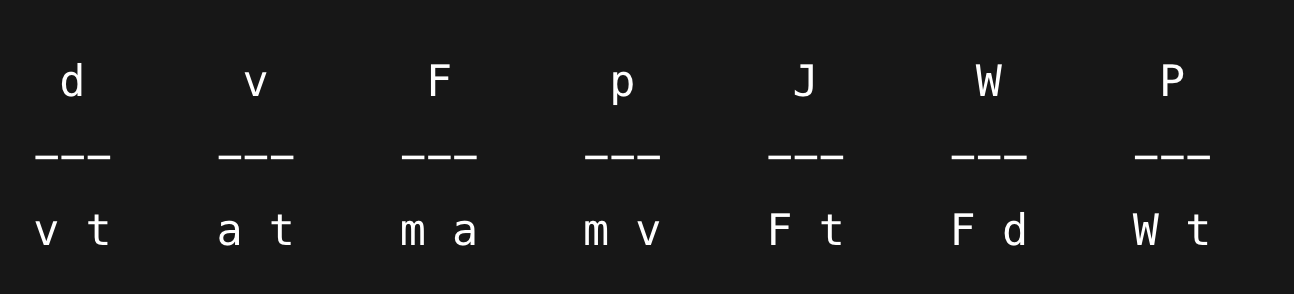
What is gravity?
mass x acceleration
What is the path of hormone release for testosterone?
Hypothalamus —> Anterior Pituitary —> Testes/Ovaries (testosterone)
How can you increase testosterone concentrations?
high intensity
high volume
short rest periods
Summarize effects of steroid use in training
increased protein synthesis
decreased protein degradation
decreased the body’s natural hormone production (so you become reliant on steroids)
What is the path of hormone release for growth hormone?
Hypothalamus —> Anterior Pituitary
acts on muscle, adipose tissue, liver, bone, immune system
What is the effects of growth hormone?
increases protein synthesis
increases breakdown of fats
increases energy
major effect is tissue repair ***
sleep is very important in increasing GH (specifically REM) but is released during deep sleep
What happens if you take Growth Hormone when you don’t need it?
chronically high glucose and insulin levels
diabetes
What is the path of hormone release for cortisol?
Hypothalamus —> Anterior Pituitary —> Adrenal Cortex
triggered by stress
depresses our immune system (can temporarily decrease inflammation)
inhibits protein synthesis and converts amino acids into carbs (BAD bc essentially takes away from our muscles for energy)
What adrenal Hormones are triggered by stress?
Catecholamines: Epinephrine, Norepinephrine, Dopamine
What are the roles of catecholamines?
increase force production
increase metabolic enzyme activity
increase muscle contraction rate
increase bp
increase energy
increase blood flow