1C: The Mole, Avogadro & the Ideal Gas Equation
 Call Kai
 Learn
Learn Practice Test
 Spaced Repetition
 Match
Match Flashcards
 Knowt Play
1/43

There's no tags or description
Looks like no tags are added yet.
Name | Mastery | Learn | Test | Matching | Spaced | Call with Kai | Chat |
|---|
No analytics yet
Send a link to your students to track their progress
44 Terms
What is the Avogadro constant?
The number of particles equivalent to the relative atomic mass or molecular mass of a substance.
What kinds of particles does the Avogadro constant apply to?
atoms
molecules
ions
electrons
What is the value of Avogadro’s constant?
6.02 × 10²³ g mol-1
The ____ of a substance with 6.02×10²³ g mol-1 particles is called a mole.
mass
What is the defenition of a mole?
The mass of a substance containing the same number of fundamental units as there are atoms in exactly 12.00g of 12C.
One mole of any element is equal to…
…the relative atomic mass of that element in grams.
One mole of carbon, that is if you had 6.02 x 10²³ atoms of carbon in your hand, would have a mass of 12 g.
One mole of water would have a mass of (2 x 1 + 16) = 18 g
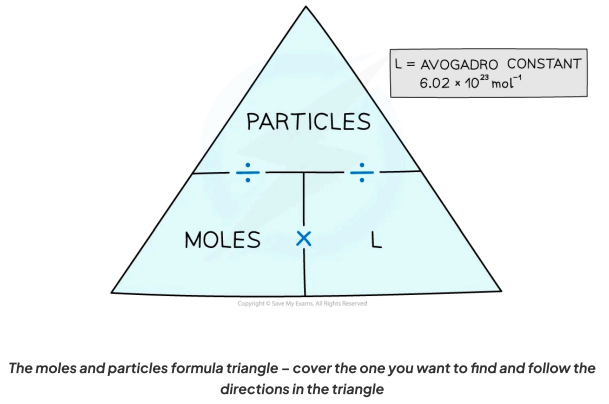
What is the formula linking moles, particles and Avogadro’s constant?
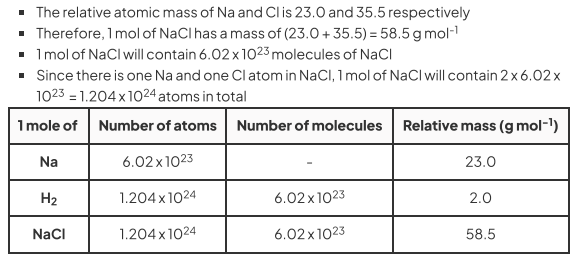
Determine the number of atoms, molecules and the relative mass of1 mole of Na.

Determine the number of atoms, molecules and the relative mass of1 mole of H2.

Determine the number of atoms, molecules and the relative mass of1 mole of NaCl.
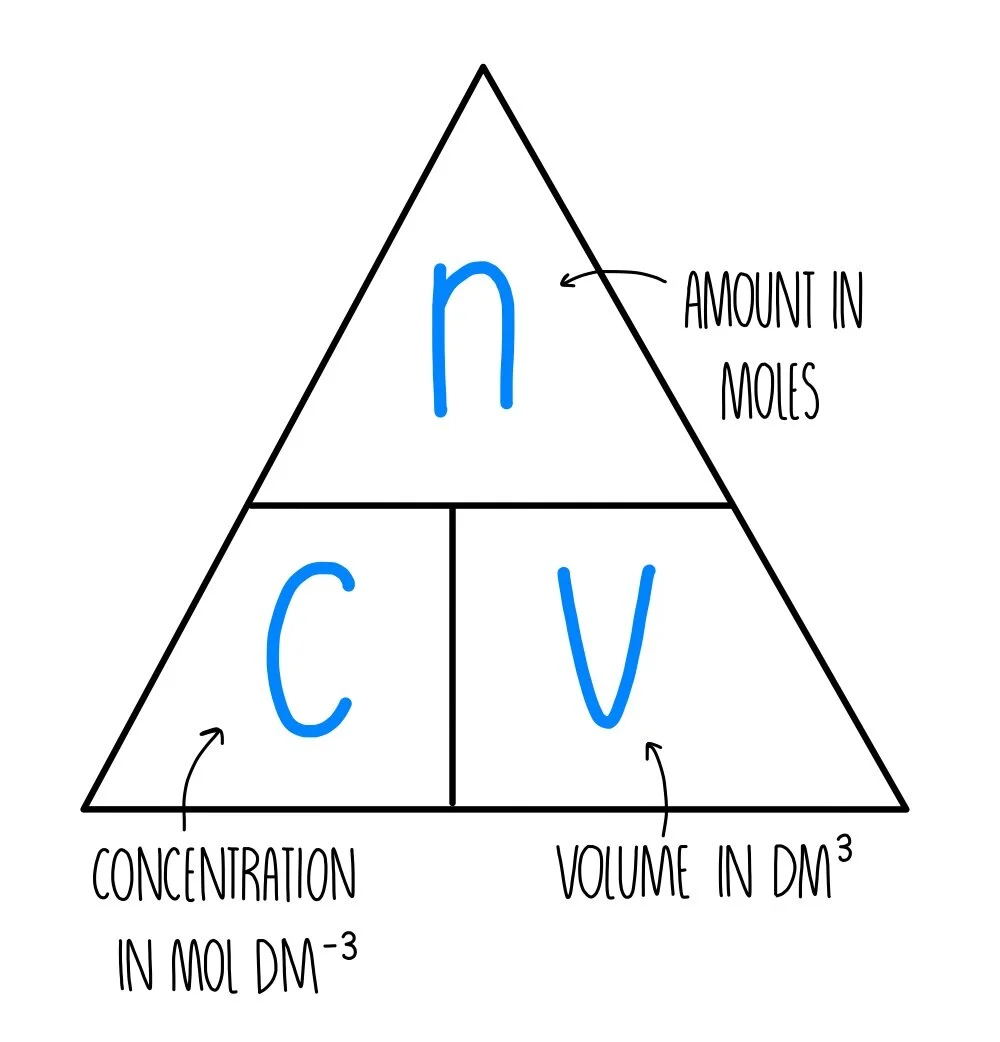
What is the equation for moles?
What is important to remember when calculating moles?
It is important to be clear about the type of particle you are referring to when dealing with moles.
E.g.1 mole of CaF2 contains one mole of CaF2 formula units, but one mole of Ca2+ and two moles of F- ions.
When is knowing the masses of reactants useful?
When determining how much of the reactants exactly react with each other to prevent waste.
What is stoichiometry?
The ratio of moles of all the reactants and products.
What information is needed to calculate the mass of products formed in a reaction?
The mass of the reactants
The molar mass of the reactants
The balanced equation
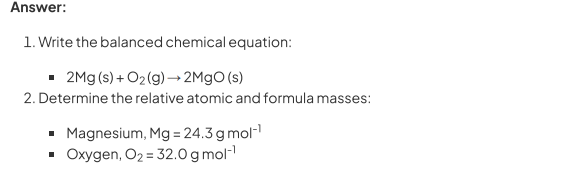
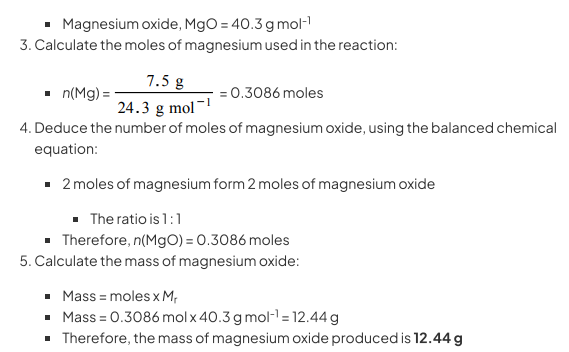
Calculate the maximum mass of magnesium oxide that can be produced by completely burning 7.5 g of magnesium in oxygen.
magnesium + oxygen → magnesium oxide
What information is needed to determine the stoichiometry if a reaction?
The exact amounts of reactants and products formed.
Or gas volumes.
In the combustion of 50 cm3 of propane reacting with 250 cm3 of oxygen,150 cm3 of carbon dioxide is formed.
Determine the stoichiometry.
propane : oxygen : carbon dioxide is 1:5:3
C3H8 (g) + 5O2 (g) → 3CO2 (g) + 4H2O (l)
What is the concentration of a solution?
The amount of solute dissolved in a solvent to make 1 dm3 of solution.
The solute is…
…the substance that dissolves in a solvent to form a solution.
The solvent is often ____.
water
A(n) ______ solution is a solution that has a high concentration of solute.
concentrated
A(n) _______ solution is a solution with a low concentration of solute.
dilute
When carrying out calculations involving concentration, what steps should yu always remember to do?
Change mass in grams to moles
Change cm3 to dm3
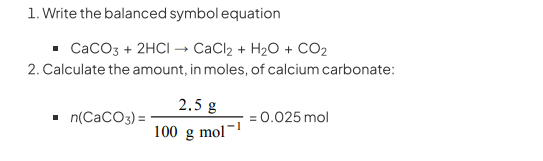
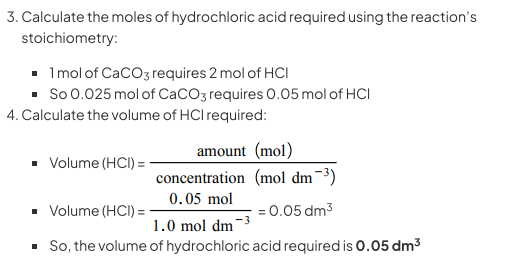
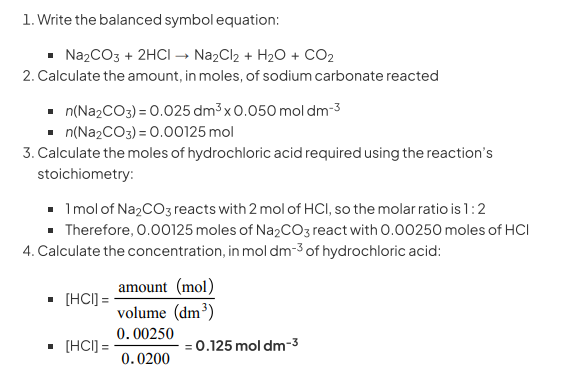
Calculate the volume of 1.0 mol dm-3 hydrochloric acid required to completely react with 2.5 g of calcium carbonate.
25.0 cm3 of 0.050 mol dm-3 sodium carbonate solution was completely neutralised by 20.0 cm3 of dilute hydrochloric acid.
Calculate the concentration, in mol dm-3, of the hydrochloric acid.
What other theory did Avogadro suggest?
At room temperature and pressure, one mole of any gas has a volume of 24.0 dm3.
What is the value for room temperature?
20°C
What is the value for room pressure?
1 atmosphere
What is the equation linking moles, volume and molar gas volume?
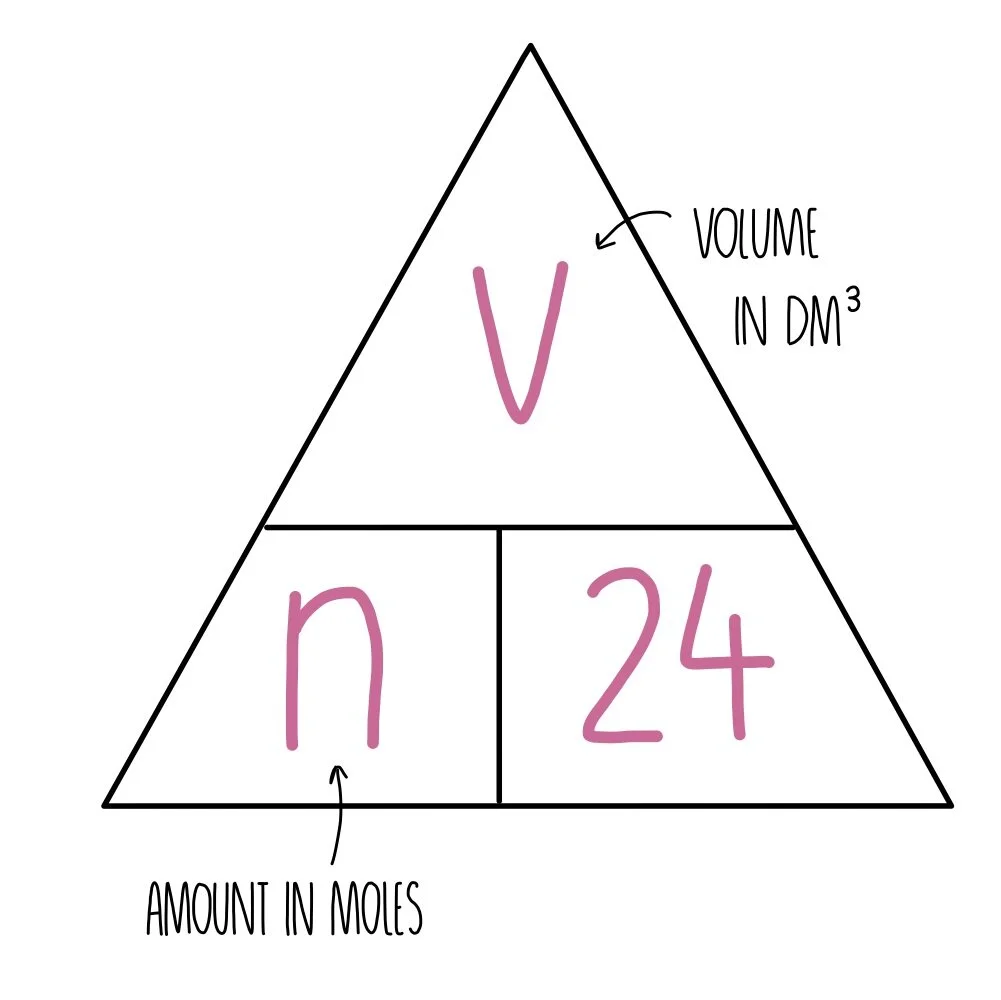
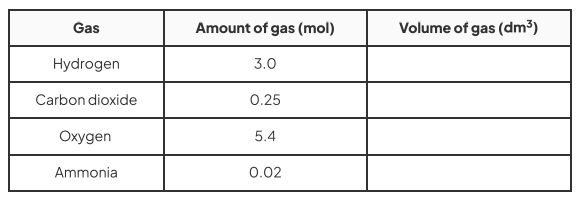
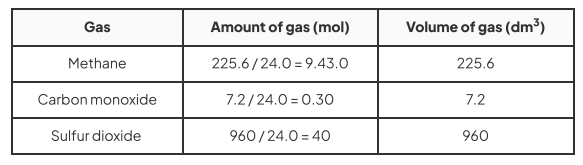
Complete the table to calculate the volume that the gases occupy:
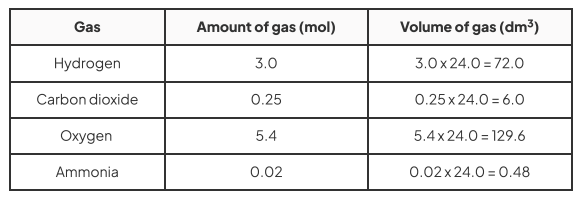
Complete the table to calculate the number of moles of gas:


What is the Kinetic Theory of Gases?
A theory stating that molecules in gases are constantly moving.
What assumptions does the Kinetic Theory of Gases make?
That gas molecules are moving very fast and randomly
That molecules hardly have any volume
That gas molecules do not attract or repel each other (no intermolecular forces)
No kinetic energy is lost when the gas molecules collide with each other (elastic collisions)
The temperature of the gas is related to the average kinetic energy of the molecules
Gases that follow the kinetic theory of gases are called…
…ideal gases.
What are real gases?
In reality, gases do not fit the description of ideal gases exactly, but may come very close. These are called real gases.
The volume that an ideal gas occupies depends on…
Its pressure
Its temperature
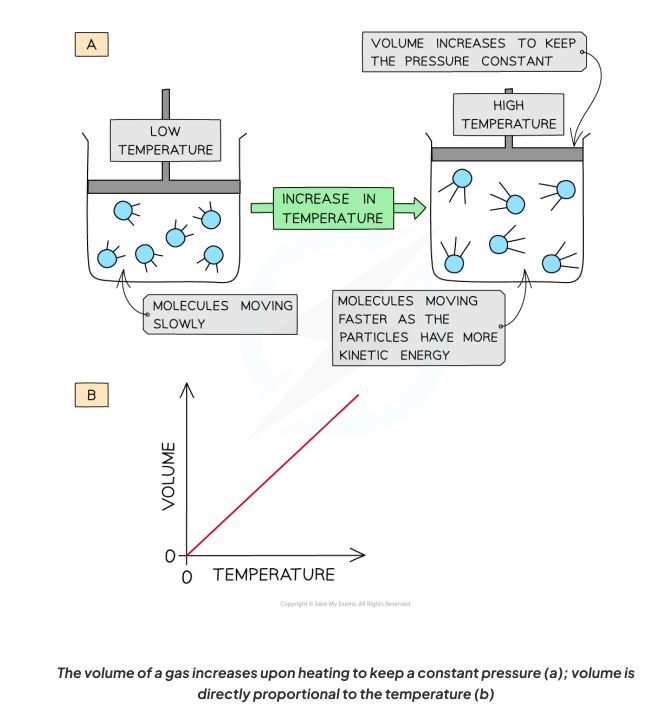
State and explain the relationship between temperature and volume in a gas.
When a gas is heated, the particles gain more kinetic energy, and so they undergo more frequent collisions with the container wall.
To keep the pressure constant, the molecules must get further apart and therefore the volume increases.
The volume is therefore directly proportional to the temperature (at constant pressure).
What are the limitations of the ideal gas law?
At very low temperatures and high pressures real gases do not obey the kinetic theory.
Why do real gases not obey the kinetic theory under low temperature and high pressure conditions?
Molecules are close to each other.
There are instantaneous dipole- induced dipole or permanent dipole- permanent dipole forces between the molecules.
These attractive forces pull the molecules away from the container wall.
The volume of the molecules is not negligible.
Therefore, they do not obey the kinetic theory as there is zero attraction between molecules (due to attractive forces, the pressure is lower than expected for an ideal gas). The volume of the gas molecules can be ignored (volume of the gas is smaller than expected for an ideal gas).
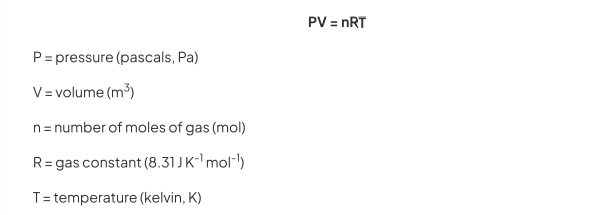
What is the Ideal Gas Equation?
How do you change from Celcius to Kelvin?
Add 273 to the Celsius temperature.
e.g.100 C is 373 Kelvin
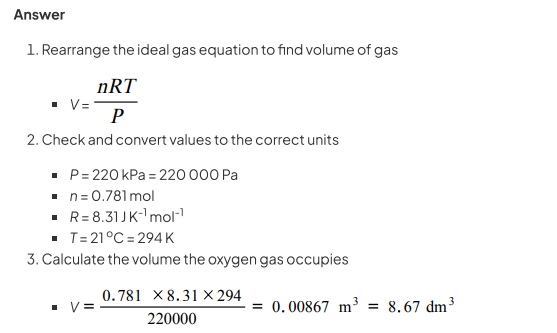
Calculate the volume occupied by 0.781 mol of oxygen at a pressure of 220 kPa and a temperature of 21 °C.
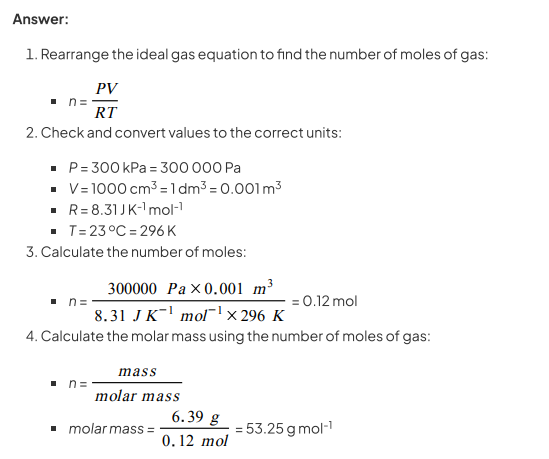
A flask of volume 1000 cm3 contains 6.39 g of a gas. The pressure in the flask was 300 kPa and the temperature was 23 °C.
Calculate the relative molecular mass of the gas.