Globalisation & Global Systems
 Call Kai
 Learn
Learn Practice Test
 Spaced Repetition
 Match
Match Flashcards
1/39

There's no tags or description
Looks like no tags are added yet.
Name | Mastery | Learn | Test | Matching | Spaced | Call with Kai |
|---|

40 Terms
Globalisation
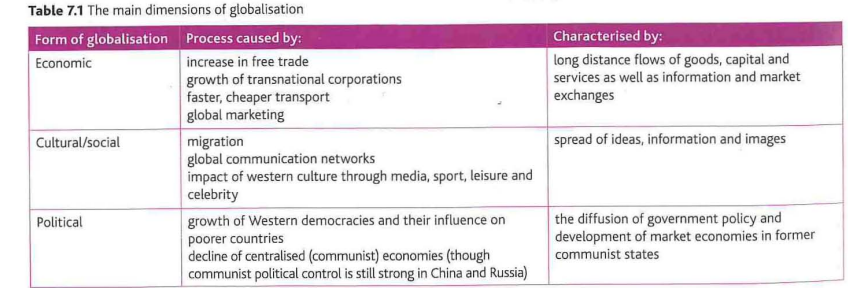
The increased integration of national economies, societies and cultures through the global network of trade, communication, transportation and immigration (driven by Time Space Compression).
Dimensions of globalisation (& how they are caused)

Characteristics of dimensions of globalisation
(forget middle column)
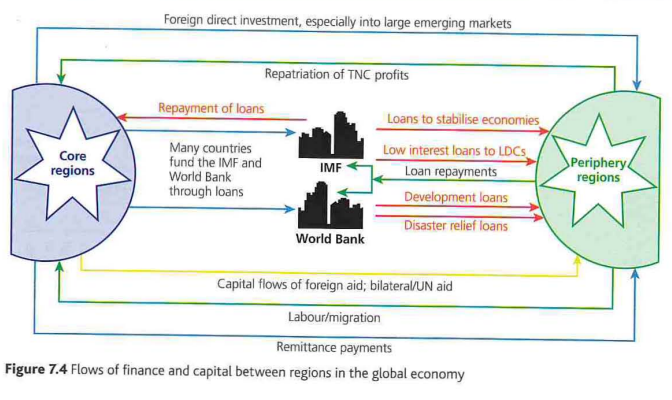
Flows of capital
Increased due to deregulation of world financial markets
“Core-periphery model”: global power concentrated in a few HDEs whilst LDEs are exploited/ & suffer from a lack of investment/leakages (as they need to import finished goods as they don’t make their own)/out-migration
However: outdated due to growth of MICs (BRIC/MINT)
India receives more remittance payments from their diaspora than any other country
Somalia: 40% of population require remittances to meet basic needs
Accounts for 50% of GNI & 80% of all investment
However: concern that remittances were funding terrorists = US/UK banks withdrawing service
Remittances vs FDI: don’t “flee” during crash > more stable, but vulnerable to Geopolitics
Capital flows highly mobile/follow path of least resistance (lowest cost) > allows TNCs to disconnect where money is made vs paid (e.g. Apple’s “Double Irish”)
Flows of labour (incl. example)
Less free flowing than finance due to restrictions on immigration/cooling markets (21% decrease in 2024-2025) > globalisation not inevitable
Most movement (apart from HICs): developing countries in South Asia, Africa & Latin America & oil-rich states
Generally migrates over short distances
Biggest movement: South Asia to West Asia
Drivers: economic opportunity e.g. Detroit’s "Great Migration" and "White Flight"), war/violence refuge e.g. Jim Crow laws, climate-linked displacement (greater over time)
Flow of products (incl. examples)
Increased due to:
Reduction in transaction costs e.g. ease of capital transferral
Reduction in transport/time costs (due to containerisation) e.g. air transport
Reduction in tariffs e.g. via WTO
Improvements in transport infrastructure e.g. Suez Canal/refrigerated containers for bananas
Impact: Global Supply Chains viable
Flow of services (incl. definitions)
High-level services: to businesses e.g. finance, investment, advertising
Low-level services: to consumers e.g. banking, travel/tourism, customer service
Can depend on communication/information transfer
Are footloose (can locate anywhere) via advancing technology, but concentrated in HICS e.g. Apple’s Cupertino HQs
LLS moving to NEEs e.g. call centres: UK > India
Increased transnational service conglomerates e.g. HSBC/TUI
Watford: shift from Production > HLS (Hilton/Allwyn HQs, decision making)/LLS (Harlequin, consumer services)
Flow of information
Governed by:
Flows of people
Speed of data/communication transfers
Particularly important for knowledge intensive goods/services (R&D, hi-tech industries, pharmaceuticals etc.)
Increased due to:
Telephone improvements > communication cheaper/easier
Mobile telecommunication
Live media coverage (via satellite technology)
Emails/the internet > instant exchange of information
Antarctica’s Scientific Research (flow of climate data between McMurdo & UNEP/UN Env. Programme)
Global patterns in distribution
Advances in transport & communication > more diverse/flexible
Economies of scale > reduced transport costs
Relies on ships (80-90% of goods): 20ft container standardised
Air freight are expensive/lower capacity > used only for high-value/time-sensitive items
Concentrated in NEEs
Why: Apple’s “Foxconn City” in Shenzhen > benefits from SEZs/agglomeration/flexible labour
Global patterns in consumption (incl. impacts)
Still mainly in HICs
Demand in “Global North” (Watford’s Atria Mall) dictates production in “Global South” (iPhone/Banana production) > interdependence (Watford can bargain cheap prices as if they stop buying, jobs lost in Shenzhen/Ecuador)
However: growing middle class in NICs (increased wealth for NEEs > increased purchasing power)
Impacts:
Consumption driving trade patterns more than production location > fastest growing trade route = India-China
Growing share of Asian exports to other Asian countries
Western finance companies capitalise from increased demand for financial services in Asia
Factors in globalisation: Finance
Technological improvements > money moved instantly/securely
Collapse of communism
Deregulation of financial markets (i.e. government influence) > removal of barriers to movement of capital (however IMF SAPs > Jamaica forced to globalise/privatise markets where Chiquita can take over)
Fewer exchange rate concerns > encourages FDI/global supply chains
Factors in globalisation: Transport
Goods moved more efficiently/cheaply due to:
Containerisation (20ft craters)
Increased aircraft size
High-speed rail
Computerised logistics systems (automating transport)
Impact: Time-Space Compression > facilitates production away from consumer base (e.g. China/Latin America for Apple/Bananas)
Factors in globalisation: Security
WCO (framework on standards for inter. trade e.g. shipping cargo locked with tamper-proof seals) > increased supply-chain security
C-TPAT (Customs-Trade Partnership Against Terrorism): 11,000 members: > labels companies as low risk of terrorism > less rigorous customs checks required > trade sped up
National Cyber Security Centre > increased confidence in UK information systems (at national & global scales)
Antarctic Treaty System: avoided a war between 56 nations over minerals
Factors in globalisation: Management & Information Systems
Global Value Chains & remote management: separates higher-order activities (R&D, marketing, design) from lower-order activities (assembly/production) which are outsourced
Just-In-Time: reduced time lag > increased volume of trade, but increased interdependence of economies
Factors in globalisation: Communications
Comm. tech. (internet/mobile/satellite tech.) > increased speed of info. transfer & FDI/remittance transfer
However: increased interdependence (e.g. Wall Street & Tokyo)
Social media > instantaneous global distribution of Western culture > cultural diffusion/homogenisation > “global brands” gain a competitive edge
Small/medium enterprises can access global market (via eBay/Amazon)
Factors in globalisation: Trade Agreements
Trade blocs > increased investment e.g. Audi built factory in Mexico to gain access to other USMCA countries
Trade blocs > increased flows of labour
WTO (covers trade in goods/services/designs) > provides a forum for negotiations > encourages trade
Unequal power > trade agreements necessary to negotiate on a global scale
Impacts of Unequal Flows of Labour
Advantages:
Economic growth (due to more people working & paying taxes)
Reduced unemployment in LICs
Reduced geographical inequality e.g. Eastern Europeans working in UK
Addresses skill shortages e.g. UK recruited nurses from Far East
Workers return to origin country with new skills
Safety for refugees
Remittances > boosted growth (e.g. 40% of Somalians rely on remittances for basic needs, accounts for 50% of GNI and 80% of investment)
Disadvantages:
Brain drain for LICs (e.g. doctors leaving Nigeria)
Migration is expensive > cycle of poverty if can’t migrate (e.g. rural sub-Saharan Africa)
Migrant workers may be exploited for low wages in unsafe conditions (e.g. construction for Qatar 2022 WC)
Impacts of Unequal Flows of Capital
Advantages:
FDI, aid, remittances > economic growth
More job opportunities/better infrastructure > improved QoL e.g. China’s investment high-speed rail links in East Africa
Lower CoP > cheaper goods & larger profits
Disadvantages:
Local businesses struggle to compete with TNCs e.g. small retail company vs Walmart opening nearby
Outsourcing > deindustrialisation in HICs e.g. Detroit
Env. degradation/worker exploitation e.g. Foxconn
Impacts of Unequal Flows of Technology
Advantages:
Improved QoL e.g. Covid vaccines & better education (via online learning platforms)
More job opportunities/better infrastructure > improved QoL e.g. China’s investment high-speed rail links in East Africa
Disadvantages:
Patents > unaffordable (e.g. antiretroviral drugs to treat HIV)
Env. degradation/climate change/pollution > coal generates 70% of electricity in India
Weapons > increased conflict & tensions e.g. Russia vs Ukraine
Trends in Volume of Trade
2008 financial crisis, US-China trade wars, COVID-19 > volume slowed (“resilience over efficiency”), though volume reached record highs in 2022-2023
Rate of trade of commercial services increase: greater than rate of trade of goods increase
Trends in Pattern of Trade
Shift towards NEEs, particularly BRICS (China: world’s largest exporter of goods)
South-South Trade (e.g. China with Brazil/Africa) = fastest growing trade flow
Trade still regionalised (within trade blocs) due to removal of tariffs between themselves
Trends in Investment
Reverse FDI e.g. India’s Tata Motors owning UK’s Jagua Land Rover
1/3 of global trade takes place within TNCs (e.g. Apple US “trading” with Apple China)
Sovereign Wealth Funds: buying infrastructure in global cities e.g. QIA buying parts of Canary Wharf
Factors creating Differential Access to Markets
Trade Blocs: “Deep Integration” (zero tariffs) for members, “Protectionism” (high tariffs/quotas) for non-members
SDTs (via WTO): LICs can bypass tariffs (however many lack information systems to navigate complex rules)
Sanitary & Phytosanitary Standards (set by HICs): LIC farmers can’t afford tech. to meet them
Infrastructure & Geography: landlocked countries/poor port management > higher trade costs
Impacts of Differential Access to Markets
High export volumes/FDI attraction > PME > reduced poverty (e.g. China/Vietnam)
Low export volumes/FDI attraction > NME > brain drain/”Race to the Bottom” > low labour costs
Raw materials have low value-added > Prebisch-Singer trap
Reliance on inter. loans > debt cycle
How Global Governance Regulates & Reproduces Global Systems
Regulation:
Country breaks a rule (e.g. illegal tariffs on steel) > WTO intervenes
Reproduction:
Structural Adjustment Programs (IMF): requires developing nations to adopt free-market policies (in exchange for loans)
UN (evaluation)
Advantages:
Peacekeeping: stabilises communities/protects millions of civilians/counters extremist violence (e.g. Mali 2013-2023)
General Assembly: allows every country to participate > neutral negotiation space
Global Polio Eradication Initiative (GPEI) ((>99.9%) case reduction)
WHO immunisation data > govt can vaccinate accordingly (3.5–5 million deaths prevented/year)
Disadvantages:
Security Council: veto power allows just 5 countries to block action even when global majority supports it
Other 10 countries are temporary, even African superpowers (i.e. Nigeria and South Africa) - limits their voice globally
Lack of strong enforcement power (& requires member-state willingness) - requires states to cooperate
Size/bureaucracy = slow decision making
Budget constraints > limits peacekeeping capacity
World Bank & IMF (evaluation)
Advantages:
Increases global financial stability
Reduces poverty
Supports multilateral projects that private investors might avoid due to risk
Disadvantages:
- Dominated by Western powers via quota system (USA: 16% of total votes + 85% required to make decisions = unilateral veto)
- Imposes privatisation/harsh austerity via SAPs > NME/profit “leakage” > erosion of labour/env. standards (to remain "competitive" for TNCs e.g. Chiquita) > The "Dependency Trap" (LIC remains a low-value exporter with no capital to diversify)
- Can create long-term dependence
- Projects may cause environmental damage/displacement of communities/social disruption
Scales of governance
Top Down: decisions made by governments/TNCs with little/no regard for local populations
Bottom Up: where local populations are consulted & decisions made in their interests
Global commons (& domains)
Resource domains/areas that lie outside of the political reach of any one nation state (2/3 of Earth’s surface)
High seas/deep oceans (incl. Arctic)
Atmosphere
Antarctica
Outer space
Cyberspace (Great Firewall of China > impacts flows of ideas/cultural homogenisation)?
Principle of common heritage
Some localities (areas) belong to all humanity & resources are available for everyone’s use & benefit
Change of global commons over time
Past:
Difficult to access = resources not scarce
However, present/future:
Improvements in science/technology & growing demand = greater pressure on resources (& increased scarcity)
Tragedy of commons (incl. how to solve & issues)
Little oversight/enforcement: commons = overexploited
Solution: international laws/treaties (e.g. UN Convention on the Law of the Sea)
However: no enforcement of laws/treaties = meaningless
Antarctica: Physical Characteristics (incl. Antarctic Convergence)
95% of surface = ice
Summer: temperatures up to 5*C
Winter: temperatures can reach -60*C
Closer to pole: cooler due to increased elevation (creating lower air pressure which expands and cools)
Antarctic Convergence: continuous curve of ocean where cold Antarctic waters meet warmer subantarctic waters. Highly productive marine zone (upwelling nutrients) but isolates the ecosystem, making it fragile.
Threats to Antarctica
Climate Change (The Biggest Threat): Southern Ocean temps have risen 1°C since 1995. Causes glacial retreat, disruption to penguin colonies, and Ocean Acidification (corrosive to marine shells).
Fishing & Whaling: Historic near-extinction of whales. Current massive threat: Overfishing of Krill (used for health supplements). Krill is the keystone species; its loss collapses the entire food web.
2007 M/S Explorer sunk > 185,000 litres of fuel oil
CCAMLR: IUU catches are 5x “Maximum Sustainable Yields” as ocean too big to patrol
Tourism: "Lindblad Plan" (each site visited every 2-3 days) >
Manages small tourist numbers well (self-regulating), vacuuming clothes to prevent invasive species, limiting shore groups to 100 people at a time >
95% of frequently visited landing sites show zero lasting damage
However: footprint damage lasts decades due to slow ecosystem recovery (ASOC = legally binding, bans tourism insfrastructure & caps visitor size)
Minerals: Currently banned, but future scarcity in HICs may put pressure on the treaty.
Resilience (ecological)
Amount of disturbance that an ecosystem can withstand without changing existing structures and processes.
Institutional thickening in Antarctica (examples & usage)
The growth of the size & complexity of global governance of Antarctica
46 countries (80% of world population)
29 voting nations
>300 recommendations
3 international agreements
Governance of Antarctica
The Antarctic Treaty System (1959):
Governs the continent. Banned military activity and established freedom of scientific research.
Appraisal: Institutional Thickening (growth of the size & complexity of global governance of Antarctica) > solved Tragedy of the Global Commons & war
However: no enforcement & Japan/Norway refuse > strategy fails
International Whaling Commission (IWC):
Introduced the 1982 Whaling Moratorium.
However: Weak enforcement. Countries like Japan and Norway exploited loopholes ("scientific whaling") or simply opted out.
ASOC (Antarctic and Southern Ocean Coalition):
Only NGO with "Observer Status" at Antarctic Treaty meetings > ensures government don't prioritize mineral extraction or commercial fishing over the environment
Example: primary force behind 1991 Madrid Protocol > 50-year ban on mining
Uses global media to "name and shame" countries that break environmental rules (e.g., illegal krill fishing), unlike the slow, bureaucratic UN & enforcement-lacking IWC
“Bottom-Up” in “Top-Down” governance system > NGO success
Globalisation: A Critique
Spatial Mismatch: benefits are "diluted" across billions of consumers, costs are "concentrated" in specific geographies (Detroit’s rust belt or Somalia’s remittance freeze)
Environment: Globalisation > Just-in-time production > increased air/marine freight > carbon emissions/ocean acidification > destroyed natural capital > systemic sustainability
State that while it was sustainable for the "Golden Age" (1990-2010), the current geopolitical climate (US/China trade wars) suggests the concept is reaching a temporal limit of sustainability (can't agree on trade = can't agree on carbon).
Political sustainability: If global governance is reactive (peacekeeping) rather than proactive (fixing the core-periphery inequality), conflict will perpetually recur.
The Verdict: The UN is a "sticking plaster" on a structurally unsustainable global system. It manages the symptoms of globalisation (conflict due to trade imbalances/resource scarcity) without curing the cause (inequality).
"Clone Town" = cultural unsustainability
- Lack of supranational environmental regulator with "teeth" (unlike the WTO for trade) > inevitable biosphere destruction
- In 20 years: NEEs richer/AI & Robotics = offshoring cheaper > globalised manufacturing has nowhere to go
TNCs most significant factor for unequal flows of people/money?
AO1:
Top-down (HQ) & sudden relocation e.g. Apple to India > job loss overnight > asymmetric relationship between capital flows (corporate decisions) & labour flows (economic desperation)
Global system: interconnected network of trade, investment, and migration where flows are structurally unequal because of the legacy of industrialisation, capital ownership, and political power
Rural vs urban?
AO2:
USA?: de-industrialisation > unequal within
Other factors: conflict, globalisation, trading blocs/tariffs, state-driven exploitation e.g. migrant Nepal workers in Qatar > documentation confiscated & few rights, SAP policies > brain drain, colonial legacies > core-periphery e.g. sub-Saharan Africa exporting raw commodities & importing manufactured goods
Reducing inequality: Adidas & East rather than West Europe, urban send remittances to rural
Conclusion: amplifier not cause
Assess the relative importance of NGOs and international government organisations in enhancing protection of Antarctica.
AO1:
Global commons (no single state has jurisdiction)
CCAMLR: regulating longline fishing > 0 seabird mortality
ASOC observer status > boundary between IGOs/NGOs not rigid & mutually beneficial
IAATO: standards effective for members but can’t bind non-members
AO2:
Conc. what specifically is relatively important in future?
CRAMRA blocked by ASOC = Madrid (but expires 2048)