ORGO test one
 Call Kai
 Learn
Learn Practice Test
 Spaced Repetition
 Match
Match Flashcards
 Knowt Play
1/52

There's no tags or description
Looks like no tags are added yet.
Name | Mastery | Learn | Test | Matching | Spaced | Call with Kai | Chat |
|---|
No analytics yet
Send a link to your students to track their progress
53 Terms
covalent bonds
An even sharing of electrons. Any two atoms of the same element or C-H bonds.
Polar covalent bonds
electrons move towards the more electronegative atom
Ionic bonds
complete transfer of electrons, which creates ions due to the need to fill the octet
Formal charge
valence electrons - number of bonds - non bonding electrons
orbitals
the 3D volume where we can find an electron
All single bonds
Sp3
one double bond
Sp2 (and a single plain p-orbital)
one triple bond
Sp (and two plain p-orbitals)
hybridization
2nd row elements mix their s and p orbitals to best bond to their neighboring atoms
hybridized orbitals create ___ bonds
sigma
non hybridized p-orbitals create ___ bonds
pi → each orbital = one bond
What shape is an Sp3 with no lone pairs
tetrahedron → 109
what shape is an Sp3 with one lone pair
trigonal pyramidal → 109
what shape is an Sp3 with two lone pairs
bent → 109
what shape is an Sp2 with no lone pairs
trigonal planer → 120
what shape is an Sp2 with one lone pair
bent → 120
What shape is an sp
linear → 180
what creates good water solubility
positive or negative charges (ions)

what functional group is this
carboxylic acid
what makes carboxylic acid water soluble
The polar covalent bond between H and O means they have a weak interaction with water. Adding a strong base will give the oxygen a negative charge, thus making it water soluble. Once the carboxylic acid donates the H+, it is water soluble.
in what state, protonated or deprotonated, is carboxylic acid water soluble
deprotenated
what happens to carboxylic acid when pH = 4
pka is equal to pH, so above 4 it is deprotonated and water soluble and below 4 it is protonated and is not water soluble

what functional group is this
amine
when is an amine water soluble
When the nitrogen has a positive charge, which happens when there are more H+ to bond with
what happens to an amine when pH = 9
pH = pka
are amines protonated or deprotonated above pH 9
they are deprotonated in a basic environment above pH 9, and therefore not water soluble because the nitrogen does not have a charge
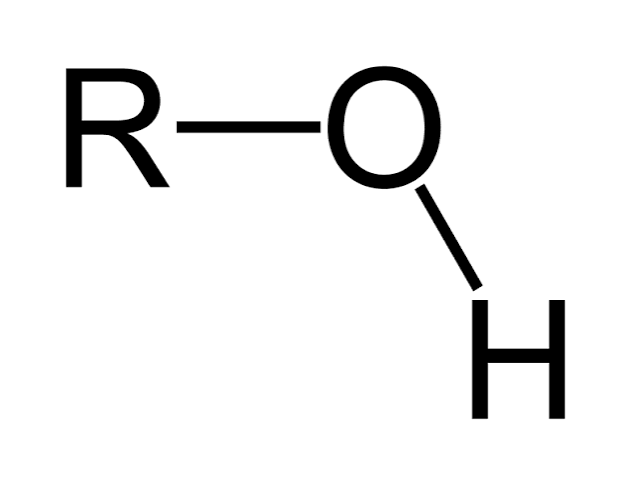
what functional group is this
alchohol
what is the water soluble ratio for alchohols
there must be at least one O-H bond for every four carbons in order for it to be water soluble

alcohol

ether

amine

thiol

haloalkane

carbonyl

aldehyde

ketone

carboxylic acid
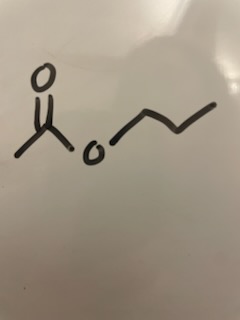
ester

amide

alkene

alkyne

aromatic ring
one carbon
methane
2 carbons
ethane
3 carbons
propane
4 carbons
butane
5 carbons
pentane
6 carbons
hexane
7 carbons
heptane
8 carbons
octane
9 carbons
nonane
10 carbons
decane
to name a substituent, what do you change the ending of the name to
yl - ex: methane → methyl