Chapter 2 Mitosis and Meiosis
 Call Kai
 Learn
Learn Practice Test
 Spaced Repetition
 Match
Match Flashcards
 Knowt Play
1/36

There's no tags or description
Looks like no tags are added yet.
Name | Mastery | Learn | Test | Matching | Spaced | Call with Kai | Chat |
|---|
No analytics yet
Send a link to your students to track their progress
37 Terms
What is the genetic material contained in all living organisms except viruses?
DNA (deoxyribonucleic acid)
What are the two processes involved in genetic continuity of nucleated cells in eukaryotes?
Mitosis and Meiosis
Mitosis
Produces two daughter cells, each with the same number of chromosomes as the parent cell (2n).
Meiosis
Produces sex gametes with half the number of chromosomes (n).
What are chromosomes visible as during mitosis and meiosis?
Condensed structures.
Uncoiled chromosomes within the nucleus
Chromatin.
What is the diploid number of chromosomes in humans?
46 chromosomes (2n).
What is the haploid number of chromosomes?
Half the normal amount of chromosomes (23 in humans)
biparental inheritance
Inheritance from two parents, resulting in two copies of each gene.
Allele
Alternative forms of the same gene.
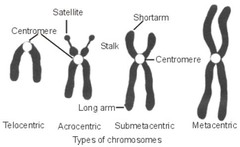
What are the four types of centromere placements?
Metacentric, submetacentric, acrocentric, and telocentric.
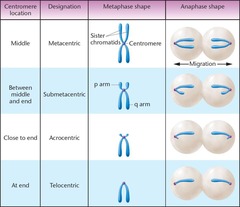
Metacentric
centromere in middle

submetacentric
centromere between middle and end

acrocentric
centromere close to end

telocentric
centromere at end
Sex-determining chromosomes of Males
XY
Sex-determining chromosomes of Females
XX
What is the purpose of meiosis?
To produce gametes or spores and enhance genetic variation.
What are the two divisions involved in meiosis?
Meiosis I (reductional division) and Meiosis II (equational division).
Prophase I of meiosis
Homologous chromosomes pair up (synapsis) to form bivalents.
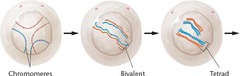
Bivalent
a pair of single strand homologous chromosomes
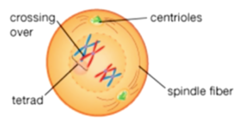
Number of bivalents
equal to the haploid number
Synapsis
Pairing of homologous chromosomes
Chiasma
The region where chromatids are intertwined and have undergone genetic exchange during crossing over.

Tetrad
structure containing 4 chromatids that forms during meiosis
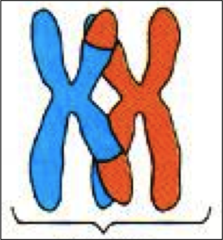
chromatids
Identical halves of a duplicated chromosome.
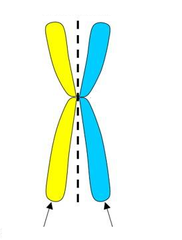
Metaphase I of meiosis
Tetrads align at the metaphase plate, and terminal chiasmata hold nonsister chromatids together.
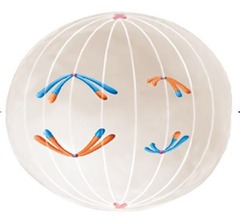
Disjunction in anaphase I
The separation of homologous chromosomes, with half of each tetrad (dyad) pulled to opposite poles.
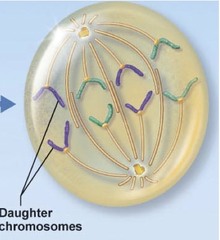
Telophase I of meiosis
Reappearance of the nuclear membrane around dyads, leading to a short interphase.
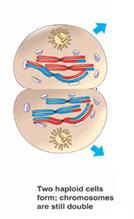
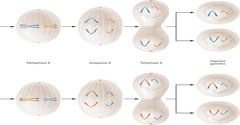
What is the result of cytokinesis after meiosis II
Four haploid gametes from a single meiotic event.
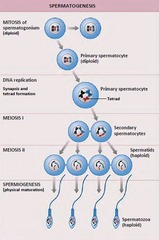
What is spermatogenesis?
The symmetrical production of male gametes (sperm) in the testes.
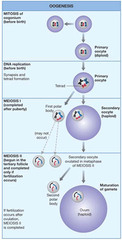
What is oogenesis?
The non-symmetrical production of female gametes (eggs) in the ovaries.
Crossing over during meiosis
It results in genetic exchange between homologous chromosomes, creating genetic variation.
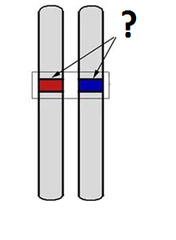
What is a locus (loci plural)?
A specific location on a chromosome where a gene is found.
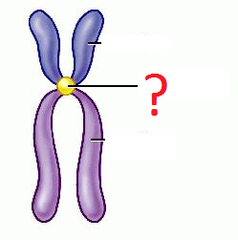
Centromere
It is the constricted region of a chromosome that plays a crucial role in the movement of chromosomes during cell division.
Homologous chromosomes
Chromosomes that have the same sequence of genes and the same structure
Nonhomologous chromosomes
Chromosomes that do not match because they have different sets of genes (sex chromosomes)