Unit 1 Amsco Review - Simple
 Call Kai
 Learn
Learn Practice Test
 Spaced Repetition
 Match
Match Flashcards
 Knowt Play
1/20

There's no tags or description
Looks like no tags are added yet.
Name | Mastery | Learn | Test | Matching | Spaced | Call with Kai | Chat |
|---|
No analytics yet
Send a link to your students to track their progress
21 Terms
Unique characteristics and adaptions to geography of Southwestern tribes
The tribes of this region used irrigation systems due to the overall dryness of the land to get access to water.
Unique characteristics and adaptions to geography of Northeastern tribes
This region had high mountain ranges which divided the region. This caused a physical barrier between the people and development.
Unique characteristics and adaptions to geography of Great Plains tribes
The conditions of this region were subject to change which promoted migration. This made migration amongst the tribes quite common.
Unique characteristics and adaptions to geography of Midwestern tribes
Due to its location close to the Mississippi River, the region supported agriculture and fishing. This supported and led to permanent settlements of the tribes.
Unique characteristics and adaptions to geography of Northeastern tribes
Some descendants of the AdenaHopwell culture, a culture that combined hunting and agriculture, lived in this region. Unfortunately, their agricultural techniques quickly exhausted the soil. This caused them to constantly move around.
Unique characteristics and adaptions to geography of Atlantic Seaboard tribes
The tribes living in this region had access to the rivers of the Atlantic Ocean, giving them a rich source of food. This allowed them to build lodgings along the coasts of rivers while living sustainably.
How did the Renaissance of the 15th & 16th cent. foster exploration?
The improvement of previous Chinese/Arab technologies like shipbuilding and mapmaking. With the improvement of these technologies, exploration was aided and was most likely a topic of interest in Europe.
Why were Europeans forced to find new land routes to Asia in the 15th century?
The land route to Asia was blocked in 1453 when the Ottoman Turks took control of Constantinople.
Nation-state
A country in which the majority of the people share both a common culture and common loyalty toward a central government.
How did the rise of the nation-state foster exploration?
They depended on trade to bring revenue to justify their right to rule.
What was the historical significance of Christopher Columbus’ voyages?
They brought about the first permanent interaction between people globally, changing the world forever.
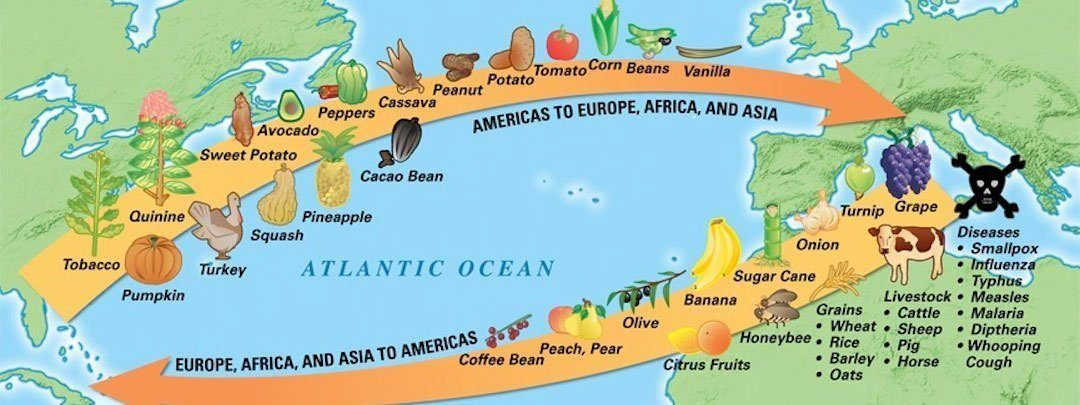
What was the Columbian Exchange?
a transfer of plants, animals, and germs from one side of the Atlantic to the other for the first time.
Cause of the Treaty of Tordesillas
Spain and Portugal’s disputes over their overlapping territory claims
Treaty of Tordesillas
Portugal's claim to Brazil and Spain’s claim to the rest of the Americas.
Encomienda system
a system where the King of Spain gave grants of land and natives to individual Spaniards. This led to more natives being exposed to European diseases and brutality leading to more natives dying.
Asiento system
This system was established due to the inflated mortality rate, in which the Spanish were required to pay a tax to their King on each imported slave.
factors that led to the development of a rigid class system in the Spanish colonies
forced natives and brought in Africans to work for slave labor,
the Spanish to always have more power than other inhabitants.
Bartolomé de Las Casas
a Spanish Priest that advocated for better treatment for the Native Americans.
How did the relations between the English and the natives change over time?
started healthy, sharing ideas, trading, and coexisting. But eventually, the relationship grew into conflict and open warfare. This change was caused by the English’s lack of respect for Native American culture, threatening their livelihood by taking their land and forcing them to move away from the coast.
Why were the natives unable to resist the European advance?
Native Americans saw themselves as distinct, non-related groups, not a larger body meaning the Europeans never had to worry about a unified response.
What were some strategies the natives used to try to survive?
Some Natives tried to ally themselves with a European power to gain support but a number of tribes simply migrated to new land.