Chemistry MCAT set
 Call Kai
 Learn
Learn Practice Test
 Spaced Repetition
 Match
Match Flashcards
 Knowt Play
1/40

There's no tags or description
Looks like no tags are added yet.
Name | Mastery | Learn | Test | Matching | Spaced | Call with Kai | Chat |
|---|
No analytics yet
Send a link to your students to track their progress
41 Terms
Rate determining step
the slowest step in a process determines the overall reaction rate
-determines reaction rate
-the slowest step in a processs
-the top of the highest hill is the rate determing step
What 3 factors help determine the reaction rate?
1) how frequently moledules collide (bc reactant molecules must collide and interact in order for old bonds to be broken & new ones to be formed) & anything affecting these collisions affect reaction rate
2)the orientation of the colliding molecules
3) their energy
transition state "activated complex"
-is not a type of intermediate (is an energy maximum)
- high-energy, short-lived energy state

intermediate
- has higher energy usually than reactants and products but less energy than the transition states
-highly reactive
-formed in one step and consumed in the other
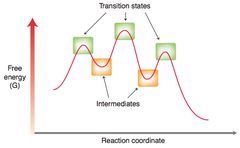
Activation energy
the minimum energy required of reactant molecules during molecular collisions in order for the reaction to proceeed to products
-relative to reactant (aka: the distance from the reactnat to the highest hill usually the activation energy needed to create products)
measured from the reactant to the distance up "top of the highest hill"
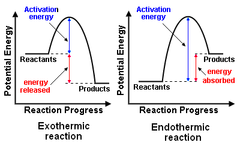
Reaction rate 3 factors that are true that make it faster?
1) the lower the activation energy --> the faster the reaction rate. The higher hill: is the reate-determining step but the smaller the highest hill the less energy required to overcome it so the reaction is faster
2) the greater the concentration of reactants --> the faster the reaction rate. Bc the more molecules the more collisions taht will happen
3) the higher the temperature the faster the reaction rate
4) GIBBS does NOT affect reaction rate (this is a thermodynamic factor doesnt affect kinetic factor)
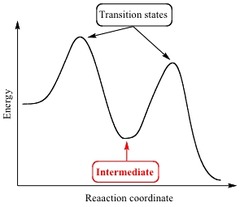
Catalyst and what they affect?
makes reaction go faster by lowering ACTIVATION energy of the rate-determining step (which is the highest hill and the activation energy is the distance from the reactant to the top of the hill of the rat-determining step)
-lowers activation energy of both the forward and reverse reaction
-WILL affect the rate of reaction
-will NOT affect equilibrium nor thermodynamics of the reaction
what will catalyst not affect?
will NOT affect:
-gibbs free energy (delta G)
-enthalpy (delta H)
-entropy (delta S)
question about catalyst: reaction without catalyst has activation energy of 140kj/mol and heat of reaction deltaH= 30 kj/mol. In the presence of a catalyst the activation energy reduced to 120 kj/mol. What will the heat of the reaction in the presence of the catalyst be (what will the deltaH or "enthalpy" be)?
the deltaH (enthalpy) stays the same it would be deltaH= 30 kj/mol as well.
Bc catalysts DONT affect thermoyndamics of a reaction.
rate of reaction
typically based on the rate at which the reactant disappears
Rate Law (page: 194)
-determined by initial rates of reaction, usually given by the rate at which the reactant disappears
-based on reactants and the effect when its conc changes what effect it has on reaction rate
ex: A+B+C --> D+E
rate constant k (which can also be calculated for when you get rate law which is determined based on conc of reactants and their reaction rates table for various experiments)
rate law: rate= k([A]^x) ([B]^y) ([C]^z)
note: only reactants that affect reaction rate included in rate law if not they wont
Rate constant "k" for rate law
-any of the experiments will give you the same rate constant bc its a constant for any given reaction at a given temperature.
-Each reaction has its own rate constant, which takes into account factors such as:
1) frequency of collisions
2) the fraction of collisions with the proper orientation to initiate the desired bond changes (that are needed for reactants to react and form products in reaction. Bc bonds are broken and formed during this process)
3) the activation energy
Rate constant usually expressed by Arrhenous equation
k= Ae^(-(Ea/RT))
Arrehnius equation
Rate constant usually expressed by Arrhenous equation
k= Ae^(-(Ea/RT))
A= arrehenius factor
Ea= activation energy
R= gas law constant
T= temp in Kelvins
hence makes sense: if Ea lowered by adding a catalyst and increasing Temp--> the rate consatnt "k" will increase so faster reaction
Ksp "solubility product constant"
Indicates the solubility of slightly soluble ionic solids in water. A higher Ksp value means greater solubility, while a lower Ksp indicates a tendency to remain solid. Example: for PbCl2, Ksp=[Pb2+][Cl−]^2. Only dissolved ions (aq) are included, not solids or pure liquids.
Qsp in relation to KSP trend
Then compare it with Ksp.
If Qsp If Qsp=Ksp: solution is saturated If Qsp>Ksp: precipitation occurs You can calculate the ion product: Qsp=[Pb2+][Cl−]^2 So when HCl is added: [Cl−]↑ which makes: Qsp=[Pb2+][Cl−]^2 increase. Once: Qsp>Ksp PbCl2 begins precipitating.
Solubility trends what atoms will remain dissolved and which ones are exceptions
So you need the solubility rules to know which ions actually react.
A very useful rule here is:
All nitrates (NO3−) are soluble
So anything paired with NO3− generally stays dissolved.
Chlorides are usually soluble too, but there are important exceptions, including:
Ag+, Pb2+, Hg22+
So PbCl2 is one of the chloride exceptions and can precipitate.
That is how you know Pb2+ and Cl− are the important reacting ions
Solubility rules
Always soluble: Compounds with Group 1 ions (Li+, Na+, K+), NH4+, NO3−, CH3COO−, and usually ClO4−. 2. Usually soluble: Chlorides, bromides, iodides. 3. Usually insoluble: Carbonates (CO3^2−), phosphates (PO4^3−), sulfides (S2−), and hydroxides (OH−), unless with certain soluble cations. 4. Sulfates are usually soluble with exceptions. 5. Key exceptions for chlorides: Ag+, Pb2+, Hg2^2+. 6. Memory aid: NAG SAG for soluble ions (Nitrates, Acetates, Group 1, Sulfates, Ammonium, Group 17 halides).
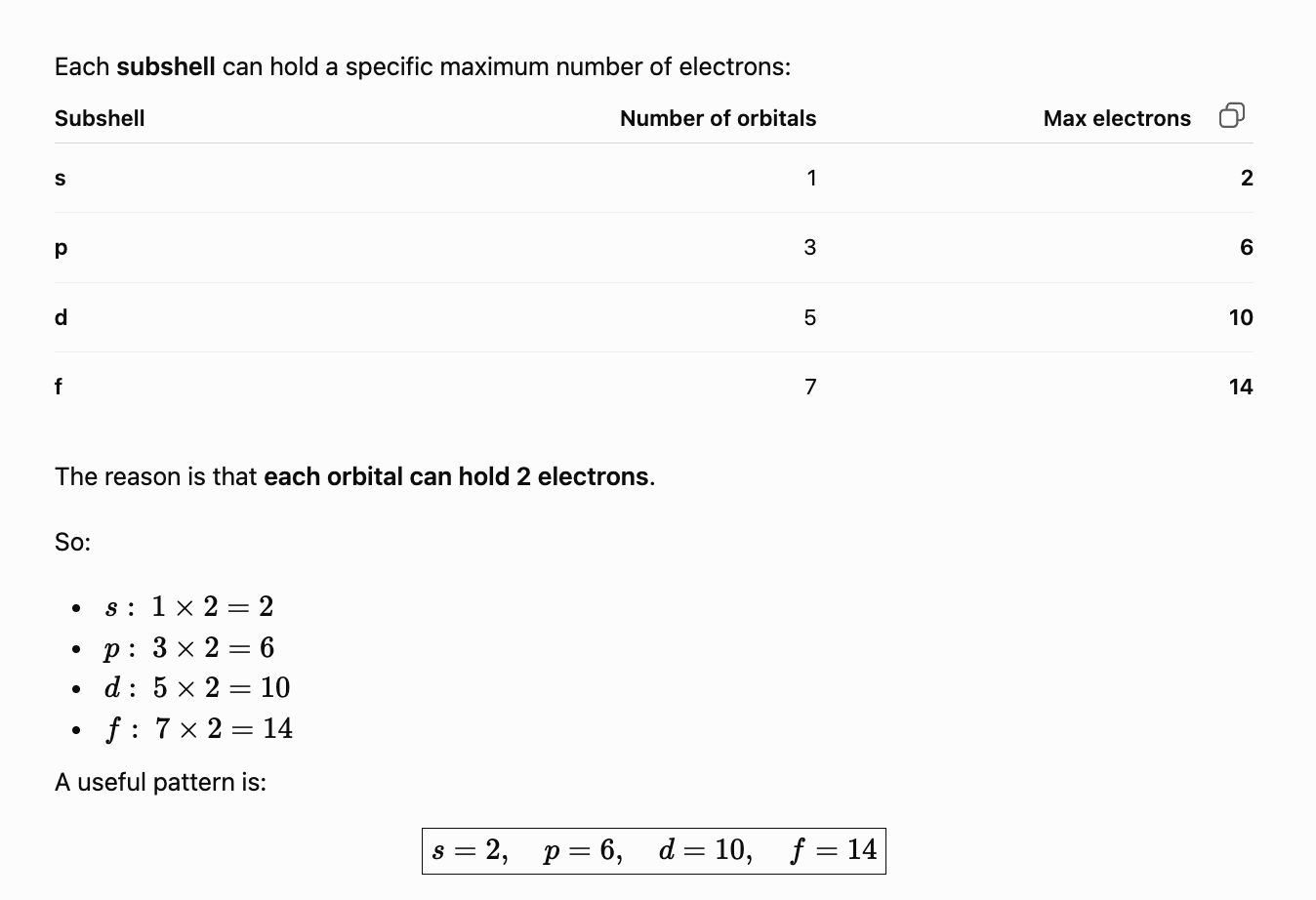
what can each electron subshell contain and number of orbitals for each?
s subshell= 1 orbital —> 2 e-
p subshell= 3 orbitals —> 6 e-
d subshell= 5 —> 10 e-
f subshell= 7 —> 14 e-
relationship between Ka and Pka
-They are inversely related
A strong acid gives up H⁺ very easily.
Stronger acid: (a strong acid has a small Pka)
Ka ↑
pKa ↓
H⁺ donation ↑
Weaker acid:
Ka ↓
pKa ↑
H⁺ donation ↓
The relationship is:
Strong acid → large Ka → small pKa
Weak acid → small Ka→ large pKa
Why? Because:
Ka=products/reactants
If an acid gives up lots of H⁺, then you get lots of H+
Ka is large.
For example:
HA→H+A−
A strong acid strongly favors the products, meaning it mostly dissociates.
So:
strong acid = gives up H+ easily
Now pKa is:
pKa=−logKa
Because of that negative log, Ka and pKa go in opposite directions:
Ka↑⇒pKa↓
what is PKA
tells you approximately the PH where a weak acid is halfway between its protonated and deprotonated form
pKa is another way of expressing Ka:
pKa=−logKa
(also tells you how strong a weak acid holds onto H+)
know:
Stronger acid:
Ka ↑
pKa ↓
H⁺ donation ↑
Weaker acid:
Ka ↓
pKa ↑
H⁺ donation ↓
Quick rule:
small pKa = strong acid
high pKa = weak acid
Example:
Acid with pKa = 2 → stronger
Acid with pKa = 7 → weaker
what is Ka
Ka is called the acid dissociation constant.
It tells you how easily an acid gives away H⁺.
For the indicator:
HIn⇌H++In−HIn \rightleftharpoons H^+ + In^-
we write:
Ka=[H+][In−][HIn]K_a=\frac{[H^+][In^-]}{[HIn]}
You do not necessarily need to calculate this for the question.
Just remember:
Large Ka = acid gives away H⁺ easily
Small Ka = acid holds onto H⁺ more strongly
what is an indicator? for the titration of an acid. and what does the PH at which the color change observed depends on what?
An indicator is itself a weak acid. We can write it as:
HIn⇌H+In−
HIn = one color
In⁻ = a different color
As the titration proceeds, you add NaOH, which raises the pH. That causes more HIn to lose H⁺ and become In⁻.
The indicator changes color when enough of it has switched from the HIn form to the In⁻ form.
-as you add base the PH increases which leads indictaor to begin to dissociate
A weak acid, written as HA, is an acid that does not completely break apart in water. It only partially releases H⁺ ions:
HA⇌H+A−
So in the solution, you have some HA still intact and some that has split into H⁺ and A⁻.
the strong base used in these cases: helps solution become less acidic and the pH increases.
what is an example of a strong base during the titration of an ACid and how does it work?
ex: NaOH, sodium hydroxide, is a strong base. It completely breaks apart into:
NaOH→Na+OH−
The important part is OH⁻, because OH⁻ reacts with H⁺ and removes acidity:
H^+ +OH−→ H2O
So as you add NaOH, the solution becomes less acidic and the pH increases.
Now, an indicator is a chemical that changes color depending on pH. In the problem, the indicator is written as:
HIn
What is a Faraday? how many mols of e- is 1 F?
What does a faraday mean?
A faraday is essentially the charge carried by 1 mole of electrons.
So:
1 faraday=1 mol e−
Therefore:
0.1 faraday=0.1 mol e−
A faraday tells you the amount of electrical charge in terms of moles of electrons.
For problems like this, the most useful relationship is:
1F= 1 mol e−
So:
0.1F=0.1 mol e−
You may also see:
1F≈96,485 C
because one mole of electrons carries about 96,48596,485 coulombs of charge. But you don't need that number here because the problem already gives the charge in faradays.
Reduction reatction
Reduction
Reduction means gaining electrons.
A helpful mnemonic:
OIL RIG\boxed{\text{OIL RIG}}
Oxidation Is Loss of electrons
Reduction Is Gain of electrons
Here:
Al^3+ +3e−→Al
Al³⁺ gains 3 electrons, so it is being reduced.
Reduction problem:Approximately how many moles of Al3+ are reduced when 0.1 faraday of charge passes through a cell during the production of Al? (Note: Assume there is excess Al3+ available and that Al3+ is reduced to Al metal only.)
Think of it like this:
Al³+ is aluminum that is missing 3 electrons.
To turn it back into normal aluminum metal, it needs to gain 3 electrons:
Al3+3e−→Al
Now the question gives you 0.1 faraday.
A faraday is just a way of counting electrons:
1 faraday=1 mole of electrons
But each aluminum ion needs 3 electrons.
So you divide by 3:
0.1÷3=0.033
Therefore:
3 electrons are needed for every 1 Al^3+
Therefore, 0.1 mol of electrons can reduce only 0.033 mol of Al3^+
Answer: A. 0.033 mol
(in depth: Al³⁺ has a charge of +3
Each electron has a charge of −1
So:
+3 + 3(−1)=0
Therefore:
Al3^+ +3e−→Al
electronegativity
Definition: How strongly an atom pulls shared electrons toward itself when it is in a chemical bond.
Think:
Electronegativity = “How badly does this atom want the bonding electrons?”
For example, in:
H−F
Fluorine pulls the shared electrons much more strongly than hydrogen does because fluorine has very high electronegativity.
Periodic trend
Across a period:
EN increases →
Up a group:
EN increases ↑
So:
Electronegativity increases ↗
Fluorine (F) has the highest electronegativity.
ionization
how hard it is to remove and e- from an atom
Definition: The energy required to remove an electron from an atom.
Think:
Ionization energy = “How hard is it to steal an electron from this atom?”
High ionization energy = atom holds its electrons tightly → hard to remove one.
Low ionization energy = atom gives up an electron more easily.
Example:
Na→Na+ +e−
Sodium loses an electron fairly easily, so it has a relatively low ionization energy.
Periodic trend
Across a period:
IE increases →
Up a group:
IE increases ↑
So overall:
Ionization energy increases ↗
Highest = toward the top right.
Lowest = toward the bottom left.
Atomic radius and its trends for e-
the larger the atom= the weaker its grip on electrons
the smaller the atom= the stronger its grip on electrons
A large atom:
Nucleus 🧲 ————— electron
The electron is far away and shielded.
Therefore:
↓ electronegativity
↓ ionization energy
↑ atomic radius
A small atom:
Nucleus 🧲 ← electron
The electron is close, so attraction is strong.
Therefore:
↑ electronegativity
↑ ionization energy
↓ atomic radius
Electron affinity
Electron affinity is the energy change that happens when a neutral atom gains an electron.
Think:
Electron affinity = “How much does this atom want to accept an extra electron?”
For example:
Cl+e−→Cl−
Chlorine gains an electron and becomes negatively charged.
What does a high electron affinity mean?
In general chemistry, an atom with a strong electron affinity really “likes” gaining an electron.
Electron affinity generally becomes more favorable as you move:
→ across a period, and ↑ up a group.
So broadly:
electron affinity increases toward the top-right ↗affinity increases toward the top-right
The halogens, like F and Cl, have especially strong electron affinities because they are only one electron away from a full valence shell.
Example:
Cl:7 valence electrons
It wants:
8
So gaining one electron is very favorable.
why does electron affibty increases up and right?
why across a period (towards the right) it increases?
the number of protons increases.
That means the nucleus has a stronger positive charge.
Therefore it attracts an incoming negative electron more strongly.
more protons→stronger attraction→more favorable electron gain
Why does electron affinity generally decrease going down?
Going:
↓
atoms get larger.
There are more electron shells and more shielding.
So the new electron is farther from the nucleus.
larger atom→more shielding→weaker nuclear attraction\text{larger atom} \rightarrow \text{more shielding} \rightarrow \text{weaker nuclear attraction}
Therefore gaining the electron is usually less favorable.
What affects electron affinity?
The biggest factors are:
Nuclear charge
More protons = stronger attraction for electrons.Atomic radius
Smaller atoms usually attract incoming electrons more strongly.Shielding
Inner electrons block some of the nucleus's attraction.
More shielding: weaker attraction for incoming electron
Electron configuration
Atoms especially like configurations that become more stable after gaining an electron.
For example, halogens:
F, Cl, Br, I
have 7 valence electrons.
Adding one gives:
8 a full valence shell.
So electron gain is very favorable.
What is Boiling point? what affects it?
Boiling point is the temperature at which a liquid changes into a gas.
For that to happen, the molecules need enough energy to separate from each other.
So the main rule is:
Stronger intermolecular forces⇒higher boiling poin
tand:
Weaker intermolecular forces⇒lower boiling point
For example, if molecules strongly attract each other, it takes more heat to pull them apart.
Stronger attractions between molecules → more energy needed to separate them → higher boiling point.
The biggest thing that determines boiling point is how strongly the particles attract each other.
The core rule is:
stronger attractions⇒higher boiling point
because more energy is needed to separate the particles and turn the liquid into gas.
The main factors are:
Type/strength of intermolecular forces
Molecular size / molar mass (bigger molecules —> bigger BP) but can be overriden by tihngs like H-bonds
Shape and surface area
Polarity (higher polarity)
Hydrogen bonding
Ionic charge, if ions are present
External pressure
For ionic compounds, ion-ion attractions are even stronger:
dispersion<dipole-dipole<H bonding<ion-ion
If the substance is made of ions, such as:
Na+Cl−
the attractions are much stronger than ordinary intermolecular forces.
Oppositely charged ions strongly attract each other.
So ionic substances usually have:
very high boiling points\boxed{\text{very high boiling points}}
Higher ionic charge generally means stronger attraction.
For example, all else being similar:
2+ and 2−
attract more strongly than:
1+ and 1−
Boiling happens when:
vapor pressure of liquid=external pressure
So changing atmospheric pressure changes boiling point.
At higher pressure:
boiling point↑
At lower pressure:
boiling point↓
That's why water boils at a lower temperature at high altitude.
What is melting point and what affects it?
Is the temperature at which a solid changes into a liquid.
At the melting point:
solid→liquid
The particles are not completely separated like during boiling. They just gain enough energy to move past each other instead of being locked into a rigid solid structure.
The main idea is:
stronger attractions holding the solid together⇒higher melting point
But melting point is a little trickier than boiling point because how well particles pack into a crystal also matters a lot.
Melting point generally increases with:
stronger particle attractions↑
hydrogen bonding↑
ionic attraction↑
molecular symmetry↑
crystal packing efficiency↑
crystal stability↑
The most important difference from boiling-point questions is:
Melting point depends heavily on how well molecules pack in the solid.
note: Symmetry
This is especially important for melting point.
More symmetrical molecules often pack more efficiently into an orderly crystal.
Better packing means a more stable solid.
So often:
symmetry↑⇒better packing⇒MP↑
This can cause a surprising result where a molecule with a similar size has a much higher melting point simply because it forms a better crystal.
What are intermolecular forces? what they affect? and order from types of IMF forces from strongest to weakest?
-bonds between 2 or more molecules (between molecules)
These are attractions between molecules.
A simplified strength order is:
London dispersion<dipole-dipole<hydrogen bonding
Hydrogen bonding is a particularly strong form of dipole-dipole interaction.
Intramolecualr forces? what they affect? and order from types of IMF forces from strongest to weakest?
Intramolecular forces vs intermolecular forces?
London dispersion forces
London dispersion forces
All molecules experience these.
They arise from temporary fluctuations in electron distribution.
Generally:
larger molecule / more electrons⇒stronger dispersion forces
So ordinarily PH₃'s larger size would help increase its boiling point.
But NH₃'s hydrogen bonding is more important here.
Dipole-dipole forces
These occur between polar molecules.
The positive end of one molecule attracts the negative end of another:
δ+⋯δ−\delta+ \cdots \delta-
NH₃ is quite polar because nitrogen is much more electronegative than hydrogen