Lecture 2: Adaptive Immunity
 Call Kai
 Learn
Learn Practice Test
 Spaced Repetition
 Match
Match Flashcards
 Knowt Play
1/100

There's no tags or description
Looks like no tags are added yet.
Name | Mastery | Learn | Test | Matching | Spaced | Call with Kai | Chat |
|---|
No analytics yet
Send a link to your students to track their progress
101 Terms
Which cells are involved in adaptive immunity
Natural killer cell
T cell/ B cell (lymphocytes) → effector T cells and plasma cells
Which ones are phagocytes
Macrophages, Neutrophils, Dendritic cells (monocytes too technically)
Innate immunity
Provides routine protection
Eg, pattern recognition receptors
Adaptive immunity
Develops throughout life
Antigens, antibodies, etc
… cause response
Antigens (foreign substance)
System produces … to bind to antigens
Antibodies
Adaptive immunity takes a week or more to build following first exposure, what must protect during this time
Innate immunity
(Person may not survive long enough)
Adaptive immunity has …
Memory
(Stronger response to re-exposure)
… relies upon this ability to have memory/ have stronger response to reexposure
Vaccination
Response of adaptive immunity has molecular …
Specificity
(Specific to certain molecules on certain microbes)
Must … between ‘healthy self’ and dangerous particles (pathogens)
Distinguish
Two responses of adaptive immunity
Primary response
Secondary response
Primary response
First response to antigen
Secondary response
Second encounter with antigen
Stronger than primary response
Why are the two responses linked
Adaptive immune system ‘remembers’ mechanism that proved effective against that specific antigen during primary response
Two basic strategies for countering foreign materials
Humoral immunity
Cell-mediated immunity (CMI)/ cellular immunity
Humoral immunity
Works to eliminate extracellular antigens (Bacteria, toxins, viruses in bloodstream, tissue fluids)
Cell-mediated immunity (CMI) or cellular immunity
Deals with antigens residing within a host cell
(Ex invading virus infecting cell)
Dendritic cells
‘Scouts’
They bring antigens to the adaptive immune cells
B cells/ T cells are initially …
Naive (they are inactive)
What happens once B/ T cells are activated
They proliferate into their active forms Th and Tc cells
Some differentiate and some become memory cells
Roles of Th cells
Increase killing power of macrophages
Can also activate B cells
Role of Tc cells
Trigger apoptosis of infected cells
Role of B cells
Trigger production of plasma cells which produces Y-shaped antibodies
Adaptive immunity - Humoral
Outside cells
Adaptive immunity - cell-mediated
Inside cells
B cells and T cells have … receptors
Membrane-bound receptors
B cell Receptors (BCR)
Correspond to antibodies the B cell is programmed to make

T cell Receptor (TCR)
Recognize ‘presented’ antigens

What gives difference to helper vs cytotoxic T cells
CD marker (surface protein)
How do T and B cells move around
Via lymphatic system
(Must interact with specific antigens)
Each B and T cells is specific to only one or few antigens… have to move around
Primary lymphoid organs
Thymus and bone marrow
Secondary lymphoid organs
Lymph nodes, spleen, tonsils
Where do naive T and B cells gather
Lymph nodes (Scattered throughout)
Lymphatic vessels
Also helps bring antigen to B and T cells
Some fluid from circulatory system and tissues enters lymphatic vessels (becomes lymph fluid)
Brings antigens (from tissues) to areas where immune cells are concentration (at lymph nodes)
Lymph nodes
Where lymphocytes gather to contact antigens
Peyer’s patches
Allows sampling of intestinal contents via specialized M cells and dendritic cells
(T and B cells gather here)
Where do all blood cells arise
In bone marrow
Where do B cells mature
In bone marrow
Where do T cells mature
Migrate to thymus and mature there
Where do mature B and T cells gather
At secondary lymphoid organs and await antigen encounter
Antigens
‘Antibody generator’
Any molecule that reacts specifically with a Y-shaped antibody, a B cell receptor, or a T cell receptor (Elicit immune response)
Enormous variety of antigens (microbes, pollen, etc)
Two general categories of antigens
T dependent antigens (most)
T independent antigens
T-dependent antigens
B cells depend on Th cell to activate
T-independent antigens
B cells independently activate without Th cell’s help
(Eg lipopolysaccharide and molecules with repeating subunits such as carbohydrates)
Antigens are … the whole organism
NOT
Part of the organism recognized by antibodies
Epitopes (aka antigenic determinants)
regions of macromolecules (10 or so amino acids; 3D shapes)
Bacteria carry many different epitopes
Can be on cell surface or on cell structures
Antibodies are also called
Immunoglobulins
Antibody structure
Y shaped proteins with two general parts
Two identical arms (Fab regions)
Stem (Fc region)
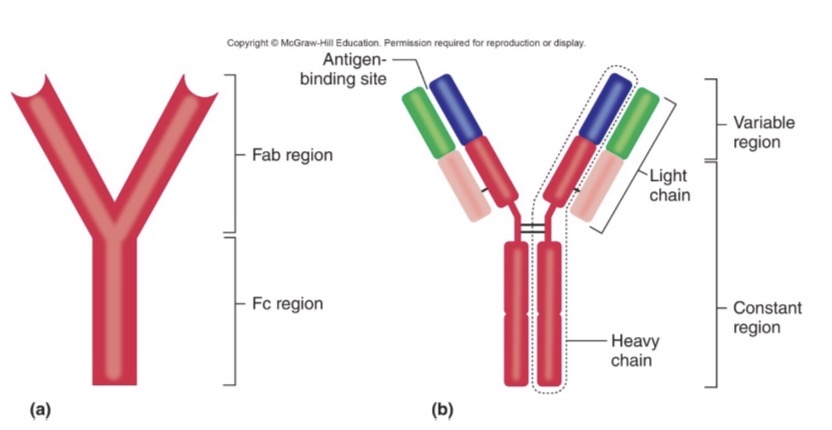
Which part of the antibody binds antigen
Fab region (ab → antigen binding)
Which part of the antibody ‘red flag’ tags antigen
Fc region (stem)
Ends of Fab
Binds to antigen and is variable + gives specificity
Free and Fc (if not bond)
Constant so cells can recognize tag
How do antibodies protect directly
Bind and prevent attachment of antigen to host cell
(No host cell gets involved)
How do antibodies protect indirectly
Tag antigen for elimination (host still does job)
What kind of protection is neutralization
Direct
covers object - can’t attach to host

What kind of protection is opsonization
Indirect
antibodies coat antigen, cell eats (phagocyte)

What kind of protection is complement system activation
Indirect
Complement system protein attaches to antigen which signal opsonization by C3b, inflammatory response, lysis of foreign cells

What kind of protection is immobilization and prevention of adherence
Direct
Antibody binds to flagellum of antigen which prevents adherence

What kind of protection is cross linking
Direct or could be indirect
Different arms of antibody attach to different antigens to immobilize and bring together

What kind of protection is Antibody-Dependent Cellular Cytotoxicity (ADCC)
Indirect
Antibodies cover infected ‘self’ cell and natural killer cell kills cell

Classes of Antibodies/ Immunoglobulin
Five major classes
Each has different constant region of heavy chain
Some form of multimers (Y-shape comes together)
Each has distinct function and properties
Not all same percentage in serum (blood)
Differ in half-lives
How do lymphocytes multiply
Clonal selection theory
Billions of different B and T cells present
Each interacts with a single epitope (of antigen)
Diversity of antigen recognition is random
Lymphocytes in secondary lymphoid organs wait their ‘dream antigen’
Once activated they multiply clonally (they are identical/ clones)
B-cell activation
Antigen presentation
To become activated and divide, need to present antigen to helper T cells for ‘confirmation of danger’
Steps for B-Cell
Bind antigen
Internalize antigen (endocytosis)
Degrade into peptides
Present peptides to Th cells via MHC class II molecules
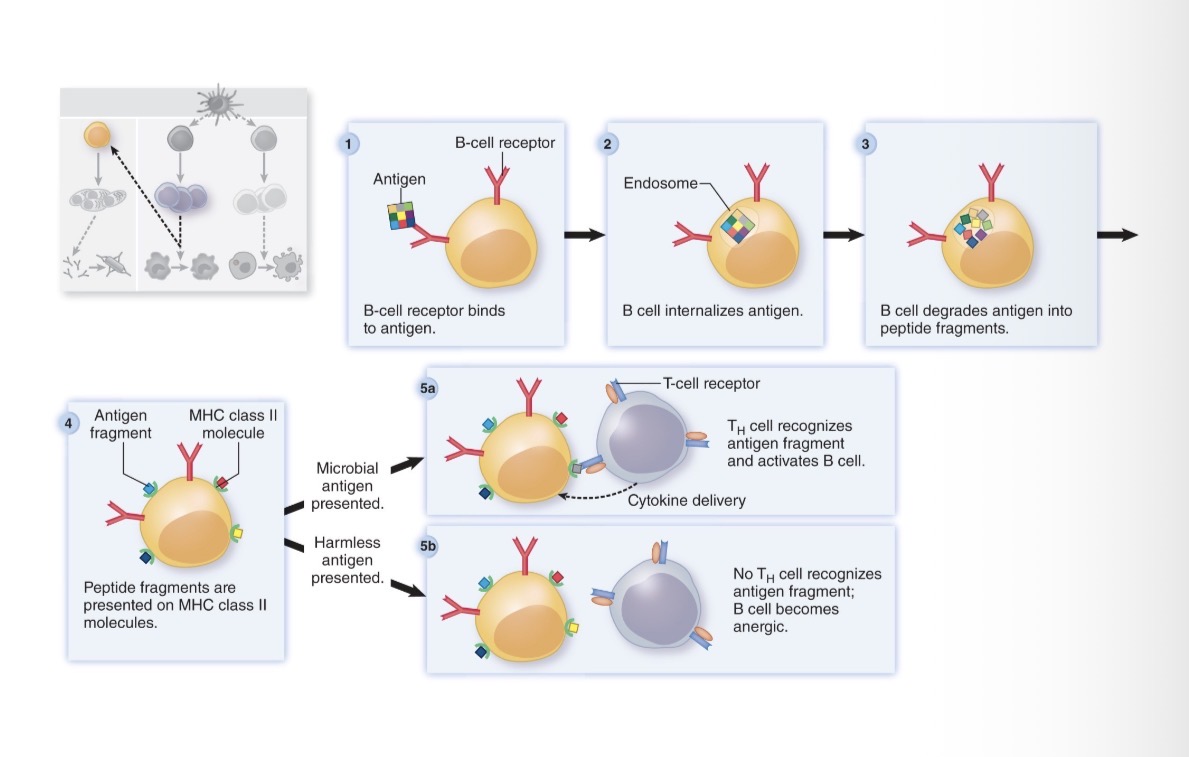
What are the MHC class II molecules called
Major histocompatibility complex (MHC) molecules
This initial B cell activation is part of the … of humoral immunity
Primary response
takes 10-14 days for substantial antibodies to accumulate
What do B cells do as infection progresses
Some activated/ memory B cells continue generating antibodies and the concentration (titer) increases over time of the immunoglobins (Ig)
In the case of resolved infection, additional exposure to the antigen later on yields
A much faster secondary respon se
Affinity maturation
Activated B cells can also gain mutations that make them bind antigens longer, and these will proliferate more (via natural selection)
Characteristics of Secondary Response
Significantly faster, more effective response
Pathogens usually eliminated before causing harm
Vaccination exploits this natural phenomenon
Memory B cells are responsible
greater number present after first response
Their receptors already fine tuned
When activated, some quickly become plasma cells, produce antibodies
T cell activation/ response
Play different role than B cells
Never produce antibodies
Effector T cells directly interact with target cells (self cells, macrophages, B cells)
cause distinct changes in target cells
Have T-cell receptors (TCR) that interact with antigens presented by by another cell
Where are the antigens presented to T cells held
In major histocompatibility complex molecules

Two types of MHC molecules
MHC class I
MHC class II
MHC class I
Presents endogenous antigens (those inside cell)
all nucleated cells make
MHC class II
Present exogenous antigens (originating outside cell)
produced by dendritic cells, B cells, macrophages
Cytotoxic T cells recognize antigens on
MHCI
Helper T cells recognize antigens on
MCHII
How do we decipher between the two T-cells
Cluster of differentiation (CD) markers
(Tc cells usually have CD8, Th cells usually have CD4)
(CD4 is a receptor for HIV, which infects Th cells)

How do dendritic cells play critical role in activation of T cells
Reside in peripheral tissue (skin, mucosa), Peyer’s patch
Have Toll-like receptors to recognize pathogens
Sense and signal danger
Present antigens on both MHC I and MHC II

What do dendritic cells produce if they sense danger
Co-stimulating molecules that signal danger
Functions of activated cytotoxic T cells (Tc)
Have learned what ‘danger’ is, seek out MHC I molecules (self cells) with antigen matches
If binds, knows that danger is likely inside cell (other similar looking cells were infected)
Induces apoptosis (via proteases and cytotoxins)

Functions of activated helper T cells (Th)
Also learned ‘danger’, seek out MHC II molecules (on self cells) with antigen matches
Cells that bind (B cells, macrophages) become activated
B cells eventually make antibodies via plasma cells
Macrophages gain ‘extra killing power’
Get bigger, get more lysosomes, produce toxic compounds

Natural Killer (NK) cells
Induce apoptosis in “self” cells
How do NK cells induce apoptosis in “self” cells
recognize host cells that have foreign proteins in their proteins in their membrane covered in antibodies (Have receptors for Fc portion of antibodies)
Deliver perforin and protease granules to cell… initiates
Also recognize host cells lacking MHC I molecules (all self cells should be displaying inner contents - some viruses interfere with antigens presentation)

MHC I vs MHC II cells
MHC I = self
MHC II = non- self
What is adaptive immunity initiated by?
Dendritic ‘scout’ cells
(Gathers antigen for presentation to native T cells)
Tc activated and look for infected …
‘Self’ cells (harbouring antigen within the cell)
Induces apoptosis
Also produce cytokines to alert neighbours
Th cells look for …
Macrophages that have ‘eaten’ antigen of danger
Macrophage
Engulfs and destroys invaders, limited killing powers
What happens when Th cells activate macrophages that present antigen
Enhance macrophages killing powers
Adaptive immunity involves cells originating in the
Primary and secondary lymphoid organs
Th also activate … that have displayed the ‘danger’ antigen
B cells
If activated, B cells make …
Plasma cells
Memory cells of T and B cells help with adapting to the response …
Making it faster, more specific and efficient
Plasma cells make
Antibodies
(Tag extracellular antigen for removal)
Picture summary

How do so many different antibodies get generated
Gene rearrangement
What makes more combinations possible
Hypermutations
Gene junctions not being perfectly cut
Hypermutations
Happens after B cells activation… B cells have good match to antigen but could be better
Start mutating which improves antigen-antibody binding
Leads to additional super potent antibodies