Week 2 Material
 Call Kai
 Learn
Learn Practice Test
 Spaced Repetition
 Match
Match Flashcards
 Knowt Play
1/14

There's no tags or description
Looks like no tags are added yet.
Name | Mastery | Learn | Test | Matching | Spaced | Call with Kai |
|---|
No analytics yet
Send a link to your students to track their progress
15 Terms
Three major drivers of internationalization:
1. The need for cross-market or Global integration
2. National or Local responsiveness
3. Worldwide innovation and learning
1. Forces for Global Integration & Coordination
• Economies of scale and scope.
• Factor cost differentials (e.g., labor, raw material).
• Increasingly liberalized environment for trade (E.U., USMCA, WTO,
CETA) – Trade agreements.
• MNEs/Global Competitors as Change Agents.
By changing product or operational context to foster global integration and coordination.
E.g: By changing national tastes and behaviour (Starbucks, premium coffee shops), by standardizing product formulations across regions (P&G) or by playing “global chess” (British Airways )
Trade Protectionism, why?
Protectionism (trade protectionism) is the economic policy of restricting imports from other countries through methods such as tariffs on imported goods, import quotas, and a variety of other government regulations – Think tariffs on EVs coming from China to US/Canada, Think current US-China Tariff war
2. Forces for National Responsiveness and Local
Differentiation
1. Cultural differences: Customer behavior and preferences
2. National infrastructure
• Technical standards (e.g. voltage, TV broadcast, etc)
• Distribution channels (e.g. supermarkets vs bazaars)
3. Government demands, Political risk
• National laws and regulations
• Host country pressures and demands
4. Local competitors success
• Culturally sensitive flexibility and responsiveness
• Appeal to nationalism
5. Customers
• Income, preferences, habits, consumption patterns
6. Economy
• GDP, disposable income, inflation, growth
3. Forces for Worldwide Innovation & Learning
Increased need for rapid and coordinated worldwide innovation
driven by:
• Shortening product life-cycles
• Increased cost of R&D
• Emergence of global technology standards (Think USB-C)
• Competitors’ ability to develop and diffuse innovation globally
Responding to Diverse Forces Simultaneously - Global
Those shaped primarily by economic forces for globalization (e.g., consumer electronics) and need for global integration. Successful MNEs (strategies) in global industries are those capitalizing on highly centralized, scale-intensive manufacturing and R&D operations and leveraging them through worldwide exports of standardized global products.
Responding to Diverse Forces Simultaneously - Multinational
Those shaped primarily by national, cultural, social, and political forces of localization. Successful MNEs (strategies) in multinational industries are those building strong, resourceful national subsidiaries sensitive to local needs and able to develop or adapt products and strategies to respond to their local needs, opportunities and demands.
Responding to Diverse Forces Simultaneously - Transnational
Increasingly industries are becoming Transnational.
Transnational strategies: means responding to all 3 diverse and competing sets of forces: global integration, national responsiveness, and worldwide learning
This should be goal of all corporate MNCs.
Political Risk
Political risk is the probability that a "political action" will
significantly affect the organization's business, positively or
negatively in the environment in which its operating
The New Forces Behind Political Risk
• Politics: Dramatic changes in politics since the end of the Cold War, today’s landscape is much more crowded and uncertain. More nationalistic.
• Supply chains: Longer, leaner global supply chains allow for lower costs and better inventory management, but leave companies more vulnerable to
disruptions from political actions in faraway places
• Technology: - Social media, cell phones and the internet have dramatically
lowered the cost of collective action.
The Political Risk Framework
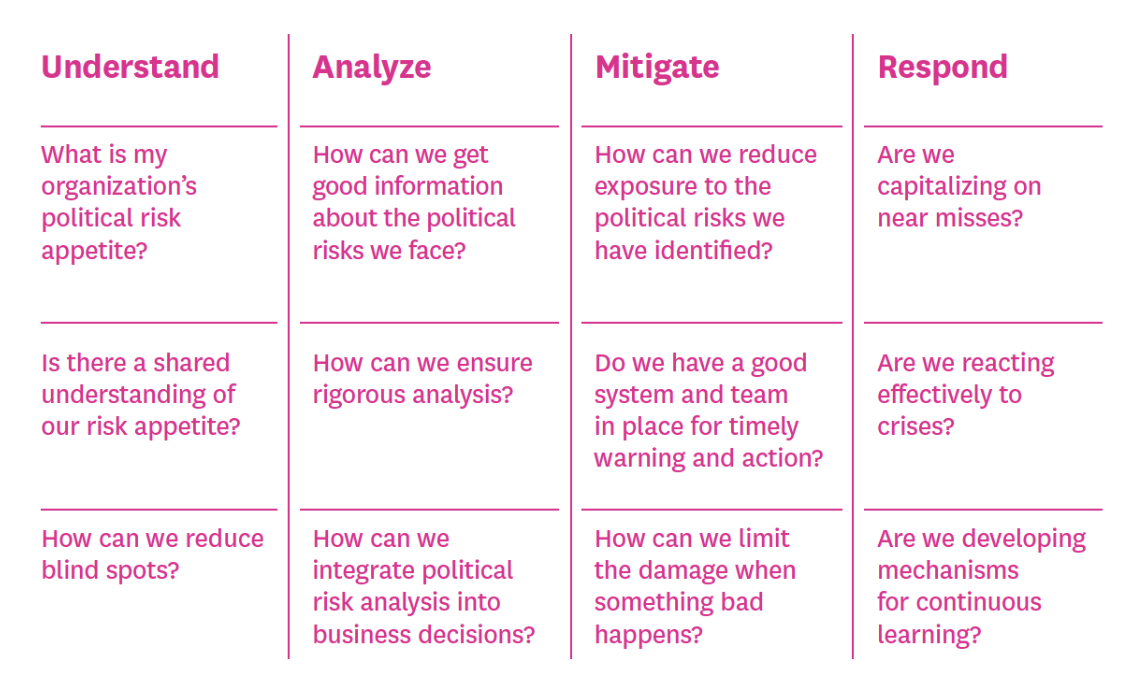
Effective risk management requires four core competencies:
1. Understanding risks
2. Analyzing risks
3. Mitigating risks
4. Responding to crise
Understanding risks
What is the organization's political risk appetite?
• Influenced by factors such as the time horizon of major investments, the availability of alternative investments, the ease of exiting investments, and visibility to consumers. (industries like oil and gas vs. consumer- facing industries like theme parks)
Is there a shared understanding of the risk appetite?
• Ensure that political risk is a concern for everyone in the organization from the boardroom to the sales floor.
How can we reduce blind spots?
• Do not expect the future to look like the present. Foster creative thinking and guard against groupthink.
Analyzing risks
1. Good information.
2. Rigorous analysis: Challenge assumptions and mental models about how risks might happen. Understand which assets are the most valuable, which are the most vulnerable. Red teams, Monte Carlo computer simulations.
3. Integrate political risk analysis into business decisions: Google
Trends search data; getting managers to use rigorous political risk
analysis to defend investments
Mitigating risks
• How can we reduce exposure to the political risk we have identified? Useful strategies: dispersing critical assets, creating surge capacity and slack in the supply chain, and sharing political risk assessments and mitigation strategies.
• Do we have a good system and team in place for timely warning and action? Set up effective warning systems, establish protocols so that responses to specific conditions are triggered automatically.
• How can we limit the damage when something bad happens? Build
relationships with external stakeholders.
Techniques MNEs use to manage country political risk include:
• Recruiting local partners
• Limiting R&D in nations with leaky intellectual property protection
• Purchasing insurance against political risks (From or Multilateral Investment Guarantee Agency or American International Group Inc (AIG)
• Diversifying their FDI across different countries
Responding to Political crises
Good crisis management: assess the situation, activate a response team, lead with values, tell your story (honestly), and not fan the flames
Continuous learning: Mechanisms for continuous learning must involve assessments of what to keep doing, what to stop doing, and what to start doing, plus an inspirational approach to motivate everyone to join in