Section 4 - Collision Regulations
 Call Kai
 Learn
Learn Practice Test
 Spaced Repetition
 Match
Match Flashcards
 Knowt Play
1/34

There's no tags or description
Looks like no tags are added yet.
Name | Mastery | Learn | Test | Matching | Spaced | Call with Kai | Chat |
|---|
No analytics yet
Send a link to your students to track their progress
35 Terms
Anchor Light
White, 360° (only on at anchor)
Stern Light
White, 135°
Port Light
Red, 112.5°
Starboard Light
Green, 112.5°
Masthead Light
White, 225°
How much do the port and starboard Lights overlap?
3°
How much area does the masthead light cover
The masthead light covers the same area as the port and starboard lights together.
How far should you be able to see the masthead light and how high should it be compared to the other lights?
The masthead light must be seen from 3 miles away and must be one meter higher than the rest.
How far should you be able to see all lights besides the masthead light?
All the other lights must be seen from 2 miles away.
When do we use the nav lights?
We turn on the Nav lights which refers to the Port, Starboard, Stern and Masthead lights when there is reduced visibility out on the lake. (I.e., rainy/cloudy days & smokey days).
how did they decide on 112.5º?
the port and starboard lights are required to be “2 points aft of the beam”.
Points – There are 360º on a compass. There are 32 points (cardinal, intercardinal, etc.). Therefore, the distance between compass points is 11.25º
Aft - behind
Beam – 90º from the front of the vessel (i.e., out the side)
So, take the beam (90º) and go aft (behind) by 2 points (11.25º + 11.25 º) and you will have 112.5º
“What kind of situation is this?” Can either be 3 things
Meeting (also known as head-on)
Crossing
Overtaking
“What is A’s responsibility to B?” Can either be 2 things
A’s responsibility is to maintain speed and course with caution.
A’s responsibility is to keep clear.
“What action do you expect she will take?” (non collision course) /2
I expect that she will maintain speed and course with caution.
I expect that she will give one short blast and alter course to starboard.
“What action do you expect she will take (collision course)?” /3
I expect that she will give five short blasts; signal not understood.
I expect that she will give one short blast and alter course to starboard. (Continuing around in a circle)
I expect that she will give three short blasts and put engines astern.
Which vessel is A?
A is the stand-on (Canadian term)/privileged vessel (American term)
A is the give-way (Canadian term), or burdened vessel (American term)
How do you know when you are on a collision course?
Your line of sight doesn’t change.
Your compass bearing doesn’t change more than 5º
What is a Meeting?
Two vessels are in a meeting situation when they are coming at each other head-on.
What is a Crossing?
Two vessels are in a crossing situation when they are about to cross paths.
What is Overtaking?
One vessel is directly in front of another (no matter how far ahead she may be). Also, speed is not a factor. If the vessel behind is slower than the vessel in front and it is highly unlikely that the one behind will pass the one in front, it is still considered an overtaking situation by how they are configured.
If a boat is coming at you from your port side, your responsibility is to…
maintain speed and course with caution.
If a boat is coming at you from your stern, your responsibility is to…
maintain speed and course with caution.
If they overtake you, your responsibility is to…
maintain speed and course with caution.
If your responsibility is to maintain speed and course with caution, then your action is to…
maintain speed and course with caution.
If your responsibility is to keep clear, then your action is to…
give one short blast and alter course to starboard.
If you are on a collision course, your action choices are…
You will give five short blasts; signal not understood.
You will give one short blast and alter course to starboard (continuing around in a circle).
You will give three short blasts and put engines astern.
What do you do in reduced visibility?
Reduce to a safe speed (being able to stop the vessel within one-half of the distance in the prevailing visibility)
Post extra lookouts
Navigation lights on
Sound the appropriate fog signal
Hoist a radar reflector
Set watch on radar
Shine a flashlight onto the sails
Radio marine stress signal example
Call: "Mayday!"
Give: name and position
Use: 156.8 MHz-Ch16
2182 kHz;
or use alarm signal.
VHF-DSC 406 MHz
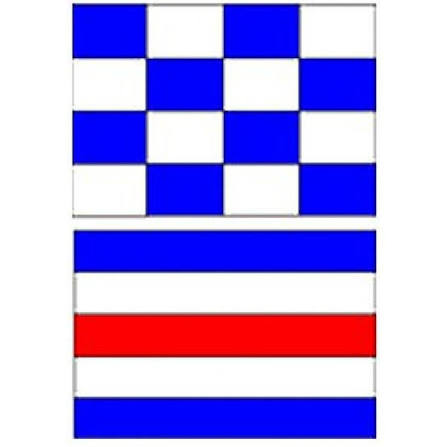
N over C flag

Distress cloth
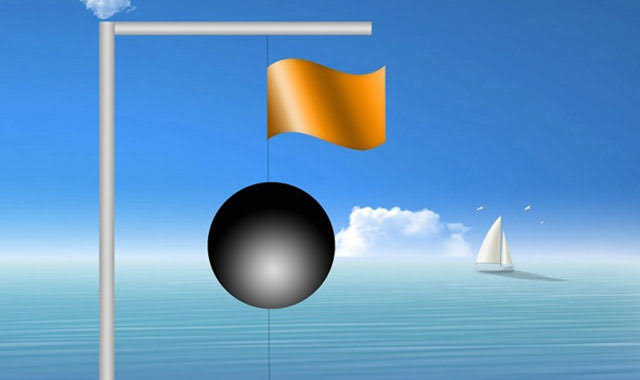
Ball over or under square
Emergency Sound Signals
Continuous fog, horn, whistle, or 1 minute intervals of a g*n or any expl*sive
Types of flares
Type A: Parachute rocket (3 parachute flares on the boat
Type B: Multi-star rocket
Type C: Hand-held
Type D: Buoyant or hand-held orange smoke.
Arm Distress signal
Eagle Arms (Do not use near helicopter - different meaning)
14 distress signals
Radio Radiotelephone
2. Emergency position indicating radio beacon (EPIRB) Code
3.N over C (N: No-negative Y: Yes-confirm)
Distress Cloth
Ball over or under Square
Continuous: Foghorn, bell, whistle
1-minute intervals: gun or any explosive
Type A: Parachute rocket (3 parachute flares on the boat)
Type B: Multi-star rocket
Type C: Hand-held (3 handheld flares on the boat)
Type D: Buoyant or hand-held orange smoke
Arm Signal – Eagle Arms
Flame on vessel (as from burning tar, oil in barrel, etc.)
Dye Marker