FINA 3000 Pope UGA Test 2
 Call Kai
 Learn
Learn Practice Test
 Spaced Repetition
 Match
Match Flashcards
 Knowt Play
1/96

There's no tags or description
Looks like no tags are added yet.
Name | Mastery | Learn | Test | Matching | Spaced | Call with Kai | Chat |
|---|
No analytics yet
Send a link to your students to track their progress
97 Terms
What is risk?
The probability that actual future returns will deviate from expected returns
What does risk represent
The variability of returns
What does risk imply?
A chance for some unfavorable event to occur
What are examples of risk?
Uncertainty in net income caused by revenue, labor cost, inventory, or exchange rate
What is average return?
Average % return on investment over a sample time period
What is variance?
How far do returns fall from the mean or average
What is a return?
The interest or % that we earn over a time period (typically a year or month
If variance increases, what happens to risk (volatility)
It increases
What formula do you use if calculating annual return?
E(R)
What does the E(R) formula represent?
The capital gain + the dividend yield
What does Rhp find?
The total compounded interest earned over a time period of investment
What does Rgeo find?
Annual compounded return
A Random Variable
Some measurement that can have a number of possible future outcomes
Examples of Random Variables
Temp, sales, expenses
What is a probability distribution
A function that assigns probabilities to the various possible outcomes that a random variable can have
What are the two forms of probability distributions?
Discrete ad Continuous
How many possible outcomes are there in a discrete distribution?
Finite
How many possible outcomes are there in a continuous distribution?
Infinite
What must probabilities add up to?
1
What can we use a distribution to calculate?
Expected value and variance
What does variance measure?
The spread of the distribution or variation in possible outcomes about the expected value
68%, 95%, 99.7%
1 SD from mean, 2 SD from mean, 3 SD from mean
Name the two sources for return on a stock
Gain in price (capital gain) and any dividend paid
What can standard deviation also be called?
Stand Alone Risk which implies the risk associated with only investing in that stock
If two stocks have the same E(R), what can we use to compare them?
The SD.
Assuming E(R)s are equal, what does the SD tell one about risk?
The greater the SD, the more risky; so we would choose the stock with a smaller SD
If two stocks have different E(R), how do we measure risk?
Using the coefficient of variation formula. We will take the stock with the smallest COV
COV Formula
COV= SD/Mean
What is a portfolio?
A collection of two or more assests
What is the goal of a portfolio?
To increase assets and decrease risk of portfolio
What does correlation measure?
How much two variables move or vary together
What can one infer about positively correlated stocks?
The stocks tend to move together. This means if stock A is above its average, stock B tends to also be above its average
In reality, all stocks are ___ correlated because...
Positively; because macro economic events move all stocks in the same direction
What can one infer about negatively correlated stocks?
Stock returns tend to move in opposite directions. This means if stock A is above average, stock B is probably below average.
When decreasing correlation, what happens to the SD
It also deceases because it is more diversified
T/F: We can remove all risk
False
What does correlation capture?
It identifies that stand alone risk for a firm can be divided into market-wide risk and firm-specific risk
What is Market Wide Risk?
Market events like: recessions, booms, changes in interest rates, taxes, politics, oil prices, wars; cause all stocks to move up or down together "High tide raises all-risk"
What is Market Risk is also known as?
Non-diversifiable risk, systematic risk, relevant, rewardable
What is firm specific risk?
economic and business events like: volatility due to an event unique to firm or industry; that impact only one or a few firms at a time
What is Firm Specific Risk also known as?
Non-systematic or diversifiable risk
What kind of risk should investors be rewarded for?
Non-diversifiable
At how many assets is a firm considered completely diversified?
30
What is the minimum SD that we can reach through diversification?
The market risk because is can not be diversified away
What is the market risk premium?
The excess return required for the investors to buy the market portfolio (the bonus)
What is Beta?
A risk index that allows us to compare the systematic risk of an individual assest vs. the systematic risk of the market portfolio. This lets us know how risky our investment is in comparison to the avg investment.
If ß=1
that means the systematic risk is the same as the avg investment
If ß>1
Stock "I" has greater systematic risk
What does beta predict?
The EXPECTED relationship between the market return and the return on the individual stock
What does CAPM stand for?
Capital Asset Pricing Model
E(R)-Rf
Difference between market index (like S&P 500) and Treasury Bill
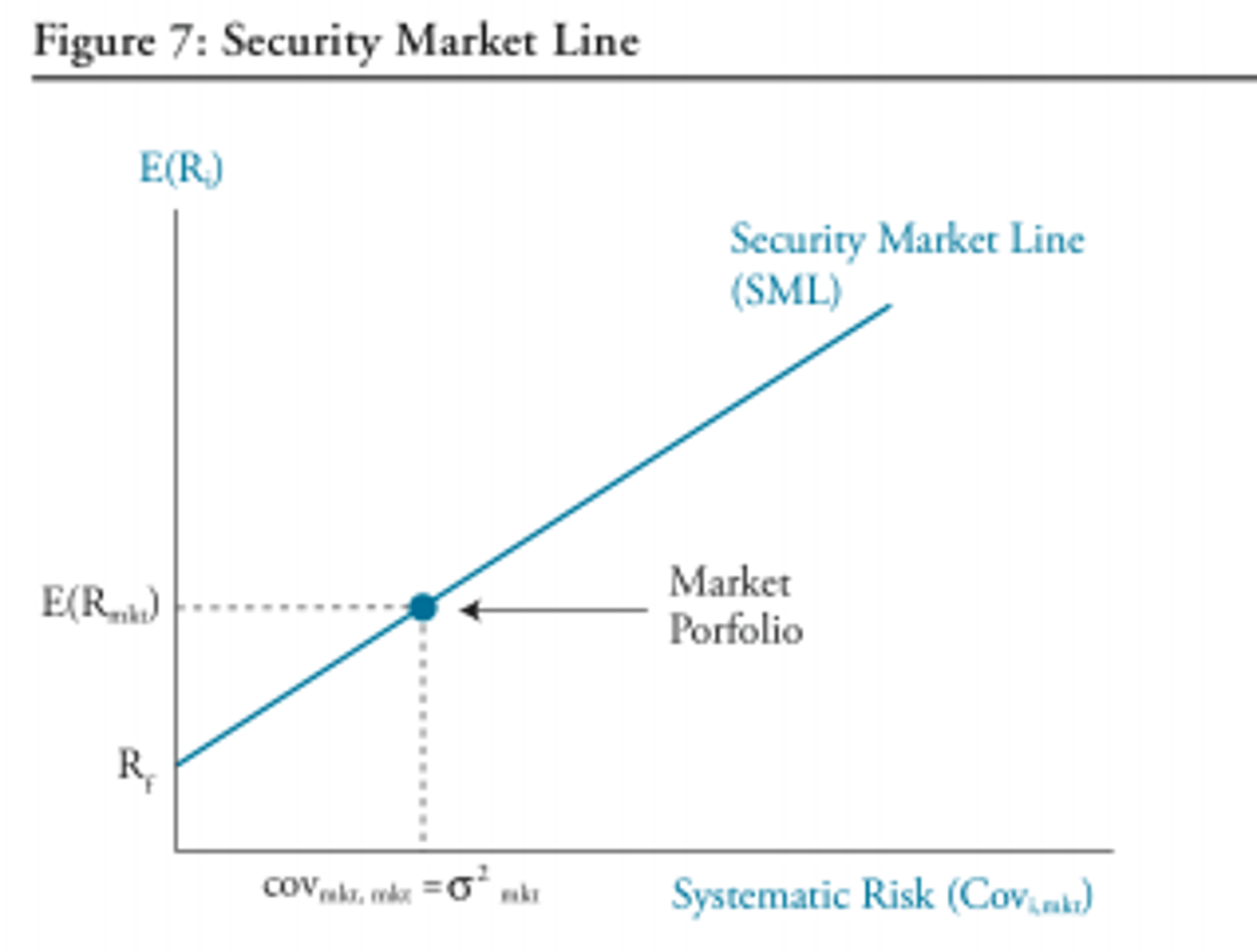
What is the Security Market Line?
Graphically represents CAPM. Shows the required return given Beta
What do we know if expected return < required return?
Stock is overvalued, so investors will sell stock which drops the price until Beta=required return
What do we know if expected return > required return?
Stock is undervalued, so investors will buy the stock and price will increase until Beta=required return
What is intrinsic value?
Net present value
What is the process of finding a stock called?
Fundamental Analysis
Primary Market Transaction
When an existing public firm issues new shares
Secondary Market Transaction
Market when existing public choices are traded
IPO
Initial Public Offering, when a private firm sells shares of public ownership
What happens when a firms net income increases?
dividends increase, stock prices increase
What happens when a firms sales increases?
Net income increases, dividends increase, stock prices increase
What happens when a firms risk increases?
Return increases, stock price decreases
What is the difference between expected return and a stocks required return?
Expected return is based on current price and expectations on future price
What is the purpose of capital budgeting?
to plot a course of action for the firm. Should only take on projects that expand shareholder value
Should one accept or reject a project if NPV <$0
Reject if NPV is less than $0
Return rate is also known as
Cost of equity, cost of capital, and CAPM
If cost of capital increases
leftover decrease
What is IRR?
Internal rate of return; what discount rate is required to make the net present value of all cash uses/sources equal to 0. The maximum value that cost of capital can be
When would you accept the IRR?
If IRRr≥ r
Independent Project
Taking one project does not prevent me from taking another
Mutually Exclusive Project
If I pick ONE project, I can no longer pick another "pick the best"
Contingent Project
If I take one project, I have to take them all
Why do IRR and NPV lead you two different ways?
because NPV uses cost of capital while IRR is its own rate
Why do the IRR rule and NPV rule differ?
1. timing of cashflows
2. scale of project
3. you can multiply IRR
What is the payback measuring?
Liquidity, so how long does it take for the firm to recover its inital investment
Payback formula
Initial cost/annual cash flow
T/F: the lower payback, the better
True
What are the weaknesses of the Payback Method
1. Ignores TVM
2. No set decision rule on good payback
3. Ignores time beyond payback period
What does the Profitability Index measure?
Is used when a firm is constrained by money, employees, machine hours, or lend. An efficiency measure
PI (budget Constraint) equation
NPV+Initial Cost/Initial Cost
PI (resource constrained) Equation
NPV/# of resources used
How did the American Dream lead to the 2008 financial crisis?
Everyone believed they should own a house and so lenders and stakeholder relaxed
How did the Mortgage Issue lead to the 2008 financial crisis?
- there was a race to meet demand for houses
- increase in the number of mortgages issues
- reckless spending
- sub-prime lending
Why was sub-prime lending (loans to those with bad credit scores) problematic during the 2008 financial crisis?
- The Adjustable Rate Mortgage was lower for the first 3 years and then became MUCH higher
- The sub-prime borrowers could not afford higher payments, so they would sell or refinance
T/F: Housing prices ALWAYS rise
False
How did the Unregulated Bank Behavior lead to the 2008 financial crisis?
- Banks were buying mortgages to repackage them as investments (called mortgage backed securities)
T/F: In MBS investors get paid when mortgage holders don't make their monthly payments
False
How were MSB rated?
Fot default Risk. AAA
T/F: Housing problems are local
FALSE; they are national
In 2006, what happened when housing prices began to fall?
Mortgage holders began to default and MSB began to fall in value
T/F: Credit Default Swaps are betting on the price of an asset to fall
True
T/F: Housing prices continued to fall which made these swaps too expensive for banks to pay off, so banks had to bail out barrowers
FALSE; the gov't had to bail out banks
NPV Pros and Cons
Pros: uses cost of capital and is a direct measure of shareholder wealth
Cons: hard to explain
IRR Pro and Cons
Pro: Easy to explain
Con: Does not use cost of capital and can conflict with NPV
What are the weaknesses of the finite holding periods?
Assuming a future selling price and predicting future dividends
What makes the infinite holding period reasonable?
The price of the stock = PV of all future dividends and because corporations have unlimited life
What are the weaknesses of the infinite holding periods?
Assuming a constant growth rate and very sensitive to g (not accurate)