econ 100 act 1
 Call Kai
 Learn
Learn Practice Test
 Spaced Repetition
 Match
Match Flashcards
 Knowt Play
1/100

Earn XP
Description and Tags
added ch 1-3 as of sr 1
Name | Mastery | Learn | Test | Matching | Spaced | Call with Kai | Chat |
|---|
No analytics yet
Send a link to your students to track their progress
101 Terms
$ Economics is best defined as:
the study of choice in a world of scarcity.
$ Your opportunity cost of going to a movie is
the total cash expenditure needed to go to the movie plus the value of your time.
opportunity cost def
what you give up to get that item
$ A marginal change is one that
incrementally alters an existing plan.
$ Governments may intervene in a market economy in order to
All of the above.
marginal change def
a small incremental adjustment to an existing plan of action
What is the invisible hand and what does it do?
the principle that the market will correct itself because people make choices that help themselves, unintentionally benefitting the society through free market trades. it guides the market towards a desirable outcome
$ A point inside the production possibilities frontier is
feasible, but not efficient.
$ When two individuals produce efficiently and then make a mutually beneficial trade based on comparative advantage,
they both obtain consumption outside their production possibilities frontier.
Describe the production possibilities frontier (visually or with words)
a graph that shows tradeoffs and various combinations of output that the national economy can possibly produce given its resources (available factors of production and production technology). depends on the concept that resources are limited. where you land on the curve is entirely dependent on the country’s resources (ex, whether people prefer wings or beer).

$ In an hour, Mateo can wash 2 cars or mow 1 lawn, and Tyler can wash 3 cars or mow 1 lawn. Who has the absolute advantage in car washing, and who has the absolute advantage in lawn mowing?
Tyler in washing, neither in mowing.
absolute advantage def
the ability to produce a good using fewer inputs
comparative advantage def
the ability to produce a good at a lower opportunity cost than another producer
$ Once again, in an hour, Mateo can wash 2 cars or mow 1 lawn, and Tyler can wash 3 cars or mow 1 lawn. Who has the comparative advantage in car washing, and who has the comparative advantage in lawn mowing?
Tyler in washing, Mateo in mowing.
$ Which goods will a nation typically import?
those goods in which other nations have a comparative advantage
$ Suppose that in the United States, producing an aircraft takes 10,000 hours of labor and producing a shirt takes 2 hours of labor. In China, producing an aircraft takes 40,000 hours of labor, while producing a shirt takes 4 hours of labor.
China will export shirts, while the United States will export aircraft.
$ A change in which of the following will not shift the demand curve for hamburgers?
The price of hamburgers
what factors determine demand (5)
price of a related good (complement or substitute), income of consumers, tastes of consumers, number of consumers, expectations of consumers
if a change occurs in a factor that determines demand, what happens to the demand curve?
a shift of the demand curve
if a change occurs in the price of a good, what happens to the demand curve?
a movement along the demand curve from the old price to the new one
$ Movie tickets and DVDs are substitutes. If the price of DVDs increases, what happens in the market for movie tickets?
The demand curve shifts to the right.
what happens to the demand of a substitute when the price of a good increases?
the demand increases (curve shifts to the right)
what happens to the demand of a complement when the price of a good increases?
the demand decreases
what does a rightward shift in a supply/demand curve imply
👍👍👍
$ The discovery of a large new reserve of crude oil will shift the ________ curve for gasoline, leading to a ________ equilibrium price.
supply, lower
what factors determine supply (4)
price of inputs, production technology, number of producers, expectations of producers
if a change occurs in the price of a good, what happens to the supply curve?
a movement along the supply curve from the old price to the new one
if a change occurs in a factor that determines supply, what happens to the supply curve?
a shift of the supply curve
$ If the economy goes into a recession and incomes fall, what happens in the markets for inferior goods?
Prices and quantities both rise.
inferior good def
a good for which demand rises when income falls
normal good def
a good for which demand rises when income rises
$ Which of the following might lead to an increase in the equilibrium price of jelly and a decrease in the equilibrium quantity of jelly sold?
An increase in the price of grapes, an input to jelly
$ A life-saving medicine without any close substitutes will tend to have:
A small elasticity of demand
elasticity def
a measure of the responsiveness of the quantity demanded or quantity supplied to a change in one of its determinants
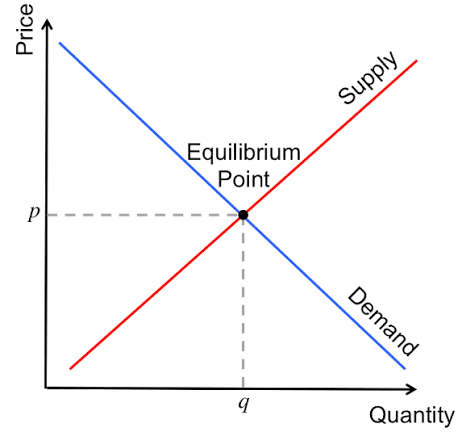
which direction do supply and demand slope
supply slopes up, demand slopes down
how to measure price elasticity demand (PED)?
% change in the quantity demanded / % change in the price; using midpoint method

$ The price of a good rises from $8 to $12, and the quantity demanded falls from 110 to 90 units. Calculated with the midpoint method, the elasticity is:
1/2
$ A linear, downward-sloping demand curve is
inelastic at some points and elastic at others.
why is the elasticity of a linear demand curve not constant
elasticity is the ratio of percentage changes in the two variables, meaning the same $1 price increase (for example) affects lower prices percent-wise, more than they affect higher prices
$ The ability of firms to enter and exit a market over time means that, in the long run,
the supply curve is more elastic.
is demand and supply curve more or less elastic in the long run
more elastic in the long run
who does the demand curve primarily relate to? who does the supply curve primarily relate to?
the demand curve primarily relates to consumers, and the supply curve primarily relates firms; obv tho both affect and impact each other
$ An increase in the supply of a good will decrease the total revenue producers receive if
the demand curve is inelastic.
TR = pxq ???
total revenue = price times quanitity
What’s the relationship between price and quantity for an elastic curve? How do you raise revenue?
q > p; lower prices to raise revenue
What’s the relationship between price and quantity for an inelastic curve? How do you raise revenue?
q < p; raise prices to raise revenue
what does the (abs value of) PED/price elasticity of supply tell you about the elasticity of a demand/supply curve?
PED = 1: unit elasticity
PED > 1: elastic
PED < 1: inelastic
how to measure the income elasticity of demand?
% change in quantity demanded / % change in income
how to measure the cross-price elasticity of demand?
% change in quantity demanded of good 1 / % change in price of good 2
how to measure the price elasticity of supply?
% change in quantity supplied / % change in price
$ When the government imposes a binding price floor, it causes
a surplus of the good to develop.
$ In a market with a binding price ceiling, an increase in the ceiling will ________ the quantity supplied, ________ the quantity demanded, and reduce the ________.
increase, decrease, shortage
$ A $1 per unit tax levied on consumers of a good is equivalent to
a $1 per unit tax levied on producers of the good.
$ Which of the following would increase quantity supplied, decrease quantity demanded, and increase the price that consumers pay?
The imposition of a binding price floor
$ Which of the following would increase quantity supplied, increase quantity demanded, and decrease the price that consumers pay?
The repeal of a tax levied on producers
$ When a good is taxed, the burden of the tax falls mainly on consumers if
supply is elastic, and demand is inelastic.
$ Jen values her time at $60 an hour. She spends 2 hours giving Colleen a massage. Colleen was willing to pay as much as $300 for the massage, but they negotiate a price of $200. In this transaction,
consumer surplus is $20 larger than producer surplus
consumer surplus definition
the difference between what consumers are willing to pay and what they end up paying
producer surplus definiton
the difference between what a producer is willing to accept for a given good or service and how much they end up selling the goods for
$ The demand curve for cookies is downward sloping. When the price of cookies is $2, the quantity demanded is 100. If the price rises to $3, what happens to consumer surplus?
It falls by less than $100.

$ John has been working as a tutor for $300 a semester. When the university raises the price it pays tutors to $400, Jasmine enters the market and begins tutoring as well. How much does producer surplus rise as a result of this price increase?
between $100 and $200
how do price increases affect producer and consumer surpluses
increase producer surplus, decrease consumer surplus
besides price, what else affects consumer and producer surpluses? how?
a shift in the supply curve
to the right (price falls) = increase cs, decrease ps
to the left (price decrease) = increase cs, decrease ps
$ An efficient allocation of resources maximizes
consumer surplus plus producer surplus.
total surplus def
consumer surplus + producer surplus
$ When a market is in equilibrium, the buyers are those with the ________ willingness to pay, and the sellers are those with the ________ costs
highest, lowest
$ A tax on a good has a deadweight loss if
the reduction in consumer and producer surplus is greater than the tax revenue.
$ Sofia pays Sam $50 to mow her lawn every week. When the government levies a mowing tax of $10 on Sam, he raises his price to $60. Sofia continues to hire him at the higher price. What is the change in producer surplus, change in consumer surplus, and deadweight loss?
$0, –$10, $0
$ Eggs have a supply curve that is linear and upward-sloping and a demand curve that is linear and downward-sloping. If a 2 cent per egg tax is increased to 3 cents, the deadweight loss of the tax
increases by more than 50 percent.
$ Peanut butter has an upward-sloping supply curve and a downward-sloping demand curve. If a 10 cent per pound tax is increased to 15 cents, the government's tax revenue
increases by less than 50 percent and may even decline.
$ The Laffer curve illustrates that, in some circumstances, the government can reduce a tax on a good and increase the
government's tax revenue.
If a policymaker wants to raise revenue by taxing goods while minimizing the deadweight losses, he should look for goods with ________ elasticities of demand and ________ elasticities of supply.
small, small
$ If a nation that does not allow international trade in steel has a domestic price of steel lower than the world price, then
the nation has a comparative advantage in producing steel and would become a steel exporter if it opened up trade.
$ When the nation of Ectenia opens itself to world trade in coffee beans, the domestic price of coffee beans falls. Which of the following describes the situation?
Domestic production of coffee falls, and Ectenia becomes a coffee importer.
$ When a nation opens itself to trade in a good and becomes an importer,
producer surplus decreases, but consumer surplus and total surplus both increase.
$ If a nation that imports a good imposes a tariff, it will increase
the domestic quantity supplied
$ Which of the following trade policies would benefit producers, hurt consumers, and increase the amount of trade?
Starting to allow trade when the world price is greater than the domestic price
what happens to the domestic price and quantity supplied when a contry becomes an importer
domestic price falls to the world price, quantity supplied drops.
What does the elasticity of the demand/supply curve tell us about who is bearing more of a tax burden
If the demand curve is less elastic than the supply curve, the buyer must be bearing more of the tax burden. If the supply curve is less elastic than the demand curve, the producder must be bearing more of the tax burden
what are some pro-trade arguments (4)
increased variety of goods, increased competition, economies of scale, enhanced flow of ideas
what are some anti-trade arguments (5)
jobs argument - hurts people that don’t have a comparative shifts
national security risk
infant industry - we don’t want to open up trade in new industries, as to protect domestic industries in the short run
unfair competition - likelihood to get scammed (?)
self-reliance - harder to access medicine during covid, for example
$ An externality occurs when there is a/an __________ impact of one person’s actions on the well-being of a bystander
uncompensated
$ Which of the following is an example of a positive externality?
Hillary's newly cut lawn makes her neighborhood more attractive.
$ Which of the following is not a market-based policy?
Occupational Safety and Health Administration regulations for job sites
$ If the production of a good yields a negative externality, then the social-cost curve lies ________ the supply curve, and the socially optimal quantity is ________ than the equilibrium quantity.
above, less
$ When the government levies a tax on a good equal to the external cost associated with the good's production, it ________ the price paid by consumers and makes the market outcome ________ efficient.
increases, more
$ Which of the following statements about corrective taxes is generally not true?
They cause deadweight losses.
$ A corrective tax sets the __________ of pollution to achieve a certain __________ of pollution, while a permitting system sets the __________ of pollution and lets the market set the _________
price; quantity; quantity; price
$ Public goods are __________ and __________ in consumption. They leave a role for the government due to __________ issues.
non-excludable, non-rival, free rider
Common Resources are ______ and ______ in consumption. They leave a role for the government due to _______ issues.
non-excludable, rival, sustainability
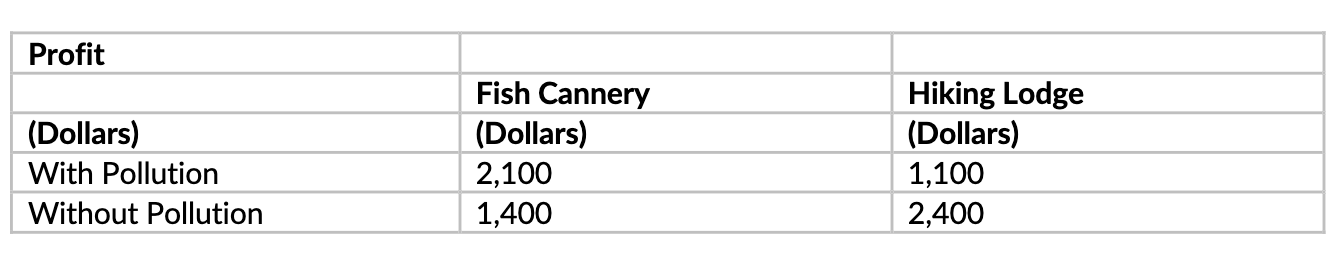
These figures in the following table show the profits per week that will be earned with and without polluting the river. Suppose the fish cannery has the property rights to the river, including the right to pollute it. In this case, assuming the two firms can bargain at no cost, the fish cannery ______________ pollute and the hiking lodge will pay the fish cannery _____________ per week.
won’t, between $700 and $1300
Where do market forces pull us in the long run in our market graph
towards the market equilibrium
what does the triangle created during a tax wedge represent
deadweight loss
do chart for rival in consumption vs excludability
private good → excludable and rival in consumption
club good → excludable, but not rival in consumption
common resource —> not excludable, but rival in consuption
public good —> neither excludable nor rival in consumption

what does it mean for a good to be excludable
you can prevent people from using it if they haven’t paid for it
what does it mean for a good to rival in consumption
someone using a good prevents other people from using it (due to limited resources usually)
how many workers should we hire to maximize profit (marginal analysis)
you should stop hiring when the extra revenue from the last worker equals their extra cost. (“revenue = cost” notion applicable even for labor)
tax incidence definition
who bears the burden of a tax
difference btwn discrete consumer surplus and continous consumer surplus
look at picture babe idkk

welfare economics def
the study of how the allocation of resources affects economic wellbeing