Parasite Diversity Exam
 Call Kai
 Learn
Learn Practice Test
 Spaced Repetition
 Match
Match Flashcards
 Knowt Play
1/55

There's no tags or description
Looks like no tags are added yet.
Name | Mastery | Learn | Test | Matching | Spaced | Call with Kai | Chat |
|---|
No analytics yet
Send a link to your students to track their progress
56 Terms
Parasite
Metabolically dependent on anoter living organism (host)
They have the potential to cause harm to the host
Ectoparasite
A parasite that lives on the external surface of a host,
e.g., fleas or lice, feeding on its tissues or blood

Endoparasite
A parasite that lives inside the body of a host, such as tapeworms or roundworms, deriving nutrients from the host's internal environment - their blood, muscle, and intestinal tract
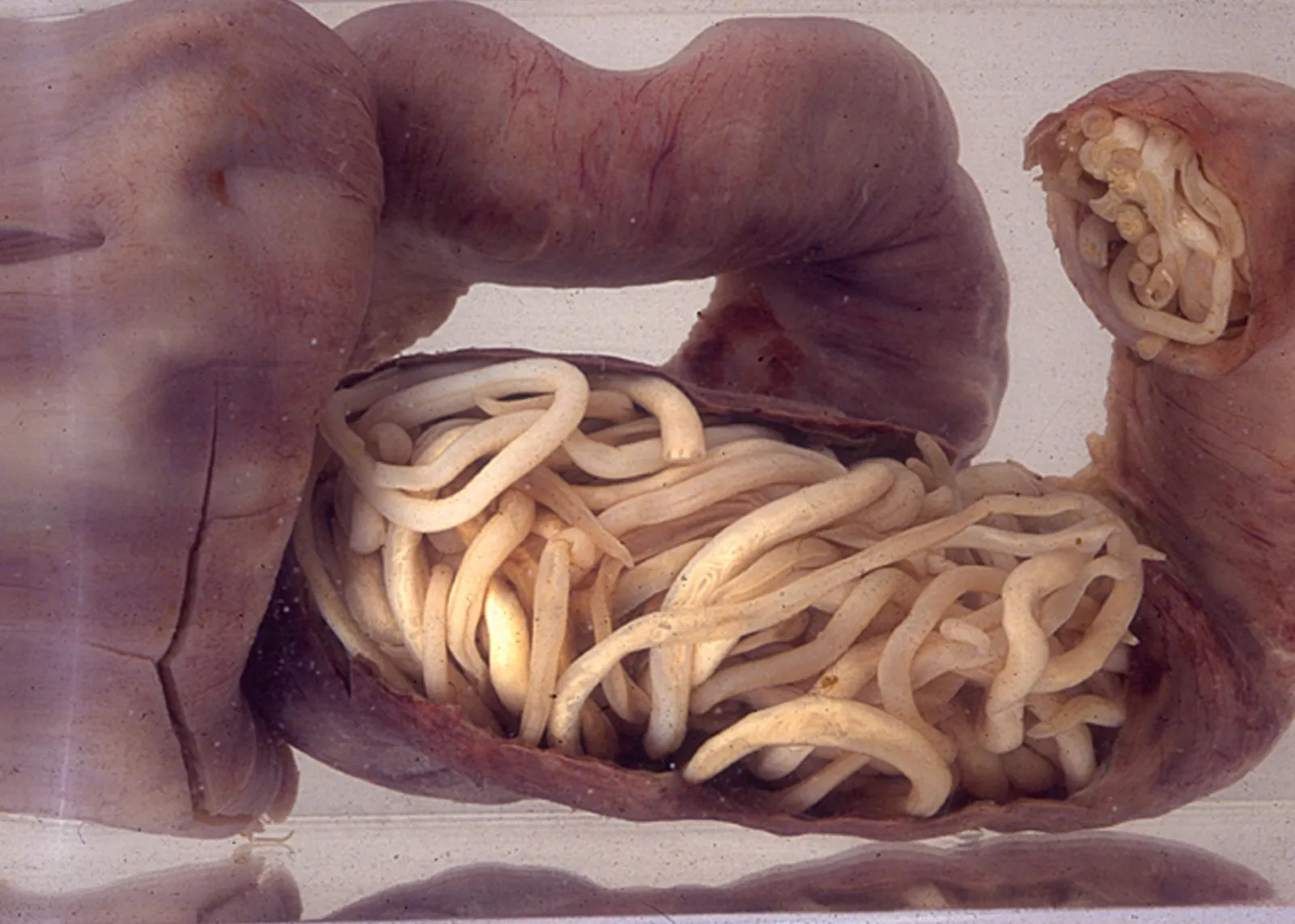
Macroparasite
A parasite visible to the naked eye; Ex: tapeworms, nematodes, flukes, which generate a weak immune response
Their impact is tied to the number of parasites present.

Microparasite
Parasites that are microscopic, reproducing quickly and asexually, and inducing a strong immune response. Ex: influenza (viruse), mycobacterium tuberculosis (bacteria), Giardia (protozoa).

Pathogen
Characterized by causing disease, which is only the case for some parasites.
(ex. anything that causes disease)
Micropredators
They feed on small amounts from multiple hosts
Ex: Leaches

Vectors
They transmit parasites from one host to another, transmitting pathogens
Parasitoid
A parasite whose larvae eats the host while the host is still living
Habitat
living in/on a host provides a stable environment for many places to live
Once inside the host, there are virtually no predators
Mobility
The act of a parasite dispersing its offspring widely on a host - using host as a personal vehicle
Energy
Parasitism requiring low energy expenditure to obtain abundant resources
What tends to happen to genomes when organisms transition from free-living to parasitic?
Parasites depend on their hosts for resources and no longer need some genes required for independent survival. Those genes are gradually lost, causing genome reduction
Briefly explain why natural selection would favor the transition of a free-living organism to a parasitic organism.
A host may be provided with reliable resources while the energy cost is reduced, thereby increasing survival and reproduction to favor traits in parasitism
Major groups on the tree of life, and particularly those that contain parasites.
Major Groups: Bacteria, Archaea, and Eukarya.
Bacteria- Contains some parasites, while many different eukaryotic lineages contain parasites.
Archaea- Have no known parasites
Eukarya- (Eukaryotic) Many Parasites
Prokaryotes vs. eukaryotes
Major Differences
All proks are unicelluar, have a cell wall and circular chromosomes (Are 10x smaller)
Euk have a nucleus and membrane-bound organelles, proks dont
Within eukaryotes, the general differences between protists, plants, fungi, and animals
Protist- Eukaryotes that are NOT plants, animals, or fungi
Plants- Multicellular photosynthetic/autotrophic eukaryotes
Fungi- Heterotrophic eukaryotes that absorb nutrients
Animals- Multicellular heterotrophic eukaryotes that consume food
Metazoans vs. non-metazoans
Metazoans- Technical term for animals that are multicellular, heterotrophic, with specialized tissues
Non-metazoans- Everything else that isn’t an animal (Ex., bacteria, protists, plants, fungi)
Arthropods (I won’t ask you the technical definition of an arthropod, but given an organism, would you be able to tell that it is/is not an arthropod?)
Has:
exoskeleton
are invertebrates
segmented body
paired, jointed appendages/legs
(ex. millipedes, centipedes, have NOT evolved parasitism)

Acari
Have only evolved in ticks and mites
Act as vectors, transmitting parasites from host to host
Can harm hosts through feeding on them

Insects
3 pairs of legs
head, thorax, abdomenn (3 segments)
2 pairs of wings
Crustaceans
Mostly Aquatic, typically hard exoskeleton
Have reduced appendages used for locomotion
(ex. shrimp, crabs, lobsters)

Nematoda
A small worm-like animal consisting of 1 million species
18 transitions to parasitism
Platyhelminthes
A phylum of worms containing parasites with 13 independent shifts
Explain how viruses are related to other organisms (generally speaking; you don’t need to be able to write in detail about all the possible hypotheses for the origins of viruses)
Viruses are dependent on host cells for reproduction and parasitize other organisms - because viruses need cells, they have evolved after the first cells appeared
Explain why you can argue that viruses are alive, or you can argue that they are not alive
Viruses are alive when they have genetic material, can reproduce inside host cells, and can evolve.
Viruses are NOT alive when they CAN’T reproduce independently, CAN’T metabolize, maintain homeostasis, grow, or respond to stimuli, making them not living
Describe the basic structures that are common to all viruses, and what characteristics make all viruses parasites
All viruses have a DNA/RNA genome surrounded by a protein capsid;
Viruses are parasites, as they need a host cell's machinery to replicate since they don’t have their own.
Explain the difference between a bacterial species that is only pathogenic, and a bacterial species that is both pathogenic and parasitic
Only Pathogenic bacteria causes diseases in a host but does NOT depend on the host's resources
BOTH Pathogenic and Parasitic bacteria causes diseases in a host and DEPEND on the host for resources and growth
know the important diseases they are associated with, and what organism is their vector (if applicable):
o Yersinia pestis
Caused: Bubonic Plague
Vector: Transmitted by fleas
Caused Black Death pandemic in Europe
know the important diseases they are associated with, and what organism is their vector (if applicable):
o Mycobacterium tuberculosis
Caused: Tuberculosis
Vector: An aerobic bacteria that spreads thru the air from person to person - attacks the lungs of humans
know the important diseases they are associated with, and what organism is their vector (if applicable):
o Borrelia burgdorferi
Caused: Lyme Disease
Vector: Tick vectored
This is the Bulls-Eye Rash”
Define what a protist is relative to other eukaryotes
Protists = a diverse group of eukaryotes that are NOT animals, plants, or fungi
Characteristics: photosynthetic, single-celled, and autotrophic
Recognize the following organisms as protist parasites and know the important diseases they are associated with:
o Genus Trypanosoma
Are blood parasites including mammals, birds, amphibians, squamates and fish
Vectored by insects, through bite or feces
Trypanosoma Cruzi: Chagas disease, vectored by the kissing bug
Trypanosoma brucei: “Sleeping sickness”, vectored by the tste tste fly
Recognize the following organisms as protist parasites and know the important diseases they are associated with:
o Entamoeba histolytica
Infects up to 50 million people worldwide
Tears apart intestinal tissues, causing Amoebic Dysentery
Recognize the following organisms as protist parasites and know the important diseases they are associated with:
o Malaria parasites, and more specifically Plasmodium falciparum
Malaria parasites are obligate intracellular parasites that invade blood cells and organ tissues
Plasmodium falciparum is a protist parasite that invades blood cells
Vector: Diptera, where sexual reproduction and causes Malaria
Define what a fungus is relative to other eukaryotes
Are heterotrophic eukaryotes that absorb nutrients
They are NOT autotrophic or photosynthetic
Can be either unicellular or multicellular
Recognize the following organisms as parasitic fungi and know the hosts that they infect:
o Genus Cordyceps
Are endoparasites of arthropods
Important fungi: insect ‘zombie’
Fungi that cause behavior changes that induce zombie-like behavior in their hostForces it to a location for fungal growth → kills the ant → grows out of the ant and releases spores
Recognize the following organisms as parasitic fungi and know the hosts that they infect:
o Chytrid fungus
Cause by Bacrachochytruim Dendrobatidis, infects the skin of frogs
Impacts frogs’ ability to breathe
Causes massive amphibian extinction
Explain what it means to be an animal
An animal is a Metazoan
multicelluar
heterotrophic
specialized tissue
Be able to recognize organisms as belonging to the phylum Arthropoda
Chelicerata: (Sea Spider, Horseshoe Crabs, Harvestmen, Mites, Scorpions, Spiders)
Hexapoda: (Insect, Springtail)
Myriapoda: (Pseudocentipedes, Bristile millipedes, Hexameraceratans, Pill millipedes, Scutigeromorphs, Scolopendromorphs)
Crustacea: (Seed Shrimp, Mystacocaridans, Fish Lice, Barnacles, Calanoids, Cyclopoids, Mantis Shrimps, Crabs, Lobsters, Horseshoe Shrimps, Water Fleas, Remipedes)
Four major arthropod groups?
Chelicerata
Hexapoda
Myriapoda
Crustacea
The only true parasites that are insects are?
Lice and Fleas
Recognize the human body and crab lice and the human flea as belonging to these groups
Lice (Order Phthiraptera)
Latin Names:
The human body louse : Pediculus Humanus
The human pubic (crab) louse : Pthirus Pubis
Recognize important parasitoid insects
Wasps, Bees, Ants , Flies
Be able to generally describe the lifecycle of a parasitoid wasp (what they do to their hosts to ensure the success of their offspring)
Evolved to vecome parasotiods, ifecting the eggs and larvae of terrestial insects
The long ovipositors lay eggs in their victims and also many also paralye their hosts
What species are parasitic members of the true bugs
bed bugs - feed on vertebrate blood
kissing bugs - act as vectors for trypanosoma cruzi
What group of protists do kissing bugs vector?
Vector: Feed on vertebrate blood at night, are vectors of chagas disease caused by Trypanosoma Cruzi
What are ectoparasites belonging to the arthropod group acari
Mites and Ticks
Recognize chiggers and Sarcoptes scabei as important mites of humans and other mammals
2 known groups of Acari mites
Chiggers (Trombiculidae) : the larval form of a mite that causes skin irritation when the larvae inject salivary secretions that digest host cells
Sarcoptes scabei: Comes form mature females mites burrowing under the skin causing rashes, ithing and hairloss
What is the disease associated with Sarcoptes scabei?
Causes sarcoptic mange or scabes
Recognize the black-legged tick (Ixodes scapularis) as an important tick species What disease does it vector?
Is a vestor for Lyme disease
Recognize __________ as parasitic barnacles (and that these are a group of crustaceans), and their behavior as parasitic castrators
rhizocephalans
behavior: they inhibit growth and reproduction and may induce loss of gonad function (parasitic castration)
also changes the hosts behavior causing it to protect the parasite egg mass as if it were it’s own
Recognize _______ and _______ as crustaceans
amphipods
isopods
What is a parasitic isopod that infects fish
Recognize the tongue-eating louse (Cymothoaexigia)
Recognize the following organisms asimportant nematode parasites of humans
• Trichinella spiralis
• Hookworms
• Guinea worm (Dracunculus medinensis)
• Filarial nematodes
Endoparasites of insects that alter the behavior of their hosts and cause them to enter bodies of water
Nematomorpha (hairworms)