exam 4 concept questions
 Call Kai
 Learn
Learn Practice Test
 Spaced Repetition
 Match
Match Flashcards
 Knowt Play
1/18

Earn XP
Name | Mastery | Learn | Test | Matching | Spaced | Call with Kai |
|---|
No analytics yet
Send a link to your students to track their progress
19 Terms
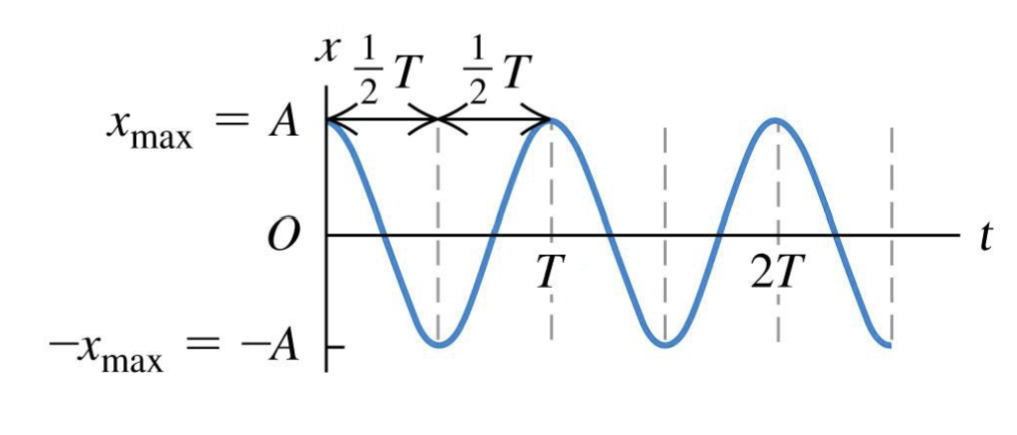
This is an x-t graph for an object in simple harmonic motion. At which of the following times does the object have the most negative velocity Vx?
t = T/4
At this point in the graph the slope is the steepest and the most negative. T/4 is simply a quarter of the period.
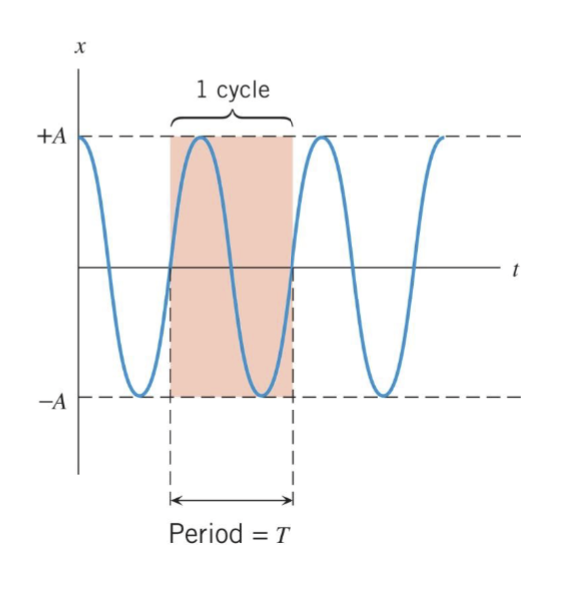
A mass on a spring in SHM has amplitude A and period T. What is the total distance traveled by the mass after a time interval T?
4A
Throughout one period of motion, the mass on a spring traveled through four different ‘quarter’ like sections, each being 1A
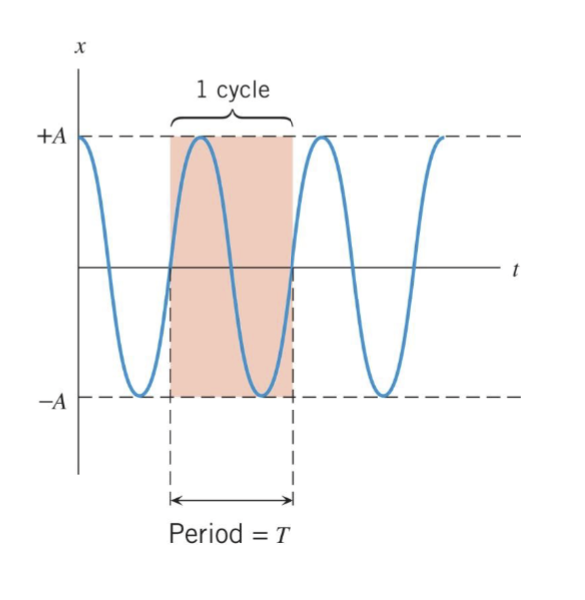
A mass on a spring in SHM has amplitude A and period T. What is the net displacement of the mass after a time interval T?
0
If one curve (period) has passed, the spring is back where is began.
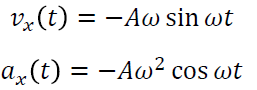
A mass on a spring in SHM has amplitude A and period T . At what point in the motion is v = 0 and a = 0 simultaneously?
This concept cannot happen in simple harmonic motion, if this was the case then we would not be oscillating. If V=0 then we are not moving, if a=0 as well, then we are continuously not moving.
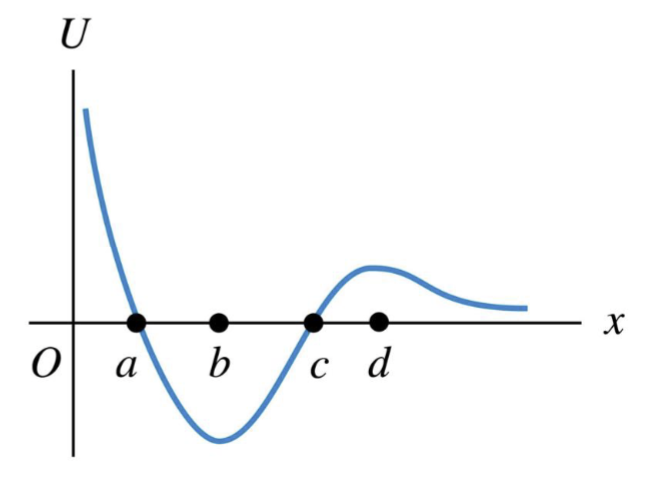
The graph shows the potential energy U for a particle that moves along the x axis. The only force that acts on the particle is the force associated with U. The particle is initially at x = d and moves in the negative x direction. At which of the labeled x coordinates does the particle have the greatest speed?
x = b
At point b, there is the most kinetic energy, and the minimum amount of potential energy.
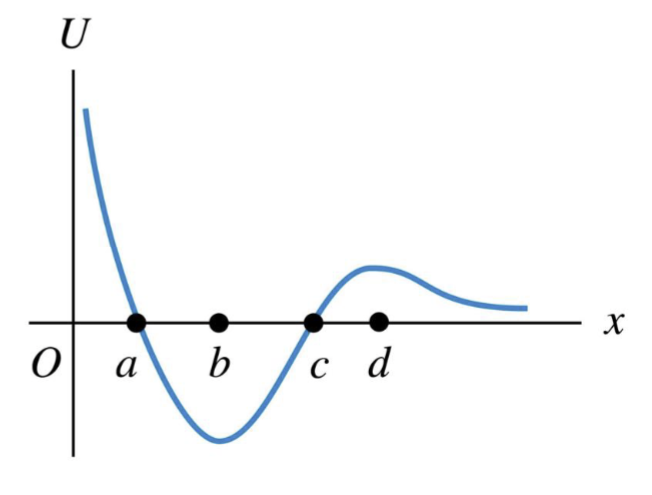
The graph shows the potential energy U for a particle that moves along the x-axis. The only force that acts on the particle is the force associated with U. The particle is initially at x= d and moves in the negative x-direction. At which of the labeled x-coordinates is the particle slowing down? 36
x = a
At point a, the particle is gaining kinetic energy as it is moving towards point b, showing us that the particle is coming to a halt in the future.
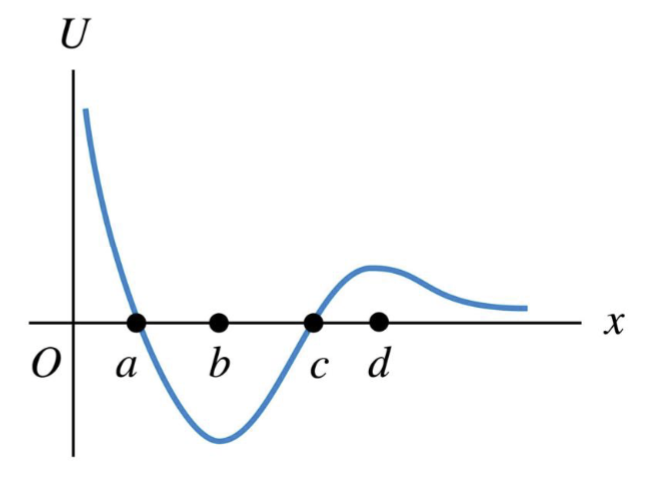
The graph shows the potential energy U for a particle that moves along the x axis. The only force that acts on the particle is the force associated with U . At which of the labeled x coordinates is there zero force on the particle?
at x = b and x = d
These are the only points in the graph in which the particle is not touching the x-axis, therefore there is zero force.
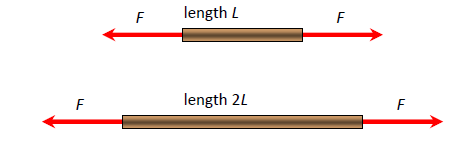
Two rods are made of the same kind of steel and have the same diameter. The same force of magnitude F is applied to each end of each rod. Compared to the rod of length L, the rod of length 2 L has…
The same stress and the same strain
The rods are made up of the same material and have the same diameter, therefore the forces applied to the rods will cause the same stress and strain.
In snowy regions of the world, the local people may wear snow-shoes below their normal shoes or boots. These snow-shoes have a much larger area than a regular shoe or boot. How does a snow-shoe improve a hiker’s ability to walk across a snowy region.
The hiker’s weight is distributed over the area of the snowshoes, which reduces the pressure on the snow below and minimizes sinking into the snow.
If area gets bigger, then pressure goes down.
A block of ice (density 920 kg/m3), a block of concrete (density 2000 kg/m3), and a block of iron (density 7800 kg/m3) are all submerged in the same fluid. All three blocks have the same volume. Which block experiences the greatest buoyant force.
All three experience the same buoyant force
All blocks are completely submerged.
A flask of water rests on a scale. If you dip your finger into the water, without touching the flask, does the reading of the scale increase, decrease, or stay the same?
The reading on the flask will increase, this is because of the pressure depth relationship. The reading increases because the depth (height) of the water goes up. (P=F/A)
Water flows through a 1-cm diameter pipe connected to a ½ cm diameter pipe. Compared to the speed of the water in the 1-cm pipe, the speed in the ½ cm pipe is…
Four times as great
Area has a quadratic dependency, and if diameter gets cut in half, so does the radius. I.e., V2 =4r
A park ranger vehicle is a ragtop roof (cloth roof). When at rest, the roof is flat, when the vehicle is moving at highway speeds with its windows up, the roof
Bows upward,
The faster the air flows, the lower the pressure, pushing the roof upwards.
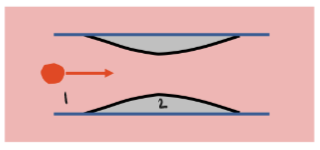
Blood is flowing through an artery that is partially blocked. Compared to the blood in the unblocked region, the blood in the partially blocked region has,
a lower pressure and the same volume flow rate
Flow rate is the same, causing speed to become faster, which causes pressure to decrease. Speed is higher here, so pressure is lower.
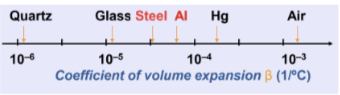
You want to take apart a couple of aluminum pieced held together by steel screws, but the screws are stuck. What should you do?
Heat the thing up
Since aluminum expands more, if it gets heated up it will expand and become bigger than the screws. If we were to cool the thing down, the entire thing will shrink and become stuck together.
A grandfather clock modeled as a simple pendulum keeps perfect time at room temperature. If the air conditioning breaks down on a very hot day, how will the clock be affected?
The clock will run slower
The volume will increase if it heats up, if it expands then ‘L’ length, the period “T” will go up.
The specific heat of concrete is greater than that of soil. A baseball field (with real soil) and the surrounding parking lot are warmed up during a sunny day. Which would you expect to cool off faster in the evening when the sun goes down.
The baseball field.
Concrete has a higher specific heat capacity then soil, therefore it can retain heat for longer periods, therefore it would be expected to cool off slower compared to the soil.
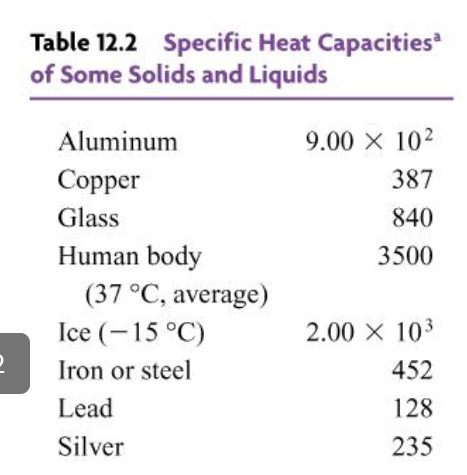
Four 1-kg cylinders are heated to 100 degrees Celsius and placed on top of a block of paraffin wax, which melts at 63 degrees Celsius. There is one cylinder made from lead, one of copper, one of aluminum, and one of iron. After a few minutes, it is observed that the cylinders have sunk into the paraffin to differing depths. Rank the depths of the cylinders from deepest to shallowest.
Aluminum > iron > copper > lead
A pitcher contains 0.50 kg of liquid water at 0 degrees Celsius and 0.50 kg of ice at 0 degrees Celsius. You let heat flow into the pitcher until there is 0.75 kg of liquid water and 0.25 kg of ice. During this process, the temperature of the ice-water mixture…
Remains the same
The ice is currently in its phase change, and until the phase change is completely over, the temperature will not change.