Unit 1: Basic Economic Concepts
 View linked note
 Call Kai
 Learn
Learn Practice Test
 Spaced Repetition
 Match
Match Flashcards
 Knowt Play
1/32

Earn XP
Description and Tags
see big notebook for terms in flashcards
Name | Mastery | Learn | Test | Matching | Spaced | Call with Kai | Chat |
|---|
No analytics yet
Send a link to your students to track their progress
33 Terms
scarcity
economic principle that states that products are finite in supply
what are the four economic resources?
land (resources from nature)
labor (human effort to produce resources)
capital (machinery, tools, equipment)
entrepreneurship (innovation/ideas)
payment for land
rent
payment for labor
wages
payment for capital
interest
payment for entrepreneurship
profit
what ISN’T an economic resource?
consumer goods, waste, money/stocks, etc.
what’s the fundamental economic problem?
wbat will be produced, how will goods/services be produced, who will get goods/services
command economy
government solely makes economic decisions (answers what, how, who)
market economy
individuals who own/produce make economic decisions (answers what, how, who)
mixed economy
mix of market + command economy
(most common)
what’s the relationship between households and firms?
consumers and sellers
what are the most common ways of allocating resources (allocation systems)?
command system (based on priority) and prices (whoever can pay can get the good/service)
traditional economy
economy is dictated by cultural customs (EX: placing value on important animal)
opportunity cost
how many x product is being given up to produce y product
(EX: in making 1 bag, i lose the opportunity to make 3 keychains in that same time)
how do you calculate opportunity cost?
opportunity cost of product x = cost (loss in creating y) / gain (how much x you create)
production possibility curve (PPC)
curve showing how much of product x (x-axis) can be produced while producing product y (y -axis)
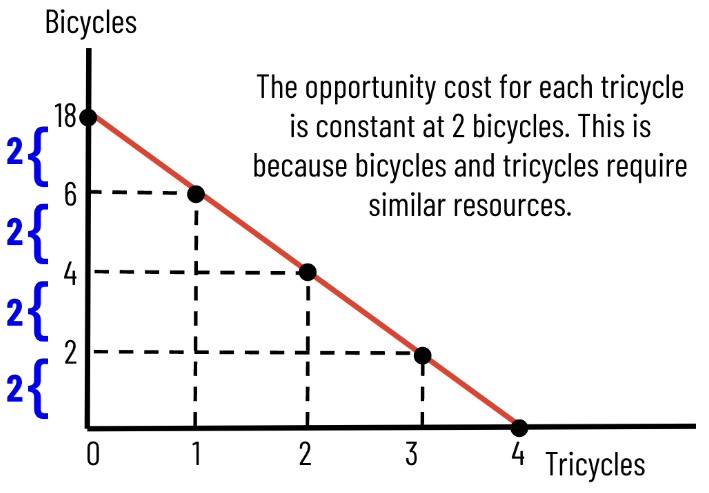
what does a PPC with a constant opportunity cost look like?
curve is linear
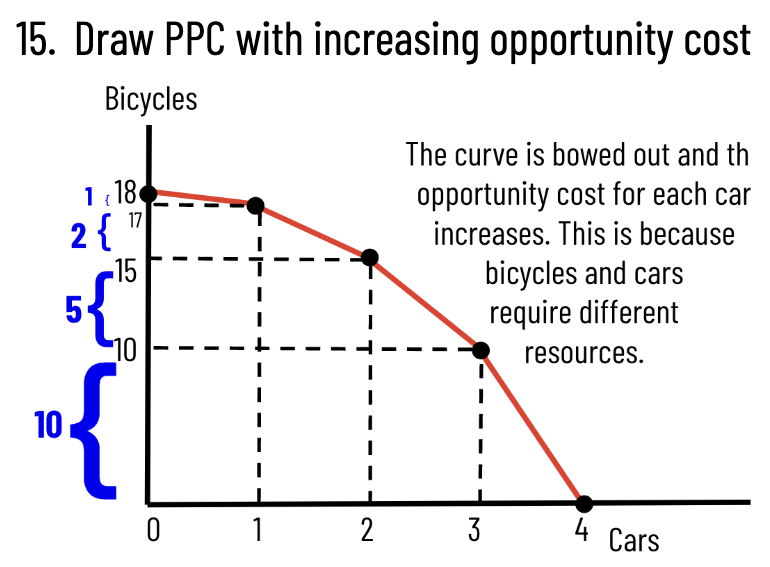
what does a PPC with an increasing opportunity cost look like?
curve is “bowed out” to the right
absolute advantage
ability to produce more of a good/service than another person w/ same resources
comparative advantage
ability to produce something at a lower opportunity cost
output problem
asking how many products can be produced with x amount of resources
opportunity cost = cost / gain
input problem
asking how much resources (EX: time) does it take to create x amount of product
opportunity cost = gain / cost
terms of trade
exchange must fall between opportunity costs of the (usually) two products ( opp a < optimal price < opp b)
explicit cost
monetary cost (like from price tag)
implicit cost
non-monetary cost (like opportunity costs)
marginal utility/cost
additional benefit/cost gained from an additional unit of the product
utility and utils
measure of satisfaction gained from benefit
total net benefit
total benefit - total cost (difference between them)
what is the most optimal net benefit?
the greatest value (biggest difference between TB - TC in the dataset)
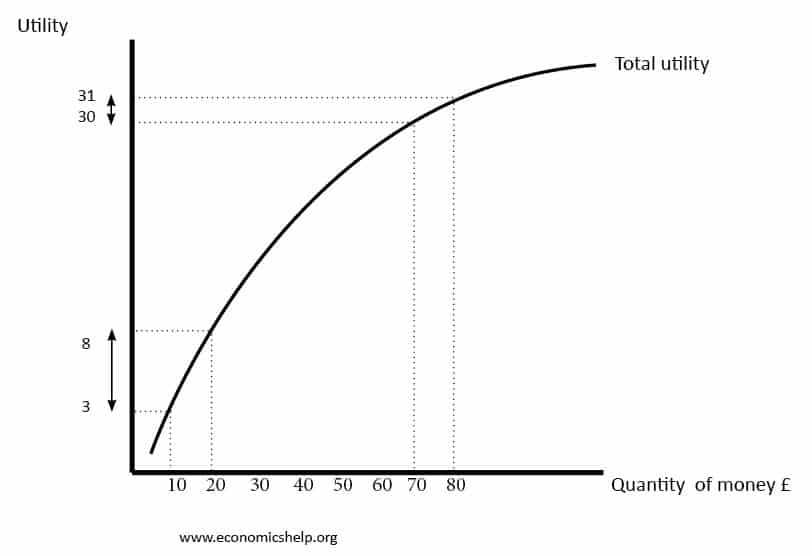
law of diminishing marginal utility
as a consumer purchases more, additional satisfaction falls with each unit
what does the (diminishing) total utility curve look like?
it increases at a decreasing rate (because of diminishing marginal utility)
maximimizing utility (MU) formula (between 2 goods + 2 prices)
MU x / P x = MU y / P y
if MU x / P x > MU y / P y, buy more of product x (vice versa)