Unit 1: Basic Economic Concepts
ALL TAKEN FROM JACOB CLIFFORD VIDEOS
(1.1) Scarcity
scarcity: products that are finite (have an end)
problem of economics: products are scarce but wants are unlimited → make choices and consider costs
4 economic resources
land: resources found in nature
payment = rent
labor: all human effort
payment = wages
capital: machinery/tools made by humans to gain resources
payment for use = interest
entrepreneurship: innovation + ideas
payment: profit
NOT economic recources = consumer goods, waste, money/stocks (are used to facilitate production)
(1.2) Resource Allocation + Economic Systems
fundamental economic problem
What will be produced?
How will goods/services be produced?
Who will get goods/services?
command economy: government makes decisions for who owns/produces
market economy: private individuals makes decisions for who owns/produces
creates competition between private individuals
traditional economy: cultural customs shape the economy
EX: indigenous communities using bartering and religious/cultural importance to certain goods
mixed economy: mix of command + market economy (private ownership with regulation)
most common economy in the world
households: consumers
firms: producers
allocation systems:
“first come, first serve”
random (lottery)
competition
command (based on need)
price (whoever can pay gets the good/service)
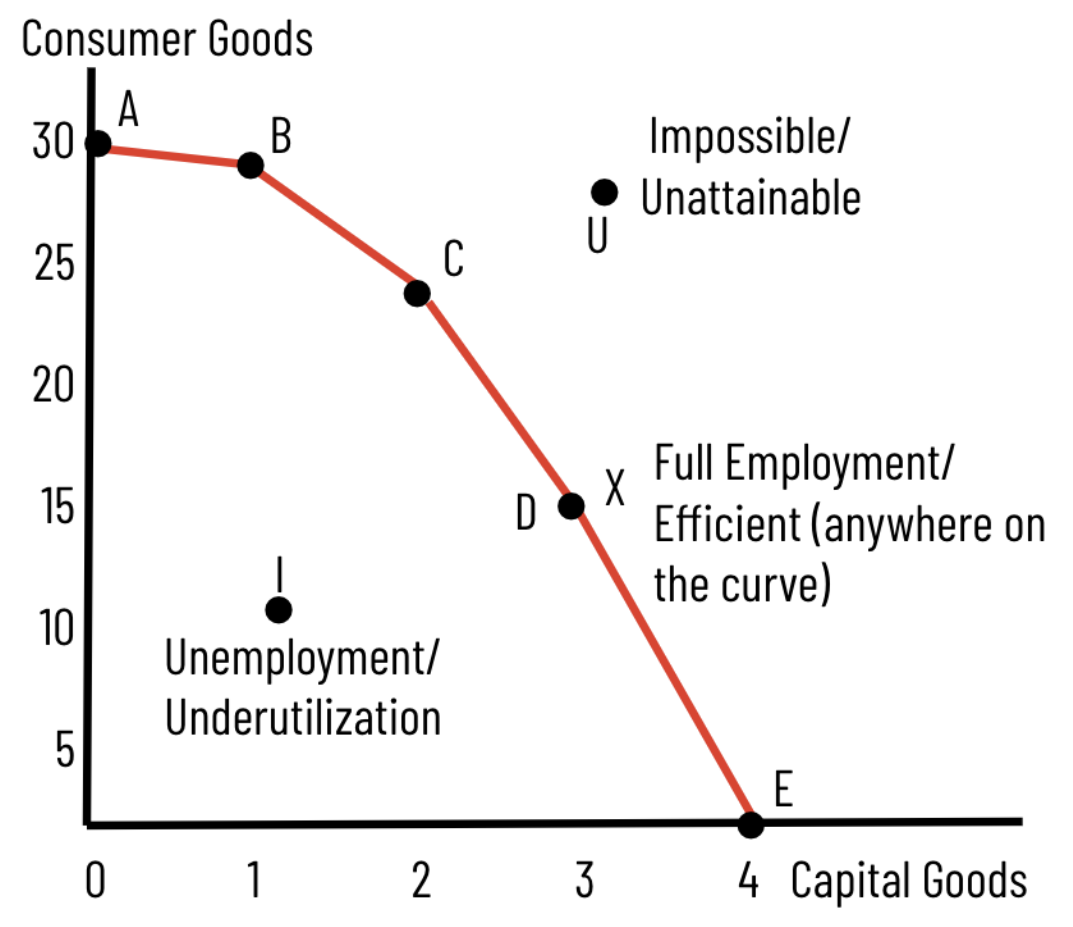
(1.3) Production Possibilities Curve
opportunity cost: how much X product is given up to produce Y product
equation = cost/gains
productions possibilities curve (PPC): conveys what society/factories are capable of producing with given resources
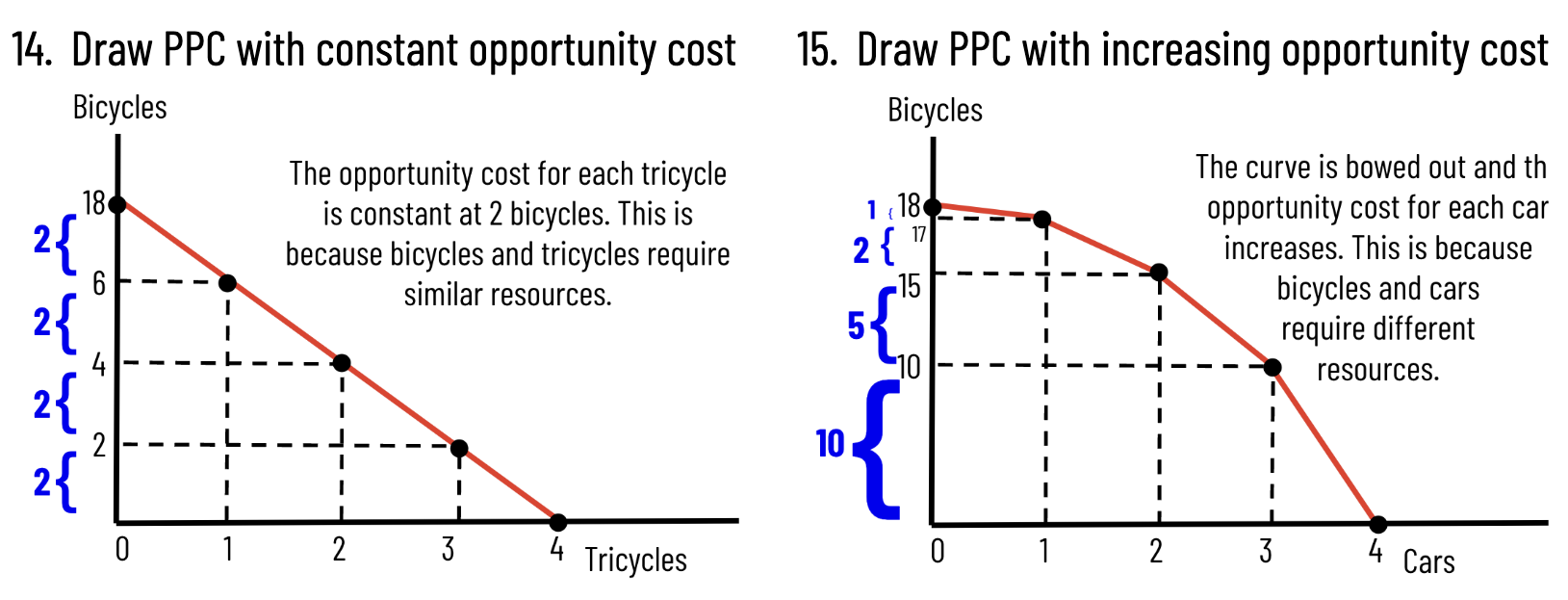
constant PPC: the production level stays the same → constant opp costs
increasing PPC: different resources → bowed out graph
the more technology → PPC bows out more to the right
most realistic PPC graph
(1.4) Comparative Advantage + Trade
absolute advantage: who’s objectively better at each good/service
comparative advantage: who has the lower opportunity cost when they produce a good → specialization
terms of trade: how many of an item should be traded for another to benefit two parties
opp cost of country 1 < ideal price < opp cost of country 2
output questions: asking how much things can be produced in x amount of time
input questions: how much time it takes to produce x amount of products
lower number (less time) = absolute advantage
(1.5) Cost-Benefit Analysis
explicit costs: out of pocket monetary costs
implicit costs: anything you possibly could’ve missed out on when making a choice
shouldn’t factor in something you were going to do anyway (eating lunch at school vs eating lunch at home)
(1.6) Marginal Analysis and Consumer Choice
law of diminishing marginal utility: as consumer gains more of a unit, the additional satisfaction (utils) diminishes
utils are subjective
marginal utility (MU): additional utils consumer gains after each unit
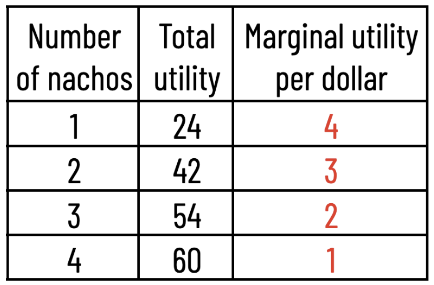
marginal utility per dollar: MU / P (price)
utility maximizing rule: consumers money should be sent so that MU x / P x = MU y / P y