Introduction of particulate nature of matter
 Call Kai
 Learn
Learn Practice Test
 Spaced Repetition
 Match
Match Flashcards
 Knowt Play
1/38

Earn XP
Description and Tags
Name | Mastery | Learn | Test | Matching | Spaced | Call with Kai | Chat |
|---|
No analytics yet
Send a link to your students to track their progress
39 Terms
What are elements ?
They are the primary constituents of matter
Can elements be broken down ?
NO. they can not be chemically broken into simpler substances
What are compounds ?
they consist of atoms from different elements chemically bonded together in a fixed ratio
What do mixtures contain?
they contain more than one element or compound in no fixed ratio
Are mixtures chemically bonded ?
are not chemically bonded and so can be separated by physical methods
How do we classify matter ?

What are the different separation techniques
starting from now ill be making each separation technique
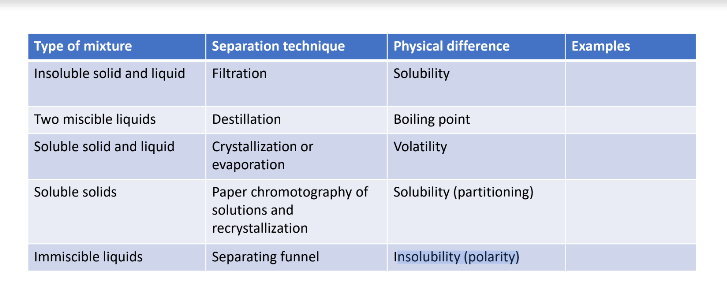
How do we separate an insoluable solid and liquid?
through filteration, the physical different being solubility
How to be separate 2 miscible liquids ?
through destillation the physical difference being the boiling point
How to be separate a soluable solid and liquid ?
through crystalization or evaporation the physical difference being volatility
How to be separate soluable solids ?
through Paper chromotography of solutions and recrystallization
the psycial difference being Solubility (partitioning)
How to be separate Immiscible liquids?
through separating funnel the physical difference being insolubility (polarity)
What are the qualities of a solid ?
particles are closely packed
inter-particle forces are strong + particles vibrate in position
they have a fixed shape
fixed volume
what are the qualities of a liquid
particles are more spaced out
inter-particle forces are weaker + can slide over each other
no fixed shape
they have a fixed volume
what are the qualities of a gas
particles are fully spread out
interparticle forces nagligble + particles move freely
no fixed shape
no fixed volume
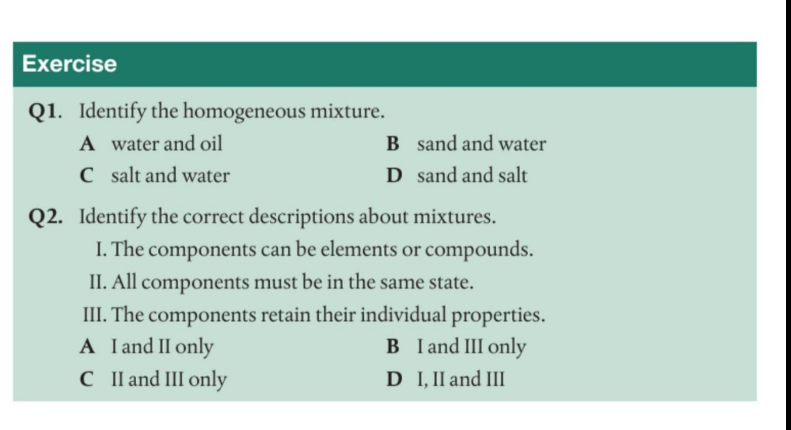
quick test
Answers:
Q1: salt and water
Q2: D
What is kinetic energy ?
the different ways molecules can store energy
what elements are found in their native form ?
nitrogen and gold are specifically found in their native form
what is a native form
they are uncombined with other elements in nature
in what way are elemenst most commonly found ?
in chemical combinations with other elements i.e. chemical compunds
Are the chemical and physcial properties of different compounds from their component elememts
yes!
what does it mean if a mixture is interspersed?
it means that the scattered amongst other things
e.g. air is a mixture due to the different elements and comounds are interspersed
What is a homogeneous mixture
having a uniform composition of properties throughout
what is a heterogenous mixture
having a non-uniform compostion and its properties are not the same throughout
what techniques are used to be able to separate the compoenets in mixtures?
solution and filteration
distillation
response to magnets
paper chromomatography
How does filteration work ?
is the process where a solid is separeted from a liquid or a gas using membrane
How does distillation work?
is used to separate a solvent from a solute
what is paper chomatography ?
what is the kinetic molecular theory?