business revenue and cost - p1 business a level
 Call Kai
 Learn
Learn Practice Test
 Spaced Repetition
 Match
Match Flashcards
 Knowt Play
1/8

Earn XP
Description and Tags
eduqas exam board
Name | Mastery | Learn | Test | Matching | Spaced | Call with Kai | Chat |
|---|
No analytics yet
Send a link to your students to track their progress
9 Terms
define costs, revenue and profit and the formulas to it
Revenue: the income a business receives from selling its goods or services. (Formula: Total Revenue (TR) = Selling Price × Quantity Sold)
Costs: are the expenses incurred by a business in producing and selling its goods/services. (formula for total cost TC =TFC + TVC)
Profit: amount left after total costs have been deducted from total revenue.(Formula: Profit = Total Revenue − Total Costs)
loss: occurs when total costs are greater than total revenue. (Formula: Loss = Total Costs − Total Revenue) If the answer is negative, the business has made a loss
what is fixed, variable, semi-variable, direct, indirect/overhead costs and total costs(different types of costs)
Fixed cost: costs that do not change as the level of output changes, within a given period/capacity. Examples: Rent, Insurance, Business rates
Variable: costs change as the level of output changes. The more units produced, the greater the total variable cost. Examples: Raw materials, Packaging, Wages (Formula: Total Variable Cost = Variable Cost per Unit × Quantity Produced)
Semi-variable costs: contain both a fixed element and a variable element. Example: Electricity/utility bills (Formula: Semi-variable cost = Fixed element + Variable element)
Direct costs: costs that can be directly attributed to the production of a particular product or service. Examples: Raw materials used in a product, Direct production labour, A specific licence used for one product. Example: A furniture business produces tables. The wood used for each table is a direct cost because it can be directly linked to the tables produced.
Indirect costs: costs that cannot be directly attributed to one particular product or service and therefore support the business as a whole. They are also known as overheads. Examples: Factory rent, Accountant's salary, Business insurance, Advertising for the whole business. Example: A factory produces five different products. The factory's rent cannot easily be attributed to just one product, so it is an indirect/overhead cost.
How can revenue, costs and profit affect a business and its stakeholders?
Owners/shareholders: Higher profit can lead to: Greater returns, More retained profit, Increased business value, Greater ability to expand. Lower profit can reduce these benefits.
Employees: Higher profit may allow: Higher wages, Bonuses, Better working conditions, More training, Greater job security However, cost-cutting may cause: Redundancies, Wage reductions, Less training
Customers: Higher costs may result in: Higher prices → potentially lower demand Cost reductions could allow: Lower prices → potentially higher demand However, excessive cost-cutting may reduce quality.
Suppliers: A profitable business may: Buy more from suppliers, Pay suppliers reliably, Expand orders A struggling business may: Reduce orders, Delay payments, Negotiate lower prices
Government: A profitable business can generate: Corporation tax, Employment, Income tax/National Insurance from employees, VAT from sales
Local community: A successful business may: Create jobs, Increase local spending, Invest in premises A failing business may: Close, Cause unemployment, Reduce local economic activity
what is contribution and total contribution
Contribution: amount left from revenue after variable costs have been deducted. It contributes towards paying fixed costs and, once fixed costs have been covered, generates profit. formula: Contribution per Unit = Selling Price per Unit − Variable Cost per Unit
Total contribution: the total amount contributed by all units sold towards fixed costs and profit. (Formula: Total Contribution = Contribution per Unit × Quantity Sold OR: Total Contribution = Total Revenue − Total Variable Costs)
Profit = Total Contribution − Fixed Costs(contribution relation to profit)
What is break-even and How is break-even calculated using contribution?
Break-even: the level of output where total revenue equals total costs, meaning the business makes neither a profit nor a loss.
At break-even: TR = TC and: Profit = £0
Below break-even: TC > TR → Loss
At break-even: TC = TR → No profit/no loss
Above break-even: TR > TC → Profit
How is break-even calculated using contribution?
Formula: Break-even Output = Fixed Costs ÷ Contribution per Unit or Break-even Output = Fixed Costs ÷ (Selling Price − Variable Cost per Unit)
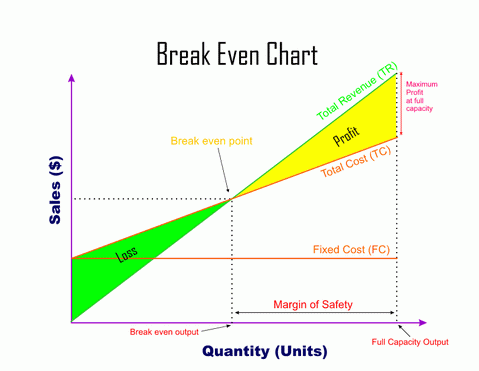
draw and fully label a break even chart
Fixed cost line: Horizontal because fixed costs do not change with output.
Variable cost line: Starts at £0 and rises as output increases because variable costs increase with production.
Total cost line: Starts at the level of fixed costs because: TC = FC + VC At zero output: TC = FC It then rises as variable costs increase.
Total revenue line: Starts at £0 because: TR = Price × Quantity At zero sales: TR = £0 It rises as more units are sold.
The break-even point is where the total revenue line intersects the total cost line. (TR = TC) Therefore: Profit = £0
Total Costs > Total Revenue=The business is making a loss.
Profit area Where: Total Revenue > Total Costs
Margin of safety is the amount by which actual or forecast sales can fall before the business reaches its break-even point.
Formula: Margin of Safety = Actual/Forecast Output − Break-even Output.
What does a large margin of safety mean?
Generally: Lower risk because sales can fall substantially before the business makes a loss.
What does a small margin of safety mean? Generally: Higher risk because even a small fall in sales could result in a loss
How can the effects of changes in costs and revenue be illustrated on a break-even chart
Change | Contribution | Break-even | Chart effect |
|---|
Fixed costs ↑ | No change | ↑ | TC shifts up |
Fixed costs ↓ | No change | ↓ | TC shifts down |
Variable costs ↑ | ↓ | ↑ | VC & TC become steeper |
Variable costs ↓ | ↑ | ↓ | VC & TC become less steep |
Selling price ↑ | ↑ | ↓ | TR becomes steeper |
Selling price ↓ | ↓ | ↑ | TR becomes less steep |
How can changes in costs and/or revenue affect break-even?
The key relationship is:
Fixed costs: Fixed costs ↑ → Break-even ↑ because more contribution is required to cover the higher fixed costs.
Variable costs: Variable costs ↑ → Contribution ↓ → Break-even ↑ because each unit contributes less towards fixed costs.
Selling price : Selling price ↑ → Contribution ↑ → Break-even ↓ because each unit contributes more towards fixed costs.
what is the usefulness of break-even to a business and its stakeholders
Business — usefulness
Advantages:
Planning: Shows the minimum output/sales needed to avoid a loss, helping managers set sales targets.
Risk assessment: Margin of safety shows how far sales can fall before the business makes a loss.
Pricing decisions: Shows how changes in price affect contribution and break-even.
Cost decisions: Shows how changes in fixed/variable costs affect break-even and profit..
Investment decisions: Can help assess whether expected sales are sufficient to cover the costs of expansion.
Disadvantages:
Based on assumptions: Assumes selling price, variable costs and fixed costs remain predictable.
Demand may change: Actual sales may differ from forecasts, making the break-even calculation inaccurate.
Costs may change: Bulk discounts, inflation or unexpected costs can make the calculation less reliable.
Multiple products: Different products have different prices/contribution, making one break-even figure less useful if the sales mix changes.
Owners/shareholders:
Useful: Helps assess profit potential and business risk.
Limitation: They should also consider other information, such as cash flow and market conditions.
Employees:
Useful: A high margin of safety may indicate greater job security.
Limitation: Cost-cutting to improve break-even could cause redundancies or lower wages.
Customers
Useful: Helps the business make pricing decisions.
Limitation: Raising prices to increase contribution could make products less affordable and reduce demand.
Lenders
Useful: Shows the level of sales needed to cover costs, helping assess risk.
Limitation: Break-even does not show whether the business has enough cash to repay debt.
Suppliers
Useful: A business comfortably above break-even may be more likely to place and pay for orders reliably.
Limitation: Break-even does not guarantee the business will have sufficient cash flow.
Government
Useful: A profitable business can provide tax revenue and employment.
Limitation: Break-even does not directly show the wider economic impact of the business.
Local community
Useful: A business with a strong margin of safety may be more likely to remain open and provide jobs.
Limitation: Cost-cutting or closure could lead to unemployment and reduced local spending.