Head and Neck Anatomy
 Call Kai
 Learn
Learn Practice Test
 Spaced Repetition
 Match
Match Flashcards
 Knowt Play
1/55

Earn XP
Description and Tags
Study questions for comprehensive final
Name | Mastery | Learn | Test | Matching | Spaced | Call with Kai | Chat |
|---|
No analytics yet
Send a link to your students to track their progress
56 Terms

Which of the following planes divides the body in anatomic position into right and eft halves?
A- Horizontal plane
B-Median plane
C- Coronal plane
D- Frontal plane
B- Median plane
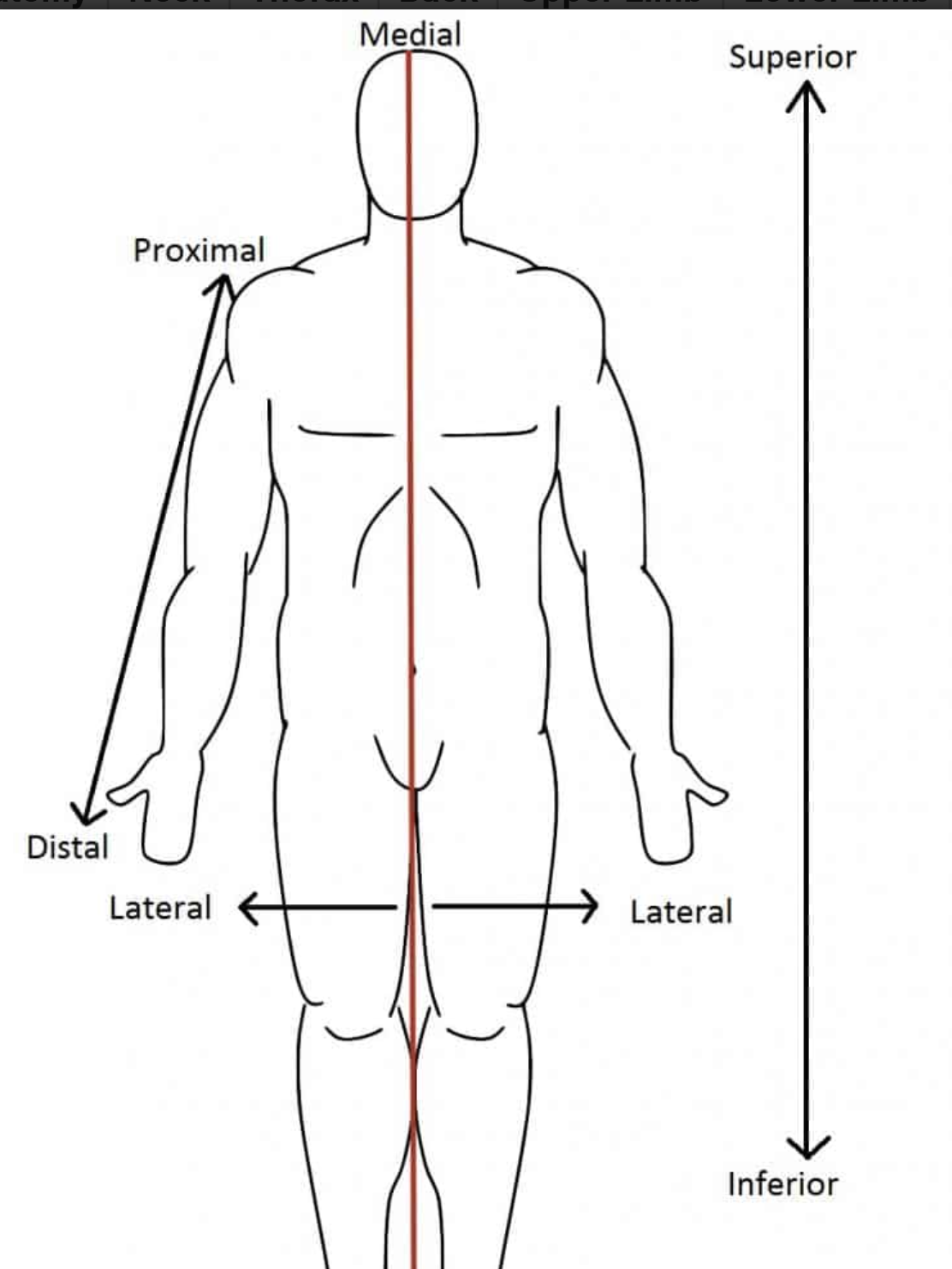
Which of the following terms is used to describe an area of the body that is farther from the median plane?
A- Proximal
B- Lateral
C- Medial
D- Ipsilateral
E- Contralateral
B- Lateral
Structures on the same side of the body are considered
A- Proximal
B- Lateral
C- Medial
D- Ipsilateral
E- Contralateral
D- Ipsilateral
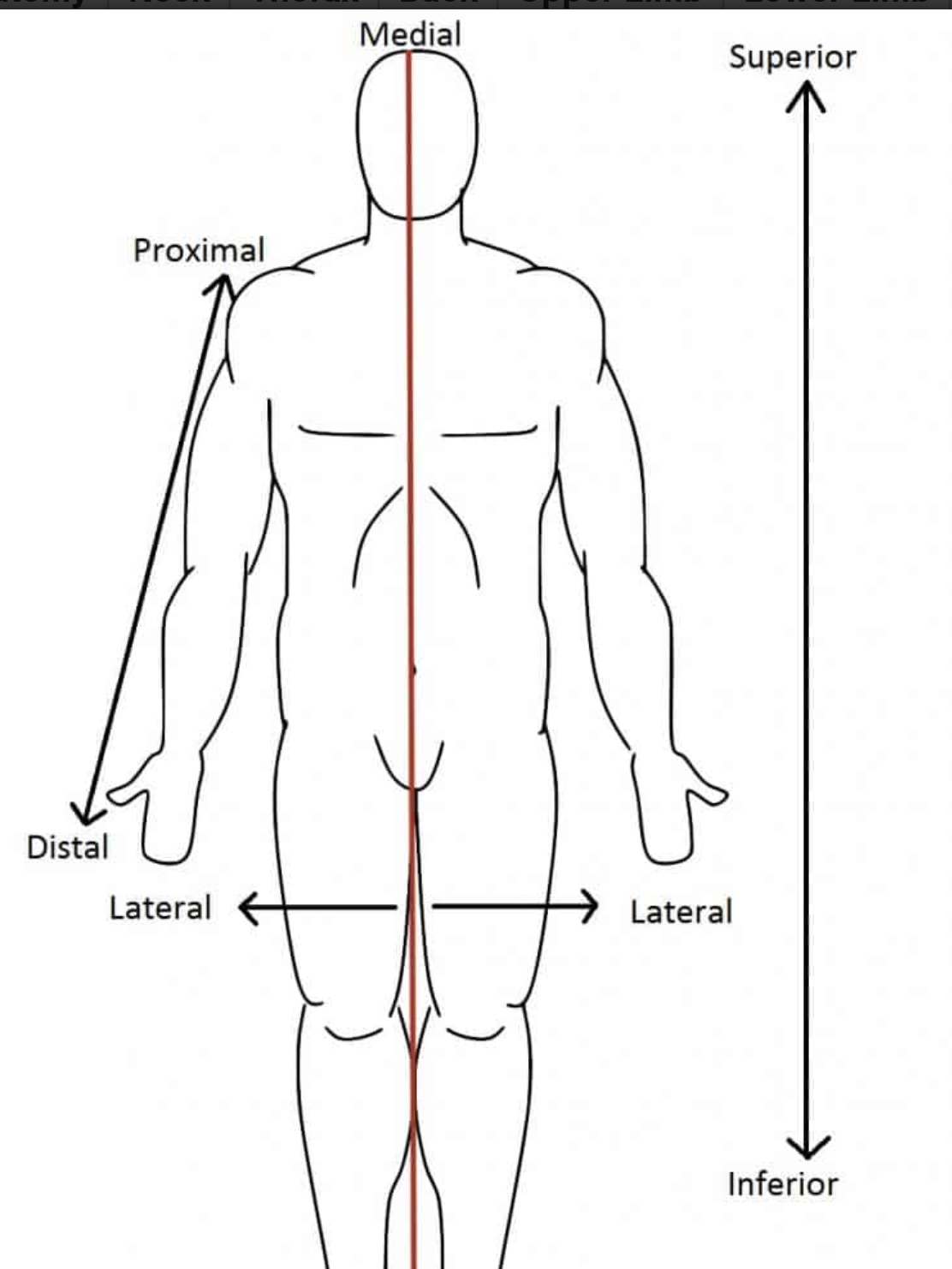
An area of the body in anatomic position that faces toward the head is considered
A- Superior
B-Inferior
C-Proximal
D- Dorsal
A- Superior

Through which plane of the body in anatomic position is a mid-sagittal section taken?
A- Horizontal plane
B- Median plane
C- Coronal plane
D- Frontal plane
B- Median plane
Which of the following statements concerning anatomic position is CORRECT?
A- Body is erect with eyes looking forward
B- Arms are at sides with palms directed backwards
C- Arms are behind the head with toes directed forward
D- Body is supine with eyes closed
A- Body is erect with eyes looking forward
Which of the following sections is considered also a horizontal section?
A- Midsagittal section
B- Transverse section
C- Frontal section
D- Median section
B- Transverse section
Structures that are located inward, away from the body surface are considered
A- Distal
B- Superficial
C- Deep
D- Contralateral
E- External
C- Deep
What gross anatomy (macroscopic) structures can be seen with your eyes?
Bones, Muscles, Teeth
What structures in microscopic anatomy are to small to be seen with the naked eye?
Cells and tissues
Why is the study of head and neck anatomy important for dental professionals?
Extraoral examinations, Intraoral examinations, radiologic exam/interpretation, identifying sources of infection and pathways of spread, patient referral for abnormal findings, treatment planning, and safe and effective delivery of local anesthesia.
Those structures in the oral region that are closest to the tongue are considered
A- Buccal
B- Facial
C- Lingual
D- Pharyngeal
E- Palatal
C- Lingual
Which of the following terms is used to described the smooth, elevated area between the eyebrows in the frontal regions?
A- Supraorbital ridge
B- Medial canthus
C- Glabella
D- Alae
E- Auricular region
C- Glabella
In which region of the head and neck is the tragus located?
A- Frontal region
B- Nasal region
C- Auricular region
D-Anterior cervical triangle
E- Submandibular triangle
C- Auricular region
The tissue at the junction between the labial or buccal mucosa and the alveolar mucosa is the
A- Mucogingival junction
B- Mucobuccal fold
C- Vermillion zone
D- Labial frenum
E- Labiomental groove
B- Mucobuccal fold
Into which of the following cervical triangles does the sternocleidomastoid muscle divide the neck region?
A- Superior and inferior triangles
B- Medial and lateral triangles
C- Anterior and posterior triangles
D- Proximal and distal triangles
C- Anterior and posterior triangles
The parietal and occipital regions are covered by the
A- Temporal region
B- Layers of the scalp
C- eyelids with their tear ducts
D- external acoustic meatus
B- Layers of the scalp
Which of the following statements concerning the location of the medial canthus is CORRECT when comparing it with the lateral canthus?
A- Nearer to the nose
B- Nearer to the ear
C-Where the upper and lower eyelid meet
D- Where the upper and lower lip meet
A- Nearer to the nose
Which of the following structures extends from just inferior to the lateral margin of the eye toward the ear?
A- Pterygomandibular fold
B- Zygomatic arch
C- Sulcus terminalis
D- Sternocleidomastoid muscle
B- Zygomatic arch
The opening from the oral region into the oropharynx is the
A- Fauces
B- Palatine tonsils
C- Pterygomandibular fold
D- Nasopharynx
A- Fauces
Which of the following terms is used for the small papilla at the anterior end of each sublingual fold?
A- Lingual frenum
B- Plica fimbriata
C- Foliate papilla
D- Sublingual caruncle
E- Incisive papilla
D- Sublingual caruncle
Which of the following structures is the opening in the center of the iric?
A- Sclera
B- Pupil
C- Orbit
D- Iris
B- Pupil
Which of the following structures is located between the tragus and the antitragus?
A- Orbit of the eye
B- Intertragic notch
C- Angle of the mandible
D- Helix of the ear
E- Labial commissure
B- Intertragic notch
Which of the following structures separates the lower lip from the chin?
A- Vermillion zone
B- Tubercle of the upper lip
C- Labial commissure
D- Labiomental groove
E- Nasolabial sulcus
D- Labiomental groove
Which of the following structures is located on the dorsal surface of the tongue?
A- Labiomental groove
B- Mucobuccal fold
C- Median lingual sulcus
D- Pterygomandibular fold
E- Median palatine raphe
C- Median lingual sulcus
Which of the following structures is located directly posterior to the incisive papilla?
A- Palatine rugae
B- Mucogingival junction
C- Vermillion zone
D- Labial frenum
A- Palatine rugaeThe
The root of the nose is located
A- Midline between the nares
B- Between the eyes
C- At the tip of the nose
D- At the lateral part of each naris
B- Between the eyes
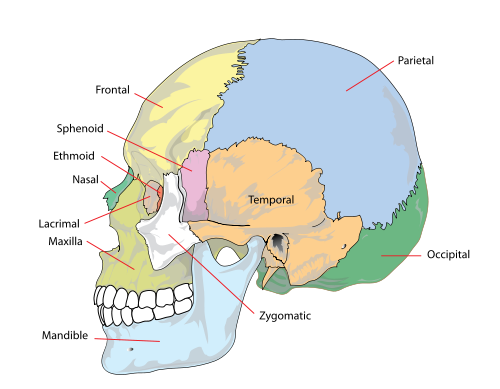
What are the names of the different regions of the head?
Frontal region, Parietal and Occipital regions, Temporal and Auricular regions, Orbital regions, Nasal regions, Infraorbital, Zygomatic, and Buccal regions, Oral region, Mental region
Define surface anatomy
Study of the structural relationships of the external features of the body to the internal organs and parts.
How many regions of the head are there?
A- 5
B- 12
C- 9
D- 10
E- 8
B- 12
What region of the head do the glabella, frontal eminence and Supraorbital ridge belong to?
A- Posterior Region
B- Temporal Region
C- Auricular Region
D- Frontal Region
D- Frontal region
What is the prominent feature of the auricular region?
A- External ear
B- Zygomatic arch
C- Eyeball
D- Labial commissure
A- External ear
What is angular cheilitis?
A- Lesions formed on the tongue
B- Inflammatory lesions at the the labial commissure, often occurring bilaterally
C- White patches on the roof of the mouth
D- Plaque accumulated on the posterior teeth
B- Inflammatory lesions at the labial commissure, often occurring bilaterally
What are Fordyce spots?
A- Initial sign of tooth decay
B- Small, yellowish elevations on the mucosa
C- Cancerous lesions beginning on the tongue
D- They are not real.
B- Small, yellowish elevations on the mucosa
Where are the plica fimbriata located?
A- Dorsal side of the tongue
B- Lateral to the deep lingual veins on both sides
C- Anterior to the circumvallate papilla
D- Base of the tongue
B- Lateral to the deep lingual veins on both sides
What papilla is shaped like a mushroom?
A- Foliate lingual papilla
B- Filiform lingual papilla
C- Parotid papilla
D- Fungiform papilla
D- Fungiform papilla
What are the names of the regions of the neck?
Sternocleidomastoid muscle, Anterior cervical triangle, Posterior cervical triangle, Thyroid cartilage, Larynx, Hyoid bone
Which of the following features is located on the temporal bone?
A- Superior temporal line
B- Foramen rotundum
C- External acoustic meatus
D- Cribriform plate
E- Orbital plate
C- External acoustic meatus
Which area is immediately posterior to the MOST distal tooth in the upper arch of the dentition?
A- Retromolar triangle
B- Postglenoid process
C- Cribriform plate
D- Maxillary tuberosity
E- Hamular process
D- Maxillary tuberosity
In addition to the zygomatic bone, which of the following bones has a process that forms the other part of the zygomatic arch?
A- Temporal
B- Maxillae
C- Sphenoid
D- Palatine
A- Temporal
Which of the following is the location of the articulation of the parietal bones and the occipital bone?
A- Coronal suture
B- Squamosal suture
C- Sagittal suture
D- Lambdoidal suture
D- Lambdoidal suture
Which of the following bony landmarks form an articulation with each other?
A- Occipital condyles with atlas
B- Occipital condyles with axis
C- Mandibular fossa with coronoid notch
D- Mandibular fossa with coronoid process
A- Occipital condyles with atlas
Which of the following features is located on the lateral surface of the mandible?
A- Lingula
B- Submandibular fossa
C- Genial tubercles
D- External oblique line
E- Mandibular foramen
D- External oblique line
The orbital apex is composed of the lesser wing of the sphenoid bone and the
A- ethmoid bone
B- Frontal bone
C- Maxillae
D- Palatine bone
E- Lacrimal bone
D- Palatine bone
Which of the following landmarks si forms by the maxillae?
A- Mental spine
B- Mediane palatine suture
C- Retromolar triangle
D- Hamulus
E- Inferior orbital fissure
B- Median palatine suture
Which of the following structures is located or travels within the infratemporal fossa?
A- Masseter muscle
B- Pterygopalatine ganglion
C- Posterior superior alveolar artery
D- Maxillary division of the fifth cranial nerve
C- Posterior superior alveolar artery
The concavity noted on the anterior border of the coronoid process of the mandibular ramus is the
A- Mandibular notch
B- Coronoid notch
C- Temporal fossa
D- Infratemporal fossa
B- Coronoid notch
Which of the following landmarks serves to locate the hyoid bone during and extraoral examination on a patient?
A- Level of the first cervical vertebra
B- Superior and anterior to the thyroid cartilage
C- Articulation with the cartilage of the larynx
D- Inferior and posterior to the “Adam’s apple”
B- Superior and anterior to the thyroid cartilage
Which of the following structures forms the floor of each maxillary sinus?
A- Alveolar process of the maxilla
B- Facial wall of the maxilla
C- Infratemporal surface of the maxilla
D- Lateral wall of the nasal cavity
A- Alveolar process of the maxilla
Which of the following processes is located just inferior and medial to the external acoustic meatus?
A- Pterygoid process
B- Styloid process
C- Mastoid process
D- Hamulus
B- Styloid process
The spaces located under the three conchae of the lateral walls of the nasal cavity are the nasal
A- Ostia
B- Ducts
C- Meatuses
D- Inferior nasal conchae
E- Vestibules
C- Meatuses
Which of the following bones and their processes forms the hard palate?
A- Maxillary processes of the maxillae and horizontal plates of the palatine bones
B- Palatal processes of the maxillae and maxillary plates of the palatine bones
C- Horizontal plates of the palatine bones and palatine processes of the maxillae
D- Maxillary plates of the palatine bones and horizontal processes of the maxillae
C- Horizontal plates of the palatine bones and palatine processes of the maxillae
Which of the following cranial nerves is associated with the stylomastoid foramen?
A-Fifth cranial nerve (trigeminal nerve)
B- Seventh cranial nerve (facial nerve)
C- Ninth cranial nerve (glossopharyngeal nerve)
D- Tenth cranial nerve (Vagus nerve)
E- Eleventh cranial nerve (Accessory nerve)
B- Seventh cranial nerve (facial nerve)
Which of the following bones of the skull is paired?
A- Sphenoid
B- Ethmoid
C- Occipital
D- Vomer
E- Parietal
E- Parietal
Which of the following bony plates is perforated to allow the passage of the olfactory nerves for the sense of smell?
A- Medial plate of sphenoid bone
B- Lateral plate of sphenoid bone
C- Perpendicular plate of ethmoid bone
D- Cribriform plate of ethmoid bone
D- Cribriform plate of ethmoid bone