CHEM08LC Lab Final Questions
 Call Kai
 Learn
Learn Practice Test
 Spaced Repetition
 Match
Match Flashcards
 Knowt Play
1/55

There's no tags or description
Looks like no tags are added yet.
Name | Mastery | Learn | Test | Matching | Spaced | Call with Kai | Chat |
|---|
No analytics yet
Send a link to your students to track their progress
56 Terms
(Experiment 1) Which of the following are examples of vicinal halohydrins?
The ones where the halogen is ortho to the OH.
Aromatic with one alkene reacts with Br2 to form what?
2 bonds to Br+
Why does the nucleophile attack the halonium ion? (Multiple correct)
a
the halonium ion is electron-rich and likes electrons
b
the halogen is electronegative and renders the adjacent carbon atoms electrophilic
c
attacking the halonium ion opens the 3-membered ring to produce a molecule with less strain
d
the nucleophile is electron-poor and therefore interacts with the electron-rich halonium ion
e
the halogen is electropositive and renders the adjacent carbon atoms nucleophilic
B and C
OxoneTM consists of a 2:1:1 molar mixture of KHSO5 (152.20 g/mol), KHSO4 (136.17 g/mol), and K2SO4 (174.26 g/mol). KHSO4 and K2SO4 act to stabilize the active oxidant. Based on their molecular weights, approximately 49.5% of the OxoneTM reagent you will measure out corresponds to the active oxidant. How many mmol of KHSO5 is present in 1 gram of OxoneTM?
3.25
How many mL of indene should you measure out if 2.15 mmol is required for the experiment? The density, ρ, of indene 0.997 g/mL.
0.25 mL
What is OxoneTM?
a
a reductant of ozonolysis
b
O3
c
KHSO5
d
a 2:1:1 mixture of KHSO5/KHSO4/K2SO4
e
KHSO4
D
You will be "rotovapping" a 1:1 mixture of acetonitrile/water. It is unlikely that all of the solvent will evaporate. Which solvent will remain and why?
a
water will remain because it has a higher boiling point
b
acetonitrile will remain because it has a higher boiling point
c
acetonitrile will remain because it has a lower density
d
water will remain because it has a higher density
e
both solvents will evaporate similarly and an equal mixture of acetonitrile/water will remain
A
The solids obtained by vacuum filtration is mostly pure. Which of the following statements is false?
a
the product is a solid that can be isolated by filtration
b
most unreacted indene should pass through the filter because it is a liquid
c
acetonitrile and indene are possible impurities contaminating the product
d
formation of a diastereomeric product is possible, which can contaminate the major product
e
vacuum filtration is capable of removing impurities because it is similar column chromatography
E
Which of the following are true regarding alkenes?
a
Alkenes contain a triple bond
b
Alkenes and olefins refer to different functional groups
c
Alkenes are C=N bonds
d
Alkenes are C=O bonds
e
Alkenes are C=C bonds
e
Alkenes are C=C bonds
How many alkenes can you count in palbociclib?
4
Which of the following statements are FALSE regarding carbonyl compounds?
a
Aldehydes and ketone are carbonyl compounds
b
Carbonyl compounds have C=O bonds
c
Carbonyl compounds have triple bonds
d
Amides and esters are carbonyl compounds
e
None of the above
c
Carbonyl compounds have triple bonds
Is the product of this reaction a stabilized or unstabilized ylide?
a
Stabilized ylide
b
Unstabilized ylide
c
Neither stabilized nor unstabilized
d
Not enough information to determine
b
Unstabilized ylide
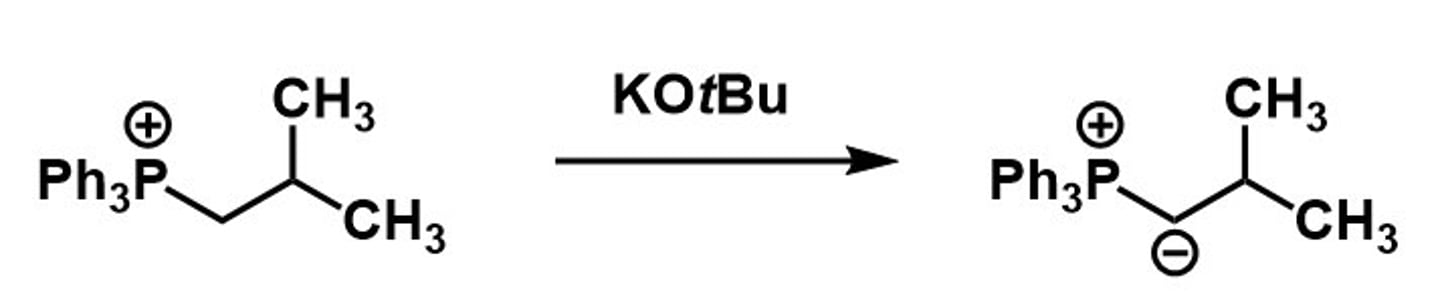
Which of the product is correct for this reaction?
a
Z-alkene
b
E-alkene
c
Both are correct
d
Both are incorrect
a
Z-alkene
What is a heterocycle?\
a
a molecule that contains two different rings
b
any cyclic ring structure
c
a cyclic ring structure that contains only carbons and hydrogens
d
a cyclic ring structure that contains any element(s) outside of carbons and hydrogens
e
a non-cyclic molecule that becomes a cyclic molecule
d
a cyclic ring structure that contains any element(s) outside of carbons and hydrogens
Referring to Figure 2 above, which statement is false?
a
primary amines are more reactive than secondary amines
b
quaternary ammonium salts do not participate in SN2 reactions
c
secondary amines are more reactive than primary amines
d
a mixture of secondary amine, tertiary amine, and quaternary ammonium salt forms
e
amines are nucleophiles
a
primary amines are more reactive than secondary amines
Which of the following are false regarding the mechanism of imine formation?
a
the carbonyl reacts with the nucleophile
b
the hemiaminal can be converted to the imine or back to the starting materials
c
the imine can be converted back to the hemiaminal
d
the hemiaminal is more stable than the imine
e
the hemiaminal cannot proceed to form an imine in the mechanism
d
the hemiaminal is more stable than the imine
e
the hemiaminal cannot proceed to form an imine in the mechanism
The synthesis of compound X requires 2 steps. The first step was accomplished in 80% yield and the second step in 80% yield. What is the overall yield of the 2-step synthesis?
a
80%
b
160%
c
81%
d
64%
e
72%
d
64%
What has happened by the time a homogeneous mixture is formed from the two solids?
a
the substances have decomposed
b
the imine is formed
c
the solids have melted
d
the amine is formed
e
nothing will happen until the next step
b
the imine is formed
What can happen if too much hexanes is used in the recrystallization?
a
the product can decompose
b
the yield will be significantly lower
c
the yield will be >100%
d
hexanes is a polar solvent so it can absorb water and complicate the recrystallization process
e
hexanes is a non-polar molecule, which can increase the yield of the reaction
b
the yield will be significantly lower
What is the most important piece of information that we can obtain from the IR spectrum at this step?
a
product formation can be distinguished by looking at the C-H stretches between 2850-3150 cm-1
b
product formation can be distinguished by the presence of an O-H stretch between 3200-3400 cm-1
c
product formation can be distinguished by looking for new C=C stretches at approximately 1600-1650 cm-1
d
consumption of starting material can be distinguished by the disappearance of the C=O stretch at approximately 1700 cm-1
e
the IR spectrum is only meaningful when used in conjunction with NMR spectroscopy
d
consumption of starting material can be distinguished by the disappearance of the C=O stretch at approximately 1700 cm-1
d
consumption of starting material can be distinguished by the disappearance of the C=O stretch at approximately 1700 cm-1
Is p-toluidine or o-vanillin expected to have a lower Rf?
Select an answer and submit. For keyboard navigation, use the up/down arrow keys to select an answer.
a
p-toluidine should have the lower Rf because it is the more polar molecule
b
o-vanillin should have the lower Rf because it is the less polar molecule
c
p-toluidine should have the lower Rf because it is the less polar molecule
d
o-vanillin should have the lower Rf because it is the more polar molecule
e
it is impossible to distinguish
a
p-toluidine should have the lower Rf because it is the more polar molecule
Which of the following statements are true with respect to Figure 3?
a
Aniline can neither be synthesized from SN2 reactions nor reductive aminationsAniline can neither be synthesized from SN2 reactions nor reductive aminations
b
Aniline can be synthesized through a reductive amination
c
SN2 reactions cannot proceed with iodobenzene
d
SN1 reaction can proceed with iodobenzene
e
SN2 reactions can proceed with iodobenzene
a
Aniline can neither be synthesized from SN2 reactions nor reductive aminationsAniline can neither be synthesized from SN2 reactions nor reductive aminations
Which of the following statements are true for household bleach? (Select all that apply.)
a
bleach contains 5.25%-5.75% sodium hypochlorite
b
bleach is mainly chlorine gas
c
bleach is mainly sodium hydroxide
d
sodium hypochlorite is in equilibrium with chlorine gas and sodium hydroxide
e
sodium hypochlorite is safe when dilute
a
bleach contains 5.25%-5.75% sodium hypochlorite
d
sodium hypochlorite is in equilibrium with chlorine gas and sodium hydroxide
e
sodium hypochlorite is safe when dilute
What is the role of bleach in this experiment?
a
to disinfect glassware
b
to kill bacteria that would interfere with the Hofmann rearrangement
c
to be used as a clean source of water
d
to be used as a convenient source of chlorine
e
to be used as a source of strong acid
d
to be used as a convenient source of chlorine
The pKa's refer to the protons highlighted in blue. Select all of the correct statements.
a
Butane is more acidic than acetone
b
Acetone is more acidic than butane
c
Butane can be deprotonated by NaOH (pKa = 15) or LDA (pKa = 35.7)
d
Acetone can be deprotonated by NaOH (pKa = 15) or LDA (pKa = 35.7)
e
Butane can deprotonate acetone
b
Acetone is more acidic than butane
d
Acetone can be deprotonated by NaOH (pKa = 15) or LDA (pKa = 35.7)
Which of the following statements is false?
a
The higher the pKa, the harder it is to deprotonate the hydrogens
b
The higher the pKa, the easier it is to deprotonate the hydrogens
c
The pKa of a molecule is low when the molecule can form a stabilized carbanion after deprotonation
d
Deprotonation of acetone forms a stabilized enolate carbanion
e
Acetone is more acidic than pentane
b
The higher the pKa, the easier it is to deprotonate the hydrogens
Identify the main electrophile in the reaction depicted in Figure 3(Aldol Condensation)?
a
HCl
b
Aldehyde
c
αβ-Unsaturated ketone
d
Ketone
e
β-Hydroxyketone
b
Aldehyde
Which of the molecules drawn on the product side of the chemical reaction is incorrect?
A
B
C
D
B

Why is a reflux condenser needed for this experiment?
a
It is not really necessary.
b
To prevent dust and dirt in the air from entering the reaction apparatus
c
It helps to heat the reaction mixture
d
It prevents the solvent from boiling away by condensing the vapors
d
It prevents the solvent from boiling away by condensing the vapors
What is the purpose of adding 6 M HCl?
a
To protonate the aldehyde
b
To react with acetone
c
To promote elimination of water in the aldol condensation
d
To heat up the ice
c
To promote elimination of water in the aldol condensation
What is the solid precipitate that forms when the mixture is acidified with 6 M HCl?
a
Hydrogen chloride
b
The β-hydroxyketone
c
Sodium chloride
d
αβ-Unsaturated ketone
e
Vanillin
d
αβ-Unsaturated ketone
Which of the following statement is false regarding TLC analysis?
a
It provides an indication of the progress of the reaction.
b
It provides information on the purity of the substance.
c
Silica gel acts as the stationary phase.
d
Ethyl acetate acts as the mobile phase.
e
Hexanes acts as the stationary phase.
e
Hexanes acts as the stationary phase.
The molecular ion, M+, is
a
an ionized fragment of the molecule that is smaller than the molecular weight
b
a positively charged molybdenum ion
c
the ionized form of the molecule with a mass that corresponds to the molecular weight of the molecule
d
the largest peak in the NMR spectrum
e
always the tallest signal in the mass spectrum
C
The molecular ion for an unknown carboxylic acid has m/z = 122. Using the Rule of 13, determine a possible molecular formula. Hint: consider how many oxygen atoms a carboxylic acid should have.
a
C9H5
b
C8H12N
c
C6H2O3
d
C8H10O
e
C7H6O2
E
Select all that is true regarding Nafion resin 417.
a
It protonates the carboxylic acid
b
It is a solvent for Fischer esterification
c
It is a solid that can be conveniently removed by filtration
d
It is a superacid
e
It is a superbase
A, C, D
Which of the following molecules has 4 degrees of unsaturations?
a
cyclohexene
b
cyclohexadiene
c
butadiene
d
benzene
e
cyclohexane
D
How many degrees of unsaturation does the compound with molecular formula C6H12O6 have?
a - 0
b - 1
c - 2
d - 3
e - 4
B
What is glacial acetic acid?
a
acetic acid that contains minimal water
b
regular vinegar
c
acetic acid extracted from glaciers
d
acetic acid with ice
e
a specific brand of acetic acid
A
When extracting water with diethyl ether, which of the follow statement(s) are correct?
a
Diethyl ether is less dense than water
b
The organic and aqueous layers are completely immiscible
c
Diethyl ether is the top layer
d
Water is the top layer
e
The product preferentially goes into the aqueous layer
A, B, C
What important information can be derived from IR spectroscopy?
a
key functional groups present in the sample
b
the total number of carbons in the molecule
c
the melting and boiling points of the sample
d
the total number of C=O bonds in the molecule
e
The size of the molecule
A
Ethanol - Is the H on the OH best described as a hydrogen, proton, or hydride?
Proton
LiAlH4 - Is the H best described as a hydrogen, proton, or hydride?
Hydride
Acetic acid - Is the H on OH best described as a hydrogen, proton, or hydride?
Proton
Methyl acetate - Is the H in CH3 best described as a hydrogen, proton, or hydride?
Proton
Benzene - Is the H best described as a hydrogen, proton, or hydride?
Hydrogen
Pyridinium - Is the H best described as a hydrogen, proton, or hydride?
Proton
Wilkinson's catalyst - Is the H best described as a hydrogen, proton, or hydride?
Hydride
What is the purpose of saving some imine for TLC analysis? Select all that apply.
a
to prevent starting material and product from decomposition
b
to determine reaction progress
c
to decrease the melting point
d
to compare the Rf's of the starting material and product
e
to end the reaction at a later point
B, D
What is in the aqueous layer?
a
ethyl acetate only
b
ethyl acetate and NaBH4
c
NaBH4 and amine product
d
ethyl acetate and amine product
e
water and byproducts from NaBH4
E
What is the consequence if not washed with brine?
a
there will be more water in the organic layer and will require more sodium sulfate for drying
b
there should be no consequence
c
the organic layer will be more pure
d
the organic layer will have more NaCl
e
the experiment will need to be repeated
A
What is the problem with having some ethyl acetate in the IR spectrum?
a
the signals from the imine may disappear
b
the signals from the amine may disappear
c
the signals from residual aldehyde starting material may be blocked
d
all the signals may disappear
e
none of the above
C
A TLC analysis using 10% EtOAc in hexanes indicated an Rf = 0.05 for the product. What should you do from here?
a
Record the Rf and proceed with the experiment according to the procedure
b
Repeat the TLC analysis using a solvent mixture with greater polarity (50% EtOAc in hexanes) to increase the Rf to 0.3.
c
Repeat the TLC analysis using a solvent mixture with lower polarity (15% EtOAc in hexanes) to decrease the Rf to about 0
d
Repeat the experiment entirely because something went wrong
e
Ask TA for help because it is impossible to obtain an Rf = 0.05
B
What is the role of para-toluenesulfonic acid?
a
it is the acid catalyst that reacts with benzaldehyde dimethylacetal
b
it removes water from the reaction
c
it is the acid catalyst that reacts with acetonitrile
d
it is the solvent
e
it is the acid catalyst that reacts with the sugar
A
What is triethylamine reacting with?
a
water
b
unreacted benzaldehyde dimethylacetal
c
para-toluenesulfonic acid
d
acetonitrile
e
unreacted sugar starting material
C
Which of the following is/are true regarding the aqueous layer? (choose any one correct answer)
a
the aqueous layer is beneath the organic layer
b
the aqueous layer consists primarily of water and NaCl
c
the aqueous layer is above the organic layer
d
the aqueous layer consists of ethyl acetate and acetonitrile
e
the aqueous layer is indistinguishable from the organic layer
A or B
What happens if one were to use too much DCM?
a
the product will revert back to starting material (i.e. deprotection)
b
the yield will decrease because the product decomposes
c
the yield will increase because more solids will precipitate
d
there should be no consequences
e
the solution will not be saturated and the product will not precipitate as easily or at all
E