mental wellbeing P2
 Call Kai
 Learn
Learn Practice Test
 Spaced Repetition
 Match
Match Flashcards
 Knowt Play
1/32

There's no tags or description
Looks like no tags are added yet.
Name | Mastery | Learn | Test | Matching | Spaced | Call with Kai | Chat |
|---|
No analytics yet
Send a link to your students to track their progress
33 Terms
Anxiety disorders
Anxiety disorders in DSM
45% of the population will experience an anxiety disorder at some point in their life.
The most common anxiety disorders in Australia are:
◦Generalised Anxiety Disorder
◦Social Phobias
◦Specific Phobias
◦Obsessive-Compulsive Disorder
◦Post-Traumatic Stress Disorder
◦Panic Disorder
What is a phobia?
Everyone is afraid of things and mostly these things are not classed as phobias
If a fear interferes with a person’s social functioning, where they deliberately avoid the distress-causing object, activity or situation to a point where it affects their day-to-day life, it is then diagnosed as a phobic disorder or a phobia.
The person’s fear of the object or event is so intense that they try to avoid the feared stimulus and if faced with it experience acute physiological arousal – the fight-flight response.
A specific phobia is an intense, irrational fear and avoidance of a particular object, activity or situation.
Application of a BIOPSYCHOSOCIAL APPROACH
The Biopsychosocial Framework is an approach to describing and explaining how biological, psychological and sociocultural factors combine and interact to influence a person’s mental health.
Many factors lead to the development of phobic disorder and no single factor can determine whether someone will experience phobic anxiety
You must be able to use the biopsychosocial approach to analyse mental health and the development and progression of phobias
Specific phobias are studied in depth to illustrate how a mental disorder may develop, progress and be treated.
Phobic disorders clearly demonstrate how the interaction of biological, psychological and sociocultural factors can result in an anxiety disorder.
Advice from VCAA
Management of mental disorder
Analysis of any mental disorder should be considered in conjunction with management options.
The psychological basis for the treatment of mental disorders is considered from a biopsychosocial approach.
Students should recognise that treatments are not always easily categorised as being solely ‘biological’, ‘psychological’ or ‘social’ since these are not mutually exclusive.
important table for BIOPSYCHOSOCIAL APPROACH
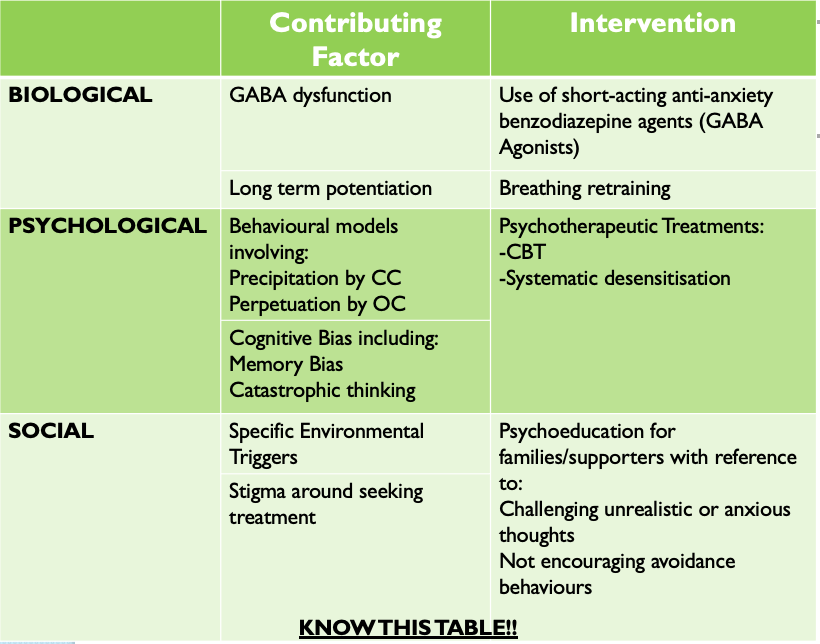
Relative Influences of Contributing Factors to the Development of Specific Phobia
BIOLOGICAL:
◦gamma amino butyric acid (GABA) dysfunction
◦long-term potentiation
PSYCHOLOGICAL:
◦behavioural models involving precipitation by classical conditioning and perpetuation by operant conditioning
◦cognitive bias including memory bias and catastrophic thinking
◦
SOCIAL:
◦specific environmental triggers
stigma around seeking treatment
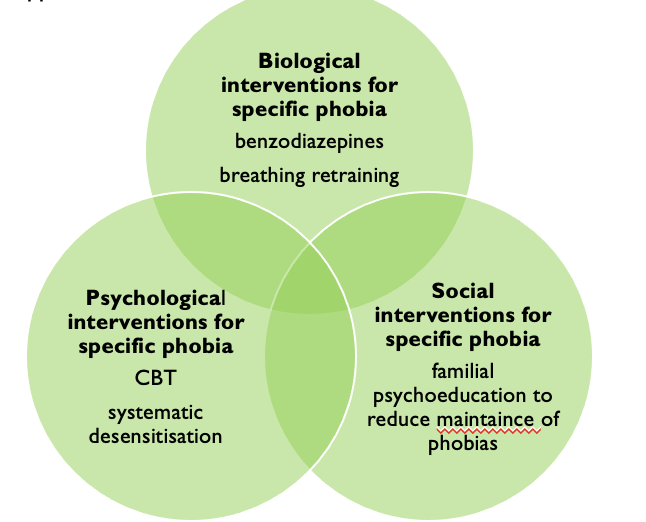
Evidence Based Interventions for Specific Phobia
BIOLOGICAL:
◦the use of short-acting anti-anxiety benzodiazepine agents (gamma amino butyric acid (GABA) agonists)
◦breathing retraining
PSYCHOLOGICAL:
◦CBT
◦Systematic desensitisation
◦
SOCIAL:
◦psycho education for families/supporters with reference to challenging unrealistic or anxious thoughts and not encouraging avoidance behaviours
Evidence Based Interventions
= treatments that have been proven effective based on the integration of clinical research and expertise aimed at changing target behaviour
We will consider each EBI as we discuss the relevant contributing factor.
Biological Contributing Factors
Tries to explain mental disorders based on biological and genetic factors.
Biological factors may include neurotransmitters, heredity and physical health.
Some evidence for genetic inheritance – predisposition but not a guarantee of a disorder
Emerging evidence about the role of the neurotransmitter Gamma Amino Butyric Acid (GABA) has contributed greatly to our understanding and management of phobic anxiety
-not enough GABA makes you anxious
GABA (and Glutamate) are the most common and widespread neurotransmitters in the brain.
GABA is known to be influential in anxiety disorders.
GABA = inhibitory
Gamma Amino Butyric Acid is the primary inhibitory neurotransmitter in the CNS.
◦(It has the opposite effect to Adrenaline and Glutamate, which are excitatory.)
◦
GABA acts to calm or slow down the body’s responses
◦It does this by inhibiting postsynaptic neurons – stops them passing on the neural impulse
◦Gets in the synapse to block transmission
◦Helps fine tune brain activity; keeps neural transmission from getting out of control
◦
If GABA levels are lacking, the stress response is not moderated as effectively as it should be
Treatment – Short acting anti-anxiety Benzodiazepines (GABA Agonists)
Mimic the activity of GABA in inhibiting post synaptic neural activity
Medications known as Benzodiazepines can be used in the short term treatment of phobic anxiety because they enhance the GABA-induced inhibition of over-excited neurons by mimicking the action of GABA
Benzodiazepines – a class of drugs that ‘calm down’ neural activity. Eg. Valiam, Xzanax, Rohypnol, Serepax etc.
Agonists – mimic the activity of a neurotransmitter
One study showed that anxiety disorder sufferers have 22% less GABA than healthy individuals
Short term treatment as it does not treat the underlying cause of the anxiety disorder.
Role of Long Term Potentiation
When we associate fear with a specific stimulus, a new memory circuit with connections within the amygdala (the brain area responsible for adding the emotional content to a memory) is made
LTP = long lasting experience dependent strengthening of neural pathways due to repeated co-activation.
LTP is necessary for learning to take place, including the establishment of a fear response
Exposure to the fear stimulus will strengthen the memory circuit and, via communication with the amygdala, activate multiple brain regions that then produce a variety of symptoms of fear and anxiety.
Evidence based intervention – Breathing Retraining
Breathing retraining is the process of identifying incorrect breathing habits and replacing them with correct ones.
Incorrect breathing includes loud, noisy, rapid or shallow breathing
Retraining will include learning to breathe from the diaphragm, through the nose with slow, even and gentle movements.
This may be taught by deliberately copying a relaxed breathing pattern.
Controlled breathing can cause physiological changes including:
◦Lowered blood pressure and heart rate
◦Reduced levels of stress hormones in the blood
◦Balanced levels of oxygen and carbon dioxide in the blood
◦Improved immune system functioning
◦Increased physical energy
◦Increased feelings of calm and wellbeing
Psychological Contributing Factors
Our psychological state can contribute to the development and perpetuation of a phobia.
◦During times of high emotion, the links we form with stimuli can form powerful memories.
◦An individual who suffers from a phobia pays more attention to threat information about that specific phobia
Behavioural model
This model explains human behaviour through studying observable actions and proposes that phobic anxiety could be the result of learning
It is possible to explain the precipitation (acquisition) of a phobia as a learnt association between two stimuli (CC) and its perpetuation (maintenance) due to rewards and punishments (OC)
Precipitation by CC
CC occurs when two normally unrelated stimuli are repeatedly linked so that existing reflex responses are elicited by the new stimuli that normally would not produce this response
Because phobias are learnt fears, the consistent pairing of a neutral stimulus with an unpleasant stimulus can cause phobic reactions
EG of how CC contributes to PRECIPITATION of a phobia:
When Joan was little a large dog chased her through a playground barking loudly.
Joan experienced extreme fear (rapid pulse, sweating palms, increased breathing rate etc)
Ten years later whenever Joan is approached by a dog she experiences the same reactions
Joan will now avoid areas where dogs may be present and this helps her feel more calm and relaxed.
NS – being approached by a dog
UCS – dog was loud and aggresive
UCR – fear response due to aggressive dog
CS – thought of being approached by a dog
CR – fear response due to thinking about a dog
Perpetuation by OC
OC is a learning process in which the likelihood of a behaviour being repeated is determined by the consequence of that behaviour.
The perpetuation of learnt fear response can be explained via operant conditioning
Avoidance of spiders or spider related places, images etc is negatively reinforcing avoiding the bad stimulus.
This strengthens further avoidance behaviours
Cognitive Model
This model explains human behaviour through investigating internal mental processes, thoughts and memories.
Our cognition is the psychological result of perception, learning and reasoning.
◦We attempt to correctly perceive things so that our understanding of a particular issue or situation is helpful in our everyday functioning.
◦
However, we may sometimes pair faulty reasoning and rationale with fearful stimuli from the environment creating a new faulty cognition.
Key assumption of many cognitive models is that people with phobias often have a cognitive bias – a tendency to think in a way that involves errors, bad judgement and poor decision making.
Cognitive biases may lead to an inaccurate judgement or illogical interpretation of a situation.
There are several types of cognitive bias
Memory bias
= a type of error in thinking that may either enhance or impair the recall of memory, or it may alter the content of what we report remembering.
Memory bias for threatening information may contribute to the development of a phobia because they cause a person to recall negative or threatening information more readily than positive information about a specific object, situation or event they have experienced in the past.
◦Eg. Only remember being dumped by a big wave, not the hundreds of small waves that were enjoyable to jump over
◦
Memories reconstructed to be worse than the actual event
Catastrophic thinking
= the tendency to perceive an object or event as being far more threatening or dangerous than it really is.
Occurs when an individual repeatedly overestimates the potential dangers of an object or event and assumes the worst.
◦Person predicts an unrealistic and irrational outcome of a future event.
◦Person then experiences heightened levels of distress and anxiety and underestimates their ability to cope with the situation
◦The physical symptoms act to reinforce their irrational thoughts
Evidence Based Interventions: Psychotherapies
Psychotherapy = any psychological technique used to facilitate positive changes in personality, behaviour or adjustment.
Most often refers to verbal interaction between trained mental health professionals and their patients.
Treatment approach would use learning and behavioural strategies to ‘unpair’ the conditioned behaviours or ‘unlearn’ what one has been taught by observational learning. New, helpful behaviours would then be taught to the patient through cognitive and behavioural therapy
CBT
Systematic Desensitisation
CBT and phobias
CBT is a psychotherapy based on the principles that changing unrealistic and unhelpful thought patterns will lead to positive changes in behaviour.
The purpose of CBT in treating phobias is to challenge the irrational and negative thoughts and the behaviours they lead to.
The cognitive component aims to assist the client to develop a new understanding that the feared stimulus is not dangerous so their avoidance is unnecessary.
◦Identify anxiety related thoughts and cognitive biases
◦Look at evidence that supports/rejects these biases
◦Switch from unhelpful irrational thoughts to evidence based rational thoughts
◦
The behavioural component aims to change any behaviours that are not helpful or are harmful.
◦May involve behavioural experiments that aim to help the client ‘test out’ the inaccuracy of their cognitive distortions.
Common CBT strategies for Phobias:
A. Relaxation Training – helps to calm mind and body in the presence of the specific phobic stimulus.
Techniques include meditation, guided imagery, progressive muscle relaxation and breathing retraining.
Systematic Desensitisation and Phobias:
A behaviour therapy that aims to replace an anxiety response with a relaxation response when an individual with a specific phobia confronts the fear stimulus
◦Also called graduated exposure
◦
Involves progressively introducing (gradually exposing) the client to the stimuli that produces the fear response
In this way the client is gradually desensitised to the fear or anxiety producing object or event.
The fear inducing situation is broken down into a hierarchy of increasingly difficult situations and then once they are comfortable with the least frightening, they move on to the next one. By confronting their fears they learn to tolerate the fearful
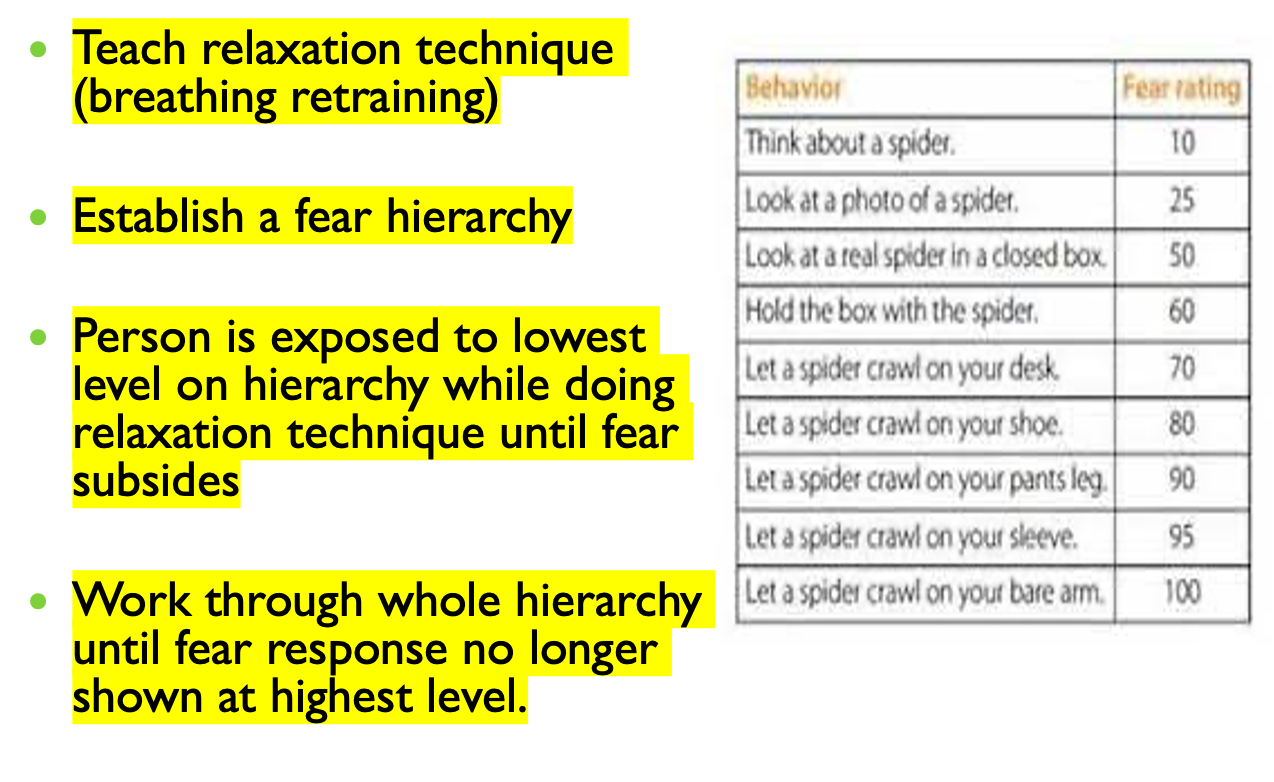
Steps – MUST use these in your explanation
Teach relaxation technique (breathing retraining)
Establish a fear hierarchy
Person is exposed to lowest level on hierarchy while doing relaxation technique until fear subsides
Work through whole hierarchy until fear response no longer shown at highest level.
Socio-Cultural Contributing Factors
Suffering a traumatic experience in response to a specific stimulus is a common contributing factor in the development of a specific phobia
These specific environmental triggers (Eg being bitten by a dog, nearly drowning) are considered sociocultural factors.
Main socio-cultural contributing factors are believed to be specific environmental triggers and stigma around seeking treatment
Specific Environmental Triggers
Several factors in the environment can predispose an individual to the development of specific phobias:
1.Traumatic events can result in development of a phobic reaction
2.Having unexpected anxiety attacks in situations that are perceived to be threatening may cause a phobic reaction.
◦Fear learned through classical conditioning
If the trauma is severe enough only one experience is necessary (unlike normal CC where repeated pairings are needed)
◦Fear persists through operant conditioning
Role of Modelling and Observational Learning
Learning by modelling can maintain the association between an object and the emotions a person experiences.
This may occur vicariously (watching someone else get upset due to something) or by being taught or warned about particular objects.
. Stigma around seeking treatment
Significant role in perpetuation (maintenance) of an anxiety disorder.
Stigma = social disapproval of an individuals personal characteristics, beliefs, or behaviours
There is a lack of knowledge and understanding surrounding mental illness in general by a large proportion of society
Because phobias involves irrational and unrealistic emotions and behaviours it is often hard for others to sympathise.
As a result, many people with a mental illness fail to seek readily available support from friends, family and professionals for fear they will be viewed in a negative way.
Some harmful effects of Stigma are:
◦Reluctance to seek help or treatment
◦A lack of understanding by family, friends and co-workers
◦Fewer opportunities for work, school or social activities
◦Difficulty finding housing
◦Bullying, physical violence or harassment
◦The belief that you’ll never be able to success at certain challenges or that you can’t improve you situation.
Evidence Based Intervention - Psychoeducation
Psychoeducation = the education about a mental illness such as the nature of the illness, its treatment and management strategies.
Offered to phobic patients and their families and supporters
Goal is to help the phobic person understand their illness and how to develop strategies to cope with and recover from it.
It is part of the first step in CBT
Families and friends play an important role in:
1.assisting the sufferer to challenge their unrealistic or anxious thoughts towards the phobic stimulus:
◦These irrational and pessimistic attitudes are known as cognitive distortions
2.Not encouraging avoidance behaviours:
◦Avoidance behaviours = those that attempt to prevent exposures to the fear provoking stimulus.
Avoidance behaviours can significantly affect a suffers life
Is considered maladaptive because it does not attempt to remove the fear response, but it assists in maintaining the disorder as it provides negative reinforcement. (example of OC acting to perpetuate the fear)
diagram (summarises the evidence-based interventions for specific phobia)