matl sci midterm
 Call Kai
 Learn
Learn Practice Test
 Spaced Repetition
 Match
Match Flashcards
 Knowt Play
1/307

There's no tags or description
Looks like no tags are added yet.
Name | Mastery | Learn | Test | Matching | Spaced | Call with Kai | Chat |
|---|
No analytics yet
Send a link to your students to track their progress
308 Terms
Stress
The pressure due to an applied load on a material
Strain
The response of a material due to stress
- Physical deformation
F, 0
Engineering Stress:
σ = ___ / A ___
Stress
σ = Engineering (Stress/Strain)
Perpendicular, Perpendicular
In the equation σ = F/A0, F is the load applied (Parallel/Perpendicular) to a specimens cross section, and A0 is the cross sectional area (Parallel/Perpendicular) to the force before its application
l, l
Engineering Strain:
ε = ∆ ___ / ___ 0
Strain
ε = Engineering (Stress/Strain)
>
For tensile strength, σ (<,>) 0
<
For compressive stress, σ (<,>) 0
Top, Bottom, Sides
Tensile stress is applied at the ________ and ____________ of a material, while shear stress is applied at opposite __________ of a material
F, S, A
Shear Stress:
𝛕 = ___ (sub) ___ / ___ 0
x, l
Shear Strain:
𝛾 = ∆ ___ / ___ 0 = tan𝜃
True
Strain is dimensionless, and can be positive or negative: True or False?
Hooke's Law
The law stating that the stress of a solid is directly proportional to the strain applied to it
- Linear
E, ε, Linear
Elastic Modulus:
σ = ___ * ___
Note: Only applies if stress and strain are __________
𝛕, 𝛾
Shear Modulus:
G = ___ / ___
Force
The derivative of the energy radius diagram gives _________
Larger, More
A steeper slope on the force radius diagram corresponds to a (Larger/Smaller) elastic modulus, which means that it can take (More/Less) stress
More, More
A deeper well in the energy radius diagram means a bond has (More/Less) energy, and a steeper slope in the force radius diagram means a bond has (More/Less) energy
Opposite
Poisson's Ratio:
v = -∑x/∑y (or any combination of dimensions)
- Transverse dimensions have the (Same/Opposite) reaction to stress as the perpendicular dimension
- Inverse contraction
Elastic Deformation
A deformation with a linear relationships between the applied force and the displacement of atoms, making it completely reversible and recoverable
- Stress and strain are proportional
Plastic Deformation
A deformation with a non-linear relationship between the applied force and displacement of atoms, causing the bonds to stretch, break, and reform which leaves planes sheared which is a permanent
- Stress and strain are not proportional
Elastic, Plastic
(Elastic/Plastic) deformation must be overcome before (Elastic/Plastic) deformation occurs
Is Not, Is
Displacement by elastic deformation (Is/Is Not) permanent, and displacement by plastic deformation (Is/Is Not) permanent
Yield Point (P)
The point in which stress and strain are no longer proportional and elastic deformation becomes plastic deformation
Yield Stress (σy)
The stress required to produce a very small, yet specified amount of plastic deformation/strain (0.002)
- Stress value of some point on plastic deformation arch
- A measure of resistance to plastic deformation
0.002, Parallel, Stress, Strain
Strain offset method:
1.) Start at __________ strain
2.) Draw a line from starting point ____________ to the linear region of the stress-strain graph
3.) Wherever this line crosses the plastic deformation arch is where the corresponding σy value is, which is the (Stress/Strain) required to do the (Stress/Strain) prior to the intercept point
Yield Point Phenomena
An abrupt transition from elastic deformation to plastic deformation
- Occurs in specific alloys such as low carbon steels
- Has 2 yield points
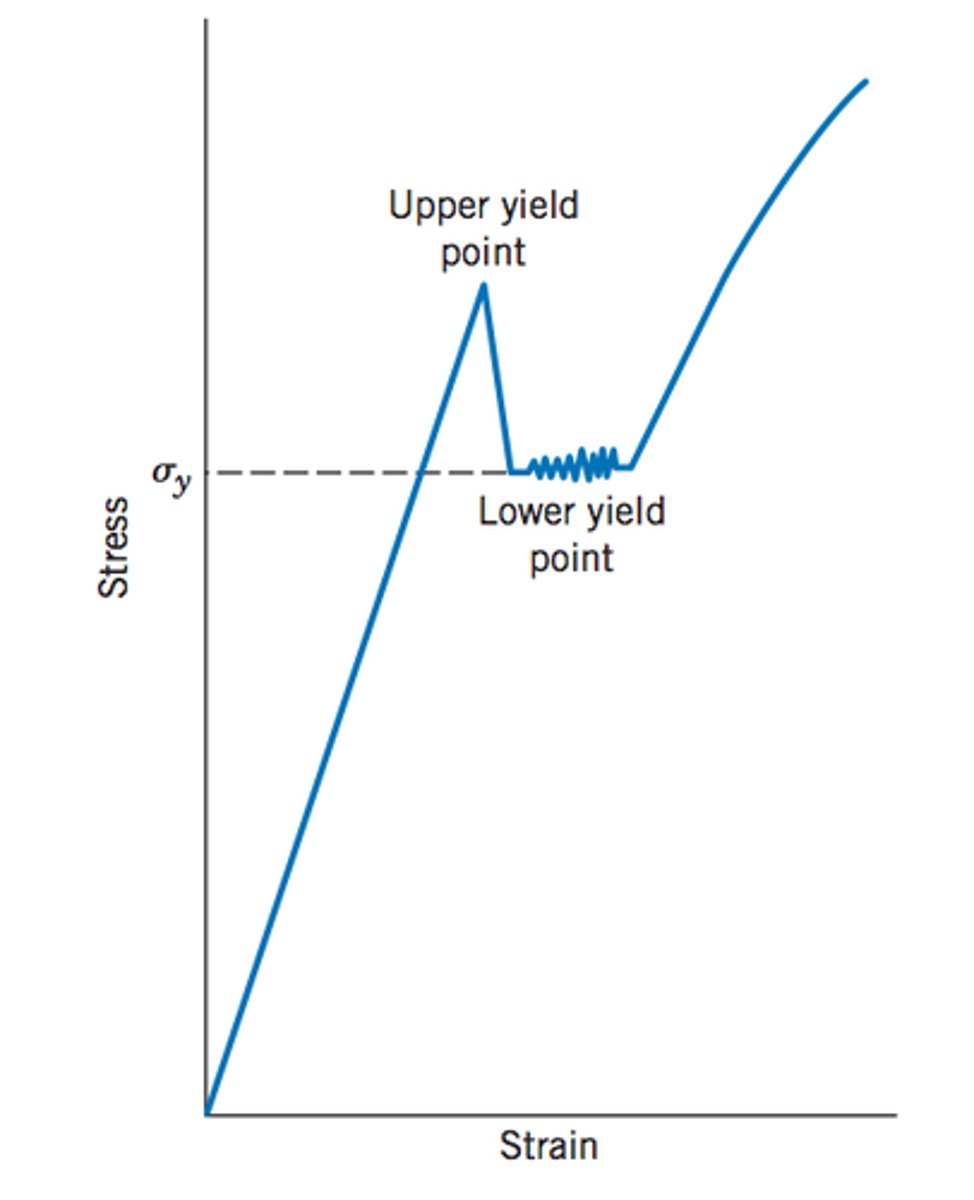
Lower
In materials exhibiting the Yield Point Phenomena, Lüder Bands occur in the (Lower/Higher) yield point and are locations in which dislocations start to layer
Average, Lower
In materials exhibiting the Yield Point Phenomena, yield strength is defined as the ____________ stress, at the (Lower/Higher) yield point
Ultimate Strength (UTS)
The maximum amount of stress a material can withstand
- Maximum value on stress-strain graph
Fracture Strength
The maximum amount of strain a material can withstand before failing
Necking
For metals, the UTS occurs when noticeable _____________ starts to appear, a stress concentrator
Ductility
Measure of the degree of plastic deformation a material has sustained at fracture
Ductility, l, l, l
Percent Elongation (%EL):
- A method of measuring _____________
%EL = ( ___ f - ___ 0) / ___ 0 x 100
Brittle
If %EL < 5%, the material is (Brittle/Ductile)
Ductile
If %EL > 5%, the material is (Brittle/Ductile)
Ductility, A, A, A
Reduction in Area (%RA):
- A method of measuring _____________
%RA = ( ___ f - ___ 0) / ___ 0 x 100
Elastic Strain Recovery
The amount of elastic strain a material will take before reaching its yield point
Greater
If stress is reapplied post-plastic deformation, the yield point with be (Lesser/Greater) than it was originally
- Concept can be used to strengthen materials
Plastic, F, El, Ductility
ε ___________ = ε ___ - ε ___
- A method of measuring _____________
Decrease, Increases
Yield strength, tensile strength, and modulus of elasticity (Increase/Decrease) and ductility (Increases/Decreases) as temperature Increases
Increase, Decreases
Yield strength, tensile strength, and modulus of elasticity (Increase/Decrease) and ductility (Increases/Decreases) as temperature Increases
Resilience
The ability of a material to store energy in the elastic deformation region
1/2
Modulus of Resilience:
Ur = 0∫εy σ dε
However, if we assume a linear stress-strain curve, it can be simplified to:
Ur = ___ / ___ σyεy
- The equation of a triangle with sides σy and εy and hypotenuse along the linear portion of the line
High, Low
Resilient materials have (Low/High) yield strengths and (Low/High) elastic modulus
Toughness
Energy required to break a unit volume of material
- Approximated by the area under the stress-strain curve
Linear, Linear
When calculating resilience, it can be approximated under the _____________ part of the stress-strain graph, but for calculating toughness, it cannot be approximated with just the _____________ part, and the entire area must be taken into account
Brittle Fracture
A fracture that occurs under only elastic energy
Ductile Fracture
A fracture that occurs under elastic and plastic energy
True Stress
The stress determined by the instantaneous load acting on the instantaneous cross sectional area
>
True Stress (<,>) Engineering Stress ALWAYS
Hardening
An increase in σy due to plastic deformation
Opposite, Positive, Negative
Compression and Tension have the (Same/Opposite) stress-strain graphs for small strains, With tension being both (Negative/Positive) coordinates and compression being both (Negative/Positive) coordinates
Lower, Higher
Compression and tension graphs mirror one another at (Lower/Higher) strain levels, but at (Lower/Higher) strain levels, compression has a steeper slope and isn't as flat in the plastic regime as tension
More
For the shear/torsion strength testing, the stress-strain graph is the same, except that it withstands (Less/More) elastic deformation before it has any plastic deformation
Weak
Any material with an open end will be very (Weak/Strong)
Hardness
Resistance to permanent indentation of a materials surface
More, Better
If a material has a larger hardness, it is (Less/More) resistant to cracking or deformation when under compression and has (Worse/Better) wear properties
Plastic
Hardness is proportional to tension because they both exhibit some level of resisting _____________ deformation
Temperature, Chemical
Elastic modulus is relatively unchanged without a change in ________________ or _____________ structure
Diffusion
Mass being transported by some atomic motion in a lattice
Active Diffusion
Upon applying high temperatures, the energy barriers of atomic motion can be overcome and (Passive/Active) diffusion will occur
Random
Gases and liquid have brownian/ _____________ motion
Vacancy, Interstitial
Solids may have ____________ diffusion or _______________ diffusion
Self Diffusion
In an elemental solid, atoms migrate
- The ability for atoms to move within the same type of atom
Interdiffusion
In an alloy, atoms tend to migrate from regions of high concentration to low concentration
- Atoms of one type A diffuse into another atom type B
- Occurs by either vacancy or interstitial diffusion
Vacancy Diffusion
Atoms exchange sites with vacancies, in turn leaving another vacancy in their former position which can ultimately be filled and so on
Substitutional Impurities
When a different type of atom than expected fills an atomic site in a crystal lattice
Vacancies, Activation
The rate of vacancy diffusion depends on the number of ______________ and the ______________ energy required for the exchange of location
- Need to break bonds to move
Self Diffusion, Interdiffusion
Substitution in homogeneous solutions is _______ ______________ , while substitution in heterogeneous solutions is ___________________
All
Vacancies exist at ______ temperatures
Increases, Increases
As temperature increases, the number of vacancies (Increases/Decreases) and the diffusion rate (Increases/Decreases)
Interstitial Diffusion
Smaller atoms in tetrahedral or octahedral sites can diffuse between atoms
- Jumps between interstices
Faster, More
Interstitial diffusion is (Faster/Slower) than vacancy diffusion because there are (More/Low) sites to move to
Elementary Jump
A sequential diffusion movement that makes up a greater migration distance of an atom
- Moves like Plinko
M (Mass or Moles), Area, Time
In general, J (Flux) = ___ / ( ___ * ___ )
Mol, Cm, 2, Kg, M, 2
The units for flux are ___ / ___ ^ ___ OR ___ / ___ ^ ___
Dependent, Independent
Diffusion is time (Dependent/Independent) , while flux is time (Dependent/Independent)
Independent, Concentration Gradient
Flux is time (Dependent/Independent) and is proportional to the ________________ ______________
D, C, x
Fick's First Law of Diffusion:
J = - ___ (d ___ /d ___ )
C, C, x, x, Linear
In Fick's First Law of Diffusion:
dC/dx = ( ___ 2 - ___ 1) / ( ___ 2 - ___ 1)
- Applied only if dC/dx is ___________
Diffusibility, Temperature, Lattice
In Fick's First Law of Diffusion:
D = ________________ (constant)
- Depends on mechanism of diffusion, the _______________ of the system, the type of crystal _____________ , Crystal Imperfections, and the concentration of diffusing species
Steady State Diffusion
The diffusion condition for which there is no net accumulation or depletion of diffusing species
- Flux in = Flux out
Non-Steady State Diffusion
The diffusion condition for which there is some net accumulation or depletion of diffusing species
- Flux in ≠ Flux out
Doesn't
In steady state diffusion, dC/dx (Does/Doesn't) change
Does
In non-steady state diffusion, dC/dx (Does/Doesn't) change
Down, Up
D (Diffusibility) has a negative sign if the system is moving (Up/Down) it's concentration gradient and a positive sign if the system is moving (Up/Down) it's concentration gradient
Concentration, Time, Position, Accumulation, Depletion
Fick's Second Law of Diffusion:
dC(x,t)/dt = D * d^2C(x,t)/dx^2
- Rate of change of __________________ at a specific ________ and ____________ is proportional to the curvature of the concentration profile
- Diffusion flux and concentration gradient may vary with time, resulting in a net ________________ or ________________ of the species
x, t, s, x, 2, D, t
(C( ___ , ___ ) - C0) / (C ___ - C0) = 1 - erf( z )
where z = ___ / ___ √( ___ ___ )
Break, Bonds
For an atom to jump into a vacancy site, it needs enough energy to __________ its ___________ and squeeze by its neighbors
x, 4, z, t, x, 4, z, D
In rewriting z = x / 2√Dt, we find that:
D = ___^2/ ___ ___ ^2 ___
OR
t = ___^2/ ___ ___ ^2 ___
QD, R, D
For the diffusion coefficient vs 1/T graph, the slope is - ___ / ___ and the y intercept is ln ___
Less
Diffusion in a solid will vary depending on its path:
- In general, diffusivity is greater through (More/Less) restrictive structural regions
- Bulk volume << Grain boundary << Surface species
Open, Lower, With, Smaller, Cations, Lower
Diffusion is better when:
- Crystal structure is (Open/Closed)
- (Higher/Lower) melting temperature
- Materials (With/Without) secondary bonding
- Structures with (Larger/Smaller) diffusing atoms
- (Cations/Anions)
- (Lower/Higher) density materials
=, ≠
Fick's 1st law is necessary when flux in (=/≠) flux out, while Fick's 2nd law is necessary when flux in (=/≠) flux out
Polycrystalline Structure
A crystalline structure that contains many grains of crystals
- If grains are randomly oriented, overall component properties are not directional (Isotropic)
- If grains are textured/stretched in a particular direction, the component properties are directional (Anisotropic)
Isotropic
When the grains of a polycrystalline structure are randomly oriented, the overall component properties are not directional
Anisotropic
When the grains of a polycrystalline structure are textured/stretched in a particular direction, the overall component properties are directional
Grain Boundaries
The junction in which individual crystals grew and fused to one another
- Transition from the lattice of one region to that of another