MIDTERM FLASHCARDS (combined)
 Call Kai
 Learn
Learn Practice Test
 Spaced Repetition
 Match
Match Flashcards
 Knowt Play
1/116

There's no tags or description
Looks like no tags are added yet.
Name | Mastery | Learn | Test | Matching | Spaced | Call with Kai | Chat |
|---|
No analytics yet
Send a link to your students to track their progress
117 Terms
260 nm
Nucleic acid absorb strongly at ____
Polymerase Chain Reaction
What does PCR stands for?
260 and 280
the ratio that gives an estimate of the purity of nucleic acid
260/280 ratio of 1.8-2.0
Pure preparations of DNA
1.8-2.0
ratio of pure preparation of DNA
260/280 ratio 1.8-2.0
260/230 ratio 2.0-2.2
DNA Template
260/280 ratio 2.0
RNA Template
Mg2+ concentration
1mM to 5 mM
Excess - non-specific primer binding
Two little - low yield
^[Mg] high sensitivity, low specificity
0.1-0.6 uM
Primer concentration
5 C - 10 C below melting temp of primers
Annealing temperature
50-500 uM
dnTP concentration
0.5-3.5 units / 50 uL
DNA polymerase
Gradient PCR
Generate a temperature gradient for the annealing step
focused on the annealing temperature
Heat Stable DNA Polymerase
Isolated from hot spring dwelling bacterium
Not destroyed at 94 C
Optimal temperature is 72 C
Error rate 3.0 × 10⁻⁴
Widely used for endpoint PCR
72 C
Optimal temperature for heat table DNA polymerase
3.0 × 10⁻⁴
Error rate for Heated Stable DNA Polymerase
Heated Stable Polymerase
Widely used for endpoint PCR
Thermus aquaticus (Taq)
Stabilizes the entire DNA polymerase process
Does not proof read
Error rate 1 per 3,300 bases
Newer polymerase have high fidelity
Problems with Taq
High Fidelity DNA Polymerase
Hyperthermophilic archaeon
3’-to-5’ exonuclease activity
Excellent for GC-rich templates
Error rate 1 per 1,000,000 bases
Applications: cloning, DNA sequencing
Pyrococcus furiosus
What does Pfu stands for?
230
At what absorbance indicates the presence of phenol
280
At what absorbance indicates the presence of protein
Gradient PCR
Optimize the reaction in one PCR run
94 C
Heat Stable DNA Polymerase is not destroyed at what temperature?
3’-5’
Exonuclease activity of High Fidelity DNA Polymerase
High Fidelity DNA Polymerase
Excellent for GC-rich templates
1 per 1,000,000 bases
error rate of High Fidelity DNA Polymerase
Cloning
DNA Sequencing
Applications of High Fidelity DNA Polymerase
Polymerase Chain Reaction (PCR)
In-vitro enzymatic amplification of a specific segment of DNA
Dr. Kary Mullis (1985)
Discovered the Theoretical basis
High temperature
Double-stranded DNA denatures at what temperature?
dsDNA
Exponential increase of _____ produced with increasing cycles
Buffer
Deoxyribonucleoside triphosphates
Magnesium
Polymerase
Primers
Salts
Template DNA
Components for PCR
Buffer
Neutralize DNA polymerase inhibitors present in blood
Deoxyribonucleoside triphosphate (dNTP)
building blocks (monomeric units) of DNA
Magnesium
cofactor of enzyme activity
Polymerase
responsible for elongation of new DNA strands
Primers
DNA fragments that recognize and bind to target DNA segment
Salts
provide the correct ionic strength
Template DNA
double-stranded helix containing genetic code
Denaturation (95 C)
double-stranded DNA (dsDNA) separates into two single strands
Annealing (50-60 C)
Primer bind to the target DNA sequence
Red short lines addition of primers to the single strands from DNA after denaturation
Elongation (72 C)
DNA Polymerase extends the primers, synthesizing new DNA strands
Nobel Prize (1993)
What did Dr. Kary Mullis won and what year was it?
increase of dsDNA
Exponential _________ produced with increasing cycles
Rapid detection
Minimal sample required
Useful for strain differentiation
Some pathogens are difficult to cultivate
High analytical sensitivity and specificity
Provides more definitive diagnostic information
Advantages of Amplification Techniques
1000 uL
1mL is equivalent to _____ uL
500 uL
0.5 mL is equivalent to ____ uL
Pathogen
Mutation
Genetic marker
PCR confirms the presence of specific:
Traditional / Endpoint PCR
uses agarose (from seaweed) gel for detection of PCR amplification at the final phase or endpoint of the PCR reaction
size-based discrimination only
Post-PCR processing
Sized-based discrimination
tells presence and size of amplified DNA
Post-PCR processing
analyze amplified DNA after reaction is complete
different from qPCR which monitors DNA amplification as it happens
Marker / Ladder
What are these called?
note: numbers inside the red rectangle
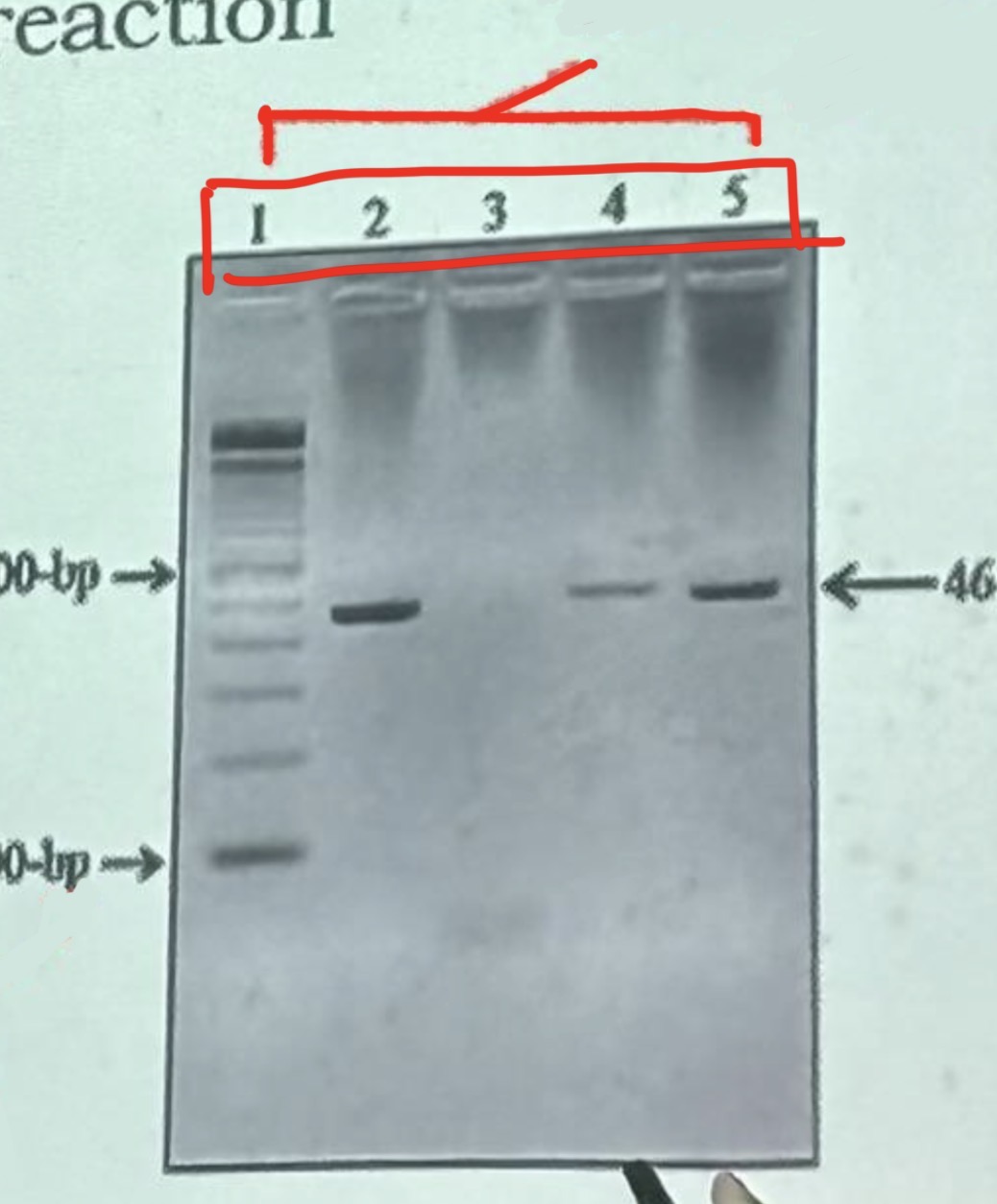
Poor precision
Low sensitivity
Low resolution
Problems with Endpoint Detection
<2 logs
dynamic range of Endpoint detection
PCR-RFLP (Restriction Fragment Length Polymorphism)
A molecular technique that combines PCR and restriction enzyme digestion to analyze genetic variations (polymorphisms) in DNA sequences
PCR amplification > Restriction enzyme > Gel electrophoresis
To detect genetic variations using these:
Genetics
Disease detection
Forensic Science
RCP-RFLP is widely used in
Nested PCR
A modification of traditional PCR
Improves specificity and reduces non-specific amplification by using 2 rounds of PCR with 2 sets of primers
2 rounds
Round/s needed using Nested PCR
2 primers
How many primers needed for the round/s of PCR in Nested PCR
1st round
Larger region of DNA is amplified
Produces a bigger PCR product, but it may contain non-specific DNA (unwanted fragments)
Result = primary amplicon
Primary amplicon
Result of the 1st round when Nested PCR is used
2nd round
small portion of the first PCR product is used as a template for the second round
inner primers are used (designed within the first PCR product)
specifically amplifies only the correct DNA sequence, filtering out non-specific bands
Multiplex PCR
Allows multiple DNA targets to be amplified simultaneously in a single reaction
several primers are used to amplify multiple sequences at the same time
Efficient and cost-effective, enabling the detection of various genes or pathogens concurrently
Multiplex Real-time PCR
Advanced version of Multiplex PCR
multiple DNA targets are amplified and detect in real-time using fluorescent probes
Fluorescent probes
Multiple DNA targets are amplified and detected in real-time using _________
Lag Phase - Exponential Phase - Linear Phase - Plateau Phase
4 stages of qPCR Amplification curve
Real-time PCR (qPCR)
Variation of endpoint PCR
Amount of amplification product is measured at each reaction cycle via fluorescent dyes, probes
Required gel electrophoresis to analyze results after the reaction
It is faster, more sensitive and widely used in disease diagnosis, genetic research and forensic science
Fluorescent dyes
Probes
Amount of amplification product is measured at each reaction cycle via:
Threshold cycle (Ct)
the product can be detected above the background
Ct (Cycle Threshold) value
The cycle number where fluorescence crosses the detection threshold
Lower Ct value - Higher DNA Concentration
Understanding qPCR Results:
more starting DNA
Higher Ct value - Lower DNA Concentration
Understanding qPCR Results:
less starting DNA
No Ct value - No target DNA
Understanding qPCR Results:
present or below detection limit
Relative Quantification
Expression of a gene in one sample is compared to the expression of the same gene in another sample
Results = fold change
Absolute Quantification
Sample of known quantity are serially diluted and amplified to generate a standard curve
Probe-based
Uses double-labeled sequence specific probes
Composed of an oligonucleotide with fluorescent dye and quencher
Fluoresces only when the probe hybridizes to specific target
Fluorescence Resonance Energy Transfer
what does acronym FRET stands for?
Intercalating Dye
non-specific DNA binding dye
fluoresces upon intercalation into dsDNA
RVR
Viral load not detected at 4 weeks of treatment
EVR
>2 log decrease from baseline viral load or not detected at 12 weeks treatment
SVR
Viral load not detected 6 months after end of treatment
Melting Temperature
function of product length and base composition
Melting Curve
Charts the change in fluorescence observed when dsDNA with the dye dissociates or melts into ssDNA as the temp is raised
Melting Curve Analysis
If the target is 1 defined genetic sequence, it should have 1 specific Tm
Target peak should be narrow, symmetrical, devoid humps or splits
Reverse Transcription PCR (RT-PCR)
Amplify an RNA target sequence
HIV
Dengue
SARS-COV
RT-PCR is used to detect:
Double-stranded nucleic acid
In RT-PCR, RNA sequence is converted to a _________ sequence using reverse transcriptase
One-Step
Two-Step
Protocol used of RT-PCR
One-step
Reaction takes place in a single tube
use of sequence-specific primers
Two-step
random hexamers
oligo dT
gene-specific primers
10.0 uL
Total reaction volume for cDNA Synthesis
RNA Extraction - Reverse Transcription - cDNA Synthesis - PCR Amplification - Agarose Gel Electrophoresis - Image Analysis
Steps in RT-PCR:
RNA Extraction
Isolating RNA from a sample
Reserve Transcription
RNA -> complementary DNA (cDNA)
cDNA Synthesis
Producing the DNA Template for PCR
PCR Amplification
Running PCR to amplify specific DNA sequence
Agarose Gel Electrophoresis
Running the amplified DNA on a gel to separate by size