Lect2: Homeostasis & Physiological Regulation
 Call Kai
 Learn
Learn Practice Test
 Spaced Repetition
 Match
Match Flashcards
 Knowt Play
1/53

There's no tags or description
Looks like no tags are added yet.
Name | Mastery | Learn | Test | Matching | Spaced | Call with Kai | Chat |
|---|
No analytics yet
Send a link to your students to track their progress
54 Terms
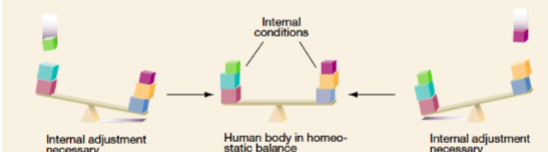
What is Homeostasis?
the self-regulating process by which an organism or biological system maintains a stable, balanced internal environment.
In homeostasis, what is the internal environment?
Extracellular fluid (ECF) surrounding cells
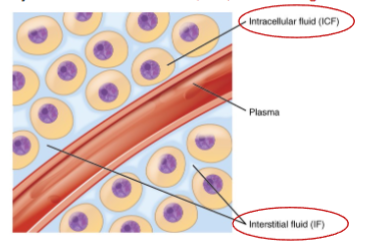
Name the 2 main components of extracellular fluid (ECF).
Interstitial fluid + blood plasma
Interstitial fluid
Fluid directly surrounding cells
Blood plasma
Fluid portion of blood that exchanges substances with interstitial fluid
Main goal of homeostasis?
Regulate the internal environment so cells function normally → temperature, pH, glucose, ions, oxygen & water balance.
What are the FIVE REQUIREMENTS for staying alive?
Nutrients
Oxygen
Water
Normal body temperature
Appropriate atmospheric pressure
Nutrients
provide energy and raw materials for cell building.
Oxygen
required for cellular respiration and ATP production.
Water
provides the medium for chemical reactions and transport.
Normal body temperature
roughly 37°C (98.6°F); enzymes and metabolic reactions require an appropriate temperature range.
Appropriate atmospheric pressure
necessary for normal breathing and gas exchange.
Homeostatic set point
Ideal value/range for a body condition.

How does the body maintain homeostasis?
Sense → Analyze → Adjust → Return toward set point
Can body conditions fluctuate and still maintain homeostasis?
Yes. Normal fluctuations occur around the set point.
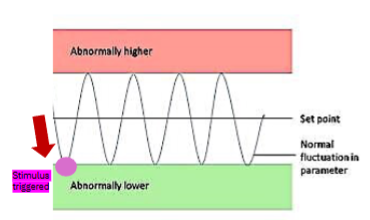
Stimulus
Change that moves a condition away from its normal range/set point.
body temperature if you go outside on a very hot or cold day.
Receptor
Detects/senses the stimulus.
thermoreceptors detect changes in temperature.
Controller
Receives the stimulus, compares it to the set point, and determines the response.
In the brain, the hypothalamus regulates many processes, including body temperature, as a controller.
Effector
Tissue that carries out the response.
Smooth muscle, sweat glands, and skeletal muscle are examples of effector tissues for body temperature.
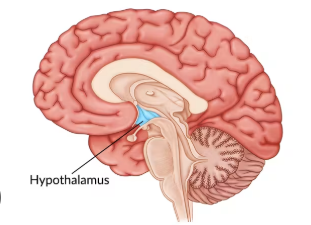
Hypothalamus
a tiny control center at the base of the brain that keeps your body's internal systems stable and balanced (homeostasis).
Role of the hypothalamus in homeostasis?
Acts as a control center → detects changes and triggers responses.
Which body conditions does the hypothalamus regulate?
Temperature, hunger, thirst, water balance & hormones.
How does the body respond when blood glucose is too high?
Pancreas releases insulin → cells take up glucose + liver stores glucose → blood glucose ↓
How does the body respond when blood glucose is too low?
Pancreas releases glucagon → liver releases glucose → blood glucose ↑
How do insulin and glucagon maintain homeostasis?
Insulin lowers blood glucose; glucagon raises blood glucose.
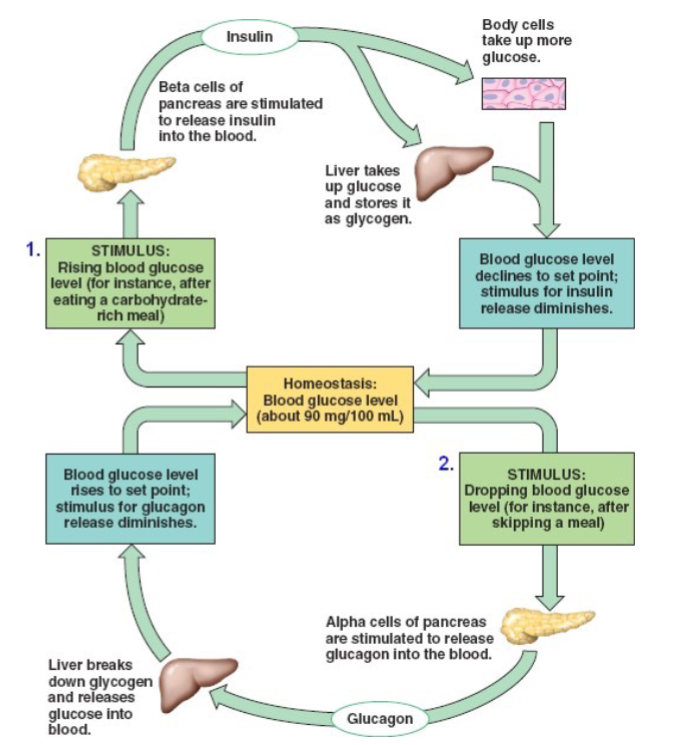
Does blood glucose regulation use negative feedback? Why?
Yes. The response reverses the change and returns blood glucose toward its set point.
Negative equals..
negate the change
Positive equals…
promote the change
Negative feedback
Reverses a change → restores normal range/homeostasis. Most common.
Positive feedback
Amplifies a change → continues until an endpoint is reached. Less common.
How does positive feedback work during labor?
Cervix stretches → oxytocin released → contractions increase → more cervical stretching.
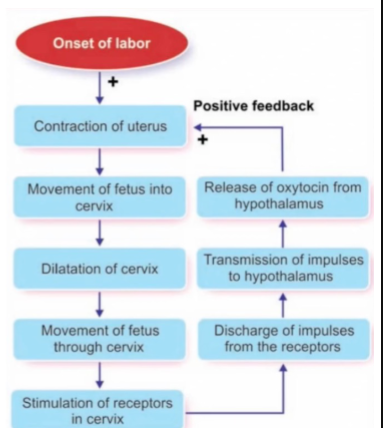
Why is labor a positive feedback loop?
The response amplifies the change until birth occurs.
How does positive feedback work during blood clotting?
Vessel breaks → platelets attach → attract more platelets → clot forms.
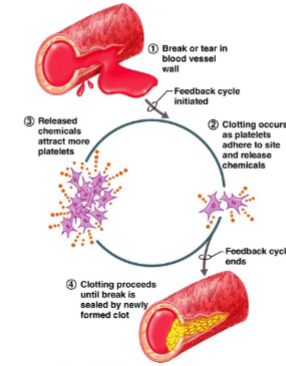
Why is blood clotting a positive feedback loop?
Platelets amplify the response until the break is sealed.
A patient’s blood pressure drops after significant blood loss. The body increases heart rate and constricts blood vessels to raise blood pressure.
Is this an example of Negative or positive feedback?
Negative feedback
In the stomach, pepsin activates inactive pepsinogen into more pepsin which can break down proteins. The newly formed pepsin then activates even more pepsinogen.
Is this an example of Negative or positive feedback?
Positive Feedback
3 types of fluid to keep track of:
INTRAcellular Fluid
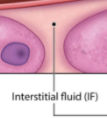
INTERstitutal Fluid
Plasma
INTRAcellular Fluid
inside the of the cell aka the cytoplasm
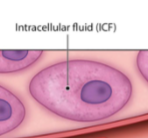
INTERstitutial Fluid
Between cells within a tissue. Part of the extracellular matrix.
Plasma
Fluid dissolving all of the components of the blood.
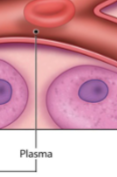
INTERSTITUAL + PLASMA equals
Extracellular Fluid
SOLUTE + SOLVENT =
SOLUTION
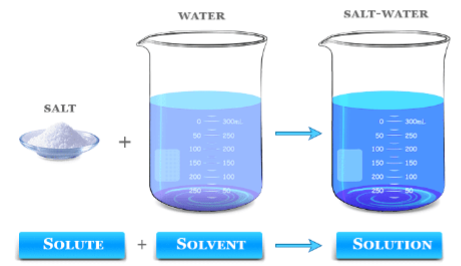
Solute is…
the thing that can be dissolved.
Solvent is…
the liquid that is solubilizing the solute.
Solution is…
the combination of the two.
Between which 3 fluid compartments are fluids and solutes exchanged?
Blood plasma ↔ interstitial fluid ↔ intracellular fluid
Which substances commonly move between body fluids and cells?
O₂, CO₂, water, nutrients, ions & wastes
How do organs help exchange substances with the blood?
Lungs exchange gases, GI tract adds nutrients/water, kidneys regulate water/ions & remove wastes.
Which direction do solutes naturally move?
High concentration → low concentration

Define concentration gradient.
Difference in concentration between two areas.

Define osmosis.
Movement of water across a membrane.
Hypotonic solution: Where does water move and what happens to the cell?
Lower solute outside → Water moves IN → cell swells.
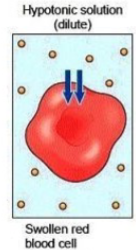
Isotonic solution: Where does water move and what happens to the cell?
Equal solute inside & outside → Water moves equally → cell stays normal.
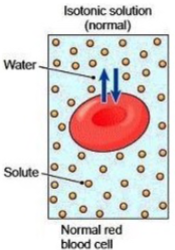
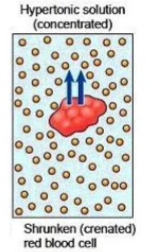
Hypertonic solution: Where does water move and what happens to the cell?
Higher solute outside → Water moves OUT → cell shrinks.