Ceramics and Other Materials
 Call Kai
 Learn
Learn Practice Test
 Spaced Repetition
 Match
Match Flashcards
 Knowt Play
1/57

Earn XP
Description and Tags
lecture 8
Name | Mastery | Learn | Test | Matching | Spaced | Call with Kai | Chat |
|---|
No analytics yet
Send a link to your students to track their progress
58 Terms
Ceramics, Glasses, and Glass-Ceramics
an inorganic, non-metallic solid prepared from powdered materials and fabricated into products through the application of A LOT of heat (primarily ionic/covalent bonds)
Category of Ceramics
cystallline (bio-resorbable or inert)
Category of Glass
amorphous (no crystalline structures)
Category of Glass-ceramics
starts as glass and then ends up as a polycrystalline ceramic (possibly w/ a residue glassy matrix)
General Properties of Ceramics, Glasses, and Glass-Ceramics
ionic bonds - difficult to shear with very low ductility, high compressive strength, and low tensile strength
low thermal/electrical conductivity (bc ion bonding so no conduction)
refractory (once formed, hard to go back) and high Tm (melting temp.)
high hardness → dental materials
aesthically pleasing appearance
Ionic Bonds - Ceramics, Glasses, and Glass-Ceramics
difficult to shear with very low ductility, high compressive strength, and low tensile strength
Dislocation Glide in Metal vs Ceramics
ceramics - must occur over 2 atomic positions due to electroneutrality requirement (need opposite charges) → less slip but more brittle
metal - one bond at a time (plastic deformation)

Dislocation Glide in Metal vs Ceramics Stress/Strain Curves

Nearly Inert Bioceramics
alumina (Al2O3) which makes sapphires and ruby
Characteristics of Nearly Inert Bioceramics
single crystal or polycrystalline
excellent corrosion resistance and biocompatability (very thin fibrous layer)
high strength → structural support (bone plates/screws)
small grain size with narrow distribution → high hardness and low surface roughness → low friction and wear → joint replacement
Nearly Inert Bioceramics - Small Grain Size/Narrow Distribution
causes high hardness and low surface roughness → low friction and wear so used for joint replacements
reduce grain size = higher strength = smoother (low friction)
increase grain size = lower mech. stremgth = increase roughness/decrease smoothness
Joint Replacement - Ceramics
alumina socket/ball; coefficient of friction decreases w/ time and approaches value of a normal joint (wear is 10 times slower than metal-PE surfaces)
plastic-metal: metal is much harder and grinds against the polymer and will start to degrade it
alumina-alumina: cool-hard surfaces and both smoother so less friction and therefore longer wear
Resorption or Biodegradation in Ceramics
caused by physiological dissolution (depending on solubility of material and local pH bc ionic bonds), physical disintegration into small particles as a result of preferential chemical attack of grain boundaries, and biological factors (phagocytosis)
What does the physiological dissolution of ceramics depend on?
the solubility of the material and the local pH because of ionic bonds
Biological Factors of Resorption or Biodegradation of Ceramics
phagocytosis (engulfs debris) which aslo causes a decrease in local pH
Calcium Phosphate
mineral phase of bone/teeth that is mainly calcium and phosphate ions (already in body so high biocompatilability)
solubility and hydrolysis decrease w/ increasing Ca/P ratio (wanr >= 1 bc if under one than not suitable for bio implantation)
What decreases with increasing Ca/P ratio?
the solubility and hydrolysis of calcium phosphate
Calcium Phosphate Picture

Hydroxyapatite (HA)
Ca10(PO4)6(OH)2
hexagonal rhombic crystal that can be converted from coral/animal bone (naturally) or synthesized and has an elastic modulus of 40-117 GPa
Hard Tissue - Hydroxyapatite (HA)
hard tissue contains 60% HA (mostly carbonate HA), 25% water, and 15% organic materials so HA can be converted from coral or animal bone
Hydroxyapatite (HA) Manufactoring (Synthesize)
Ca(NO3)2 + NaH2PO4 → precipitate of HA → drying and filtering → furnace 1150 degrees C → grounding (tiny pieces/powder) → sieving → press in a die → sintering (at high temp.)
Hydroxyapatite (HA) Elastic Modulus
40-117 GPA
enamal - 74 GPa
dentin - 21 GPa
compact bone - 12-18 GPA
Hydroxyapatite (HA) - Hexagonal Rhombic Crystal
sub OH- with F- to increase chemical stability
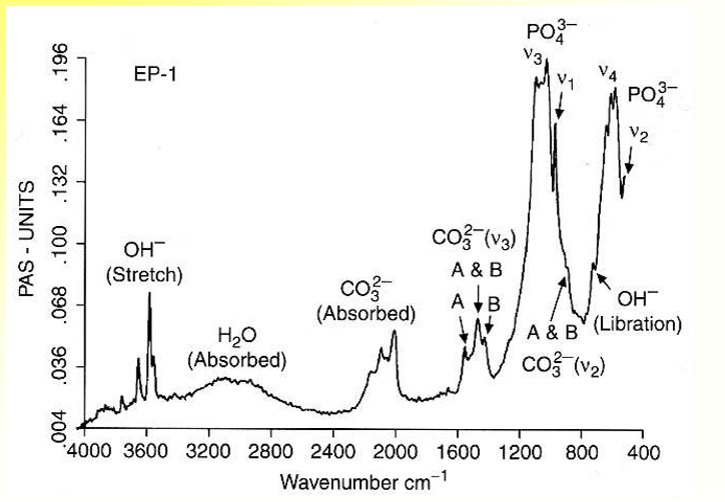
defects/impurities can be characterized by X-ray diffraction (crystallinephase), FTIR (cehm. groups)
Why do some toothpastes have flouride in them?
because in a hexagonal rhombic crystal (ceramic = crystalline) OH- gets subs by F- to increase chemical stability
Hydroxyapatite (HA) Crystal Structure Picture
2 OH (hydroxyl) groups per unit cell because inc roners; very complex

Hydroxyapatite (HA) X-ray Diffraction Picture
shows how crystalline something is

Typical FT-IR Spectrum of HA Picture
used instead of X-ray diffraction (???); uses absorbance to define chemical groups in the sample
Factors that Influence the Degradation Rate of Calcium Phosphate
Ca P degradation rate increases as:
chem. susceptibility to dissolution - increases
surface area - increases
crystallinity - decreases
crystal perfection - dcereases
grain size - decreases
F- substitution - decreases
Clincial Application Advantages of Calcium Phosphate
it is bioactive and osetoconductive (pormotes bone integration → linear component of bone)
Calcium Phosphate Bioactive Bonding Mechanism
differentiated osteoblasts (guided by these) produce a cellular bone matrix of 3-5 um layer at surface → 0.05-0.2 um → normal bone attached through thin epitaxial bonding layer to the bulk implant; has a dense and porous forms and also can be coatings or fillers
Dense Form of Calcium Phosphate
small unloadd implants such as in the middle of an ear implant
Porous Form of Calcium Phosphate
to promote bone regeneration → granuales for filling bony defects in orthopedic and dental surgery
Coatings - Calcium Phosphate
coat outside of metal to promote bone integration → with reinforcing metal posts as in dental materials
Specific Composition of Bioactive Glasses and Glass-ceramics
highly reactive surface in aqueous medium which forms a biologically active carbonated HA layer that provides bonding interface for tissues; interfacial strength >= bulk strength of both implant and tissue; ex. SiO2 <= 60%, high Na2O and CaO and CaO/P2O5 (all glass has similar components just diff. %’s)
Bioactive Glasses/Glass-Ceramics - Surface
forms a biologically active carbonated HA layer that provides bonding interface w/ tissue
interfacial strength >= bulk strength of both implant and tissue
once binds has a higher interfacial strength than the bulk strength
Bioactive Glasses and Glass-ceramics Clincial Applications
45S5, SiO2 45%, Ca/P - 5:1 (bioactive glass)
Ceravital (middle ear surgery to replace ossicles damaged by chronic infection)
Periodontal defect repair (maintenance of alveolar ridge for denture wearers)
Toothpaste ingredient against sensitivity
Compositional Dependence (w%) of Bone and Soft Tissue Bonding Picture

Index of Bioactivity (IB)
the level of bioactivity of a specific material can be related to the time fro more than 50% of the interface to be bonded (t0.5bb); higher this = higher bioactivity
Sequence of Interfacial Reactions Involved in Forming a Bond Between Tissue and Bioactive Glass Picture

Table of Attachment Types Picture
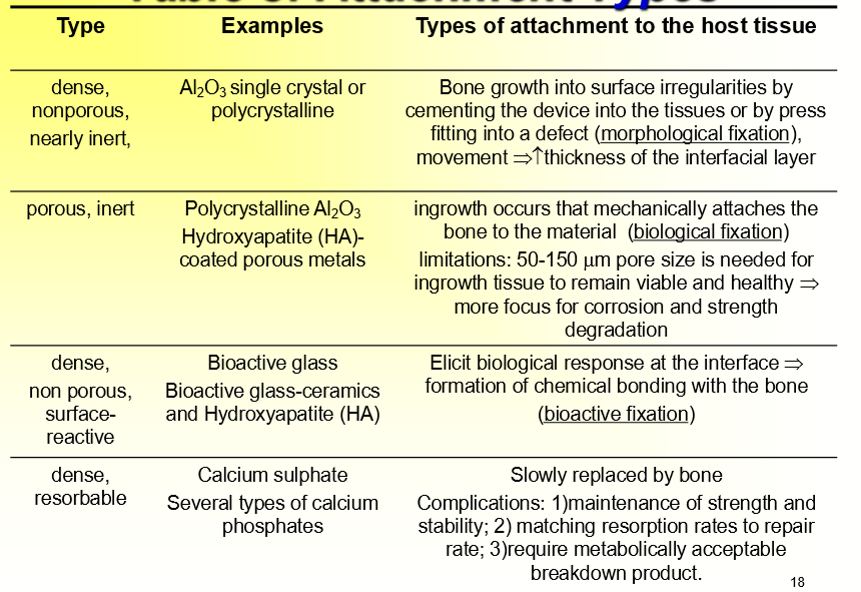
Dense, Nonpourous, Nearly Inert Attachment Type
ex. Al2O3 single crystal or polycrystalline
attachment to host tissue: bone growth into surface irregularities by cementing device into tissues or by press fitting into a defect (morphological fixation), movement → increases thickness of interfacial layer
Porous and Inert Attachment Type
ex. Polycrystalline Al2O3, Hydroxyapatite (HA) (coated porous material)
attachment to host tissue: ingrowth occurs that mechanically attaches the bone to material (biological fixation)
limitations: 20/100 um pore size needed for ingrwoth tissue to remain viable/healthy → more focus fror corrosion and strength degradationBio
Dense, Nonporous, and Surface-Reactive Attachment Type
ex. bioactive glass, glass-ceramics, and HA
attachment to host tissue: elicit biological response at the interface causes the formation of chemical bonding with the bone (bioactive fixation)
Dense and Resorbable Attachment Type
ex. calcimum sulphate and several types of calcium phosphates
attachment to host tissue: slowly replaced by bone
complications - 1. maintenance of strength and stability, 2. matching resorption rates to repair rate, and 3. requires metabolically acceptable breakdown product
Fixation Limitations
if not tight enough, there wil be movement and will cause fibrosis which is not desirable
Morphological Fixation
when bone growth into surface irregularities by cementing the device into the tissues or by press fitting into a defect
Biological Fixation
when ingrowth occurs that mechanically attaches the bone to the material
when pores are large enough, they grow into them but if they are too small, no cells so: pores too big = lower mechanical strength
Bioactive Fixation
when elicit biological response at the interface causes the formation of chemical bonding with the bone
forming chemical bond with bone tissue
Carbon Materials
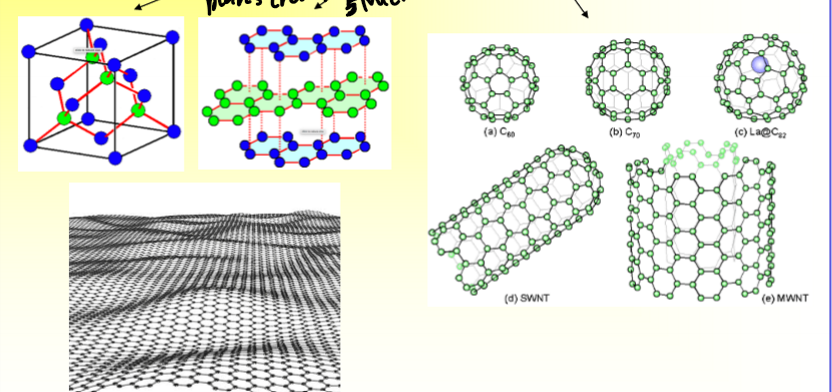
crystalline: diamond, graphite, and fullerene
Fullerene
carbon structure; take a layer of graphite and wrap it in a ball or as a cylindar → electrically conductive bc sp2 C’s

Graphene
singel sheet of graphite = increased conductivity;
Quasicrystalline Carbon Materials
glassy carbon - extremely inert and used as electrodes in electrochem or prosthetics
pyrolytic carbon - as implant surface coating, has higher mechanical strength than glassy/graphite carbon, excellent tissue/blood compatibility, and used in heart valves and finger joint implants
Glassy Carbon
a quasicrystalline carbon material; extremely inert and used as electrodes in electrochem or prosthetics; network of sp2 C’s in a not very well defined structure and bc of sp2 = very electrically conductive
Pyrolytic Carbon
a quasicrystalline carbon material; as implant surface coating, has higher mechanical strength than glassy/graphite carbon, excellent tissue/blood compatibility, and used in heart valves and finger joint implants
Composites
consist of 2 or more chemically distinct parts in the macro-scale and have a distinct interface separating them; properties depend on the properties of each constituent, shape of the heterogeneities, volume fraction, and interface; ex. fiber and particulate composites; real life ex. bone and tendon/vessel
Fiber or Particulate Composites
usually consist of 1 or mre discontinous phases (usually stronger → reinforcing material) that is embedded into a continous phase (matrix)
Composite Properties
depends on properties of each constituent, shape of the heterogeneities, volume fraction, and interface (how tightly bound here they are)
HAPEX
composite of hydroxyapatite (to promote osteoblast attachment since it has teh right mechanical strength for bone implants but not liked my body very much or very osteoblastconductive???) in a polyethylene matrix; stiffnes similar to cortical bone; high toughness; bone bonding in vivo; orbital implant and middle ear implants
