Clinical Parasitology
 Call Kai
 Learn
Learn Practice Test
 Spaced Repetition
 Match
Match Flashcards
 Knowt Play
1/71

There's no tags or description
Looks like no tags are added yet.
Name | Mastery | Learn | Test | Matching | Spaced | Call with Kai |
|---|
No analytics yet
Send a link to your students to track their progress
72 Terms
Infestation
the presence of ectoparasites on their host
Infection
the presence of endoparasites in their host
From which 6 groups do most of the important parasites that affect domestic animals come from?
insects, arachnids, nematodes, tapeworms, trematodes, and protozoans
Vector
an animal that transfers an infective agent from one host to another
Insect life cycle
four stages: egg, larva, pupa, adult
Arachnid life cycle
four stages: egg, larva, nymph, and adult
Ticks are an example of what kind of parasite?
an ectoparasitic arachnid
Which parasites are generally small, wormlike organisms covered by a tough skin called a cuticle?
nematodes (roundworms)
Nematode life cycle
3 stages: egg, four larval phases, and adult
What kind of parasites are nematodes?
endoparasites
Which parasites are flat, ribbonlike worms with no digestive tract?
Tapeworms (cestodes)
Describe parts of tapeworm
scolex = head
proglottids = many segments of body
Tapeworm life cycle
3 stages: egg, larva, and adult
All _______ are endoparasites, and as adults always live in host’s digestive tract.
tapeworms
Which parasites are flat, leaf shaped worms with a mouth and gut, but no anus?
Trematodes (flukes)
Parasitic trematode life cycle:
complex: egg, several larval stages (some of which are endoparasites of snails) and adult
Protozoans
large group of single-celled animals made up of many different types of organisms
endoparasites as adults
Diagnostic stage of a parasite
the life-cycle stage the vet uses to identify the parasite that has infected an animal
What are the diagnostic stages for parasites in the gastrointestinal tract?
eggs of the worms and the cysts of the protozoa in the feces
What to look for to decide if what you are looking at is parasite eggs and not plant debris?
parasite eggs and cysts have a regular outline and will contain an embryo or cells
Nematode larvae can be distinguished in photos because:
they will have a head and tail and will contain an intestine + other organs
Describe eggs of Toxocara canis or Toxocara cati (look similar but cat one is smaller)
They have a rough shell and a brown central mass that fills most of the shell
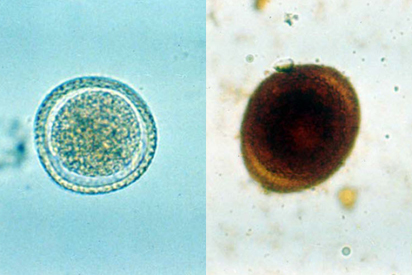
Toxocara canis
roundworm of dogs
Describe Toxascaris leonina eggs comapred to Toxocara eggs
surface is smoother and the central mass doesn’t fill all of the space in the shell as compared to Toxocara
same color as Toxocara when unstained
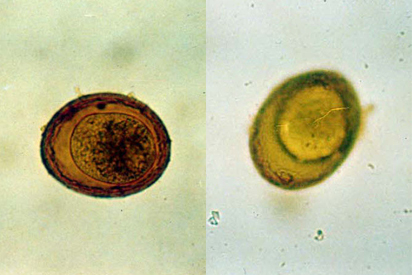
Toxacaris leonina
an ascarid/roundworm that can be found in both dogs and cats
Describe Trichuris vulpis eggs
It’s a symmetrical lemon-shaped egg with a plug at either end.
The whipworm egg has a smooth shell and is about 80 μm long.
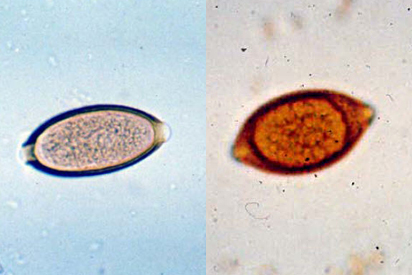
Trichuris vulpis
whipworm of dogs
Describe Eucoleus aerophilus eggs
smaller egg, more oval, and less symmetrical than the whipworm (Trichuris vulpis)
has rough, pitted shell
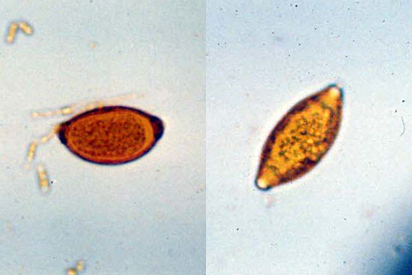
Eucoleus aerophilus
lungworm whose egg is found in both dogs and cats
Describe Ancylostoma eggs
egg has very thin shell and mass of cells in center
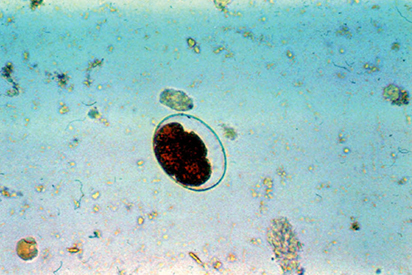
Ancylostoma
hookworm of dogs and cats
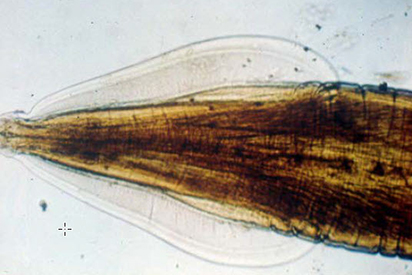
Identify the parasite, it is commonly found in the stomach contents of small animals.
Toxocara cati
- a common nematode w “wings” along the head, like other ascarids of dogs and cats.
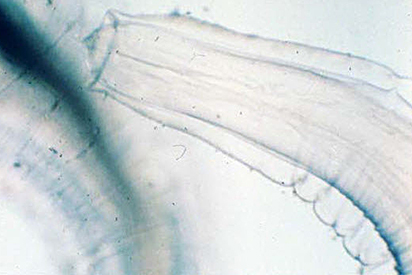
Identify the parasite which is commonly found in the stomach contents of small animals.
Physaloptera
stomach worm of dogs and cats
unique head that looks like it has been pulled back into body, forming a collar
Which parasites are sometimes found during fecal exams of dogs and cats, when the feces is fresh?
larval nematodes such as
Strongyloides stercoralis
lungworms, such as Eucoleus aerophila
Which parasites are sometimes found during the fecal exams of dogs and cats, particularly in feces more than 24 hours old?
larval nematodes, specifically hookworm larvae which have hatched from their eggs
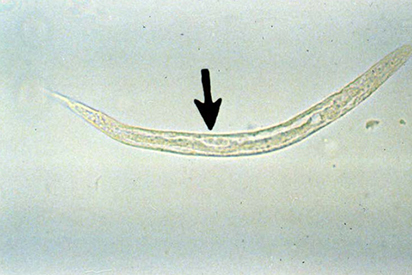
Identify the parasite and its characteristics
1st stage larvae of Strongyloides stercoralis
nematode that lives in small intestine wall of dogs and cats
tapered tail
oval-shaped group of cells near center of worm
The larvae of FIlaroides is very similar to the larvae of which other parasite?
the larva of the cat lungworm Aleurostrongylus.
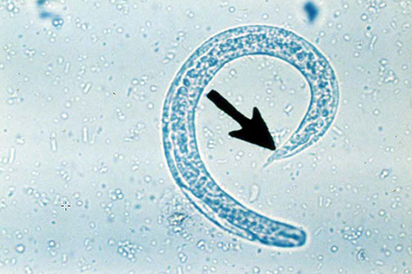
Identify the parasite and its characteristics:
first-stage larva of the dog lungworm Filaroides.
very similar to the larva of the cat lungworm Aleurostrongylus.
Both have a small notch in the tail (arrow) which allows you to tell them apart from Strongyloides
Why are the eggs of Dipylidium caninum distinctive?
bc they’re found in packets containing 10 to 30 eggs
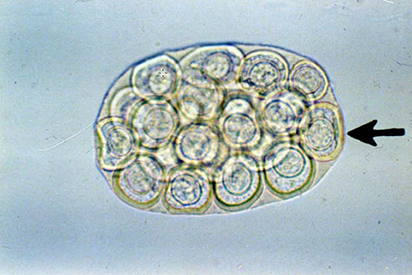
Which animals is Dipylidium caninum seen in?
it is a common tapeworm in dogs, but also seen in cats
Taenia
tapeworms common in cats, but also seen in dogs
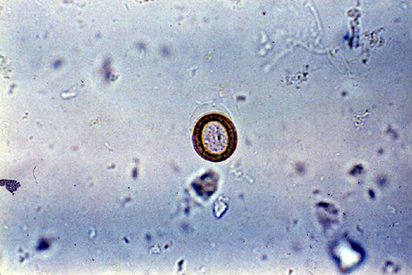
Which parasite does the egg belong to?
Taenia - tapeworms
In both Taenia and Dipylidium infections, the terminal segment of the worm is called the _____________, and contains the eggs. It drops off and passes out with the feces.
proglottid
Which part of Taenia and Dipylidium drop off and pass out with the feces?
proglottid (terminal segment of the worm)
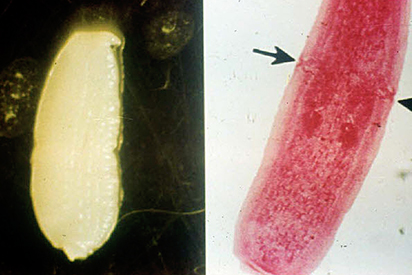
Identify the parasite and which part it is, the arrows are pointing to its two genital openings:
Proglottids of Dipylidium caninum
Identify the parasite and which part it is, the arrows are pointing to its one genital opening:
Taenia taeniaeformis Proglottids
cat tapeworm
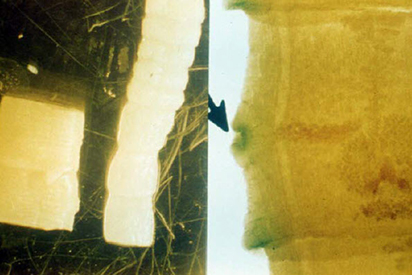
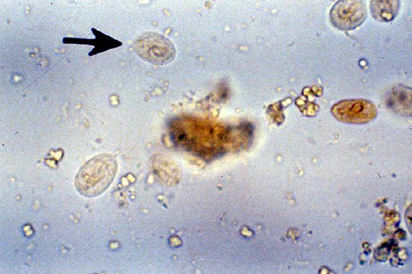
Identify the parasite
cysts of Giardia, found in both dogs and cats and extremely small
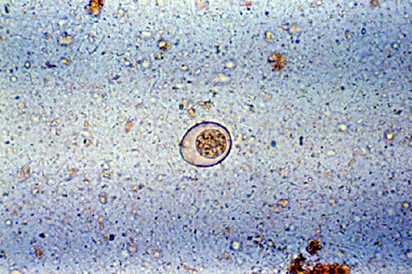
Identify the parasite
oocyst of Isospora canis
coccidian parasite of dogs
one central mass in young cyst and 2 in older
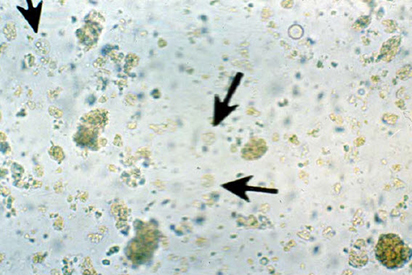
Identify the parasite
oocyst of Toxoplasma gondii
coccidian parasite of cats
one central mass in young cyst and 2 in older
Trichomonas sp. has no cyst stage, how is this protozoan then diagnosed?
through a direct smear of diarrhea
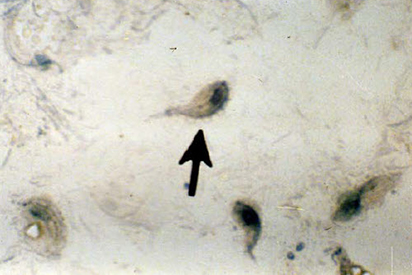
Identify the parasite
Trichomonas sp.
protozoan that lives in the large intestine of cats and dogs.
Which parasite is being described?
Lives in the large intestine of cats and dogs, measures 15 to 20 μm long and is pear-shaped. It has several flagella (hairlike projections) coming out of its front end and an undulating membrane running the length of the body (arrow).
Trichomonas sp.
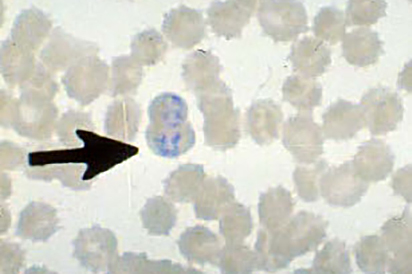
Identify the parasite and describe where is it found/what it infects:
Babesia canis
found in blood of small animals
infects red blood cells
All bird red blood cells have a ________.
nucleus
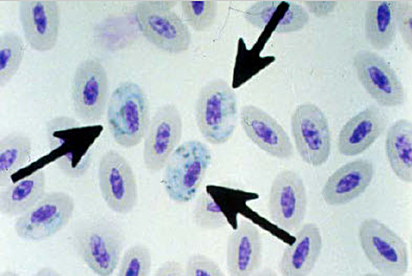
Identify the parasite and describe where is it found/what it infects:
Haemoproteus sp.
protozoan parasite that infects blood cells of birds
Which parasite is a nematode that lives in the hearts of dogs and causes serious disease?
Dirofilaria immitis
heartworm found free in the blood of dogs
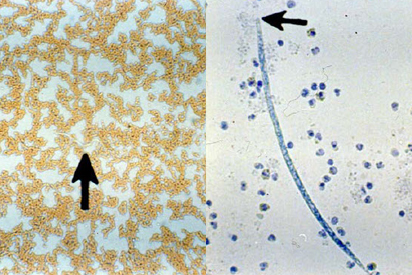
Identify the parasite
Dirofilaria immitis
heartworm found free in blood of dogs (not in blood cells)
When killed in formalin (part of the concentration process), these microfilaria have a straight or slightly curved body.
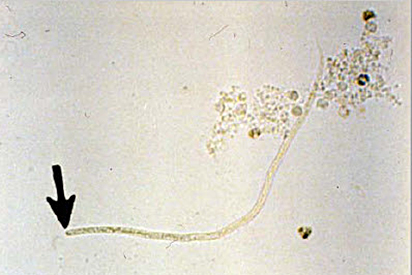
Identify the parasite
Acanthocheilonema reconditum
filarial worm that can be found free in blood of dog
a nematode which lives in skin and causes no disease
Which nematode lives in the skin of dogs and causes no disease, but looks similar to Dirofilaria immitis and is also found free in the blood?
Acanthocheilonema reconditum
Single-celled animal
Protozoan
Leaf-shaped worm with a mouth
Trematode
Flat, ribbonlike worm with no digestive tract
Tapeworm
Small, cylindrical worm covered with a cuticle
Nematode
Adult parasite with eight legs and two body parts
Arachnid
Adult parasite with six legs and three body parts
Insect
Myiasis
general term for disease caused by larval flies
Chewing/biting lice
have mouthparts made for chewing their food, feed on skin and hair
One-host tick
spends all three of its feeding stages on one host
Two-host tick
stays on one host for two of its life stages and then feeds on a second host during its third feeding life stage
three-host tick
feeds on three different hosts, one for each life stage.
Mites can cause a skin disease called ______
mange