Molec Cell Ch 6- DNA Repair & Rearrangement
 Call Kai
 Learn
Learn Practice Test
 Spaced Repetition
 Match
Match Flashcards
 Knowt Play
1/43

There's no tags or description
Looks like no tags are added yet.
Name | Mastery | Learn | Test | Matching | Spaced | Call with Kai | Chat |
|---|
No analytics yet
Send a link to your students to track their progress
44 Terms
A strand of DNA serves as a template for the synthesis of a _____________ antiparallel strand in the _______ direction.
complementary ; 5' to 3'
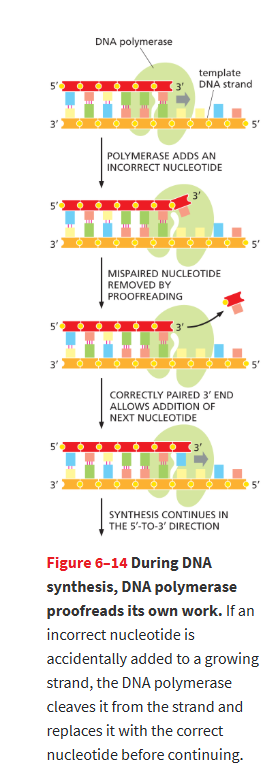
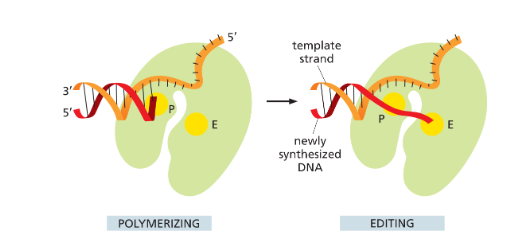
DNA polymerase also has 3' to 5' exonuclease activity- Proofreading ability.
If the wrong nucleotide is added during 5' to 3' DNA synthesis, DNA polymerase can remove it via its 3' to 5' exonuclease activity. Polymerase will then replace it with the correct nucleotide by resuming the 5' to 3' polymerase activity.
DNA can be altered by interacting with other molecules in the cell, UV radiation, etc.
______ is the loss of the purine bases, leaving behind an empty sugar-P behind.
Depurination
_________ is the removal of an amino group from cytosine, producing uracil.
Deamination
Mutations will be retained in ___ of the resulting daughter strands if they are not fixed before the next round of replication.
1/2
UV decontamination:
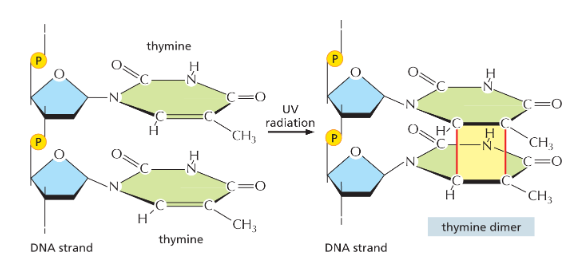
UV-induced thymine dimer= A cyclobutane ring forms between adjacent thymine bases. The joined thymines can not pair with adenines.
Mechanisms for DNA repair
Excision, re-synthesis, ligation
DNA polymerase
an enzyme that catalyzes the addition of nucleotides to the 3’ end of a growing DNA strand, catalyzes synthesis of DNA
-has 3’ → 5’ exonuclease activity for proofreading.
Removes wrong nucleotides and replaces them correctly.
polymerase can then replace it w/ the correct nucleotide by resuming the 5’ to 3’ polymerase activity.
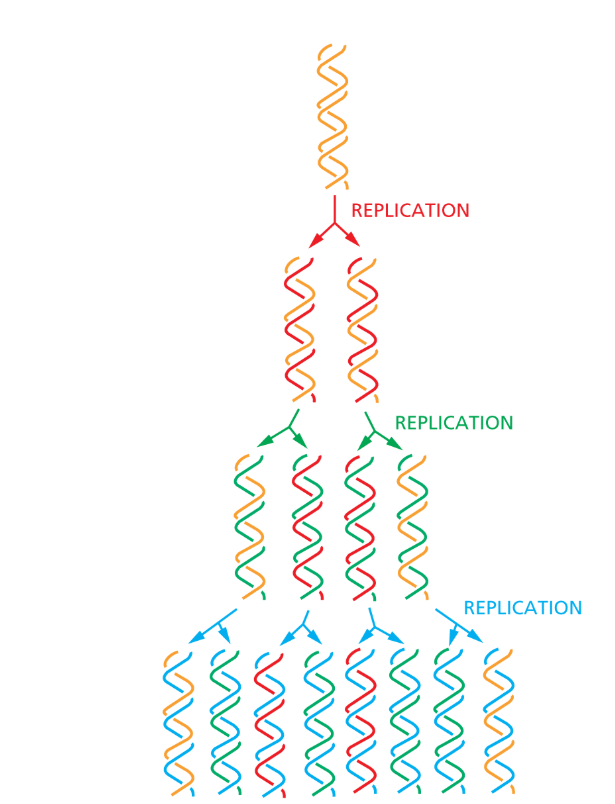
DNA is semiconservative
Because each parent strand serves as the template for one new strand, each of the daughter DNA double helices ends up with one of the original (old) strands plus one strand that is completely new
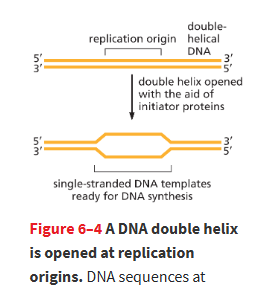
replication origins
initiator proteins that bind to DNA and pry the DNA strands apart so DNA synthesis can start
at regular temps
breaks apart H-bonds holding bases together
creates replication forks (y-shaped junctions where DNA begins to be replicated)
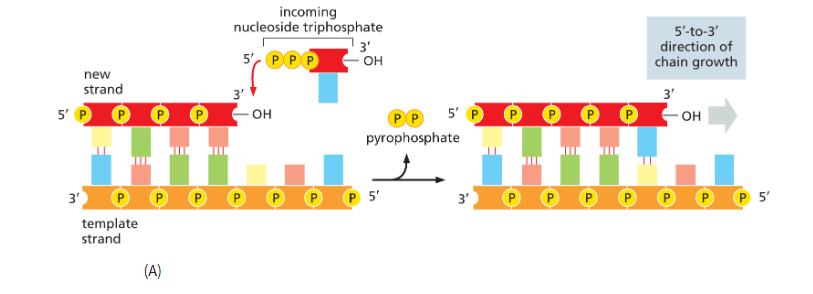
DNA synthesis energy
involves the formation of a phosphodiester bond between the 3ʹ end of the growing DNA chain and the 5ʹ-phosphate group of the incoming nucleotide
energy for polymerization is provided by the incoming deoxyribonucleoside triphosphate itself: hydrolysis of one of its high-energy phosphate bonds drives the reaction that links it to the chain, releasing pyrophosphate which is hydrolyzed to 2 molecules of P, making the rxn irreversible
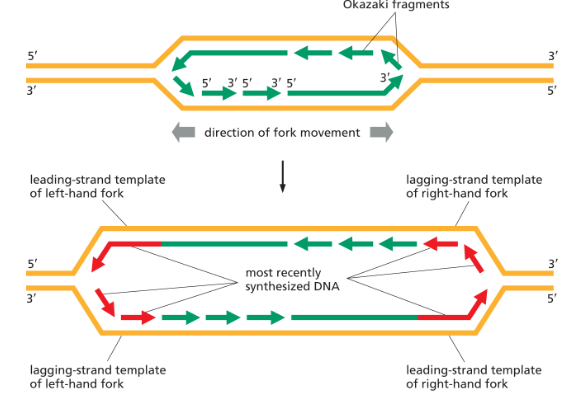
okazaki fragments
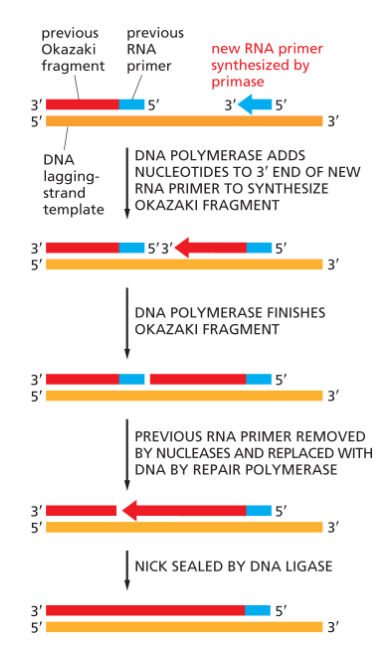
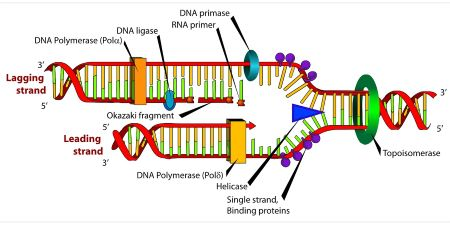
short length of DNA, including an RNA primer, produced on lagging strand during DNA replication.
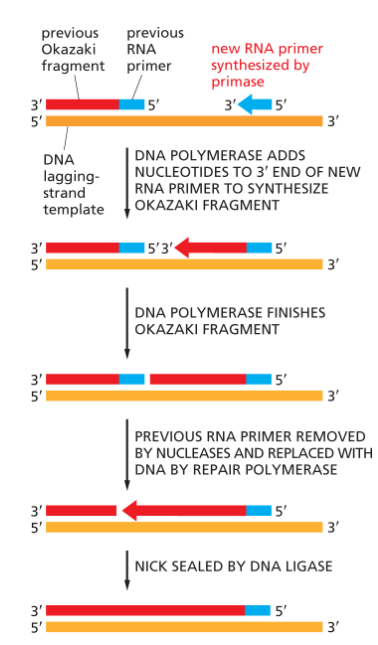
the discontinuous strands then joined together by DNA ligase
DNA ligase
an essential enzyme that repairs and seals together the discontinuous strands in DNA replication to form a continuous DNA
first a nuclease needs to degreade the primer
leading strand
the DNA strand that is made by continuous synthesis in the 5′-to-3′ direction
only one RNA primer needed
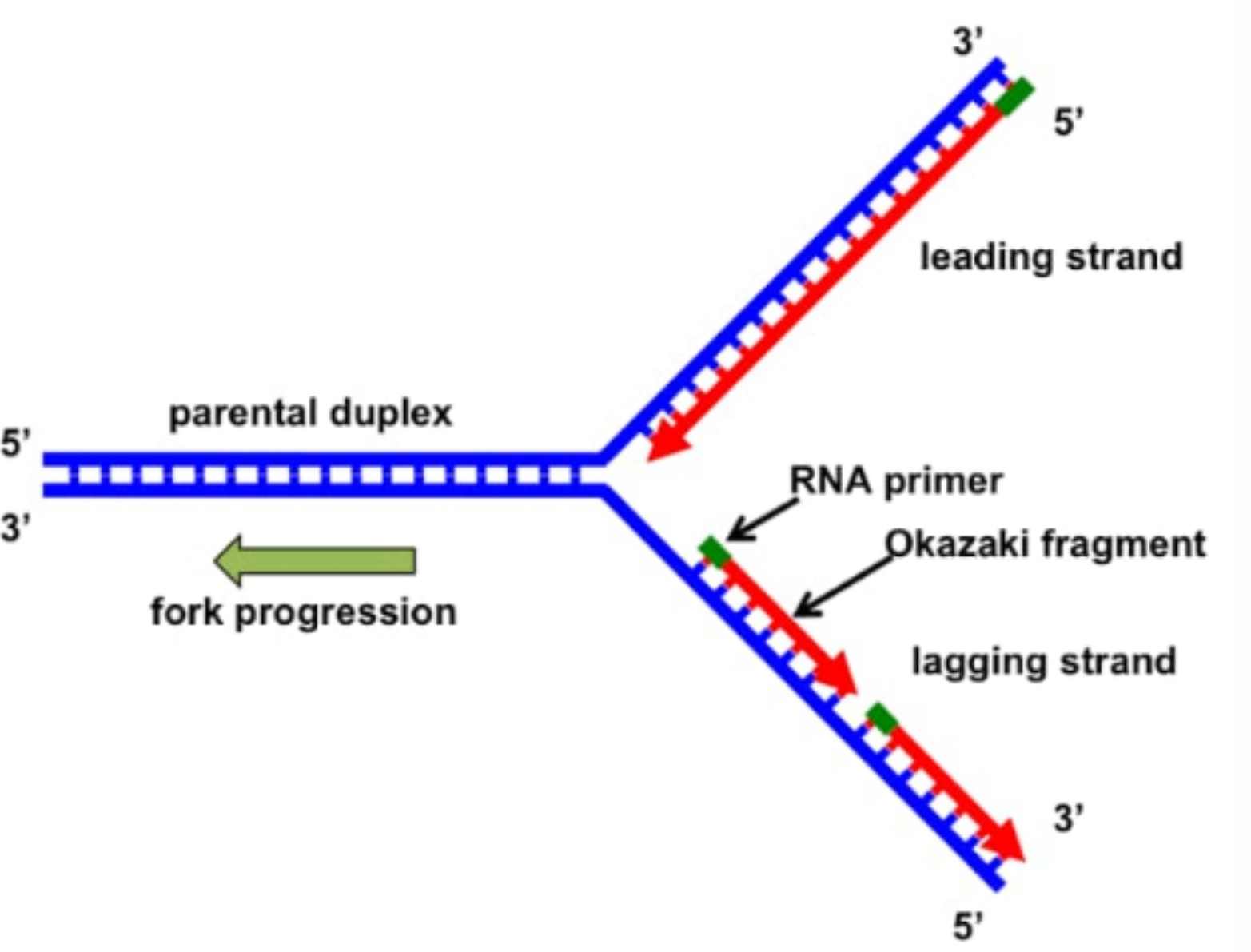
lagging strand
the DNA strand that is made discontinuously in short fragments that are later joined together to form one continuous new strand.
appears to grow in 3’ to 5’ direction but it does NOT!
DNA polymerase only synthesizes in 5’ to 3’ direction!!
numerous RNA primers needed
sources of DNA damage
Depurination: Loss of a purine base → leaves empty sugar-phosphate.
Deamination: Cytosine loses an amino group → forms uracil.
UV radiation: Forms thymine dimers (adjacent thymines join → can’t pair with adenine).
If not repaired, mutations are passed to ½ of daughter strands during replication.
DNA polymerase proofreading
Proofreading takes place at the same time as DNA synthesis. Before the enzyme adds the next nucleotide to a growing DNA strand, it checks whether the previously added nucleotide is correctly base-paired to the template strand. If so, the polymerase adds the next nucleotide; if not, the polymerase pauses to clip off the mispaired nucleotide and then tries again
Polymerization and proofreading are tightly coordinated, and the two reactions are carried out by different catalytic domains in the same polymerase molecule
primase
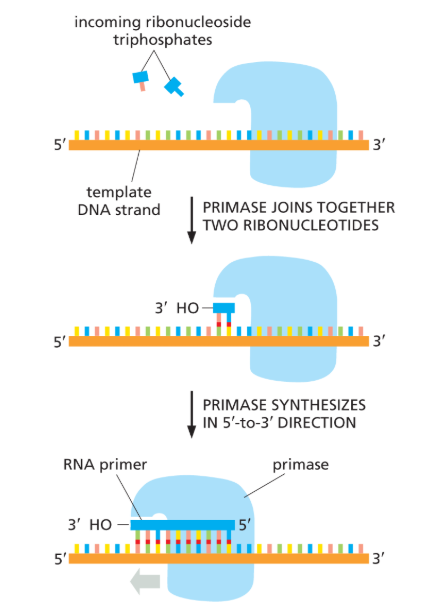
An RNA polymerase that uses DNA as a template to produce a short RNA fragment that serves as a primer for DNA synthesis
DNA synthesis requires an RNA primer to initiate replication
primase is an example of RNA polymerase, an enzyme that synthesizes RNA using a DNA template
primase does NOT proofread work! but since its RNA, errors stand outr
RNA polymerase
Synthesizes RNA from a DNA template (transcription).
primase is a type of RNA polymerase but its specifically a primer for DNA replication!
DNA polymerase III
the polymerase that carries out the bulk of DNA replication at the forks
DNA polymerase I
the repair polymerase that replaces RNA primers w/ DNA before DNA ligase goes to join Okazaki fragments
DNA helicase
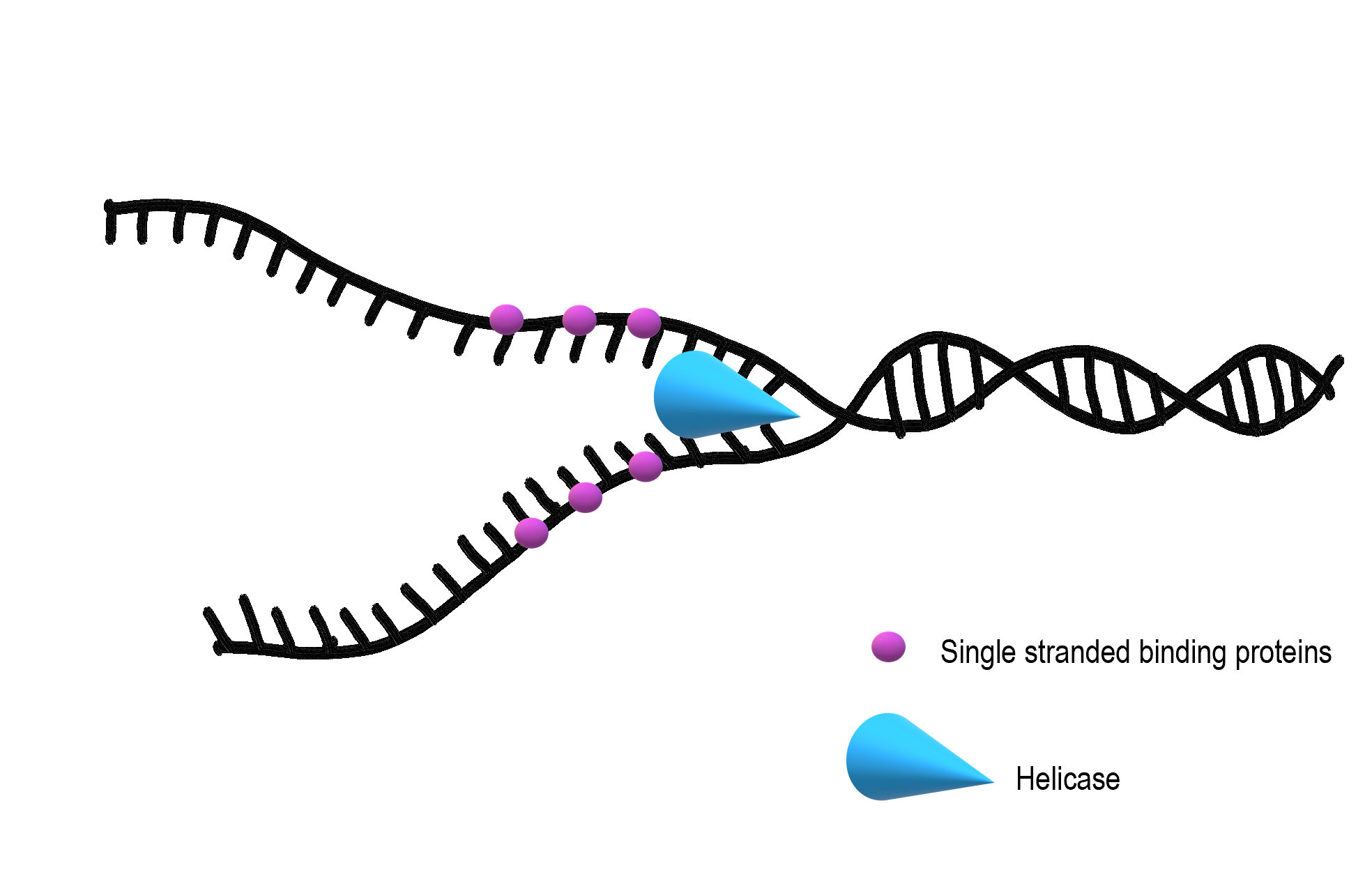
Enzyme that pries open the DNA double helix, using energy derived from ATP hydrolysis. Used to expose DNA single strands for DNA replication
SIngle-strand DNA-binding protein
Binds to single-stranded DNA exposed by DNA helicase, preventing base pairs from re-forming before the lagging strand can be replicated
DNA topoisomerase
Produces transient (not permanent) breaks in one strand of the DNA double helix to relieve the tension built up by the unwinding of DNA ahead of the DNA helicase; reseals breaks after DNA has relaxed
relieve torsional strain and supercoiling during replication, transcription, and repair
sliding camp
Keeps DNA polymerase attached to the template, allowing the enzyme to move along without falling off as it synthesizes new DNA
clamp loader
Uses the energy of ATP hydrolysis to lock the sliding clamp onto DNA
telomeres
Repetitive nucleotide sequence that caps the ends of linear chromosomes. Counteracts the tendency of the chromosome otherwise to shorten with each round of replication.
mark true end of a chromosome
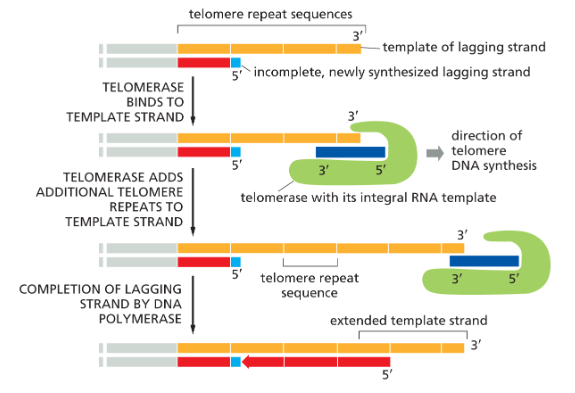
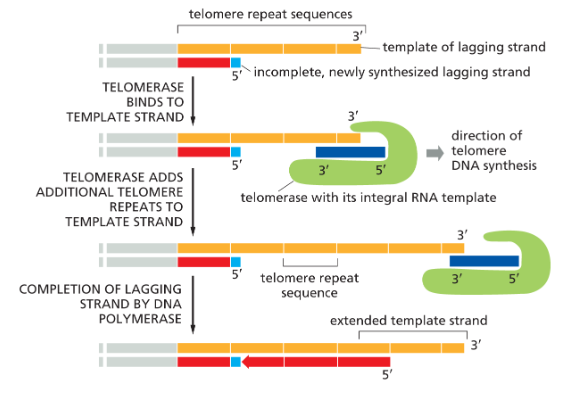
telomerase
Enzyme that elongates telomeres, synthesizing the repetitive nucleotide sequences found at the ends of eukaryotic chromosomes
carries its own RNA template
xeroderma pigmentosum
cannot mend the damage done by ultraviolet (UV) radiation because they have inherited a defective gene for one of the proteins involved in this repair process
develop severe skin lesions or skin cancer
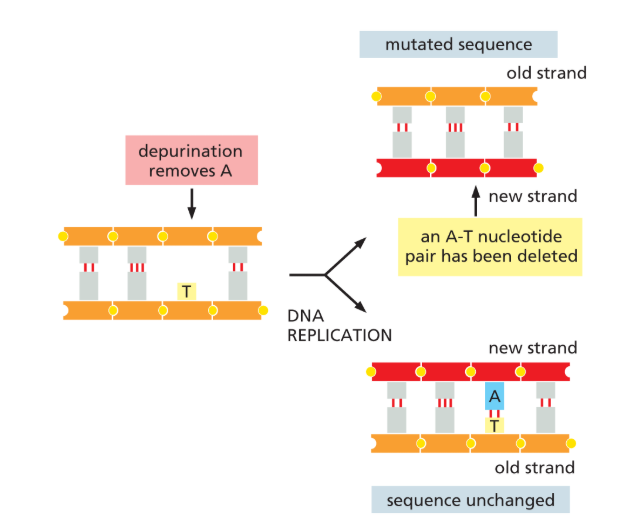
depurination
does not break the DNA phosphodiester backbone but removes a purine base from a nucleotide, and it gives rise to lesions that resemble missing teeth
leaves an empty sugar-P behind
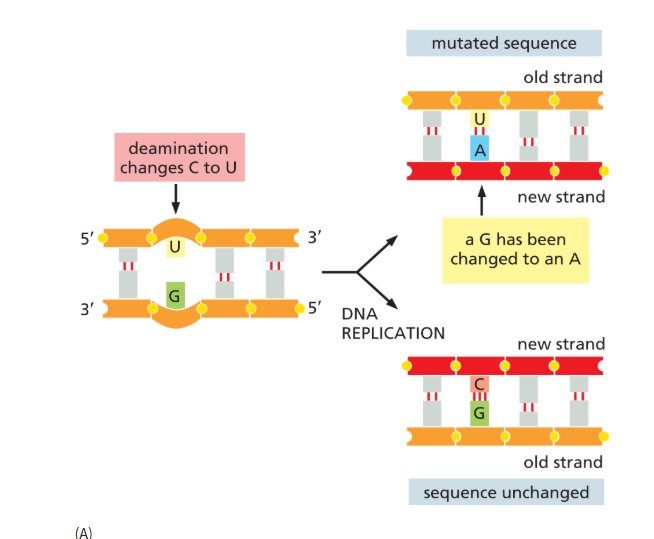
deanimation
causes spontaneous loss of an amino group from cytosine in DNA to produce base uracil
UV DNA damage
it promotes covalent linkage between two adjacent pyrimidine bases, forming, for example, the thymine dimer
cyclobutane ring formed btwn thymine bases
the joined thymines cant pair w/ adenines
this is basis for UV decontamination
DNA repair
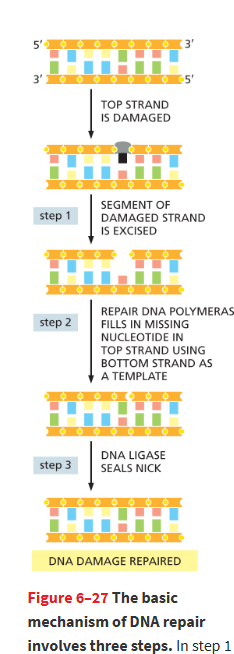
Cells constantly repair DNA to prevent mutations.
Most repair involves three steps:
Excision – removal of damaged bases or nucleotides.
Re-synthesis – DNA polymerase I fills in correct nucleotides.
Ligation – DNA ligase seals the strand.
mismatch repair
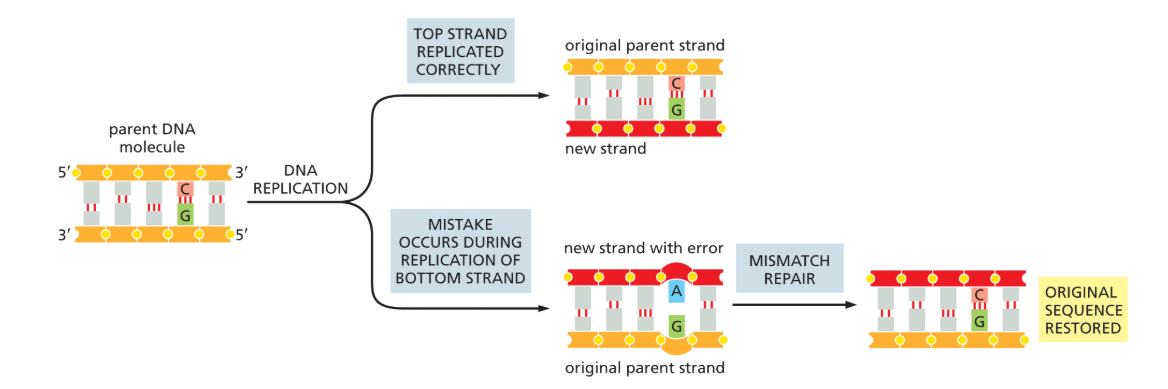
Fixes replication errors btwn incorrectly paired nucleotides that escape DNA polymerase proofreading.
If repair fails (e.g., Xeroderma pigmentosum), mismatches persist.
only removes newly made DNA!
double-strand break repair
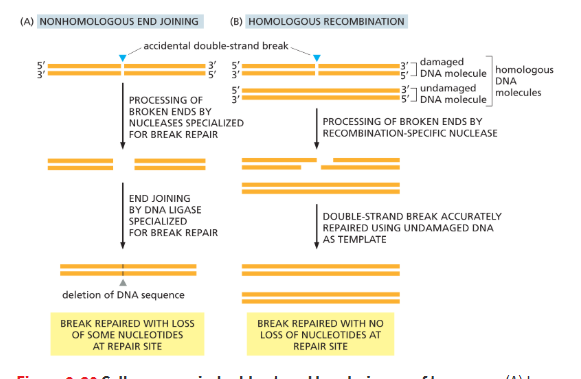
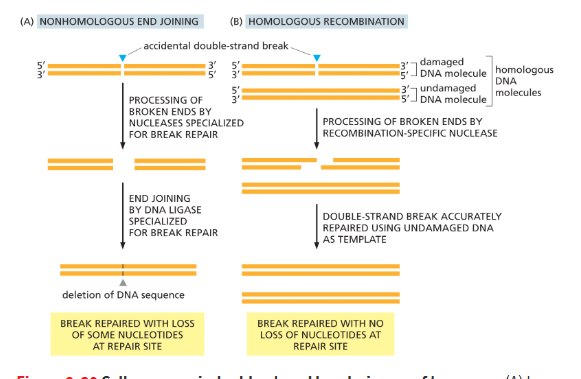
1. Non-Homologous End Joining
Directly joins broken DNA ends.
Broken ends are processed (flush) → sequence may be lost.
DNA ligase seals the ends.
2. Homologous Recombination
Occurs after DNA replication but before sister chromatid separation.
Steps:
Broken DNA strands digested → staggered ends.
Sister chromatid serves as a template.
Strand invasion and repair using numerous protein complexes.
Advantage: Flawless repair without loss of sequence.
consequences of DNA damage
Unrepaired DNA can lead to mutations.
Mutations accumulate with age.
Persistent damage can have severe effects on cells and organisms.
DNA replication and repair fidelity is recorded in genome sequences.
double-strand break
when both strands of DNA segment are damaged at the same time
nonhomologous end joining
involves hurriedly sticking the broken ends back together, before the DNA fragments drift apart and get lost.
Directly joins broken DNA ends.
Broken ends are processed (flush) → nucleotide sequence may be lost.
DNA ligase joins flush ends together
risky, dirty
homologous end joining
uses an undamaged, duplicated, or homologous chromosome to guide the repair. During meiosis, the mechanism results in an exchange of genetic information between the maternal and paternal homologs.
one of the broken 3ʹ ends “invades” the unbroken homologous DNA duplex and searches for a complementary sequence through base-pairing. Once an extensive, accurate match is made, the invading strand is elongated by a repair DNA polymerase, using the complementary undamaged strand as a template
Occurs after DNA replication but before sister chromatid separation.
Steps:
Broken DNA strands digested → staggered ends.
Sister chromatid serves as a template.
Strand invasion and repair using numerous protein complexes.
Advantage: Flawless repair without loss of sequence.
mutation
permanent change in DNA sequence
Mutations can arise during DNA replication, and if the event is not repaired, then the genetic change will be inherited by the daughter cells.
How is DNA replicated with high accuracy?
DNA polymerase adds nucleotides using a template strand and proofreads with its 3’ → 5’ exonuclease activity, fixing mistakes as it goes.
How does the mismatch repair system work?
After replication, mismatch repair proteins detect and remove incorrectly paired bases missed by proofreading, then fill in the correct nucleotides.
What mechanisms have cells evolved to repair spontaneous mutations?
Excision repair: removes damaged bases and replaces them.
Double-strand break repair:
Non-homologous end joining (NHEJ): directly joins broken ends.
Homologous recombination (HR): uses a sister chromatid as a template for flawless repair.