AP Bio Unit 3
 Call Kai
 Learn
Learn Practice Test
 Spaced Repetition
 Match
Match Flashcards
 Knowt Play
1/36

There's no tags or description
Looks like no tags are added yet.
Name | Mastery | Learn | Test | Matching | Spaced | Call with Kai | Chat |
|---|
No analytics yet
Send a link to your students to track their progress
37 Terms
Primary protein stucture
Amino acid sequence order

Secondary protein structure
Folding because of hydrogen bonds - α helix + β pleated sheet

Tertiary protein structure
Folding because of interactions between amino acids

Quaternary protein structure
Arrangement of MULTIPLE proteins together

Amino Acid structure
Amino group, R-group (determines function), carboxyl group

Peptide bond
Covalent bond linking amino acids, formed by dehydration synthesis

Denaturation
When proteins lose their shape (and probably function) due to disruptions
Enzymes
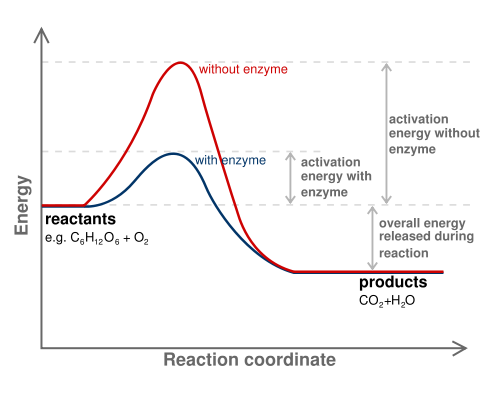
Protein that lowers activation energy in chemical reactions. Ends in -ase
Substrate
The molecule upon which the substrate acts

Active site
The region of an enzyme where a substrate binds
Anabolic
Enzyme reaction where molecules are being built and joined

Catabolic
Enzyme reaction where molecules are being broken down

Confirmation change/Induced fit
“Squeeze” where enzyme adapts to shape of substrate

Metabolism
All chemical reactions in the body
Environmental conditions on enzymes
Possible denaturation:
Temp - high temp affect hydrogen bonds, etc
pH change
Ionic concentration change (disrupts bonds)
Cofactors and coenzymes
Non-proteins that speed up enzyme reaction (ex. Vitamin B)

Competitive enzyme inhibitors
Resembles substrate and takes up their spot

Allosteric (uncompetitive) enzyme inhibitors
Doesn’t enter active site, binds to enzyme and changes enzyme shape

1st law of thermodynamics
Energy cannot be created or destroyed

2nd law of thermodynamics
Every time energy is used, the entropy increases ( hot → cold)

Energy input and output
Living things must obtain MORE energy than they use to keep living
Metabolic Pathway
The product of a reaction gets reused as a reactant of another pathway

Energy coupling
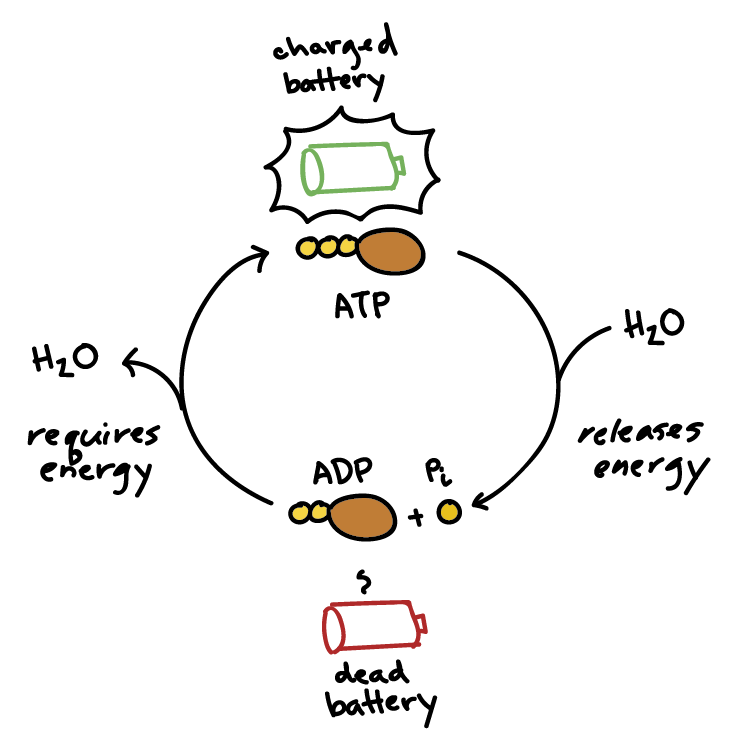
Pairing reactions that release energy w/ reactions that absorb energy to minimize energy lost
Energy and bonds
Breaking bond - uses energy
Forming bond - releases energy
Light Reactions
Input: Water and light energy
Output: Oxygen, ATP, NADPH
Light energy energizes electrons from water, which power the rest of the reaction.
H+ ions from water go through ATP synthase and are attached to ADP to make ATP. Also attached to NADP+ to make NADPH in NADP reductase
Photosystems II and I
Enzymes art of light reactions, II goes before I
Contains chlorophyll and is where electrons get energized
Thylakoid membrane
In chlorophyll, where light reactions take place
Stroma
Fluid in chlorophyll where dark reactions/Calvin cycle takes place
Calvin cycle
Inputs: CO2
Outputs: Sugars (ADP, NADP+, and H+ left over goes back to light reactions)
Carbon Fixation
Reduction (Adds carbon)
Regeneration (Leftover carbon-phosphates/G3P are recycled back into cycle)
Rubisco
Enzyme that pairs carbon and RuBP together at the start of Calvin cycle, ESSENTIAL for photosynthesis
Spongy/Palisade mesophyll
Where photosynthesis happens in leaves (think: -phyll)
Stomata
Plant pores that allow things in/out. Can open and close
C3 Plants
Most plants, typical photosynthesis. Carbons fixed 1 time
C4 Plants
Plants in humid/hot conditions (ex corn), photosynthesis is ALSO in bundle sheath cells. Carbons fixed 2 times
CAM Plants
Plants in hot and dry conditions (ex cacti), stomata open to collect CO2 ONLY at NIGHT to minimize water loss, Calvin cycle in daytime. Carbon fixed 2 times
Photolysis
Water broken down using light absorption. Happens in photosystem II
Photorespiration
Too much oxygen in plant, rubisco pairs oxygen instead of carbon in Calvin cycle. Inhibits photosynthesis