Signal Amplification
 Call Kai
 Learn
Learn Practice Test
 Spaced Repetition
 Match
Match Flashcards
 Knowt Play
1/5

Earn XP
Description and Tags
Thevenin equivalent, Impedence matching, Operational Amplifiers (summing , multiplying, differentiation, difference & integration)
Name | Mastery | Learn | Test | Matching | Spaced | Call with Kai | Chat |
|---|
No analytics yet
Send a link to your students to track their progress
6 Terms
impedence matching
when combining two distinct circuits, one of them draws voltage from the other because of different effective resistance (create a load)
→ to minimize the problem we match the impedence of the two circuits (=/ equal)
best way to get EQUIVALENT RESISTANCE is to get THEVENIN EQUIVALENT
Thevenin equivalent
turns a complicated circuit into a simpler one → Multiple sources and resistors will be converted into a single voltage source and series resistor
from viewpoint of the load circuits are perfectly equivalent
Thevenin equivalent - how to
Steps:
Review your circuit, identify your load and the nodes it is connected to.
Remove the load resistor.
Find RTh by shorting all voltage sources and by open circuiting all the current sources and then see what the resistance looks like from the point of view of the nodes where the load resistor was located.
Find VTh by finding the voltage across the nodes the load was originally hooked to, using standard circuit analysis methods.
Replace the load and find the current flowing through the load with these new values.
Sanity check!

what is the thévenin voltage and resistance for a voltage divider
-thévenin resistance is found by removing voltage supply from circuit and considering resistance across two output terminals (start at A and redraw the circuit whilst taking into consideration what happens when we reah each node)
-for voltage divider → thévenin resistance (see picture)

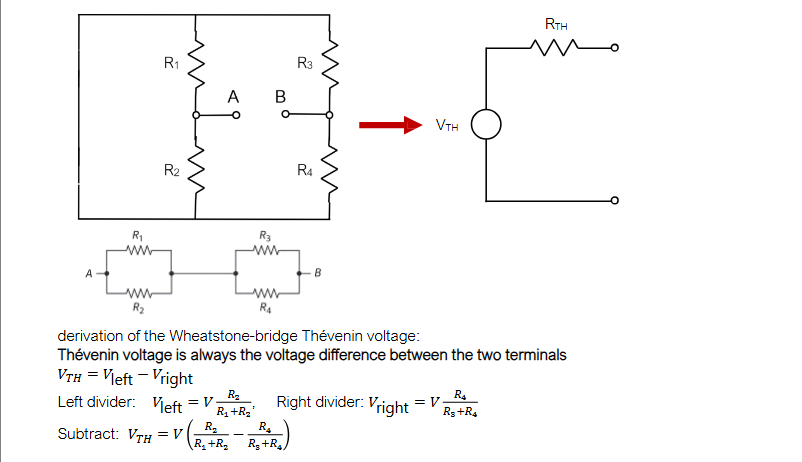
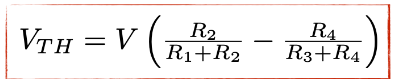
thévenin voltage for wheatstone bridge
Thévenin resistance for wheatstone bridge
obtained by shortening the circuit (ignoring the voltage source)