Lecture 2: Adaptive Immune System
 Call Kai
 Learn
Learn Practice Test
 Spaced Repetition
 Match
Match Flashcards
 Knowt Play
1/9

There's no tags or description
Looks like no tags are added yet.
Name | Mastery | Learn | Test | Matching | Spaced | Call with Kai | Chat |
|---|
No analytics yet
Send a link to your students to track their progress
10 Terms
The Immune System and Adaptive Immunity
Defined by 3 characteristics:
Systemic effects
Specificity
Memory
Types of adaptive immunity:
Cellular immunity
Humoral immunity
Active immunity: Body makes its own antibodies or T cells
Passive immunity: Body acquires these from another person or animal

Components of Adaptive Immunity
Antigens: Any molecule that triggers an immune response (epitopes are part of the molecule that triggers the immune response.)
Antibodies: AKA immunoglobulins (Igs), proteins that play a variety of roles in defense
Three classes of lymphocytes: Natural killer (NK) cells, T cells, and B cells
Macrophages
Dendritic cells
T Lymphocytes (T Cells):
Produced: Red bone marrow
Mature: Thymus
Cortex: Can recognize antigens (immunocompetent)
Medulla: Distinguish self vs non-self. If it can’t distinguish self it will lead to autoimmune disorders
Disperse throughout the body; colonize Lymphatic tissue and organs all over the body
Cannot recognize antigens by itself, requires assistance
B Lymphocytes (B Cells):
Formation and maturation in red bone marrow
Adults produce 50 million/day only 10% enter circulation
Immunocompetent B cells disperse and colonize same locations as T cells
Main function: Produce antibodies
Antigen Presenting Cells
Include: Dendritic cells, macrophages, reticular cells and B cells
Major Histocompatibility Complex: Proteins on the APC surface - have an elongated groove for holding the foreign antigen
MHC’s are unique to you - they are “identification tags” that label every cell of your body

Cellular (Cell-Mediated) Immunity
Cytotoxic T (TC) Cells: Carry out the attack on foreign cells
Helper T (TH) Cells: Promotes action of TC cells playing key roles in humoral and innate immunity (AKA T4, CD4, or CD4+)
Regulatory (TR or T-regs) Cells: Limit immune response by inhibiting activities of other T cells; down regulate the response to limit tissue damage (AKA T4, CD4, or CD4+)
Memory T (TM) Cells: Responsible for memory in cellular immunity
Adaptive immunity occurs in three stages:
Recognition
React (Attack)
Remember
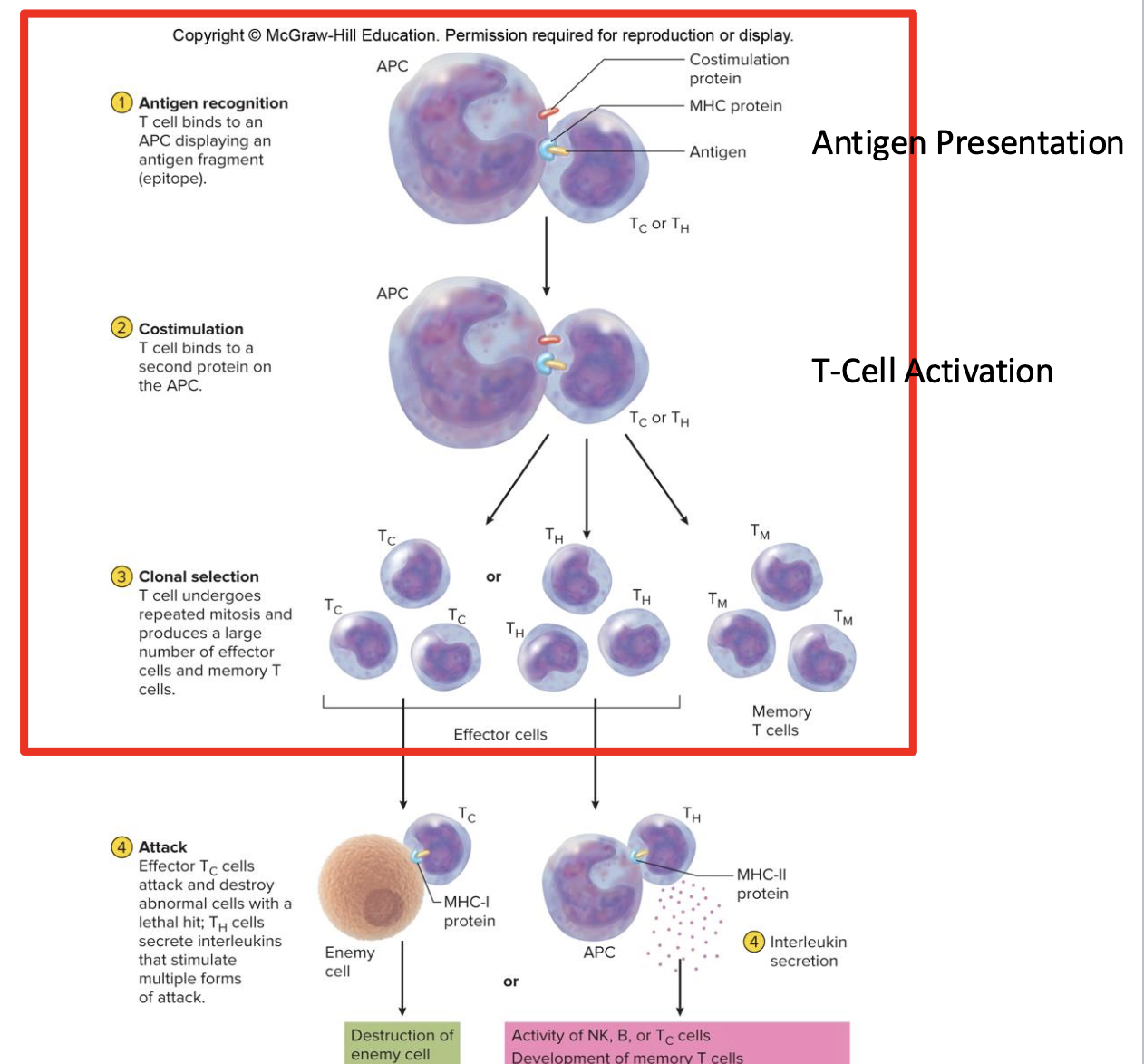
Cellular (Cell-Mediated) Immunity: Recognition
T cells respond to 2 classes of MHC proteins:
MHC I: Proteins on every cell
MHC II: Proteins occurring only on foreign antigens
Activation occurs when a TC or TH cells binds to an MHC protein that the T cell recognizes (must also bind to a second protein)
Successful costimulation activates clonal selection
Cellular (Cell-Mediated) Immunity: Attack
When TC cells recognize an MHC complex, they directly attack and kill other cells
Specifically, helper T cells secret interleukins that cause 3 main effects:
Attract neutrophils/NKCs
Attract macrophages, stimulate phagocytosis & keep in area
Stimulate T and B cell mitosis and maturation
Perforin and Granzymes
Interferons - Activate macrophages
Tumor Necrosis Factor (TNF) - Activate macrophages
When TH cells recognize an MHC complex, it secretes interleukins

Cell (Cell-Mediated) Immunity: Memory
Primary response is followed by immune memory
T cell recall response

Humoral Immunity: Recognition
When antigens bind to several receptors and takes them in by receptor-mediated endocytosis
Antigen is processed, linked to MHC-II proteins and displayed
Binding of TH leads to secretion of interleukins and B cell activation

Humoral Immunity: Attack
Once released by plasma cells, antibodies use 4 mechanisms to render antigens harmless
Attack on antigens steps:
Neutralization: Mask critical region of an antigen antibodies
Complement Fixation: Antibodies bind complement proteins to an enemy cell
Agglutination: Clumping of enemy cells by antibodies
Precipitation: Antigen molecules are clumped by adhesion to antibodies
Note: Antibodies don’t directly destroy antigens, they render them harmless

Humoral Immunity: Memory
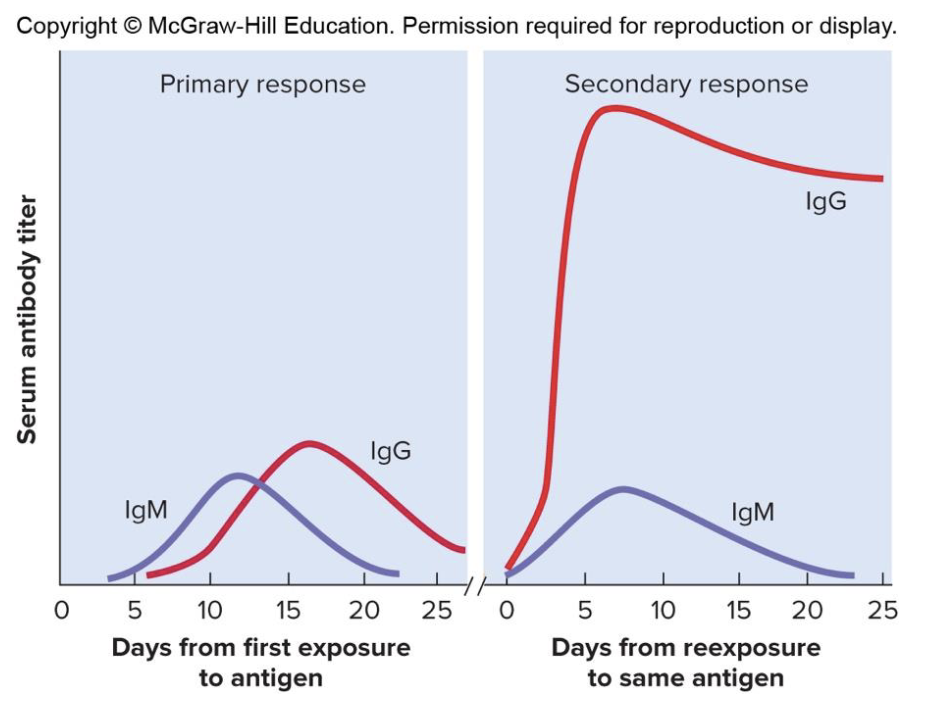
Primary Response: When a person is exposed the first time
Antibody titer (measurement of concentration of antibodies) increases until day 10
Leaves an immune memory
Memory B cells mount a quick secondary (anamnestic) response upon re-exposure