2) Tumor Immunology
 Call Kai
 Learn
Learn Practice Test
 Spaced Repetition
 Match
Match Flashcards
 Knowt Play
1/31

There's no tags or description
Looks like no tags are added yet.
Name | Mastery | Learn | Test | Matching | Spaced | Call with Kai | Chat |
|---|
No analytics yet
Send a link to your students to track their progress
32 Terms
Briefly explain the approaches by which immunity against tumors be induced.
→ Immunity can be induced by immunizing subjects (such as mice or rats) with irradiated cancer cells
surgical resection of a 1er tumor can cause the animal be be immune to subsequent challenges with the same tumor
What are the factors influencing tumor immunity?
Type of cancer (e.g., high to low immunogenic - UV > methylcholanthrene > spontaneous)
Method of its induction
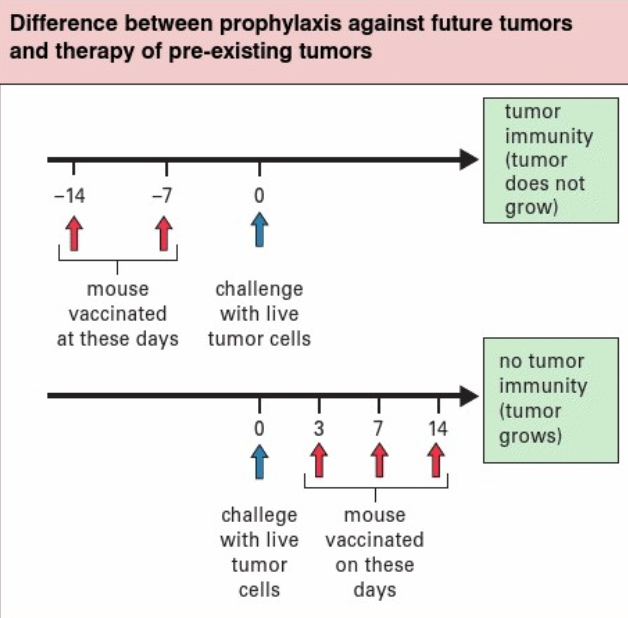
What kind of immunization confers protective immunity against tumors?
prophylactic immunization (not therapeutic immunization)
giving the vaccine before the pt get tumour (prophylactic)
How many days prior to challenge with live tumor cells is the prophylactic immunization initiated?
14 days & 7 days prior
Briefly describe specific immunity with an example.
→ immune response is unique to the individual tumor used for immunization
e.g., mice immunized against a specific fibrosarcoma are immune only to that individual tumor line
if challenged with a different fibrosarcoma, even one induced by the same carcinogen → tumor growth is unaffected
Name some common tumor types caused by Epstein Barr Virus.
Lymphoma
Burkitt’s lymphoma
Nasopharyngeal cancer
What is the influence of immunosuppression on development of tumors?
Immunosuppression → ↑ risk developing various cancers
Give 2 examples of tumor types found in Kidney transplant patients.
Kaposi’s sarcoma
Non-Hodgkin’s lymphoma
Name some common Hsp antigens and the type of cancer they are associated with.
Gp96: associated with fibrosarcoma, lung carcinoma, lymphoma, prostate carcinoma
Hsp70 & Hsp90: associated with fibrosarcoma & colon carcinoma
What are tumor specific antigens mainly made up of? What contributes to immunogenicity?
→ antigens belong to the family of HSPs
specificity of immunogenicity is derived from the peptides chaperoned within the HSP's binding pocket rather than the HSP molecule itself
Identify the major families of tumor specific antigens.
HSP90 (gp96 and HSP90)
HSP70 (HSP110 and HSP/c70)
HSP170 (grp170)
Calreticulin
What do the HSP-chaperoned peptides contain?
→ have any tumor-specific antigenic epitopes present in the tumor cell
act as the “antigenic fingerprint” of the tumor from which they were isolated
What happens when the peptides dissociate from HSP?
dissociation abrogates (ends) the tumor rejection activity
Outline the steps involved in the presentation of tumor specific antigens to APC’s.
HSP-peptide complexes bind to HSP receptors (like CD91) on APC
Complexes are endocytosed into the APC
Chaperoned peptides follow both the endogenous (Class I) and exogenous (Class II) pathways of antigen presentation
Peptides are processed and re-presented by MHC I & MHC II on the APC surface
HSP ligation induces upregulation of CD40 and CD80/85 + chemokines & cytokines production
What are the 2 types of MHC’s and T cells involved in recognition of tumor specific antigens?
MHC Class I - recognized by CD8+ CTLs
MHC Class II -recognized by CD4+ T cells
What are the main categories of tumor specific antigens?
HSP-peptide complexes
Cancer/testes (CT) antigens (e.g., MAGE, NY-ESO1)
Differentiation antigens (e.g., gp100)
Unique tumor-specific antigens (mutations)
Viral antigens
Name the 2 HPV antigens involved in development of cervical cancer.
E6
E7
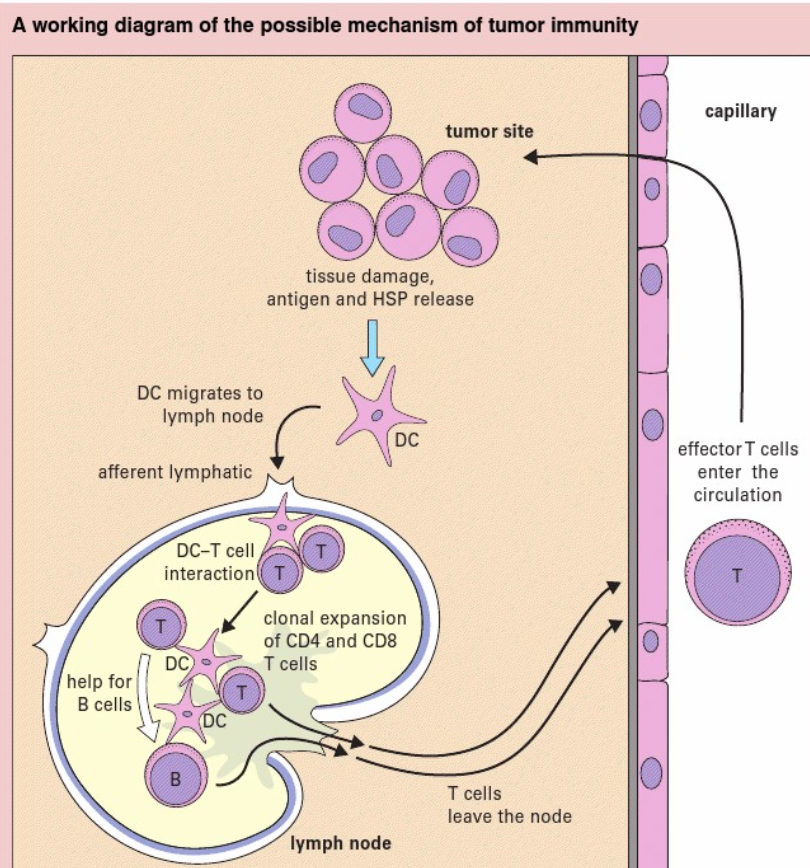
Outline the steps involved in development of tumor immunity involving APCs and NK cells.
Tissue damage at the tumor site releases antigens and HSPs, which are taken up by APCs
APCs migrate to the draining lymph nodes and interact with naive T cells → clonal expansion of CD4 and CD8 T cells
NK cells play a crucial role in the response
Cytokines (IL-2, IFN-γ, IL-12) are needed for the effector functions of CD4, CD8 & NK cells
Effector cells enter circulation to reach the tumor site
What is concomitant immunity and its features?
→ phenomenon where a host with an already growing tumor is resistant to a 2nd challenge of the same tumor
tumor-specific
eliciting a response that can eliminate a nascent tumor
fails to eliminate the original tumor that elicited the response
What is the time frame during which concomitant immunity elicits protection? Why is the protection lost after this time frame?
Narrow window of 7–10 days after tumor implantation
protection is lost after this time b/c a new population of suppressor T cells appears
Name the marker used for detection of Ovarian cancer, Leukemia, Hodgkin’s lymphoma.
Ovarian cancer: Ca 125
Leukemia: Common acute lymphoblastic leukemia antigen (CALLA) or CD25
Hodgkin’s lymphoma: CD30
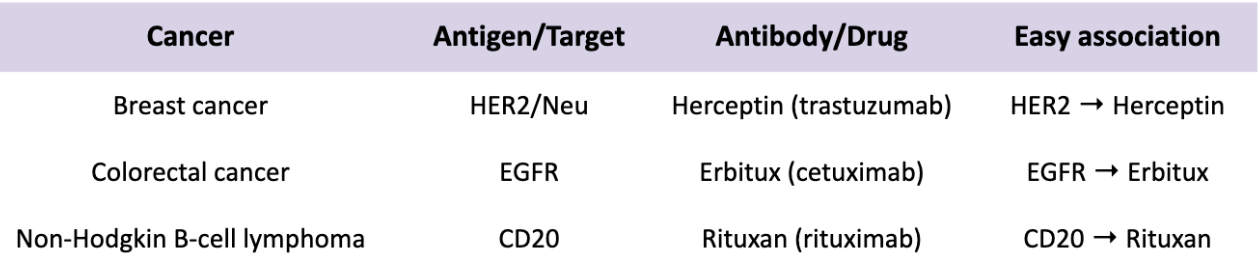
Name the antigen involved and antibody used for Breast cancer, Colorectal cancer, Non-Hodgkin’s B cell lymphoma.
What are the major factors contributing to failure of tumor recognition?
Inhibitory cytokines (TGF-β, IL-10)
Inhibition of T cell activity via CTLA-4 & PD1
Down-regulation through regulatory T cells
Down-regulation of MHC Class I
Generation of antigen-loss variants
Loss of β2-microglobulin or components of the antigen processing machinery
How does CTLA-4 inhibit T cell?
By either
raising the stimulatory threshold
inhibiting the proliferative drive of the cells
What is the advantage of combining Anti-CTLA-4 antibody with a vaccine of irradiated melanoma cells?
(+) produces a significantly higher anti-tumor response than using anti-CTLA-4 antibody or vaccine alone
What is the influence of anti-CD25 antibodies on tumors?
Targeting CD25+ cells with these antibodies → robust T cell response and protective tumor immunity (even in aggressive models like B16 melanoma)
Name the antibody used against B cell lymphoma, colon cancer, breast cancer.
B cell lymphoma: Rituximab
Colon cancer: Cetuximab
Breast cancer: Trastuzumab
Briefly explain the approach of HSP-peptide complex immunization used for cancer.
Tumor specimen is surgically excised from a patient
HSP-peptide complexes (like gp96 or hsp70) are purified from it
Purified complexes are vaccinated back into the same patient
has been shown to ↓ recurrence risk in some cancers (e.g., renal cell carcinoma)
What are the steps involved in adoptive immunotherapy using T cells?
Isolating tumor-infiltrating T cells from the pt
Expanding them in vitro
Infusing them back into the pt
What is the benefit of adoptive immunotherapy in melanoma pt?
dramatic tumor shrinkage
What are 2 types of primary tumors arise within the eye itself?
Retinoblastoma in children (under 5)
Melanoma in adults (60-65)
What are ways to treat eye tumors?
Laser treatment
Freezing (cryosurgery)
Surgical removal → reconstructive eye surgery with artificial eye implant
Radiation therapy