An Introduction to the Biopsychosocial Model
 Call Kai
 Learn
Learn Practice Test
 Spaced Repetition
 Match
Match Flashcards
 Knowt Play
1/23

There's no tags or description
Looks like no tags are added yet.
Name | Mastery | Learn | Test | Matching | Spaced | Call with Kai | Chat |
|---|
No analytics yet
Send a link to your students to track their progress
24 Terms
What is the Biomedical Model?
An approach to health that suggests that disease is rooted in biology.
Focuses mainly on physical/biological causes of illness.
It ignores psychological and social factors that may influence health and disease.
According to the Biomedical Model, where does disease come from?
Disease is viewed as being rooted primarily in biological or physical abnormalities within the body.
What major factors does the Biomedical Model tend to ignore?
Psychological factors
Social factors
It mainly concentrates on biological causes.
What are the two philosophical perspectives associated with the Biomedical Model?
Mind-body dualism
Reductionism
What is mind-body dualism?
The perspective that the mind and body are separate from one another.
Key idea: Mental processes and physical processes are treated as separate areas.
What is reductionism?
The process of breaking down complex phenomena into simpler principles.
In the Biomedical Model, reductionism may treat disease as having:
one singular cause
one singular target for treatment
How does reductionism view the cause and treatment of disease?
Reductionism tends to look for:
One cause → One treatment target
Instead of considering many interacting causes or systems.
A doctor believes a patient's illness has one specific biological cause and treatment should only target that abnormality. What perspective does this represent?
Because the complex health problem is being reduced to a single cause and treatment target.
A theory says someone's thoughts and emotions are completely separate from their physical body. What perspective is this?
Mind-body dualism
What is an infectious disease?
An acute illness caused by viruses or bacteria.
What is a chronic disease?
A degenerative illness that persists over time.
What are the 4 reasons chronic disease overtook infectious disease as a leading cause of death in the U.S.?
Prevention
Vaccinations
Living longer
Industrialization
What example does the lecture give for why the Biomedical Model may be insufficient?
A person may experience symptoms even when no biological abnormality is detected.
This raises the question of whether health can always be explained through biology alone.
What is the Biopsychosocial Model?
An approach to health that incorporates:
Biological factors
Psychological factors
Social factors
Disease is viewed as the interplay between systems, rather than simply one biological abnormality.
What is the biggest difference between the Biomedical Model and Biopsychosocial Model?
Biomedical Model
Disease primarily rooted in biology
May ignore psychological/social factors
Associated with reductionism
Can look for one cause and one treatment
Biopsychosocial Model
Includes biological, psychological, and social factors
Looks at interactions between different systems
Uses a more holistic approach
What are biological factors in the Biopsychosocial Model?
Biological factors include:
Genetic predispositions
Function of our physiology
Structure of our physiology
What are psychological factors in the Biopsychosocial Model?
Psychological factors include:
Behaviors
Mental processes
What three major mental processes are listed as psychological factors?
Cognition
Emotion
Motivation
What are social factors in the Biopsychosocial Model?
Social influences and processes that can affect health.
What three levels of social influence are identified in the lecture?
Family/friends
Community
Society
What is the Systems Approach?
Viewing complex phenomena as the interplay between related systems.
What perspective is the Systems Approach contrary to?
Reductionism
Reductionism breaks a problem into simpler pieces, while the Systems Approach considers the interaction between multiple systems.
Does the Systems Approach take a reductionist or holistic view of disease?
Holistic view
The disease is considered in the context of multiple interacting systems rather than one isolated cause.
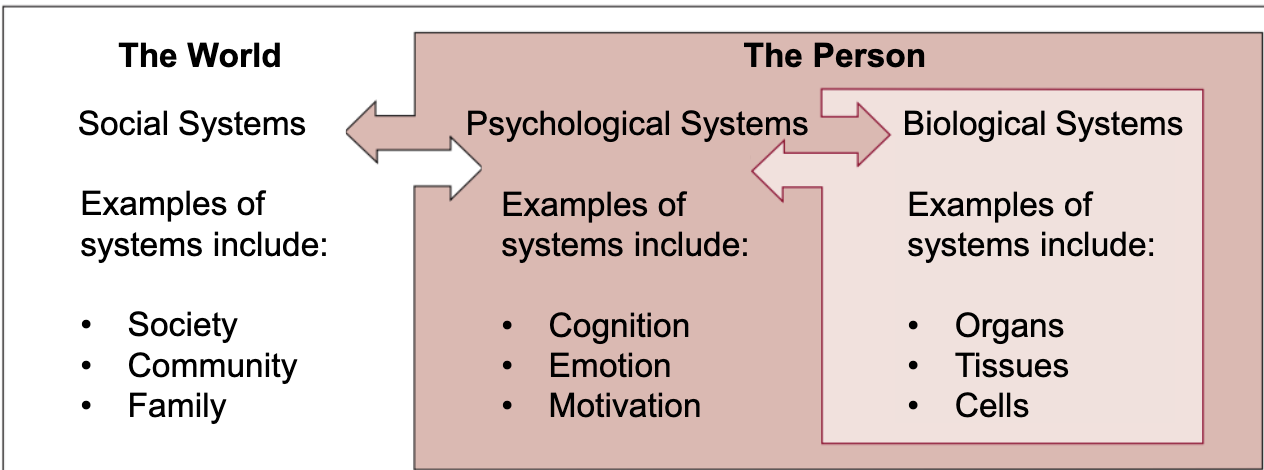
According to the diagram on page 13, how are biological, psychological, and social systems organized?
The World
→ Social Systems
→ The Person
→ Psychological Systems
→ Biological Systems
The main idea is that these systems interact rather than operate independently.