Environmental Microbiology Exam 3
 Call Kai
 Learn
Learn Practice Test
 Spaced Repetition
 Match
Match Flashcards
 Knowt Play
1/547

There's no tags or description
Looks like no tags are added yet.
Name | Mastery | Learn | Test | Matching | Spaced | Call with Kai | Chat |
|---|
No analytics yet
Send a link to your students to track their progress
548 Terms
Taxonomic level 1
Domain
Taxonomic level 2
Phylum
Taxonomic level 3
Class
Taxonomic level 4
Order
Taxonomic level 5
Family
Taxonomic level 6
Genus
Taxonomic level 7
Species
-ales
order suffix
-aceae
family suffix
DNA
deoxyribonucleic acid
Thymine pairs with…
adenine
Adenine pairs with…
thymine
Cytosine pairs with…
guanine
Guanine pairs with…
cytosine
What bond do base pairs use?
Hydrogen
G+C content (%) =
(G+C)/(G+C+A+T) x 100
Actinobacteria G+C
High
Firmicutes G+C
Low
Actinobacteria and Firmicutes are gram…
positive
Actinomycetes are commonly found in…
soil
actinomycetes lack
flagella
Actinomycetes are
filamentousa
actinomycetes produce
hyphae (filaments), forming mycelium
Actinomycete aerial hyphae differentiate into
exospores
What percent of streptomyces produce antibiotics?
50%
How many antibiotics are produced by streptomyces?
Over 500
Streptomyces can produce ____ antibiotics
one or more
How large is a typical streptomyces genome?
greater than or equal to 8Mbp
Antibiotic synthesis requires
many genes
Streptomyces also produces
antifungals and anticancer drugs
In adverse conditions, streptomyces…
directs nutrients to aerial hyphae
uses PCD in substrate mycelium
produces antibiotics to protect released nutrients
Streptomyces filamentous growth G+C content
69-78%
Streptomyces filamentous growth produces
exospores
Streptomyces filaments grow by
hyphal tip extension
Step 1 of streptomyces exospore formation
growth phase
Step 2 of streptomyces exospore formation
Tip curls
Step 3 of streptomyces exospore formation
partitioning of tip
Step 4 of streptomyces exospore formation
cell walls thicken and constrict
Step 5 of streptomyces exospore formation
spores mature
What does streptomyces substrate mycelium produce?
antibiotics and antifungals
What do aerial hyphae form?
exospores
Step 1 of sporulating actinomycetes life cycle
spore germination
Step 2 of sporulating actinomycetes life cycle
vegetative growth
Step 3 of sporulating actinomycetes life cycle
substrate mycelium
Step 4 of sporulating actinomycetes life cycle
antibiotic production & formation of reproductive aerial hyphae
Step 5 of sporulating actinomycetes life cycle
chromosome segregation and septation
Step 6 of sporulating actinomycetes life cycle
spore maturation
Step 7 of sporulating actinomycetes life cycle
spore dispersal
Exospores can
withstand desiccation
Exospores can not
withstand heat
Exospores are dispersed by
wind
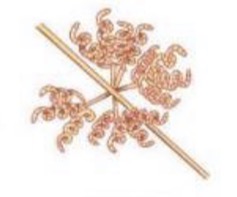
What streptomyces spore-bearing structure is this?
Biverticillate with spirals
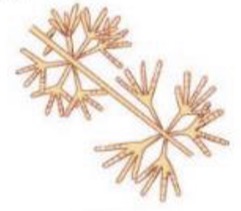
What streptomyces spore-bearing structure is this?
Biverticillate, no spirals
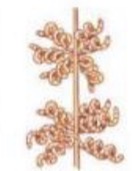
What streptomyces spore-bearing structure is this?
Monoverticillate with spirals
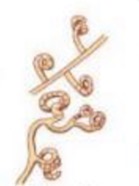
What streptomyces spore-bearing structure is this?
Closed spirals
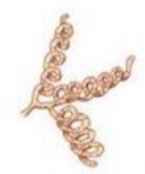
What streptomyces spore-bearing structure is this?
Open spirals
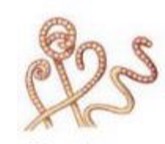
What streptomyces spore-bearing structure is this?
Open loops, primitive spirals, hooks
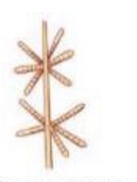
What streptomyces spore-bearing structure is this?
Monoverticillate, no spirals
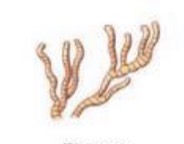
What streptomyces spore-bearing structure is this?
Flexous
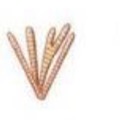
What streptomyces spore-bearing structure is this?
Straight
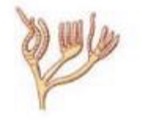
What streptomyces spore-bearing structure is this?
Fascicled
Streptomyces are primarily found in
soil
Streptomyces are (oxygen requirements)
strict aerobes
Earthy smells come from
geosmin
Streptomyces produce
extracellular enzymes
Streptomyces can
mineralize organic matter
Streptomyces are
mostly free-living, a few pathogens
Nocardia mycelium breaks into
rods and coccoid elements
Nocardia can form
aerial mycelium and conidia
Conidia
asexual, non-motile spores produced by fungi
Nocardia are (oxygen requirements)
strict aerobes
Nocardia are
free-living saprophytes
Saprophytes
organisms that feed on dead and decaying organic matter
Nocardia can degrade
petroleum, hydrocarbons, detergents, benzene, and pesticides
Nocardia may cause
Nocardiosis
Nocardiosis can infect
lungs and central nervous system
Rhodococcus are
soil saprotrophs
Rhodococcus can store
lipids
Rhodococcus can degrade
xenobiotics
Xenobiotics
petroleum hydrocarbons, detergents, benzene, various pesticides, polychlorinated biphenyls
TEM
transmission electron microscopy
Propionibacterium is mainly used in
dairy products (swiss cheese)
What propionibacterium does
ferments sugars
Propionibacterium fermentation produces
CO2 - holes in swiss cheese
Proprionic acid - unique flavor of cheese
Acetic acid
Pyruvate fermentation of sugar lactose produces
lactic acid
Streptococcus Lactobacillus fermentation product
Lactic acid
Cutibacterium is found in
skin and digestive tracts of animals
Cutibacterium on human skin causes
cutibacterium acne and body odor
Frankia forms
nodules in nonleguminous tree species
How many nonleguminous tree species are there?
8
What do Frankia do?
symbiotically fixate nitrogen gas
N2
nitrogen gas
Frankia also produce
hyphae and multilocular sporangia with spores
Mycobacterium looks like
straight or slightly curved rods that sometimes branch or form filaments
Mycobacterium are (oxygen requirements)
aerobic
Mycobacterium have
capsules
Mycobacterium filaments fragment into
rods and coccoid bodies
Mycobacterium growth rate
slow
Mycobacterium strains causes ___ in humans
tuberculosis and leprosy
Mycobacterium cell walls contain
waxes: mycolic acids, lipids, and polysaccharides linked to peptidoglycan