BSF Chapter 9: NS Spinal Cord + Nerves
 Call Kai
 Learn
Learn Practice Test
 Spaced Repetition
 Match
Match Flashcards
 Knowt Play
1/63

There's no tags or description
Looks like no tags are added yet.
Name | Mastery | Learn | Test | Matching | Spaced | Call with Kai | Chat |
|---|
No analytics yet
Send a link to your students to track their progress
64 Terms
Central Nervous System (CNS)
brain and spinal cord
primary command center of body
Peripheral Nervous System (PNS)
12 Cranial Nerves that carry messages to and from the brain
31 Spinal nerves (mixed) that carry messages to spinal cord to parts of body
Somatic NS
Voluntary; skeletal muscle
Autonomic NS (ANS)
sympathetic + parasympathetic NS; involuntary (smooth + cardiac muscles, glands)
Neurons
functional cells of NS, highly specialized
Cell body
main portion contains nucleus + other organelles
Cell fibers
what distinguish the cells (nerves)
Dendrites
multiple branches carry impulses to cell body, neurons receive stimuli via dendrites
postsynaptic cell, binds neurotransmitters via protein receptors
Axons
single fiber carry impulses AWAY from cell body
presynaptic cells, releases neurotransmitter
Sensory Messages
carries TOWARDS CNS (AFFERENT)
conduct impulses to spinal cord + brain
(“S”ent Central)
Motor Messages
carries AWAY from CNS (EFFERENT)
impulses from CNS to muscle + glands
(“Moved Away”)
Neurilemma
outermost nucleated cytoplasmic layer of Schwann cells that surround axons + neurons
covering in PNS + helps peripheral nerves regenerate
Myelin Sheath
PNS has MYSH (neurilemma)
CNS DOES NOT! Once damaged, there is no fixing it
Myelinated axons
white matter
Unmylienated axons
gray matter
PNS CNS relations
PNS relays messages to CNS
Interneurons (central or associated neurons)
relay info from place to place w/in CNS
what are the 3 layers of a nerve (Superior/Top to Inferior/Bottom)
Epineurium (around entire nerve)
Perineurium (around fascicle)
Endoneurium (around nerve fiber
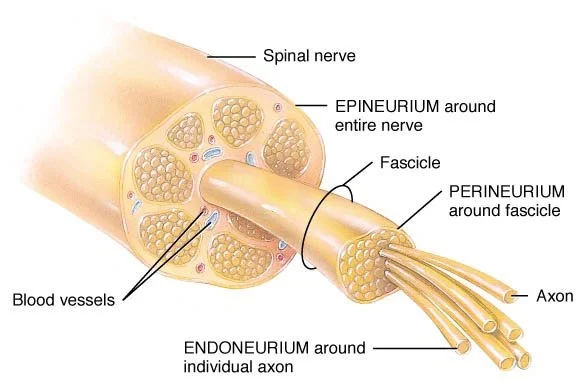
Nerve
fiber bundles in PNS
Tract
fiber bundles in CNS (train tract)
Neuroglia (glial cells)
protects, supports, + nourish nervous tiss
aid in cell repair, remove pathogens + impurities
continues to multiply throughout life
DO NOT CONDUCT IMPULSES
Examples of Neuroglia
Schwann cells, Oligodendroytes, Astrocytes, Ependymal cells
Synapse
tiny gap or junction b/w 2 nerves cells where messages pass from one cells to another
NS works by means of electric impulses sent along fibers + transmitted, specialized junctions
Plasma membrane
polarized (has negative charge)
Resting State
a stable electrical charge across cell mem when it is not actively sending signals
how are ions transported?
ATP
Action Potential
a rapid temporary shift/electrical charge at the membrane

Depolarization (AP)
Na+ flows into cell changing the electrical charge inside the mem (before)
Repolarization
ATP is used to return Na+ + K+ back to original resting state (Na+ more concentrated on inside)
role of myelin
enables impulse to jump from node to node thus speeding up impulse
Synaptic cleft
tiny gap
Neurotransmitters
chemicals released from nerve fibers to allow impulses over synaptic junction
Epinephrine (adrenaline), Norepinephrine (noradrenaline), Serotonin, Dopamine, Acetylcholine
Review for Synapse
Dendrites bring info to cell body
Axons take info away from cell body
info from 1 neuron flows to another across SYNAPSE (small gap separating neurons) which consists of:
Postsynaptic ending that contains receptor sites for neurotrans
synaptic celft or space between post and pre synaptic endings
Structure of Spinal Cord
links PNS + brain
SC extends from medulla to below the thoracic vertebrae b/w 1st + 2nd lumbar vertebrae
h-shapped section of gray matter is located internally + white matter is located around it

Inner Gray Matter
unmyelinated axons
dorsal end extends up and down on both sides
central canal in center of gray horn contains CSF (cerebral spinal fluid)
Outer White Matter
Myelinated axons
divided into right + left portions of white matter
anterior median fissure deeper groove that separates the anterior white matter
tracts in wm of sc carry impulses to + from brain
asending (afferent pathways to brain) and desending tracts (efferent pathways away from brain towards PNS)
31 pairs
according to level of spinal cord from where it arises
all 31 are mixed (both sensory + motor)
each nerve is attached to spinal cord by which two roots?
Dorsal root w dorsal root ganglion (sensory) afferent fibers from sensory receptors throughout body
Ventral root/ ventral root ganglion (motor) efferent fibers carry mess to muscles + glands
Cervical plexus
supplies motor impulses to neck muscles + receive sensory impulses from neck + back of head
phrenic nerve activates diaphragm
Brachial plexus
sends branches to shoulder, arm, forearm, wrist + hand (radial nerve originates from here)
Lumbosacral plexus
supplies nerves to pelvis + legs (sciatic nerve originates here)
Dermatones
sensory neurons from skin (expect face + scalp that feed info via spinal nerves)
Reflex Arc
spinal cord relay center for coordinating neural pathways
Receptor
detects stimuli
sensory neuron
transmits nerve impulses to CNS
CNS interneuron
coordinates nerve impulses + organizes response
Effector
muscle or gland outside CNS recieves nerve impulses from CNS + carries out response
Simple reflex
involves a few neurons (rapid, uncomplicated, automatic)
sympathetic NS
fight or flight
preganglionic motor neurons originate in spinal cord w/ cell bodies in thoracic + lumbar areas (L1-L2)
postganglionic neurons are adrenergic (activated by norepinephrine/adrenaline)
parasympathetic NS
rest + digest
SLUDD (Salvation, Lacrimation, Urination, Digestion, + Defecation)
Preganglionic neurons sacral part of spinal cord
Postganglionic neurons are choliengeric (activated by acetlycholine)
Lumbar puncture (spinal tap)
CSF removed for testing
done between L3-L4 vertebrae
Drug administration
Anesthetic (epideral)
Pain medi
Multiple Sclerosis (MS)
degenerative of nerve fiber due to destruction of MYSH
amyotrophic lateral sclerosis (ALS)
disease that destroys motor neurons
poliomyelitis
viral disease of NS
tumors
often arise in support tiss in + around SC
Monoplegia
paralysis of one limb
Diplegia
paralysis of both upper or lower limbs
Paralegia
paralysis of both lower limbs
Hemiplegia
paralysis of one side
tetraplegia
paralysis of all 4 limbs
Neuorpathy
any disease of nerves
Mononeuropathy
affect a sinlg enerve
polyneuropathy
impacts more than 1 nerve