BIO CHEM Metabolism
 Call Kai
 Learn
Learn Practice Test
 Spaced Repetition
 Match
Match Flashcards
 Knowt Play
1/52

There's no tags or description
Looks like no tags are added yet.
Name | Mastery | Learn | Test | Matching | Spaced | Call with Kai | Chat |
|---|
No analytics yet
Send a link to your students to track their progress
53 Terms
What does the term 'metabolism' mean?
It originates from the Greek word 'metabolé,' meaning 'change,' and encompasses the sum of chemical reactions in living organisms.
What are metabolites?
Compounds participating in metabolic reactions.
What is a metabolic pathway?
A sequence of reactions where the product of one reaction becomes the reactant of the next.
What is Δ in the context of metabolism?
Δ signifies change and represents the difference between values at final and initial states.
What is the equation for free-energy change (ΔG)?
ΔG = ΔH - TΔS, where T is absolute temperature.
What indicates an exergonic reaction?
ΔG < 0, meaning the reaction is favorable, spontaneous, and energy-releasing.
What indicates an endergonic reaction?
ΔG > 0, meaning the reaction is not favorable spontaneously and is energy-absorbing.
What does ΔG = 0 signify?
It indicates that the free energy of products equals that of reactants, representing a dynamic equilibrium.
What is ΔG°?
Standard free-energy change occurring when all substances are at a concentration of 1 mol · L^-1.
What is the role of the gas constant (R) in the ΔG equation?
It converts temperature into energy units, with a value of 1.987 · 10^-3 kcal · mol^-1 · K^-1.
What is the significance of manipulating reactant and product concentrations?
It affects ΔG and the favorability of the reaction.
What is the definition of a kilocalorie (kcal)?
The energy needed to raise the temperature of a kilogram of water by one degree Celsius.
What happens during ATP breakdown?
ATP is broken down into ADP and inorganic phosphate (Pi), releasing stored energy.
What is ATP's role in cellular energy?
ATP serves as the energy currency of the cell, linking energy-releasing and energy-consuming reactions.
What components make up ATP?
An adenosine molecule (adenine + ribose) and three phosphate groups.

What is a decomposition reaction?
A reaction that breaks down molecules into smaller units, releasing energy (exergonic).
What is hydrolysis in the context of ATP?
The process where ATP is broken down into ADP and Pi, releasing energy.
What is the significance of phosphoanhydride linkages in ATP?
They are high-energy bonds that release substantial energy upon hydrolysis.
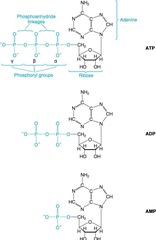
What is catabolism?
The breakdown of biomolecules into smaller units, providing raw materials for anabolism and releasing energy.
What is a common misconception about catabolism?
It is often misconstrued as the entirety of metabolism, which also includes anabolism.
What does 'high phosphoryl-transfer potential' refer to?
It describes ATP as a high-energy compound due to its phosphoanhydride linkages.
What is the role of ATP in muscle contraction?
ATP provides the energy required for muscles to contract and perform work.
What is the relationship between exergonic and endergonic reactions?
Exergonic reactions release energy, while endergonic reactions require energy input.
What is the impact of pH on metabolic reactions?
Modified ΔG°' is used for metabolic reactions at pH 7, reflecting neutral conditions.
What is the outcome of increased reactant concentration?
It favors the reaction, affecting ΔG positively.
What is the significance of entropy change (ΔS) in reactions?
It measures the disorder or randomness in a system, influencing reaction spontaneity.
What is the energy change during ATP hydrolysis at pH 7?
The standard free-energy change is -7.3 kcal per mole of ATP hydrolyzed.
What are the two main components of metabolism?
Catabolism and Anabolism
What does catabolism do?
Breaks down large molecules into smaller ones, releasing energy.
What does anabolism do?
Constructs molecules from smaller components, requiring energy.
What is the ΔG°' of an exergonic reaction?
Negative, indicating that energy is released.
What is the ΔG°' of an endergonic reaction?
Positive, indicating that energy is required.
How can endergonic reactions become favorable?
By coupling them with exergonic reactions to yield a negative ΔG°'.
What is the role of ATP in metabolism?
ATP acts as the energy currency, providing energy for endergonic reactions.

What is a redox reaction?
A reaction involving the transfer of electrons, where one substance is oxidized and another is reduced.
What does OIL RIG stand for?
Oxidation Is Loss, Reduction Is Gain.
What happens during oxidation?
A substance loses electrons (or hydrogen atoms).
What happens during reduction?
A substance gains electrons (or hydrogen atoms).
What is the significance of NAD in metabolism?
NAD acts as a hydrogen acceptor in redox reactions, facilitating energy transfer.

What are the two forms of NAD?
NAD+ (oxidized) and NADH (reduced).
What is the role of FAD in metabolism?
FAD serves as a hydrogen acceptor, participating in metabolite oxidations.

What are the stages of catabolism?
1. Breakdown of macromolecules into monomers; 2. Conversion of monomers to acetyl CoA; 3. Oxidation of acetyl CoA to CO2 and ATP synthesis.

What is the energy yield of carbohydrates?
4 kcal/g.
What is the energy yield of fats?
9 kcal/g.
What is the energy yield of proteins?
4 kcal/g.
What is the energy yield of ethanol?
7 kcal/g.
What is the first stage of catabolism?
Breaking down macromolecules into smaller components.
What occurs during the second stage of catabolism?
Conversion of smaller molecules to acetyl CoA.
What occurs during the third stage of catabolism?
Oxidation of acetyl group to carbon dioxide and ATP synthesis.
What is the role of hydrogen in redox reactions?
Hydrogen atoms carry electrons and are involved in oxidation and reduction processes.
What is the relationship between catabolism and anabolism?
Anabolism depends on catabolism for raw materials and energy.
What is the importance of balancing catabolism and anabolism?
It ensures efficient utilization of energy resources within cells.
What is the ultimate oxidant in metabolic reactions?
Oxygen.