Lecture 1: Dental Anatomy & Nomenclature
 Call Kai
 Learn
Learn Practice Test
 Spaced Repetition
 Match
Match Flashcards
 Knowt Play
1/43

There's no tags or description
Looks like no tags are added yet.
Name | Mastery | Learn | Test | Matching | Spaced | Call with Kai | Chat |
|---|
No analytics yet
Send a link to your students to track their progress
44 Terms
What type of teeth have short crowns, well-developed roots, and only narrow canals in the roots (short teeth)?
brachydont
What type of teeth are found in horses, cows, and other herbivores, characterized by high crowns that erupt throughout life providing extra material for grinding food particulates down?
hypsodont
What is the cusp of a tooth?
a pronounced point on the occlusal or most coronal portion of the tooth
What outer most layer covers the tooth crown and acts as an effective barrier to heat/cold/sweet sensitivities and bacterial entrance into the tooth?
enamel
How is enamel formed?
by ameloblasts in the root bud, but amelogenesis stops prior to tooth eruption and that enamel is incapable of repair after eruption
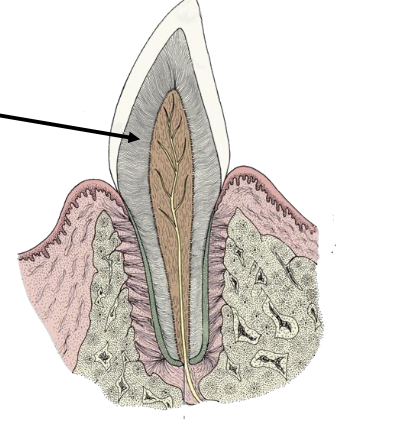
What is this layer that makes up the bulk of the tooth?
dentin
What is contained within the dentinal tubules that produce dentin when the tubule is exposed?
odontoblast
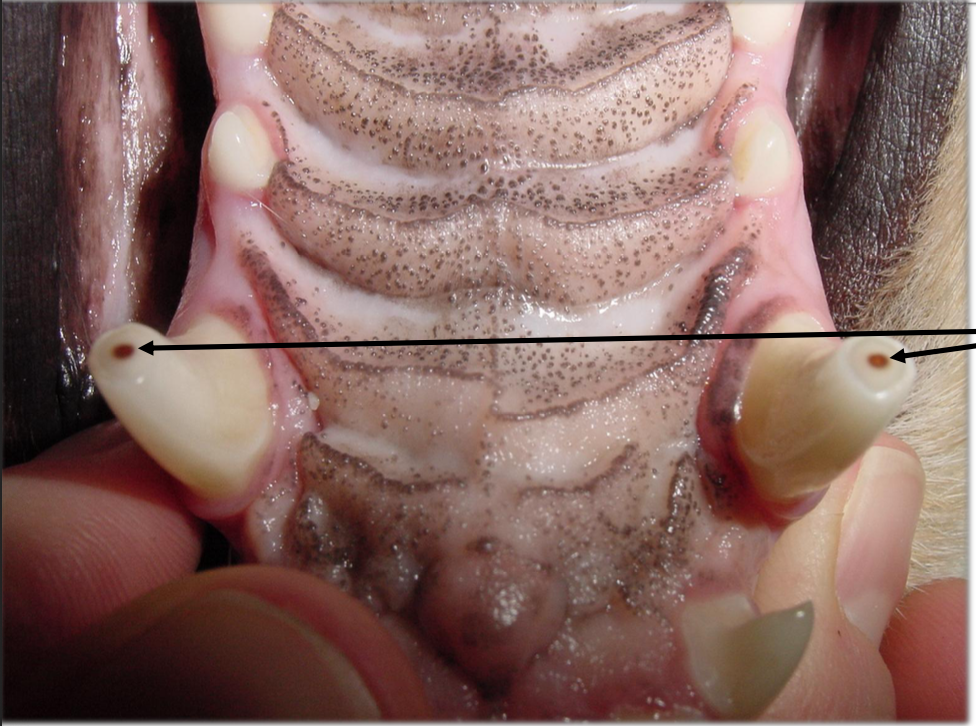
What has happened to this canine teeth?
enamel and dentin have been gradually lost as a result of local insult causing existing odontoblasts or odontoblast-like cells to produce tertiary dentin to protect pulp
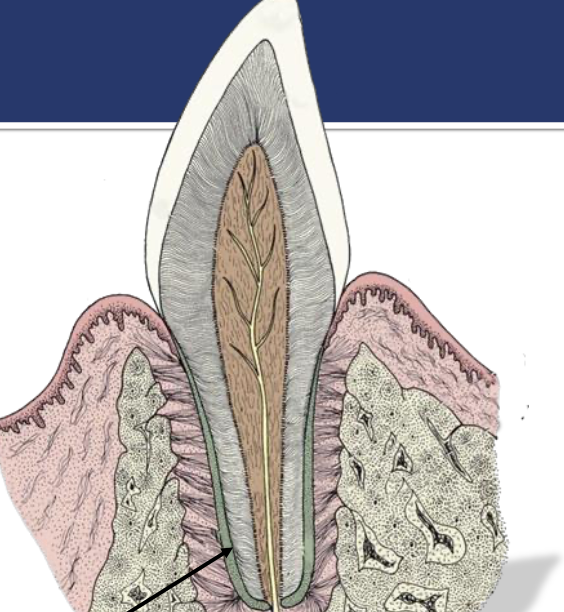
What is this hard tissue forming the surface of the root?
cementum
What is attached to the cementum?
periodontal ligament and gingiva
True or false: cementum is produced throughout life increasing the width with age.
true
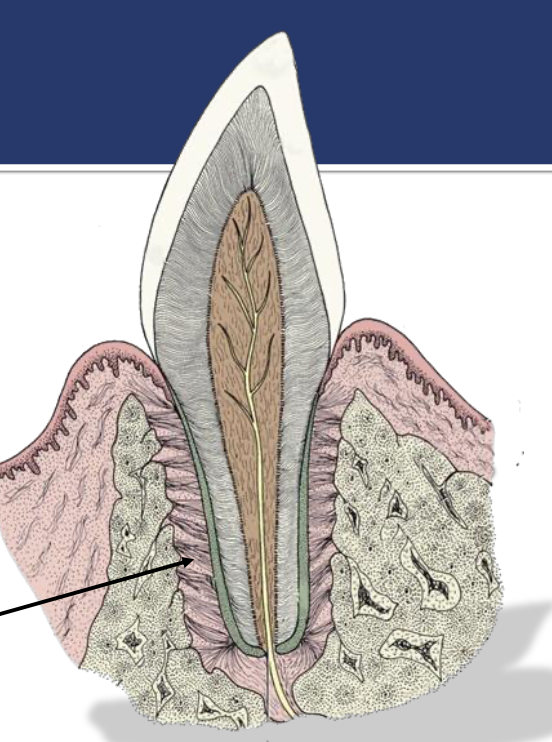
What is this tooth layer that fills space between cementum of the tooth root and alveolar bone?
periodontal ligament
What are the function so of the periodontal ligament?
• Shock absorption
• Transmits occlusal forces
• Attaches tooth to bone and cementum
• Supplies nutrients
• Provides tactile and proprioceptive information
The periodontal ligament is composed of _______ fibers.
Sharpey’s
What is the soft connective tissue encased in root canal containing nerves, fibroblasts, collagen fibers, blood, and odontoblasts, which produce dentin throughout the life of the tooth?
pulp
True or false: as animals age the pulp chamber / root canal widens.
false: it narrows
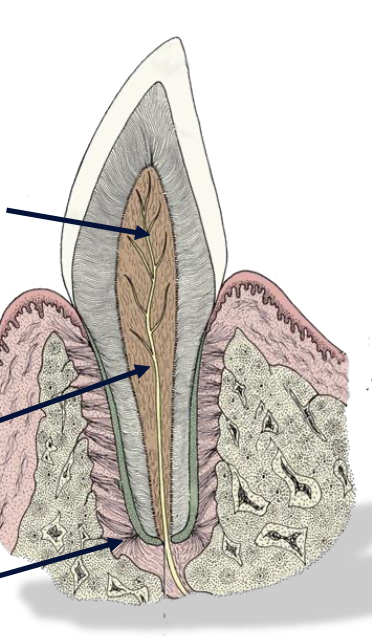
What are these three portions of the tooth?
top arrow: pulp chamber
middle arrow: root canal
bottom arrow: apical junction
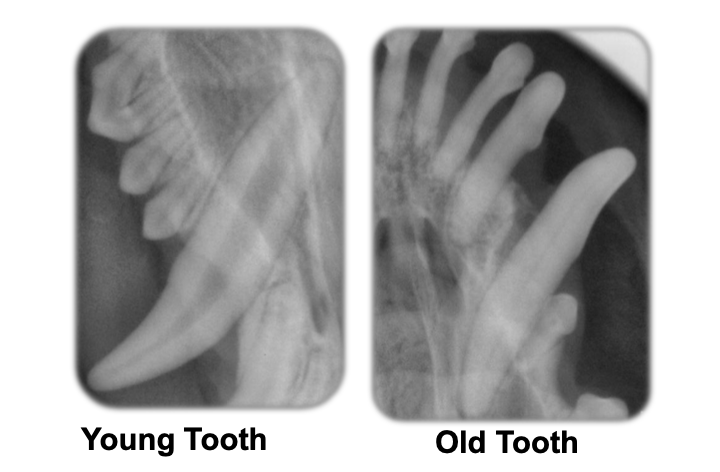
What is the major difference between these two teeth that allows you to differentiate young vs old?
the pulp chamber / root canal has narrowed (radiolucent line in middle of tooth)
How is the pulp chamber / root canal developed?
Odontoblasts lining the pulp chamber and root canal produce secondary dentin, causing the pulp to become narrower as the animal ages
What are the four components of the periodontium that can be affected and lost from periodontal disease?
gingiva
cementum
periodontal ligament
alveolar bone
What is the normal, physiological space between the free gingiva and the tooth surface?
gingival sulcus
What is the normal gingival sulcus depth for dogs and cats?
dogs = less than 3mm
cats = less than 1mm
What do apical, coronal, subgingival, supragingival, proximal, interproximal, and occlusal mean as positional terminology?
apical – toward the apex of the root
coronal – toward the tip of the crown
subgingival – area or structure apical to the gingival margin
supragingival – area or structure coronal to the gingival margin
proximal – mesial or distal surfaces of a tooth in close contact with an adjacent tooth
interproximal – space between adjacent teeth
occlusal – surface of a tooth that faces the tooth of the opposing arcade
How are teeth described via surfaces and directions?
vestibular/buccal/labial: surface of tooth facing vestibule or lips
lingual: surface of a mandibular tooth facing the tongue
palatal: surface of a maxillary tooth facing the palate
mesial: interproximal surface of tooth that faces rostrally or towards midline of dental arch
distal: interproximal surface of tooth that faces caudally or away from the midline of the dental arch
rostral and caudal
Wha tis the modified triadan tooth numbering system?
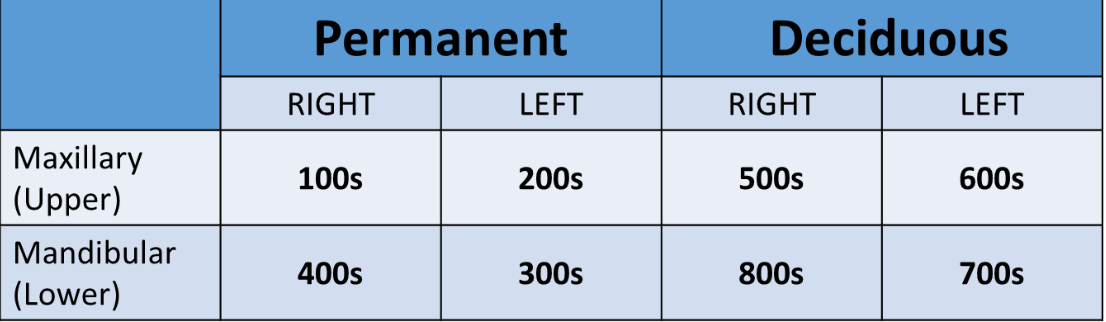
What is the total amount of deciduous teeth for canines?
2 x (I 3/3, C 1/1, PM 3/3) = 28
What tooth numbers are considered the premolars?
05-08
How many teeth do adult canines have?
2 x (I 3/3, C 1/1, PM 4/4, M 2/3) = 42
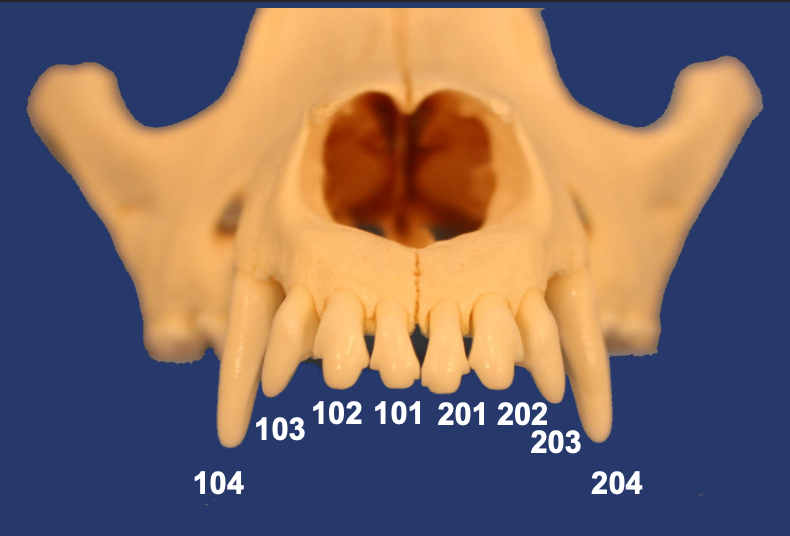
How many roots do these teeth have?
1
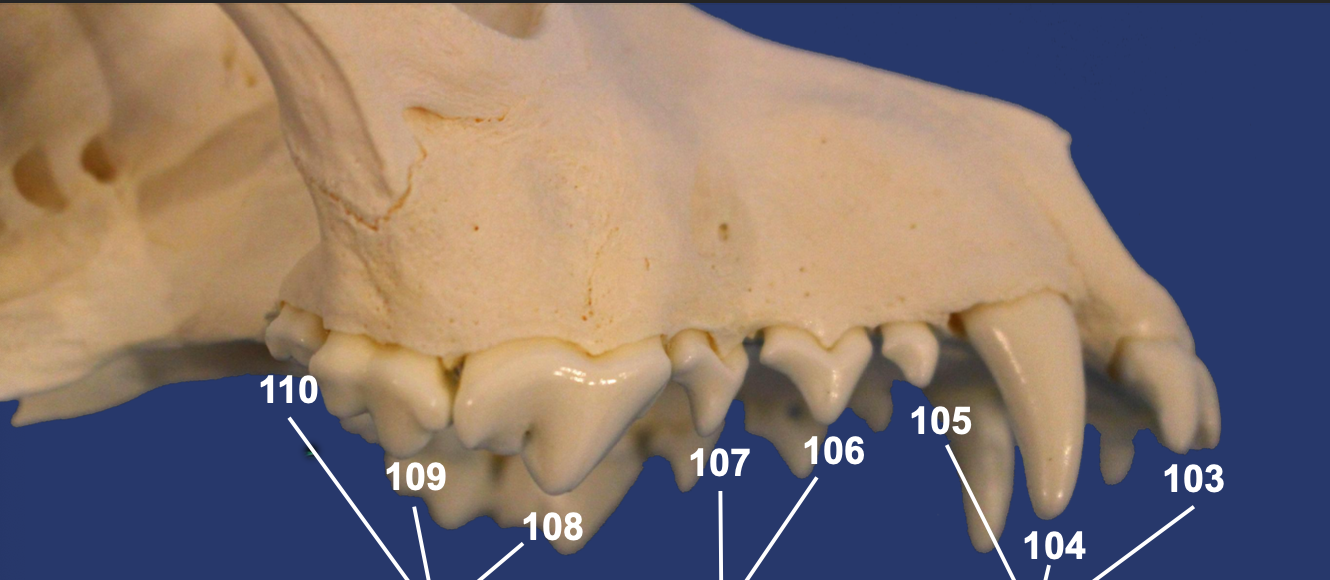
How many roots do these teeth have?
103-105: 1 root
106 & 107: 2 roots
108-110: 3 roots
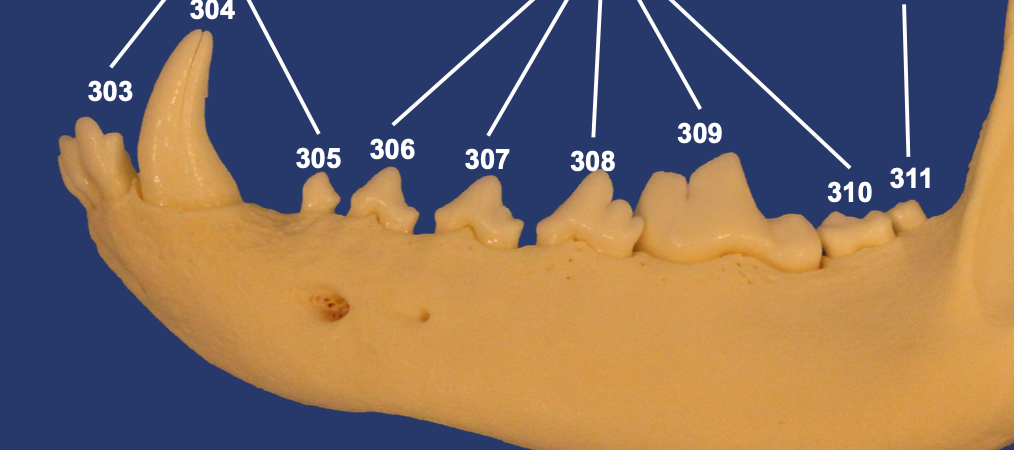
How many roots do these teeth have?
303-305: 1 root
306-310: 2 roots
311: 1 root
What is the canine deciduous teeth eruption schedule?
Incisors: 4 - 6 weeks
Canines: 3 – 5 weeks
Premolars: 5 – 6 weeks
What is the canine permanent teeth eruption schedule?
Incisors: 3 - 5 months
Canines: 5 - 7 months
Premolars: 4 – 6 months
Molars: 5 – 7 months
How many deciduous teeth do felines have?
2 x (i 3/3, c 1/1, pm 3/2) = 26
How many permanent teeth do felines have?
2 x (I 3/3, C 1/1, PM 3/2, M 1/1) = 30
What tooth is missing on the feline mandible (according to the modified triadan tooth numbering)?
305, 405, 306 and 406
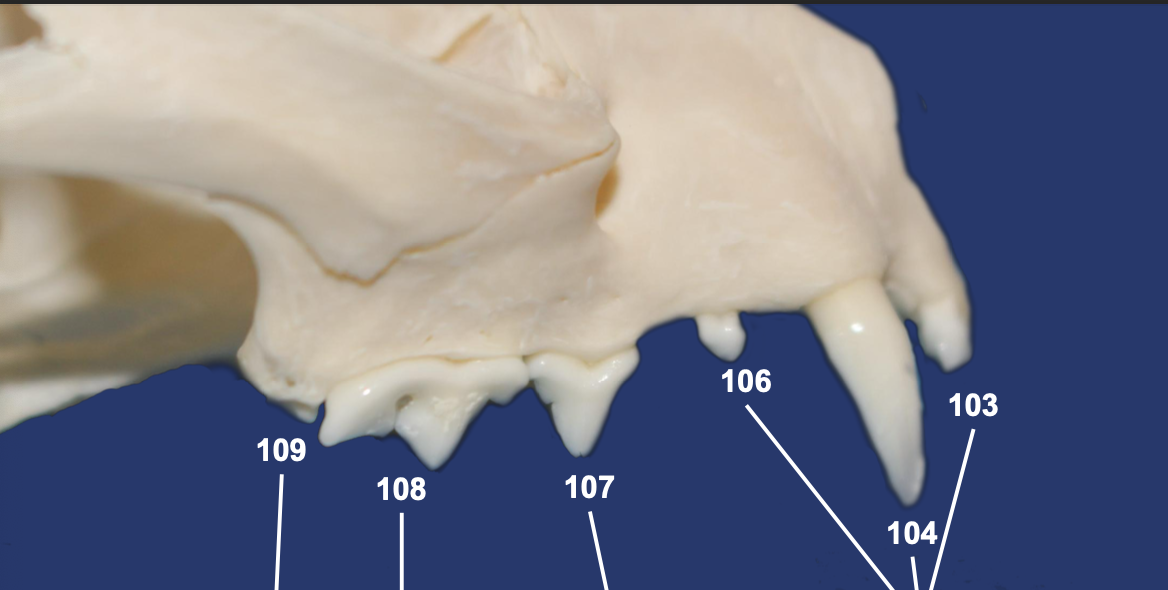
How many roots do these teeth have?
103-106: 1 root
107: 2 roots
108: 3 roots
109: 2 roots
Which teeth are missing on the feline maxilla (according to the modified triadan tooth numbering)?
105 and 205
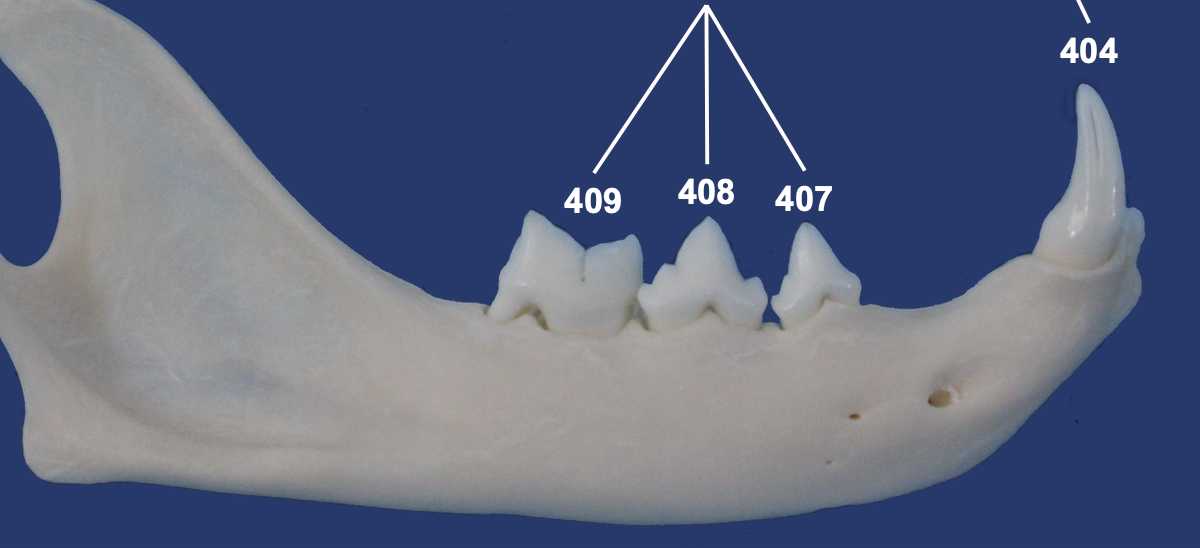
How many roots do these teeth have?
404: 1 root
407-409: 2 roots
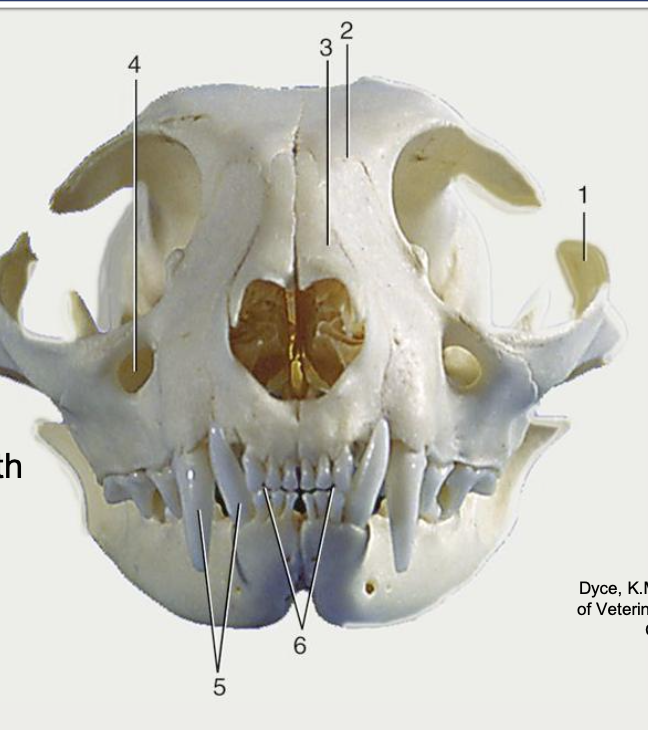
What are the numbers labeling on this cat skull?
1. zygomatic arch
2. frontal bone
3. nasal bones
4. infraorbital foramen
5. upper and lower canine teeth
6. upper and lower incisors
What is the feline deciduous tooth eruption schedule?
• Incisors: 3 - 4 weeks
• Canines: 3 - 4 weeks
• Premolars: 5 - 6 weeks
What is the feline permanent tooth eruption schedule?
• Incisors: 3 – 4 months
• Canines: 4 – 5 months
• Premolars: 4 – 6 months
• Molars: 5 – 7 months
What is the rule of 4s and 9s?
▪ Canines are always a 4 (104, 204, 304, 404).
▪ 1st molars are always a 9 (109, 209, 309, 409).
▪ To identify a premolar, count rostrally from the 1st molar
What are the strategic teeth?
canines and carnassials (4th maxillary premolars and 1st mandibular molars): important to maintain the integrity of the mouth and to chew hard food