Dosage Regimen Design
 Studied by 0 people
 Call Kai
 Learn
Learn Practice Test
 Spaced Repetition
 Match
Match Flashcards
 Knowt Play
1/20

There's no tags or description
Looks like no tags are added yet.
Name | Mastery | Learn | Test | Matching | Spaced |
|---|
No study sessions yet.
21 Terms
Approaches to Dosage Regimen
• Empirical Dosage Regimen
• Individualized Dosage Regimen
• Dosage Regimen on Population Averages
• Fixed Model
• Adaptive Model
• Fixed Model
From clinical trials (phase 2)
• Adaptive Model
Dose/wt
DOSE FREQUENCY:
the time interval between doses.
High Dosing Frequency (T < t1/2)
Lesser fluctuations but shows both therapeutic and toxic responses.
Optimum Dosing Frequency (T = t1/2)
Therapeutically successful
Less Dosing Frequency (t > t1/2)
Large fluctuations; therapeutically unsuccessful.
• Dosage regimen –
systematized dosage schedule for a drug therapy.
• Drug accumulation –
the build up of drug in the blood/body through sequential dosing.
• Steady-state condition -
achieved at a time when, under a given dosage regimen, the mass of drug administered is equal to the mass of drug eliminated over a dosing interval.
Loading dose –
a single intravenous bolus dose administered in order to reach steady-state condition instantly.
Maintenance dose –
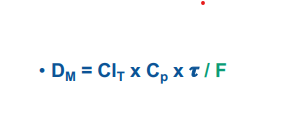
dose administered every dosing interval to maintain the steady-state condition
Loading Dose
• IV Route
• DL = Css VD
• DL = R0 / k
Loading Dose
EV Route
• DL = CssVD / F
Maintenance Dose depends upon:
• The therapeutic index of the drug.
• The half-life of the drug.
• Convenience of dosing.
Maintenance Dose formula
Dose Ratio
• The ratio of loading dose to maintenance dose.
• 𝜏 = t1/2
, dose ratio equals 2.0
• 𝜏 > t1/2
, dose ratio is smaller than 2.0
• 𝜏< t1/2
, dose ratio is greater than 2.0
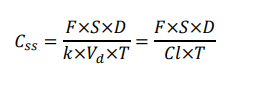
Steady-State Concentration