Genetics Chapter 3
 Call Kai
 Learn
Learn Practice Test
 Spaced Repetition
 Match
Match Flashcards
 Knowt Play
1/33

There's no tags or description
Looks like no tags are added yet.
Name | Mastery | Learn | Test | Matching | Spaced | Call with Kai |
|---|
No analytics yet
Send a link to your students to track their progress
34 Terms
Blending theory of inheritance
Factors that control hereditary traits are malleable
They can blend together from generation to generation
What theory did Mendel’s experiments with garden peas refute?
Blending theory of inheritance
Hybridization
The mating or crossing between 2 individuals that have different characteristics
Purple-flowered plant X white-flowered plant
Hybrids
The offspring that result from such mating (hybridization)
Why did Mendel choose to experiment on garden peas?
It existed in several varieties with distinct characteristics
Its structure allowed for easy crosses where the choice of parental plants could be controlled
Self-fertilization
Pollen and egg are derived from the same plant
Naturally occurs in peas because a modified petal isolates reproductive structures
Cross-fertilization
Pollen and egg are derived from different plants
Required removing and manipulating anthers
Trait vs Character
Trait- describes the specific properties of a character
eye color is a CHARACTER, blue eyes is a TRAIT
True breeder
A variety that produces the same trait over several generations
7 characters Mendel studied
Height
Flower color
Flower position
Seed color
Seed shape
Pod color
Pod shape
Variants Mendel studied
Height (Tall vs Dwarf)
Flower color (Purple vs White)
Flower position (Axial vs Terminal)
Seed color (Yellow vs Green)
Seed shape (Round vs Wrinkled)
Pod color (Green vs Yellow)
Pod shape (Smooth vs Constricted)
Empirical approach
Mendel believed that a quantitative analysis of crosses may provide mathematical relationships that govern hereditary traits
Used to deduce empirical laws
Monohybrid cross
Crossing 2 variants of the same characteristic
a single characteristic is being observed
Tall X dwarf
Dihybrid cross
Crossing individual plants that differ in 2 characters
Character 1- Seed texture (round vs wrinkled)
Character 2- Seed color (yellow vs green)
Single factor crosses
For each of seven characters, Mendel cross-fertilized two different true breeding strains. Keep in mind that each cross involved in two plants that differed in regard to only one of the seven characters studied. The illustration at the right shows one cross between a tall and dwarf plant. This is called a P (parental) cross.
Collect the F1 generation seeds. The following spring, plant the seeds and allow the plants to grow. These are the plants of the F1 generation.
Allow the F1 generation plants to self-fertilize. This produces seeds that are part of the F2 generation.
Collect the F2 generation seeds and plant them the following spring to obtain the F2 generation plants
Analyze the traits found in each generation
Particulate Theory of Inheritance
The genetic determinants that govern traits are inherited as discrete units that remain unchanged as they are passed from parent to offspring
Mendel’s Law of Segregation
During gamete formation, the paired factors for a given character segregate randomly so that half of the gametes receive one factor and half of the gametes receive the other
Genes
Mendelian factors
Alleles
Different versions of the same gene
Homozygous
An individual with 2 identical alleles
Heterozygous
An individual with 2 different alleles
Genotype
Specific allelic composition of an individual
Phenotype
Outward appearance of an individual
Principle of Segregation
2 alleles for a gene segregate during gamete formation and are rejoined at random, one from each parent, during fertilization
Physical basis for allele segregation is the behavior of chromosomes during meiosis
Mendel had no knowledge of chromosomes or meiosis
Mendel’s 2nd Law of Independent Assortment
2 genes on different chromosomes segregate their alleles independently
The inheritance of an allele of 1 gene does not influence which allele is inherited at a 2nd gene
Principle of Independent Assortment
In a dihybrid cross, the alleles of each gene assort independently
The segregation of different allele pairs is independent
Independent alignment of different homologous chromosome pairs during metaphase I leads to the independent segregation of the different allele pairs
Pedigree Analysis
Pedigree analysis is commonly used to determine the inheritance pattern of human genetic diseases
2 normal heterozygous individuals will have, on average, 25% of their offspring affected
2 affected individuals will produce 100% affected offspring
Cystic Fibrosis (CF)
A recessive disorder of humans
Gene encodes a protein called the cystic fibrosis transmembrane conductance regulator (CFTR)
CFTR protein regulates ion transport across cell membrane
Mutant allele creates altered CFTR protein that causes ion imbalance
Abnormalities in pancreas, intestine, sweat glands, and lungs
Probability
Probability = # of times an event occurs / Total # of events
P(heads) = 1 heads/(1 heads + 1 tails) = ½ = 50%
Random sampling error
Accuracy of the probability prediction depends largely on the size of the sample
Large for small samples and small for large samples
Product Rule
The probability that 2 or more independent events will occur is equal to the product of their respective probabilites
Two heterozygous individuals plan to start a family
• What is the probability that the couple’s first three children will all have congenital analgesia?
Applying the product rule
Calculate the individual probabilities
Obtained via Punnett square
P(congenital analgesia) = ¼
Multiply the individual probabilites
¼ x ¼ x ¼ x 1/64
1/16 can be converted to 0/016
Therefore 1.6% of the time, the first 3 offspring of a heterozygous couple, will all have congenital analgesia
Binomial Expansion
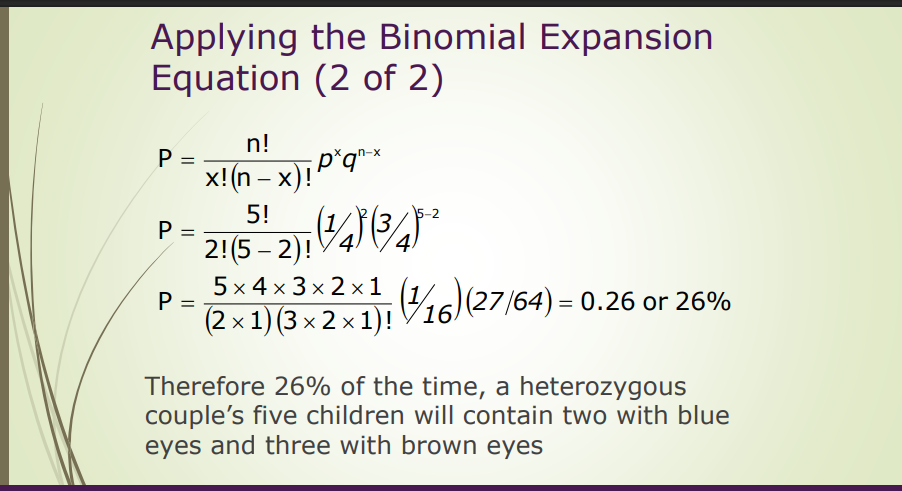
Represents all of the possibilities for a given set of unordered events
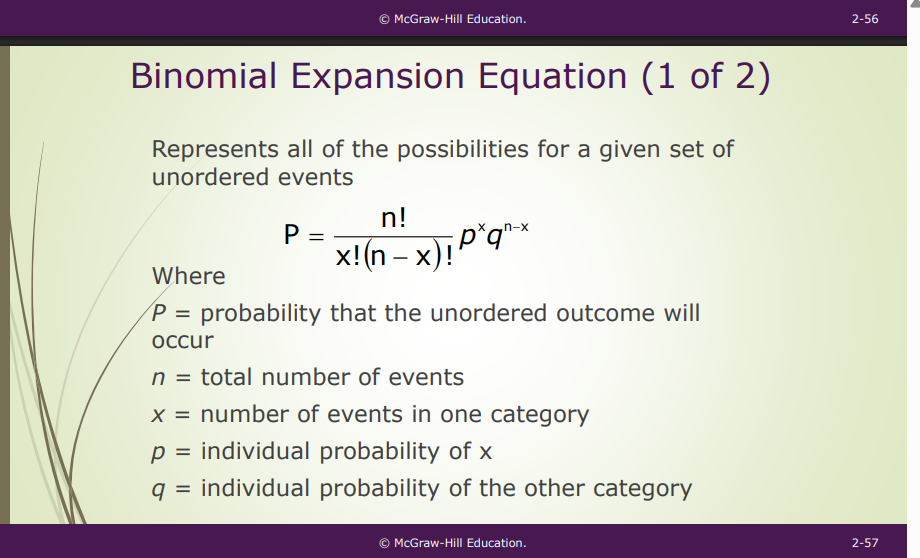
Two heterozygous brown-eyed (Bb) individuals have 5 children
What is the probability that 2 of the couple’s 5 children will have blue eyes?
Calculate the individual probabilities
P(blue) = p = ¼
P(brown) = q = ¼
Determine the # of events
n = total # of children = 5
x = # of blue-eyed children = 2
Substitute the values for p, q, x, and n in the binomial expansion equation