Biopsychology
 Call Kai
 Learn
Learn Practice Test
 Spaced Repetition
 Match
Match Flashcards
 Knowt Play
1/36

There's no tags or description
Looks like no tags are added yet.
Name | Mastery | Learn | Test | Matching | Spaced | Call with Kai |
|---|
No analytics yet
Send a link to your students to track their progress
37 Terms
Define the term “nervous system.”
A complex communication network comprised of nerves and cells that allows messages to be sent to and from various parts of the body.
Sketch the nervous system.
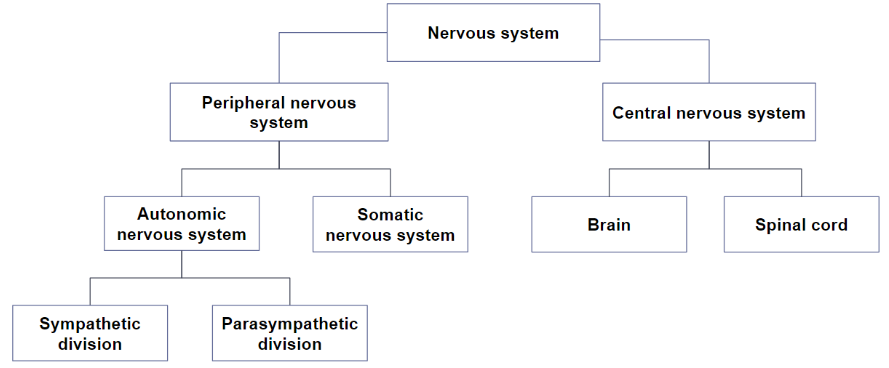
Describe the functions of each element of the nervous system: brain, spinal cord, PNS, somatic, autonomic.
Brain - receives information from sensory receptors and sens messages to muscle glands in the body
Spinal cord - consists of a collection of nerve cells and is responsible for reflex actions like withdrawal reflex
PNS (in general) - relays information via nerve impulses from the body to the CNS
Somatic - controls voluntary movement and transmits messages from sense organs to muscles
Autonomic - controls involuntary movement: divided into sympathetic (fight or flight) and parasympathetic (rest and digest)
What is the purpose of a neuron?
To communicate electrically and chemically. They receive and send information to other cells.
Do neurons communicate electrically or chemically?
Signals within neurons are transmitted electrically.
Signals between neurons are transmitted chemically across the synapse.
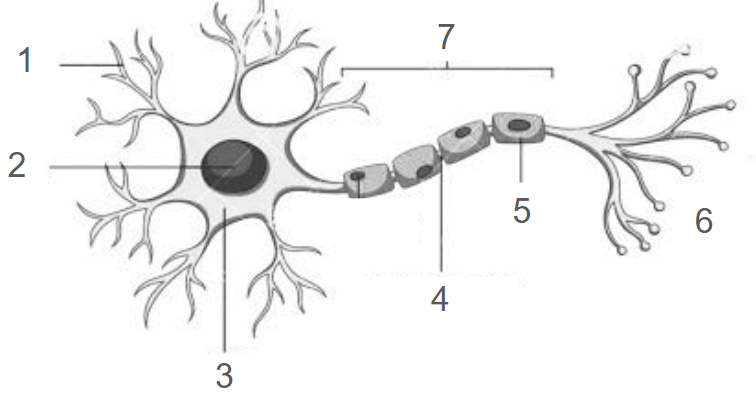
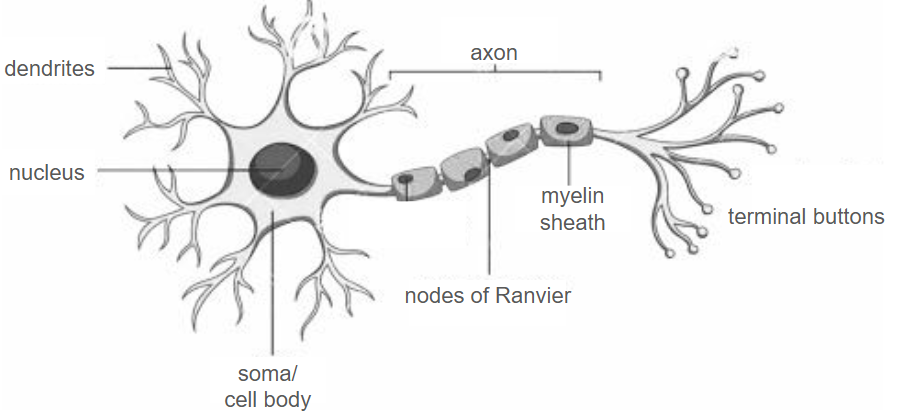
Label the diagram of the neruon.
Dendrites - receive impulses from neighbouring neurons & carry signal towards the cell body.
Nucleus - (doesn’t matter)
Soma/ cell body - contains the nucleus and the genetic material of the cell
Nodes of Ranvier - gaps between the myelin sheath. They speed up transmission by allowing the signal to “jump” across the gaps on axon.
Myelin sheath - fatty layer that surrounds the axon and speeds up transmission of signal
Terminal buttons - where the signal has to cross a synapse to the next neuron
Axon - carries the signal away from the cell body down the neuron
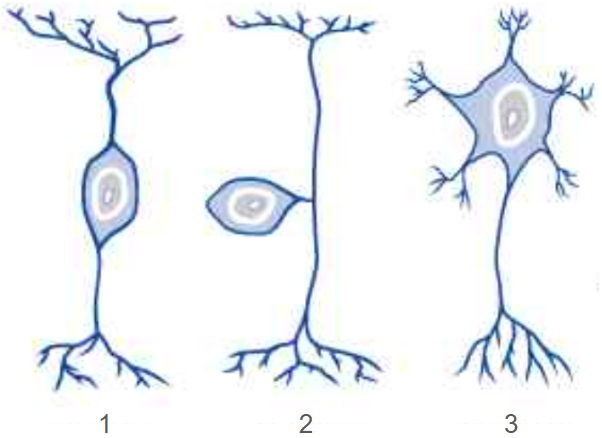
Label the types of neurons and describe the functions of each.
Relay - connect other neurons together (short dendrites and short axons)
Sensory - carry messages to the CNS from the senses processed by the skin receptors (long dendrites and short axons)
Motor - transmit messages from the CNS towards organs and muscles (long axons and short dendrites)
Define synaptic transmission
The process by which a signal is carried across a synapse between two neurons
Outline the process of synaptic transmission
An electric signal travels down the presynaptic neuron.
This triggers the movement of neurotransmitters, that are held in vesicles, towards the edge of the presynaptic neuron.
The neurotransmitters are released into the synaptic gap and diffuse across the gap.
They bind to receptors on the postsynaptic neuron and this triggers an electrical signal down that postsynaptic neuron.
Excitatory NTs increase the positive charge of a neuron, increasing the chance the postsynaptic neuron will fire. Inhibitory NTs increase the negative charge of a neuron, decreasing the chance the post-synaptic neuron will fire.
If the excitatory influences outweigh the inhibitory ones, the postsynaptic neuron will fire. This is referred to as summation.
What is the role of the endocrine system?
A series of glands which release chemicals called hormones through the body.
Name 4 glands and describe what they are responsible for.
Pituitary - controls release of hormones from all other endocrine glands (and so is called the “master gland”)
Testes - produces testosterone, which controls the development of male sex
characteristics during puberty
Ovaries - produces oestrogen, which is crucial in regulating the menstrual cycle
Adrenal - produces adrenaline and is important in fight or flight
Describe the process by which hormones are secreted (including the role of glands)
A signal is sent from the hypothalamus to the pituitary gland in the form of a “releasing hormone”. This causes the pituitary to secrete a “stimulating hormone” into the bloodstream. This then signals the target gland to secrete its hormone.
As levels of this hormone increase in the bloodstream the hypothalamus stops secreting the releasing hormone and the pituitary gland shuts down the secretion of the stimulating hormone.
What is meant by the term “stress”?
A physical and psychological response when a person feels like they cannot cope with a stressor.
Outline the fight or flight response.
The hypothalamus detects a threat, triggering the sympathetic NS and pituitary gland, which sends a signal to the adrenal gland.
The adrenal gland secretes adrenaline, stimulating physiological arousal in the body such as increased heart rate, pupil dilation and digestion inhibition.
Once the threat has passed, the parasympathetic NS restores the body to
resting state by reversing physiological changes- heart rate slows, pupils constrict and digestion resumes.
Evaluate the stress response
+ One strength of the stress response is that there is supporting evidence from research. For example, researchers found that people who don’t have adrenal glands can’t produce enough cortisol and need to be given more, if stressed, in order to survive. This supports that the essential stress hormones are needed to aid survival.
+ Another strength is that stress response can be measured quantitatively. For example, it is possible to monitor the bodily levels of hormones and to measure the effects (such as heart rate). This is good because the
/ However, one issue raised by this is biological reductionism. For example, a high heart rate, which can be interpreted as an indiction of stress, can also be caused by other emotional responses such as excitement. This decreases the accuracy of measures of stress in psychological research, and calls into question the validity of the conclusions drawn.
- Another limitation is that the fight or flight response may not be as appropriate in modern life. For example, people don’t really often come across life-threatening situations any more as frequently as our ancestors did There may be an issue with temporal validity of the fight or flight response in that it is less applicable in modern times.
- Another limitation is that the fight or flight response may not be applicable to all people. For example, researchers found that females tended to seek comfort from friends in times of stress, which they referred to as “tend and befriend.” This is a weakness because F&F ignores individual differences and doesn’t account for the fact that people can respond differently to different stressors. F&F may not be as applicable to females so it was inappropriate to generalise to females.
/ However, it could be argued that this research may have been subjected to alpha bias. The study could be exaggerating insignificant differences between males and females, since it may increase the likelihood of the research being published. This reduces the applicability of this “tend and befriend" response, whilst also diminishing the integrity of the research.
Define the term “spatial resolution”
The smallest feature (or measurement) that a scanner can detect - greater spatial resolution allows psychologists to differentiate between different brain regions with greater accuracy.
Define the term “temporal resolution”
The accuracy of the scanner in relation of time (how quickly the scanner can detect changes in brain activity).
What does fMRI stand for, and what is it?
Functional Magnetic Resonance Imaging - detects changes in blood oxygenation and flow. Brain areas that are more active consume more oxygen to meet the increasing demand, blood flow is directed to this area.
Evaluate the use of fMRI in psychological research.
+ One strength of is that, unlike other scanning techniques such as PET, it does not rely on the use of radiation. If administered correctly it is theoretically risk-free, non-invasive and straightforward to use.
+ Another strength is that it produces images of very high spatial resolution, depicting detail by the millimetre and providing a clear picture of how brain activity is localised.
- One weakness is that it is expensive compared to other neuroimaging techniques and can only capture a clear image if the person stays perfectly still.
- Another weakness is that it has poor temporal resolution because there is a delay of approximately 5 seconds between the image on screen and the initial firing of neuronal activity.
What does EEG stand for, and what is it?
Electroencephalograph - measure electrical activity within the brain via electrodes that are fixed to an individual’s scalp using a skull cap. Provides an overall account of brain activity by recording brainwave patterns. A use is in diagnosing sleep disorders.
Evaluate the use of EEGs in psychological research.
+ One strength is that EEGs have proved invaluable in the diagnosis of conditions such as epilepsy, a disorder characterised by random bursts of activity in the brain that can easily be detected on screen.
+ Another strength is that EEGs have contributed to our understanding of the stages involved in sleep. Unlike fMRI, EEG technology has extremely high temporal resolution of a single millisecond (and even less in some cases).
- The main drawback of EEG lies in the low spatial resolution - it provides generalised nature of the information received (that of many thousands of neurons) - it cannot discriminate between different brain regions so is unable to provide information on what is happening in the deeper regions of the brain.
- Another limitation of EEGs is that the EEG signal is not useful for pinpointing the exact source of neural activity as electrical activity is often detected in several regions of the brain simultaneously, and it does not allow researchers to distinguish between activities originating in different locations.
What does ERP stand for, and what is it?
Event-related Potentials - measure electrical activity within the brain via electrodes that are fixed to an individual’s scalp using a skull cap. The key difference from EEGs is that a stimulus is presented to a participant.
Evaluate the use of EEGs in psychological research.
+ As ERPs are derived from EEG measurements, they have an excellent temporal resolution, especially when compared to neuroimaging techniques such as fMRI, and this has led to widespread use in the measurement of cognitive functions and deficits.
+ ERPs are non-invasive. Unlike other scanning techniques, ERPs do not use radiation or involve inserting instruments directly into the brain and are therefore virtually risk-free. Furthermore, EEG and ERP are much cheaper techniques in comparison with fMRI scanning and are therefore more readily available - further data on the functioning human brain can be obtained which can broaden understanding.
- Critics have pointed to a lack of standardisation in ERP methodology between different research studies which makes it difficult to confirm findings.
- A further issue is that, in order to establish pure data in ERP studies,background noise and extraneous materials must be completely eliminated, and this may not always be easy to achieve.
What are Post-mortem Examinations?
A technique involving the analysis of a person’s brain following their death. Post-mortems are often brains of those who have a rare disorder and have experienced abnormal mental processes or behaviour during their lifetime.
Complete the summary table of brain areas and their functions.
Area | Lobe? | Hemisphere? | Contralateral? | Function |
Motor | ||||
Somatosensory | ||||
Visual | ||||
Auditory | ||||
Broca’s | ||||
Wernicke’s |
Area | Lobe? | Hemisphere? | Contralateral? | Function |
Motor | Frontal | Both | Yes | Controls voluntary movement |
Somatosensory | Parietal | Both | Yes | Processes sensory info |
Visual | Occipital | Both | Yes | Processes visual info (eg light, colour) |
Auditory | Temporal | Both | Yes | Analyses speech-based information |
Broca’s | Frontal | Left | No | Language production |
Wernicke’s | Temporal | Left | No | Language comprehension |
Evaluate the theory of localisation.
Define the term “plasticity”.
Plasticity - This describes the brains ability to change and adapt (functionally and physically) as a result of experience or learning.
Define the term “functional recovery”.
Functional recovery - A form of plasticity where the brain can redistribute or transfer functions usually performed by a damaged area to another area of the brain.
Describe functional recovery.
During infancy the brain experiences a rapid growth in synaptic connections. These connections undergo synaptic pruning, which is when connections are lost due to lack of use.
Describe the three types of functional recovery.
Axonal Sprouting - growth of new nerve endings which connect with other undamaged nerve cells
Denervation supersensitivity - occurs when axons that do a similar job become aroused to a higher level to compensate for the ones that are lost
Recruitment of similar areas on the opposite side of the brain - the same area on the opposite side of the hemisphere will take over the functions lost
Evaluate the use of Post-mortem Examinations in psychological research.
+ Post-mortem evidence was vital in providing a foundation for early understanding of key processes in the brain. Broca and Wernicke both relied on post-mortem studies to establish links between language, the brain and behaviour decades before neuroimaging ever became a possibility.
+ Post-mortems studies improve medical knowledge and help generate hypotheses for further study.
- Causation is an issue within these investigations. Observed damage to the brain may not be linked to the deficits under review but to some other unrelated trauma or decay.
- A further problem is that post-mortem studies raise ethical issues of consent from the patient before death. Patients may not be able to provide informed consent e.g. in the case of HM who lost his ability to form memories and was not able to provide such consent – nevertheless post-mortem research has been conducted on his brain.
Evaluate the theory of lateralisation.
+ One strength is that there is evidence that the two hemispheres process information differently. For example, PET scans were used to identify which brain areas were active during a visual processing task, and it was found that regions of the right hemisphere were much more active. This suggests that lateralisation is a feature of connected brains as well as split brains.
- One limitation is that there is opposing evidence which suggest the right hemisphere is capable of language. For example, a patient had his left hemisphere removed at the age of 2 and he learned to use relatively normal language through the remaining right hemisphere. This suggests that functional recovery of brain areas is possible and lateralisation is not fixed.
- Another limitation is that the experimental procedure used in split brain patients is artificial. For example, in the real world, both hemispheres would have access to information because the patients could simply turn their head. This means the studies lack ecological validity as the situation produces deficits in the patients that they wouldn't have in real life.
- A final limitation is that the behaviour of Sperry's split brain participants was compared to a control group of participants, none of which had epilepsy. This is a major confounding variable, as any differences observed between the two groups may be the result of the epilepsy rather than the split brain. This makes it difficult to establish a cause and effect relationship as the cognitive abnormalities of their participants may be due to their epilepsy rather than split-brain.
Evaluate the theory of brain plasticity.
+ One advantage of the theory of plasticity is that it has practical applications. For example, understanding plasticity has led to neurorehabilitation which uses electrical stimulation of the brain to counter the deficits in cognitive or motor functions following injuries such as strokes. This demonstrates that knowledge of plasticity can be useful in helping to help restore the brain when recovery slows down.
+ Furthermore, there is supporting evidence for plasticity. For example, Maguire carried out a study into the hippocampus volume of taxi drivers, who were very knowledgeable of the streets of London. It was found that taxi drivers had a much larger hippocampus that non-taxi drivers. This suggests that the high spatial processing demands placed on their brains caused structural changes, demonstrating brain plasticity.
/ However, it could be argued that there is a lack of cause and effect. For example, there is no evidence that the size of their hippocampus increased due to their being a taxi driver. It could be that they sought out the occupation of taxi driver, because their brains were suited to it.
- One limitation of functional recovery is that level of education may influence recovery rates. For example, researchers found that brain injury patients with a higher level of education has greater chances of disability free recovery than those who hadn’t spent as many years in education. This suggests that the brain’s ability to recover could be affected by other factors like experiences.
What is lateralisation of function? Give an example.
The idea that the two halves of the brain are functionally different and certain processes or behaviours are controlled by one hemisphere. Eg. the right side of the brain processes info from left half of body
How are the hemispheres of the brain joined?
By a bundle of fibers called the corpus callosum that delivers messages from one side to the other.
State 3 tasks that the left hemisphere of the brain is responsible for.
Is the language centre of the brain
Controls the right hand
Receives information from the right visual field
State 3 tasks that the right hemisphere of the brain is responsible for.
Focuses on visuo-spatial tasks
Controls the left hand
Receives information from the left visual field