Ecology Quiz 1
 Call Kai
 Learn
Learn Practice Test
 Spaced Repetition
 Match
Match Flashcards
 Knowt Play
1/94

There's no tags or description
Looks like no tags are added yet.
Name | Mastery | Learn | Test | Matching | Spaced | Call with Kai | Chat |
|---|
No analytics yet
Send a link to your students to track their progress
95 Terms
Ecology is
The study of relationships between organisms and their environment
Zoonosis
Disease due to pathogen that resides in a non-human vertebrate
Reservoir
Non-human vertebrate that maintains/amplifies the pathogen
Emerging infectious disease
Appears suddenly OR increase dramatically in incidence or geographic extent
Vector-borne disease
Pathogen moves from host-to-host via blood-feeding anthropod
In the black-legged tick example, what is the relationship between ticks, mice, Lyme disease, and acorns?
On years where trees mast (produce more acorns), the mice have lots of food and can reproduce more. Therefore, the FOLLOWING year, there’s a boom of mice. After THAT year, ticks peak, and along with it, Lyme disease cases
In the black-legged tick example, which year does Lyme disease peak?
Year 3
Evolution
a change in allele frequencies over time
What are the 4 mechanisms for evolution?
Mutation
Natural Selection
Genetic drift
Gene flow
Which evolutionary mechanism is the source of all variation?
Mutation
What do natural selection, genetic drift, and gene flow all have in common?
They change the frequency of variants
Where does variation come from?
Mutations in alleles
What makes up the gene pool?
All alleles from ALL individuals in a population
Evolution is driven by……
Ecological interactions among organisms and with their environment
What kinds of mutations could we have?
Point mutations (single nucleotides)
Chromosomal rearrangements
Mutations have effects on…
Function and fitness
What kinds of effects can mutations have on function?
Loss of function
Gain of function
What kinds of effects can mutations have on fitness?
Lethal effects
Neutral effects
Deleterious effects
Beneficial effects
Is mutation the direct cause of allele frequency changes?
No! It’s too rare
Is all variation the result of different genotypes?
No! Think tans due to sun exposure
Phenotype is a product of…
genotype + environment
What is phenotypic plasticity?
The ability of one genotype to produce more than 1 phenotype when exposed to different environments
Hydrangea example

What does no plasticity mean?
Change in environment does not change trait value
What does high variable plasticity mean?
Strong genotype-by-environment relationship
What is the plasticity example in ducks?
In seasons when male-to-male competition for access to mates is greater, males grow longer penises
Genes did NOT change, but the environment did
What is the guppy example with natural selection?
Endler noticed that guppies at the top of the waterfall are colorful (no predators). Guppies at the bottom are not (blend into environment bc predators).
Ran experiment: 2 different backgrounds (course gravel and fine gravel) and after 15 generations, the guppies closely matched their gravel
Fish with these traits survive long enough to breed… natural selection!
What are the 3 things required for evolution by natural selection?
1) There is variation in traits
2) There’s differential reproduction (some survive to reproduce and some do not)
3) There is heredity (surviving individuals have babies that are similar to them bc of shared genes - CONSISTENT CHANGE)
At what level does selection occur? At what level does evolution occur?
Selection occurs at level of the individual (traits are properties of individuals)
Evolution occurs at level of population
What are the 3 types of selection
1) Directional selection
Selection that acts to push some aspect of a pop. phenotype in one particular direction
2) Stabilizing selection
Selection favoring phenotypes that are intermediate in some aspect
3) Disruptive selection
Selection favoring extreme phenotypes at the expense of intermediate phenotypes
Adaptive evolution
Increase in average fitness of the population in their environments
Adaptations
Features of organisms that improve their ability to survive and reproduce in their environments
Fitness
Relative genetic contribution of individuals to future generations
Depends on your population.
Are you higher in fitness RELATIVE to people in your population?
Population
Group of individuals of the same species inhabiting a particular area
What is the mechanism that consistently causes adaptive evolution?
Natural selection
What is genetic drift?
Stochastic process - Occurs when chance events determine which alleles are passed on to the next generation. Totally random
When is genetic drift the most important?
For small populations
founder effects
Bottlenecks
What happens with genetic drift within populations? (A consequence!)
Loss of alleles through fixation
What happens with genetic drift between/among populations? (A consequence!)
Increased diversity bc fixation is random and differs across populations
Why is genetic drift important for small populations?
One consequence of drift is loss of alleles, which means reduced diversity within populations. BAD!!
Why is reduced diversity bad?
Harmful alleles can increase in frequency by chance
Less variation on which selection can act (won’t be able to respond in adaptive direction if environment changes)
Prairie chicken example
What is gene flow?
Movement of alleles between populations
introduces new alleles to populations
Homogenizes different populations genetically making them more similar to one another
Gene flow homogenizes….
populations genetically
How does the example of the Male Teleogyllus oceanicus (cricket)’s call to attract females bring together selection, drift, and gene flow?
Flatwing males were missing the scraper and were therefore silent.
This meant they were protected from the parasitoid fly and survived to be able to mate with females. Not choosy females were favored in small island populations (selection)
In small founding populations, genetic drift took place upon island colonization. More males becoming silent.
Crickets moved from island to island in the Pacific (gene flow)
Research definition
Systematic study to gain a fuller scientific knowledge or understanding of a subject
What is applied research?
Research to gain knowledge or understanding to meet a specific need. Solving problems.
What is basic research?
Research directed toward fuller knowledge or understanding of fundamental aspects of phenomena without specific applications or products in mind
generating NEW knowledge. Exploring for exploring’s sake
Does NOT aim to solve a problem
Can produce discoveries that unexpectedly contribute
What are proximate causes?
Mechanistic answers that answer the “how”
concerned with the environmental stimuli and underlying genetic, physiological, developmental, and anatomical mechanisms
What are ultimate causes?
Address evolutionary significance and answer the “why”
concerned with selection (natural/sexual), fitness, evolutionary history
Is this an applied or basic research question?
How does the amount of light affect growth of shade tolerant versus intolerant plants?
Basic
What mechanisms can get ecological answers?
Natural history observations
Analysis of patterns
experiments
Quantitative models
What does a good experiment have?
Manipulation and controls, replication, and randomization
What do you do when you can’t measure a whole population?
Sample it.
all metrics have some distribution — there’s variation among individuals -- and their average is assumed to have some “true” value
What are the 3 metrics we are concerned with?
1) Central tendency
2) Spread
3) Confidence (how certain we are about our estimates)
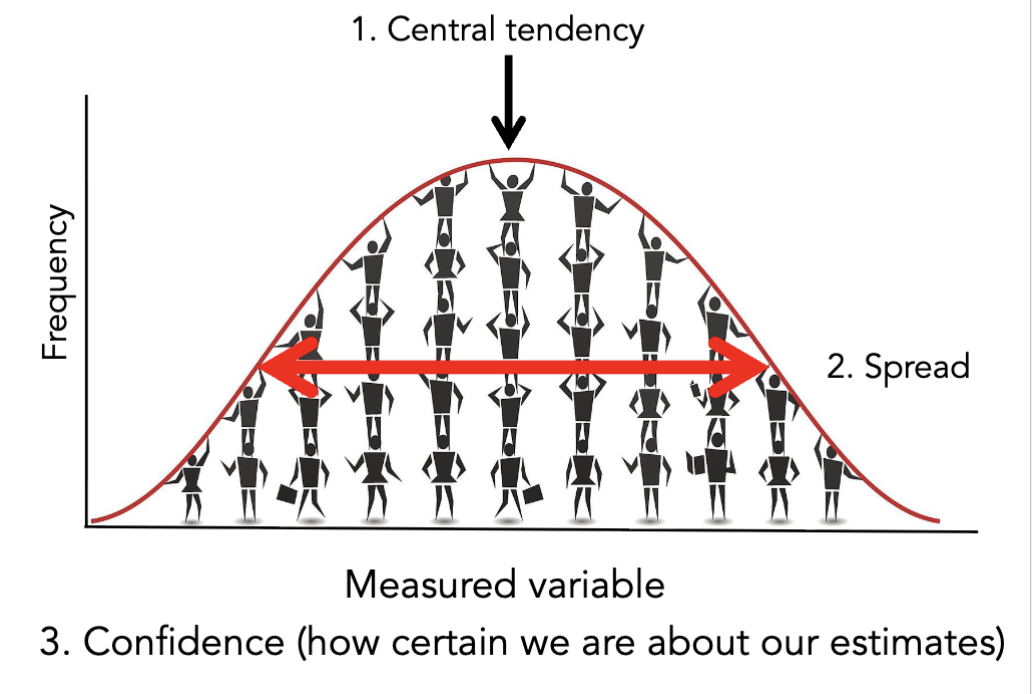
What are the 3 measures of central tendency?
Mean (average)
Median (middle value)
Mode (most common value)
Why don’t we always just use the mean?
The mean is sensitive to extreme values, which could skew data dramatically
What is standard deviation?
How far away a value is from the mean
Small st dev = data points CLOSE to the mean
Big st dev = data points SPREAD over large # of values
What is variance?
Average squared distance of each data pt. from the mean
Independent variable
On x-axis
Thought to be the cause of the observed effect
Dependent variable
on y-axis
Response variable
Categorical (discrete) variable
Variable with separate, indivisible categories
Continuous variable
Variable that can take on number values
Why are temperature and water relations important for evolution/life?
The physical world can constrain life and environmental conditions can be very variable, but organisms are adapted to a narrow range of conditions
All of the following are likely examples of trade-offs, except for:
The brightest red guppies are also the most parasite resistant
Measuring fitness is complicated because
organisms can mate outside of the pair bond
There are lots of components and proxies (# of children, # of grandchildren, etc.)
Animals are difficult to follow throughout life
What are trade-offs in evolution?
The ability to perform 1 function reduces the ability to perform another
Compromises in ability of organisms to perform many different, sometimes conflicting functions
What was the experiment with E. coli warm or frozen demonstrating?
Question was: Does adaptation to a low temperature reduce fitness at a high temperature?
E. coli adapted to 20º C because their fitness was greater than their ancestors. So no, not exactly.
Principle of allocation!!
Principle of allocation
Energy allocated to one of life’s functions will reduce the amount of energy available for other functions
What are the 3 ways organisms adapt to temperature extremes?
1) Storage
2) Dormancy
3) Thermoregulation
What is storage for adapting to extreme temperatures?
Reliance on resources accumulated under more favorable conditions
Ex) Cacti storing water, squirrels remembering where food is
What is dormancy for adapting to temperature extremes?
Becoming inactive
Ex) Hibernation in mammals, diapause in insects
What is thermoregulation in adapting to temperature extremes?
Maintaining particular internal temperatures.
Behavioral:
Reptiles sunning
Cactus wrens in microhabitats
Internal:
Countercurrent exchange
Skunk cabbage metabolize starch from root and melt snow around it to bloom
How do you balance water in an organism? What is the “equation?”
Wia = Wd + Wf + Wa - We - Ws
Wia = internal water of animal
Water sources:
Wd = water taken in by drinking
Wf = water taken in by food
Wa = water absorbed from air
Water Losses:
We = water lost by evaporations
Ws = water lost through secretions and excretions
Ex) Kangaroo Rats. How do they balance water?
They have both physiological (producing concentrated urine, minimizing evaporation losses) and behavioral (venturing above ground at night) adaptations to conserve water.
Ex) Fog-basking beetles. How do they balance water?
They have an adaptation where they can take water in from the surrounding fog
The internal water balance of animals depends on
both water sources and losses
True or false: Both plants and animals can thermoregulate internally
True
Ecosystem
A biological community plus all the abiotic factors that influence the community
Climate
the average daily weather for an extended period of time at a given location
Weather
Current condition of temperature, precipitation, humidity, and cloud cover
What’s the difference between climate and weater?
Climate is what you expect, weather is what you get
Why are we interested in the climate in ecology?
Climate drives abiotic environment (availability of water and degree of heat)
Global biomes are predictable from climate
Biome
Large geographic area characterized by similar flora, fauna, and microorganisms

What does this tell us?
Vegetation follows precipitation patterns
What are the (4) things that have variation that global biomes are predictable from the climate?
Solar radiation
Precipitation
Atmospheric and ocean circulation
Topography
What is the major driving force behind climate?
Solar radiation
How does solar radiation affect Earth’s climate?
Climate variation mostly caused by uneven heating of its surface by the sun (due to sun angle and path length)
Tilt of the earth results in seasonal changes in climate
Can affect species interactions (Mountain Pine Beetle example)
Explain Mountain Pine Beetle example and how it relates to solar radiation
The Mountain Pine Beetle attack trees under stress, but move to healthy trees. Beetles bore in, lay eggs, and eat the layer giving nutrients to the tree.
Usually, winters freeze and kill them, but warming causes beetle increases because winter in CO is no longer cold enough to kill larvae.
Results in millions of trees lost
Explain surface heating and the uplift of air
Sun heats air near equator. Less dense warm air rises and forms clouds. Once in the atmosphere, it spreads north + south, cools, rises, until it goes back into Earth
Hadley Cells
What are hadley cells?
global-scale tropical atmospheric circulation patterns where warm air rises at the equator, moves poleward, cools, and sinks
There are multiple air circulation cells that are not just at the equator
What do global ocean currents do?
Distribute heat around the globe, generating warm coastal climates
One reason we don’t have perfect bands of climate at latitude
Rain shadow
Air picks up moisture over water or flat land, hits the mountain and rises/cools, releasing moisture. As air descends on the other side, it warms, creating rain
Why isn’t the east side of the Rockies as lush as the west side?
Because of rain shadows. By the time cool air gets to eastern side, it’s lost a lot of its moisture
Why does climate differ across elevations?
Due to adiabatic heating/cooling
Adiabatic heating/cooling
Temperature decreases as air pressure decreases. As pressure decreases, gases expand, occupy larger volume, and lead to decreased temperatures (uses energy)
Are south or north facing slopes warmer?
South. They receive more incoming sunlight and are warmer and drier.
Slope aspect