BIOC221 Mod 2 - Regulation of Transcription in Bacteria
 Call Kai
 Learn
Learn Practice Test
 Spaced Repetition
 Match
Match Flashcards
 Knowt Play
1/26

There's no tags or description
Looks like no tags are added yet.
Name | Mastery | Learn | Test | Matching | Spaced | Call with Kai | Chat |
|---|
No analytics yet
Send a link to your students to track their progress
27 Terms
Why are most genes subject to regulation?
Conserved resources. By limiting the expression of genes not required, bacteria can commit more resources to making ribosomes and maximise growth rate •
Respond to changes in internal and external environments - Adaptability
Ordered development of the cell wall

Break down bacterial transcription/translation and its main difference with eukaryotic transcription.
RNA-polymerase binds to the template strand to synthesise mRNA
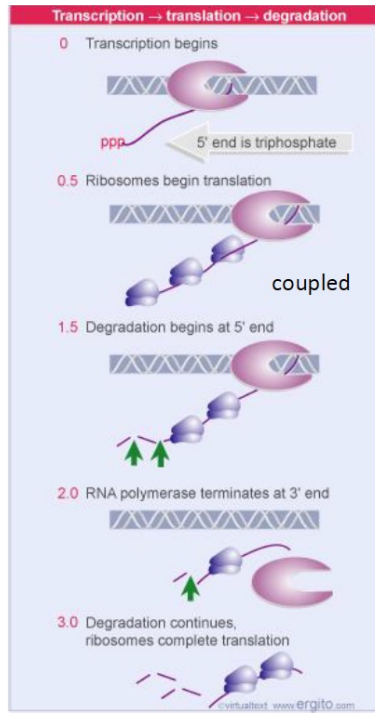
Transcription and translation are coupled in bacteria. The Ribosome will bind to and translate the mRNA as it is being synthesized
Operons
Co-transcribed genes under the control of a single regulated promoter
Why are operons used?
For efficiency. Most operons contain multiple genes with similar functions or in the same pathway, so its makes sense for all of them to be expressed in similar amounts. Sometimes operons contain genes that perform functions for different cell pathways.
ncRNAs
non-coding RNAs, transcribed but not translated. Function alone or as part of RNA-protein complexes • Often facilitate RNA-nucleotide binding
How does Crispr promote immunity?
Crispr is a bacterial ncRNA-protein complex that is used by the immune system to target invading viruses or other genetic elements. CRISPR associated (cas) proteins are expressed from cas genes, Cas proteins form a complex, recognize foreign DNA, cuts and inserts small piece into the CRISPR array

Describe the structure and role of the subunit of DNA dependent RNA polymerases in transcription that allows for initiation
RNA polymerases have a protein subunit called a Sigma factor which binds to promoters upstream of a DNA sequence. This is the site of transcriptional initiation.
Describe the key features of bacterial promoters
Sigma (σ) factors bind to -35/-10 regions upstream from the transcriptional initiation site (+1). There is variation in sequence, but consensus across -35/-10 sequences. Better match to consensus = stronger promoter = more expression.

Describe the process of transcriptional initiation and elongation
Sigma factors on RNA polymerase binds to promoters in DNA if they have good enough match with the transcription site.
How do sigma factors contribute to gene regulation and response to environmental stimuli?
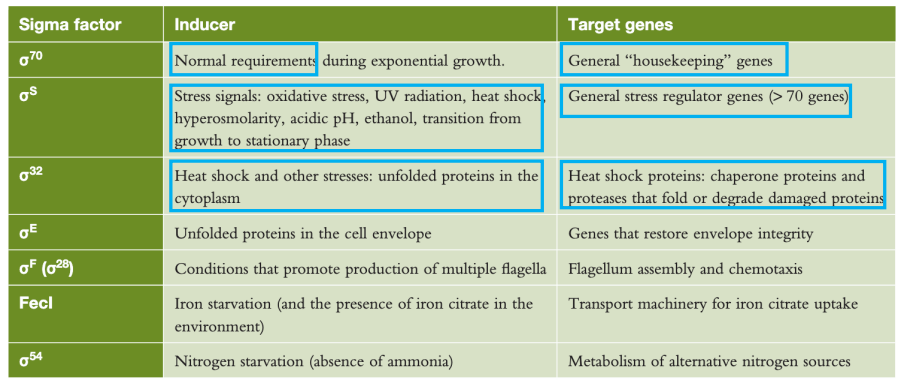
Sigma70 (σ) is required for the expression of housekeeping genes. Alternative sigma factors, active under different conditions, regulate different genes. Inducing signal and target genes are linked. Different sigma factors recognize different consensus sequences. Ensures that genes are only expressed when needed
Describe the structure of DNA dependent RNA polymerases in transcription
Core enzyme : ⍺⍺ββ’
RpoA: Two subunits from same gene
RpoB/C: Two different catalytic subunits (different genes)
Holoenzyme: Core + sigma factor
Sigma factors: Promoter specificity
RpoZ (sometimes): stability and assembly of the largest subunit, β′, into the core enzyme
Outline the role of DNA dependent RNA polymerases in transcription
1. Non-specific binding of RNAP to DNA-migration to promoter
2. Sigma factor recognize promoter = Closed complex (DNA is still dsDNA)
3. dsDNA is pulled apart = Open complex
4. Transcription initiates at a purine (A/G)
5. Elongation leads to the addition of successive nucleotides
6.Sigma factor is released
Outline with an example how we can inhibit bacterial transcription
Rifampicin is a popular antibiotic for tuberculosis, inhibiting transcription of Mtb. This is by binding to the bacterial RNA polymerase active site and sterically hindering the binding of the RNAP with DNA.
What is the difference between rho-dependent and independent transcriptional termination
Two mechanisms of termination
1. Rho-dependent (RNAP core requires additional proteins to stop transcription)
2. Rho-independent (intrinsic nucleic acid terminator, sometime enhanced by a partner)
Describe rho-dependent transcriptional termination
1. Rho complex binds in open conformation at rut site
2. Rho complex recognizes SBS and recruits to the central channel
3. Rho transitions from inactive open to active closed form
4. Rho uses ATP to pull RNA away from RNAP, leaving behind a completed transcript

What are two differences between RNA and DNA that allow for rho-independent transcriptional termination?
1. RNA base pairing is similar to DNA 1. Except Adenine-Uracil, rather than Adenine-Thymine (2H bonds). G-C is same, with 3H bonds
2. RNA can interact with complementary regions
Interactions lead to stems
Non-interacting sites are loops
Describe rho-independent transcriptional termination
Intrinsic terminator = Termination is driven by RNA interactions forming a hairpin structure.
This is possible as RNA has a G + C–rich region followed by a run of 4 to 10 consecutive A - T base pairs, (A’s on the template strand).
1. Self-complementary G-C rich region is transcribed and forms a hairpin structure (3H bonds)
2. Transcription of run of A = U-A pairing (2H bonds) in RNA-DNA hybrid (2H is weaker than 3H)
3. Hairpin structure leads to RNAP pausing
4. Hairpin is more stable than A-U pairing, pulling RNA away from template strand

Describe negative regulation using lac operon as an example
lac operon encodes proteins that catabolize (breakdown) lactose into energy sources. Only want to express lac under appropriate conditions. lacI is the inhibitor of lac operon, Binds operator sequences of lac operon (which surround the promoters and overlap with the +1 transcriptional start site) LacI monomers bind to form dimers that bind to a whole operator sequence and these bind with another dimer to form a tetramer, this wraps up the gene to make sure it can’t be transcribed.
How do transcription factors help regulate gene expression?
Transcription factor exists in an inactive state and can’t bind DNA. If a Ligand binds (often linked to downstream gene), this changes conformation its (allostery). The Transcription factor can now bind DNA and helps RNAP to bind to induce gene expression.
(The image shows positive and negative regulation, negative being similar but the transcription factor blocks RNAP binding, and a ligand binding to the TF releases it to allow gene expression.

In the lac operon example, what triggers the gene to be turned on or off?
Allolactose is the first product made in the metabolic pathway to turn lactose into glucose, and is produced by beta-galactosidase. Allolactose is an inducer of the lac operon, binding to lacI and causing it to detach from the DNA for that gene, allowing gene expression so lactose can be metabolised. Once all the Allolactose has been metabolised, lacI rejoins and represses the lac operon.
How is lactose metabolism started via allolactose synthesis upon ingestion of lactose?
Initial lactose metabolism to allolactose to activate the lac operon is possible due to a weaker constitutive promoter, and leaky transcription where some of the gene is still transcribed when the gene is repressed, which leads to low mRNA production. Despite being repressed, some transcription of the lac gene still occurs which produces trace Beta-galactosidase in cells, thus lactose can be converted to allolactose to kickstart/massively upregulate lactose metabolism
What is the secondary lac operon regulatory system that uses positive transcription factors
cAMP is produced in glucose metabolism therefore, Low glucose = increase in cyclic AMP (cAMP-starvation signal). High glucose = decrease in cAMP
cAMP binds CRP (cAMP receptor protein, (CRP=Catabolite repression protein))
Active cAMP-CRP complex helps RNAP bind lac promoter
Active cAMP-CRP complex is required to initiate transcription of lac operon
Describe features of gene repression, using trp operon as an example
trpR (inactive) is the inactive form of the repressor of the trp operon, which contains all the genes required for tryptophan synthesis. Tryptophan binds to trpR and activates it, causing it to bind to the inducible promoter and repress gene transcription. This is so the bacteria does not produce tryptophan when it can get it from its environment.
Compare and contrast the regulation of lac and trp operons
the lac operon has both positive and negative transcription factors
How is the trp operon regulated used transcriptional attenuation?
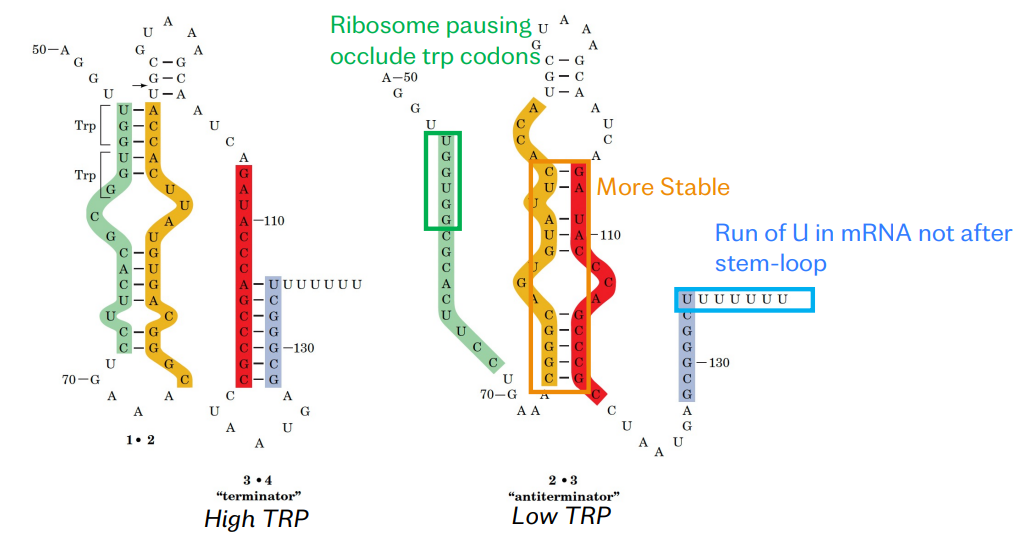
(Amino acid biosynthetic operons have small peptides that encode several AA to be made, of the type that the operon produces. These Trp AA’s cause the ribosome to pause its translation. This gives the RNA strand time to fall into a more stable positition which is one with an anti-terminator hairpin structure.
If tryptophan was present then the ribosome does not pause in transcription so comes into contact with a an intrinsic terminator at the 3-4 stretch, which is a stretch of RNA that forms a hairpin structure that due to steric hindrance, detaches from the ribosome upon joining and terminates transcription.
During trp transcription attenuation, why does high concentration of tryptophan cause the ribosome to process the two tryptophan-coding codons much more quickly?
At high trp concentration, the ribsome can very quickly bind to tryptophan-charged tRNA’s so it can process the two tryptophan codons very quickly. This means it doesn’t give the mRNA enough time to switch from the initial terminator position to the more stable anti-terminator hairpin position, causing termination of trpytophan operon transcription/translation.
Explain how regulatory systems can be manipulated to produce a product, using tryptophan in bacteria as an example:
The following treatments were applied to bacteria that produce tryptophan to massively upregulate their synthesis of the amino acid.
1. Place trp operon on multicopy plasmid with constitutive promoter
2. Mutate TrpR repressor
3. Tryptophanase mutant (no degradation of tryptophan/product)
In general, the methods are:
Remove feedback loop, i.e., remove repressors, replace with constitutive/inducible promoter
Duplicate synthetic operons
Increase levels of precursors (growth conditions or genetic modifications)
Remove product-degrading enzymes